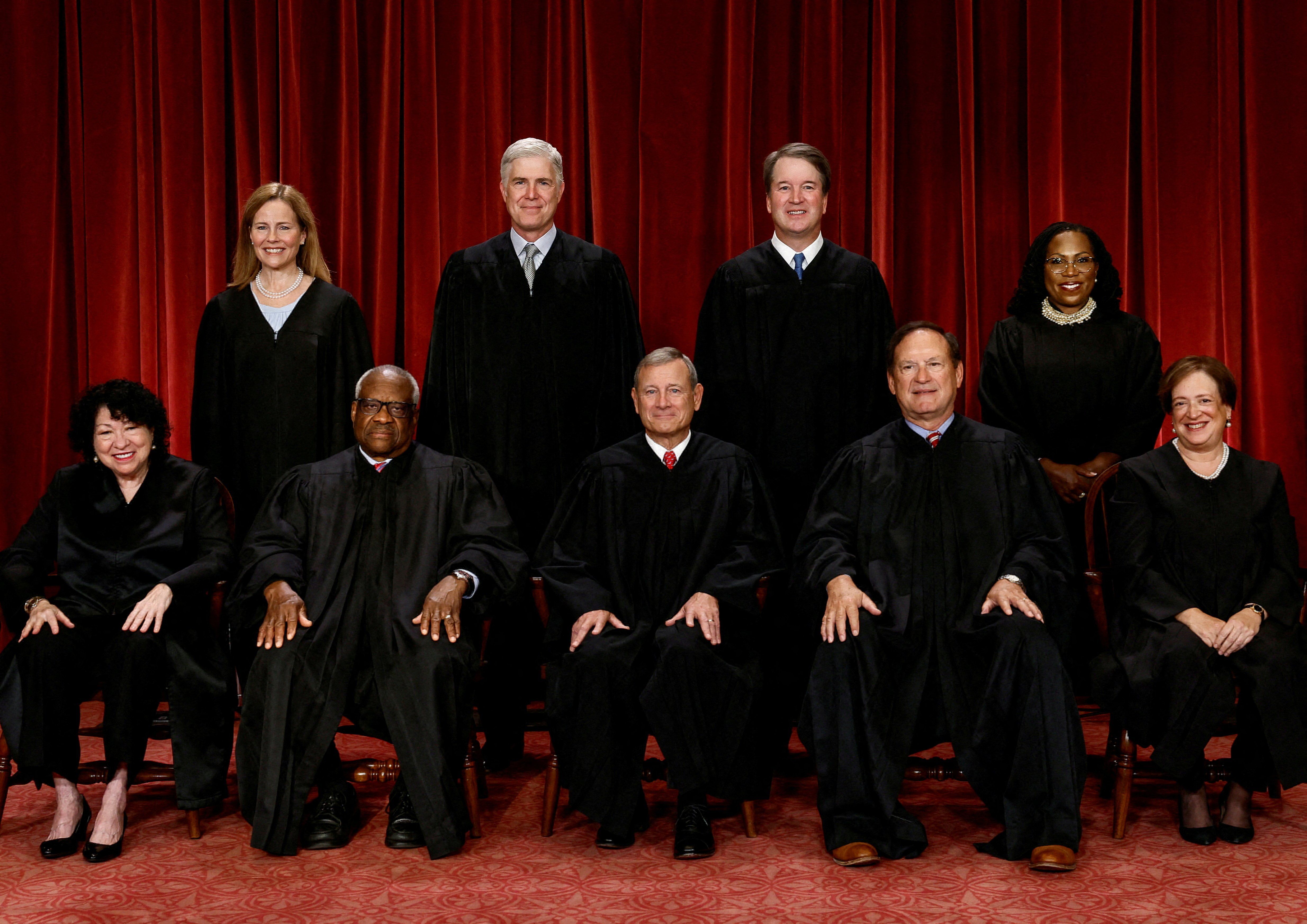
FILE PHOTO: U.S. Supreme Court justices pose for their group portrait at the Supreme Court in Washington, U.S., October 7, 2022. Seated (L-R): Justices Sonia Sotomayor, Clarence Thomas, Chief Justice John G. Roberts, Jr., Samuel A. Alito, Jr. and Elena Kagan. Standing (L-R): Justices Amy Coney Barrett, Neil M. Gorsuch, Brett M. Kavanaugh and Ketanji Brown Jackson. REUTERS/Evelyn Hockstein/File Photo
The Supreme Court will hear oral arguments in two weeks on birthright citizenship, with legal experts examining the 14th Amendment's historical context.
Constitutional rights expert Anna O. Law challenged the myth that pre-19th century America had open borders, noting states actively enforced restrictive migration laws. Law explained that present-day immigration assumptions about poor migrants becoming state dependents originated in the colonial period.
She emphasized that the Amendment's framers intentionally used "all persons" rather than "all citizens" to protect unauthorized migrants' children, including enslaved people smuggled after the 1808 slave trade ban and Chinese immigrants, despite contemporary anti-Chinese sentiment. The 14th Amendment explicitly granted birthright citizenship to all persons born in the U.S., regardless of parental immigration status.
Law warned that originalist approaches sometimes rely on false historical narratives, potentially distorting arguments in this case.