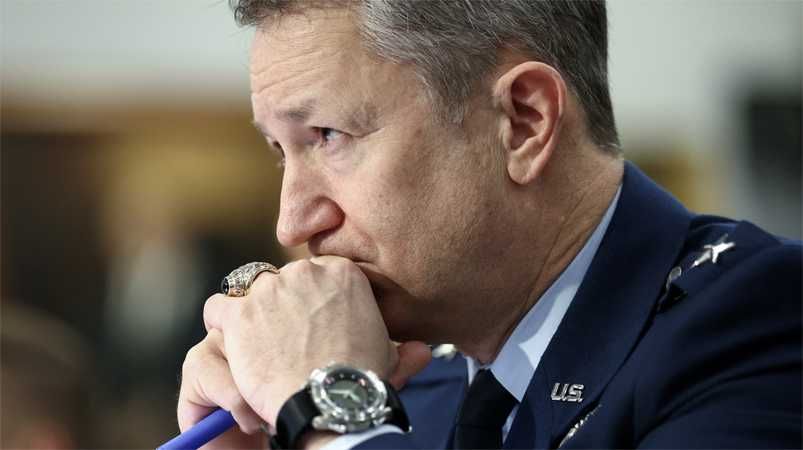
Donald Trump's chairman of the Joint Chiefs of Staff is facing mounting scrutiny over his evasive testimony before Congress regarding the Iran war strategy — raising questions about whether his silence reflects genuine military uncertainty, or fear of contradicting an unpredictable president.
According to the New York Times, in nearly 14 hours of recent congressional testimony, Gen. Dan Caine was repeatedly asked the same fundamental questions: How had the world's most powerful military allowed Iran to cut off oil flow through the Strait of Hormuz, and what was the plan to reopen it and end the war?
As the Times' Greg Jaffe wrote, the general's answers revealed a man walking an increasingly precarious tightrope. As chairman of the Joint Chiefs, Caine is obliged to remain apolitical. Yet he works for Trump, who demands absolute loyalty — a tension that appears to be paralyzing Caine's willingness to articulate a coherent strategy, according to the report.
In public testimony, Caine has narrowly defined the military's mission. On Tuesday, when frustrated Democratic and Republican lawmakers pressed him and Defense Secretary Pete Hegseth for concrete plans, Caine offered only tactical descriptions.
"Our military objectives have been clear the whole time," Caine said, citing "targeting Iran's ballistic missile systems," destroying its Navy and defense industrial base, and stopping Iranian forces from threatening U.S. troops and regional allies. He repeatedly praised American troops' dedication.
The report noted that he continually and cautiously avoided any discussion of broader U.S. military strategy or an endgame scenario.
Caine has been similarly evasive on damage assessments of Iran's missile and drone capabilities — a critical indicator of bombing campaign effectiveness and overall war progress. The reticence, analysts suggest, stems from working under Trump's "mercurial" leadership, Jaffe reported.
Trump has sought to preserve negotiating flexibility by avoiding binding war aims beyond preventing Iranian nuclear weapons development. His unpredictable nature — his willingness to reverse course almost daily — puts military leaders in an impossible position. Speaking publicly about war strategy risks immediate contradiction from the commander in chief.
The cost of Caine's silence extends beyond politics, according to one military expert.
"When military leaders only talk about tactics, it reinforces this fallacy within the ranks that they don't need to worry about strategy, that other people will take care of that stuff," said Heidi Urben, a retired Army colonel and associate director of Georgetown University's security studies program.