Latest Headlines
Epidemiologists forced to adjust pandemic spread models to account for Trump misinformation: report
March 27, 2020 2:04PM ET
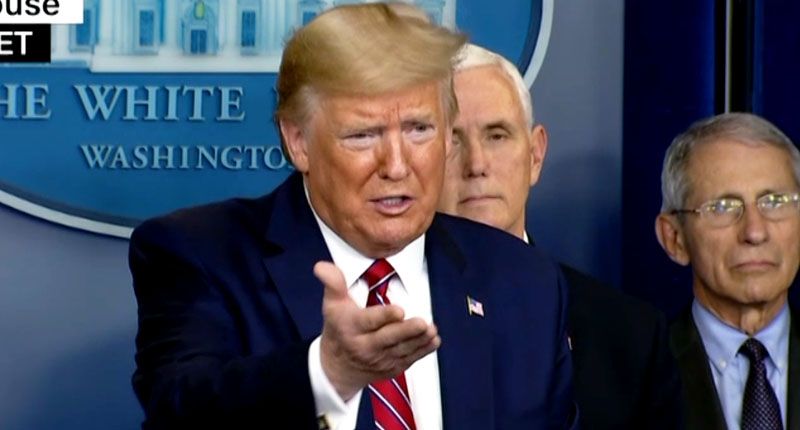
According to the Washington Post, virologists and epidemiologists attempting to predict how badly the coronavirus will spread are now having to factor in the possibility it could become worse due to misinformation being shared with the public -- including claims being made by President Donald Trump.
With the president hijacking the almost daily press conferences by the White House Task Force -- charged with keeping the public informed of developments in the fight against COVID-19 ---- where he spouts opinions and provides information that is often at odds with the scientists on the dais with him -- epidemiologist's models used to predict growth patterns and quantities of life-saving personal protection equipment needed by health care workers are having to be adjusted.
"Its practitioners use math and scientific principles to understand disease, project its consequences, and figure out ways to survive and overcome it. Their models are not meant to be crystal balls predicting exact numbers or dates. They forecast how diseases will spread under different conditions. And their models allow policymakers to foresee challenges, understand trend lines and make the best decisions for the public good," the report notes. "But one factor many modelers failed to predict was how politicized their work would become in the era of President Trump, and how that, in turn, could affect their models."
Of particular note are the comments made by the president that are amplified by right-wing media outlets like Fox News where personalities back up the president often by attempting to undercut government health experts as part of a "deep state" conspiracy to make the president look bad.
"The notion is deeply troubling, say leading health experts, because what the country does next and how many people die depend largely on what evidence U.S. leaders and the public use to inform their decisions. Epidemiologists worry their research — intended to avert massive deaths in situations exactly like this pandemic — will be dismissed by federal leaders when it is needed most," writes the Post's William Wan and Aaron Blake.
"A new model released Thursday by the University of Washington’s School of Medicine is one of the first to forecast a national peak. It projects that the peak in daily U.S. deaths will arrive in mid-April, and the tail end of that curve, subsiding below 10 daily deaths, will arrive by the first week of June. But that projection comes with huge caveats because of estimations and assumptions that have to be built into the calculation, given how much is still unknown about the disease covid-19," the report continues. "The Washington model assumes the entire country will maintain these strict restrictions until summer. But Trump has increasingly made clear he wants to reopen parts of the country by Easter on April 12. And on Thursday, Trump unveiled a plan to identify specific counties that he thinks should reopen soon."
The University of Washington model predicts that the "first wave of infections will end by summer (with subsequent waves a possibility) and that the death toll during this initial period will range from 38,000 to 162,000," but now that is in doubt because the president has been changing the game by undercutting multiple projections.
“I have a feeling that a lot of the numbers that are being said in some areas are just bigger than they’re going to be,” Trump told Fox News host Sean Hannity in a phone interview this week. “I don’t believe you need 40,000 or 30,000 ventilators. You know, you go into major hospitals, sometimes they’ll have two ventilators, and now all of a sudden they’re saying, ‘Can we order 30,000 ventilators?’”
That could impact response rates to upping borders for equipment as well as convincing c some members of the public that expert's concern the pandemic are overblown -- leading to riskier behavior.
According to Howard Markel, a historian and physician at the University of Michigan who co-wrote a much-cited 2007 paper on the spread of the 1918 flu pandemic in cities, that can affect pandemic spread modeling.
“Knowing when to release the throttle is hard. There’s is no button that says push me now,” he explained “But the trick is to be patient, not to jump the gun. Otherwise, all that happens is you get more cases, more deaths and everything you worked so hard for with those restrictions just goes to waste.”
You can read more here.