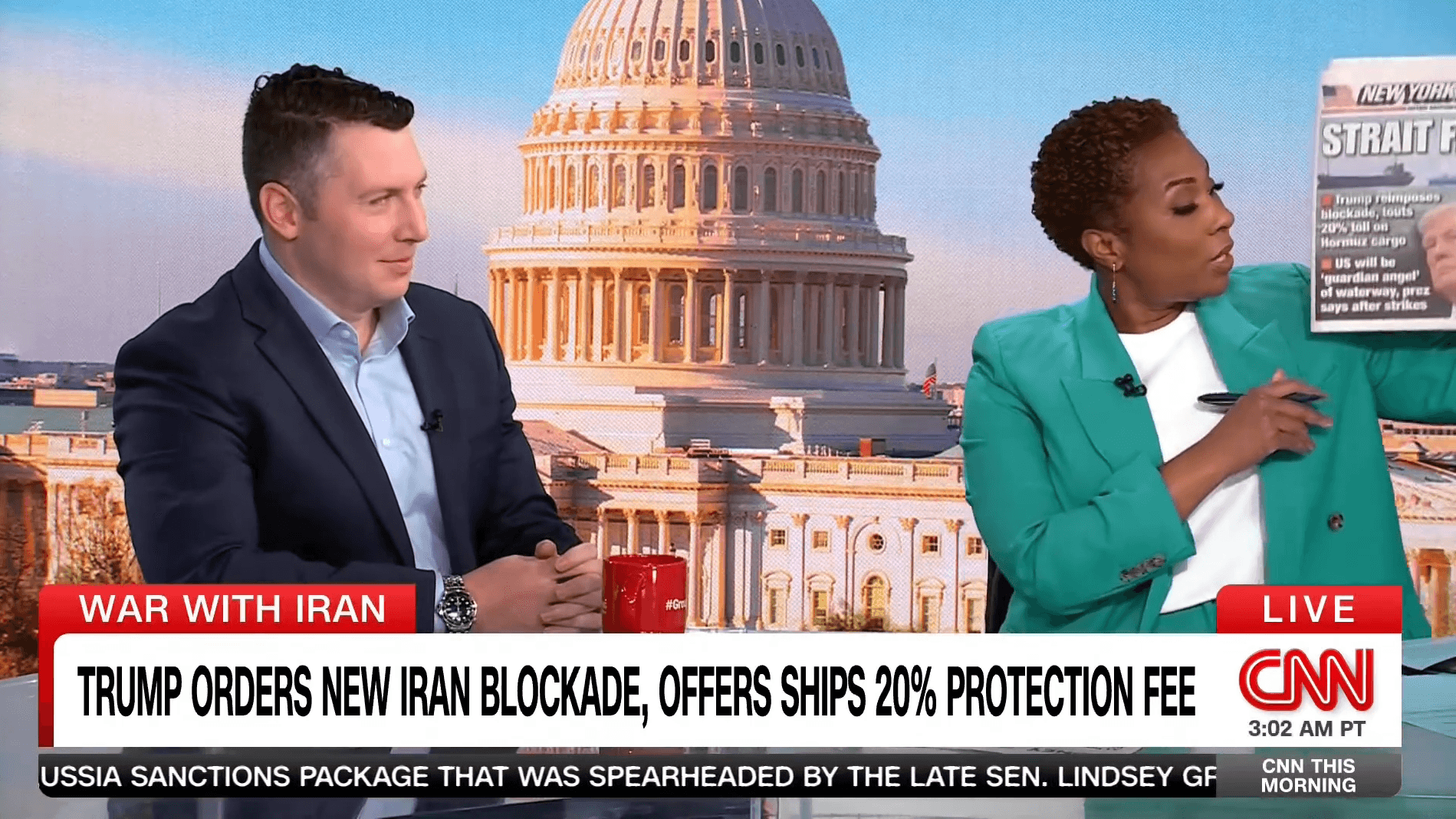
A former U.S. Army intelligence officer was left dumbstruck Tuesday following President Donald Trump’s latest attempt to degrade Iran’s control of the Strait of Hormuz, an effort they described as a manifestation of the president’s “new levels of desperation.”
On Monday, Trump announced that the United States would be reinstating its naval blockade on Iran and charging hefty fees to transiting vessels. The decree came amid renewed exchanges of fire between the United States, Iran and U.S.-aligned Middle Eastern nations.
“This is just new levels of desperation that I couldn't have imagined a couple of months ago,” said Harrison Mann, a former U.S. Army major and intelligence officer, during an appearance on CNN.
“We've got to remember that the free protection from the U.S. Navy has not been successful for the past several months; it's why we're in a new cycle of escalation over the past week. The Navy has repeatedly tried to secure transit through the Strait of Hormuz – Iran has still been able to attack ships.”
The flare-up in violence was sparked last week after Iran struck a container ship transiting the Strait of Hormuz in a manner Iranian officials claimed was a violation of the U.S.-Iran ceasefire agreement. The United States launched strikes at Iran in retaliation, which itself was met with a flurry of strikes from Iran targeting U.S. allies in the region.
Mann, who resigned in protest over the U.S. facilitation and support for the Israeli siege on Gaza – which a United Nations commission and countless human rights organizations have described as a genocide – said that not only was the Trump administration’s plan doomed to fail, it also undercut its own position.
“So the protecting ships part of it, we already know won't work. Is he actually going to charge fees? I doubt it, but he is doing something that's kind of dangerous for his own strategy, which is legitimizing that demand,” Mann said.
“Marco Rubio just two weeks ago said nobody can charge passage through this international waterway. Trump is now saying, 'oh no, that's fine, we're going to try and do it.'"