Jacques Cousteau's grandson warns: Florida port project could devastate only US barrier reef
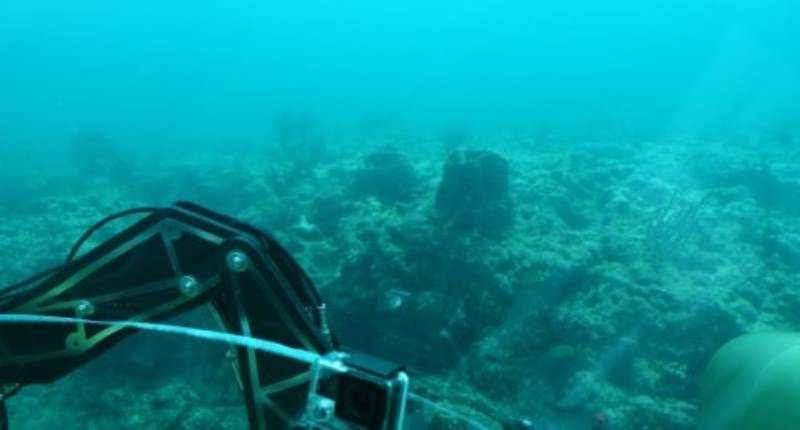
A view of the seafloor from the inside a submersible off the coast of Fort Lauderdale, Florida (AFP/Kerry Sheridan)
March 22, 2016
Filmmaker and conservationist Philippe Cousteau has warned that a multimillion-dollar plan to deepen an international shipping port off south Florida could devastate fragile parts of the continental United States' only barrier reef.
Cousteau, the grandson of famed ocean explorer Jacques Cousteau, joined a team of divers, scientists and journalists on Monday and Tuesday to document the current state of the reefs off Port Everglades, near Fort Lauderdale, and to draw attention to future dredging plans by the US Army Corps of Engineers.
"There is a chance that what few coral reefs are left here in this region could be excessively damaged by the deepening of the port," said Cousteau.
"It would be a tragedy and -- considering that there are probably staghorns there -- literally a federal crime."
Staghorn and elkhorn corals are listed as "threatened" under the US Endangered Species Act, and their numbers have declined in recent years by 98 percent, according to the non-profit Miami Waterkeeper.
Coral reefs offer important habitat for fish, storm protection for beachside communities, and are a key draw for tourists.
As many as 80 percent of reefs off south Florida have died since the 1970s due to disease, storms, climate change and sewage outflows.
"We are losing these corals faster than we know how to save them," said Miami Waterkeeper director Rachel Silverstein.
- Dredging plans -
A plan to carve out the sea bottom near Port Everglades was sent to Congress in January, detailing a $313 million plan to deepen and widen a channel that was first dredged nearly a century ago.
The port is one of the most active for cargo in the United States, and is a leading hub for goods from Europe, the Mediterranean, South America and the Caribbean. It is also one of the three largest cruise ports in Florida.
The dredging project aims by 2022 to make room for larger vessels by expanding the entrance channel from 42 to 55 feet (13 to 17 meters), and by deepening other areas of the port.
The first such project of its kind along the eastern seaboard began at the nearby Port of Miami in 2013, and wrapped up last August.
Silverstein is concerned that the current plan is the same as the Port of Miami project, which allowed sediment to settle on corals, smothering these living animals and destroying more than 250 acres (101 hectares) of reef, including hundreds of staghorn corals.
"None of them were supposed to be killed by sedimentation," said Silverstein.
Miami Waterkeeper and other environmental groups have filed a lawsuit against the US Army Corps of Engineers for violating the Endangered Species Act by killing coral and injuring its critical habitat.
And while Silverstein doesn't expect to stop the dredging at Port Everglades, she said she wants to avoid a case of history repeating itself.
"We want better protection for these reefs during this port expansion," she said.