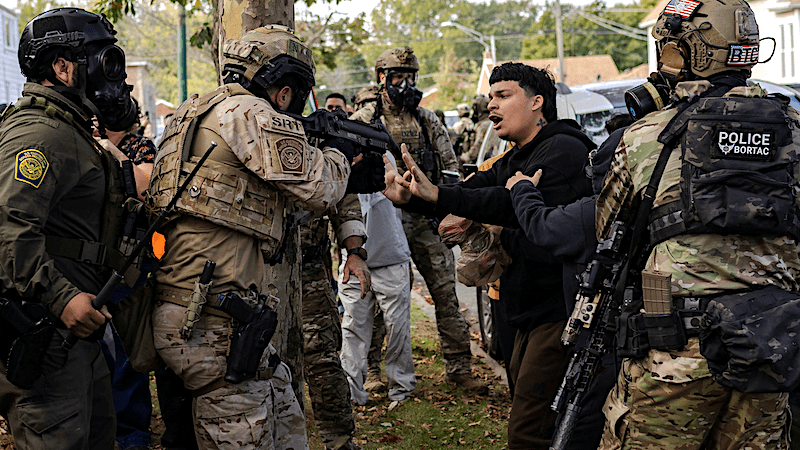
Federal prosecutors in Chicago face the threat of criminal contempt charges in a case stemming from President Donald Trump's Chicago immigration crackdown, and the Justice Department is begging the judge to back off, according to court records and reports.
U.S. District Judge April Perry, in Chicago, found in May that prosecutors vouched for the charges, dismissed skeptical grand jurors, and held private conversations with panel members outside the jury room, court records show.
They had also redacted more than 80 pages of those proceedings from what she received, according to court records.
Defense attorneys have since asked Perry to appoint an independent outside counsel — one who would not report to the attorney general — with authority to bring criminal contempt charges against the prosecutors involved, according to WTTW.
Allowing such a prosecutor, the Justice Department warned in a new court filing, would "amount to criminal proceedings against federal prosecutors."
It would also force the department to expose "intra-office conversations and memoranda, legal advice and work product, and inter-agency communications," the filing said — materials it argues are shielded by privilege.
"The Court's message has been clearly heard," the filing added, "and there is no need to do more."
The prosecution that triggered the crisis began in fall 2025, after Trump wrote on Truth Social that Chicago was "about to find out why it's called the Department of WAR."
Two days later, he launched a mass deportation sweep called Operation Midway Blitz, according to court records.
Six protesters opposing Immigration and Customs Enforcement operations were charged with felony conspiracy under a statute the district had never before used, court records show.
It took prosecutors three grand jury sessions to secure an indictment. At the first, former Assistant U.S. Attorney Sheri Mecklenburg told jurors she had chosen them specifically because "you know me and you trust me." The jury refused to indict.
"I heard this case like last week and I thought it was a crock of s--- then and I still think it is," a grand juror said at the second session, according to Lawfare.
Mecklenburg responded, "Then you have to go—."
Before the third session, Mecklenburg disclosed she had spoken privately with two grand jurors in the hallway. All of it had been redacted from the transcripts submitted to the court.
"I have never seen the types of prosecutorial behavior before a grand jury," Perry said after reviewing the full unredacted transcripts at a May hearing, according to court records. "Trust has been broken."
"Individual AUSAs have been publicly identified in these proceedings," the filing acknowledged, and prosecutors have self-reported the case to the Justice Department's Office of Professional Responsibility — the department's internal misconduct watchdog.
The department is also reviewing "potentially more than 1,000" grand jury transcripts for similar problems, court records show.
It is auditing Mecklenburg's presentations going back to 2007, court records show.
A second unrelated case was thrown out after investigators found additional "grand jury irregularities."
"Recognizing that missteps occurred in this case," the filing stated, "the Office has studied the root-cause issues giving rise to these errors and has implemented substantially new policies, procedures, practices, and trainings to try to avoid repeating what happened here."
Defense attorneys argued in June that the misconduct "runs much deeper and indeed to the highest levels of the Chicago U.S. Attorney's Office and likely to the Department of Justice in Washington D.C.," according to WTTW.
"No one can credibly investigate themselves," they wrote.