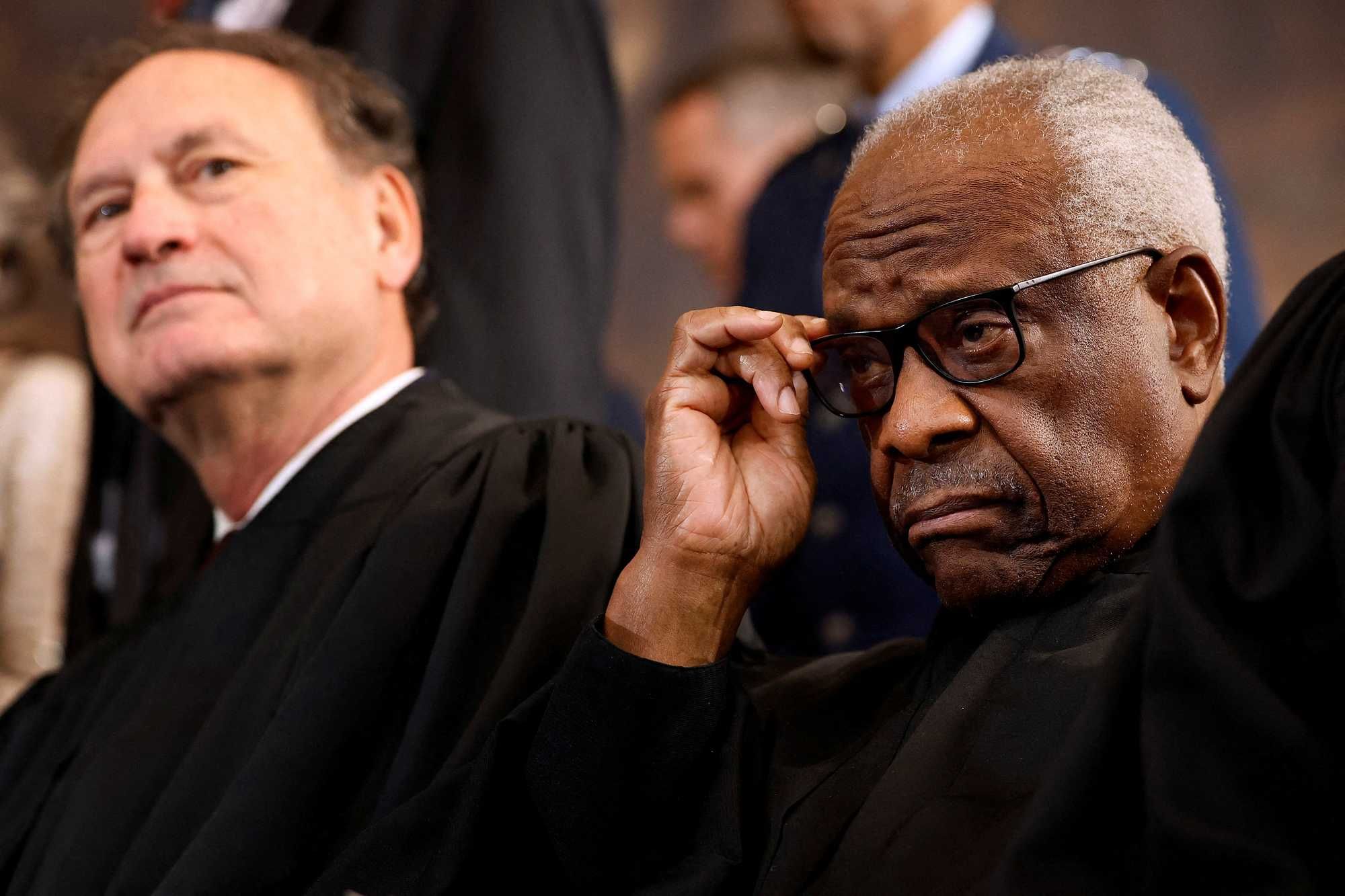
One legal expert flagged a "gobsmacking" detail tucked away inside the opinions of a pair of Supreme Court justices that raises a troubling set of problems for the court.
Harry Litman, a former federal prosecutor, argued in a new Substack essay that Justices Clarence Thomas and Brett Kavanaugh's opinions in the contentious birthright citizenship case, otherwise known as Trump v. Barbara, raised a "troubling" set of problems for a couple of reasons. Not only did the dissents portray flawed legal reasoning, but the practical impact of the opinions could also be disastrous, he argued.
"The real, gobsmacking detail was not the Court’s holding but the fact that 4 Justices—Thomas, Gorsuch, Alito, and Kavanaugh—were prepared to uphold a radically counter-textual reading of the plain text of the 14th Amendment to exclude from citizenship children born here to parents who were in the country illegally or only temporarily," he wrote.
"Justice Thomas’s principal dissent in Trump v. Barbara—joined by Justice Gorsuch—rests on a discredited method: original-intent originalism, the practice of asking what a text’s drafters subjectively meant to accomplish rather than what the words they wrote actually say," he continued. "Justice Kavanaugh’s separate opinion raises a different, and in some ways more troubling, set of problems of its own."
Litman pointed to the passage in Thomas's dissent where he discussed the 14th Amendment, which establishes birthright citizenship and requires someone to have a "domicile" and established roots in the country. He does so, aiming to get at what the framers "intended," Litman argued, but his argument was "proof of how far he had to strain to make a flagrantly anti-textual position sound tenable."
Justice Kavanaugh's concurring opinion also raised problems of its own, Litman noted. While he reached the right conclusion that the plain text of the 14th Amendment prohibited Trump from eliminating it by executive order, the path he took to get there was "well outside the lines" of established precedent.
"Kavanaugh’s separate opinion may be ungrounded speculation, but its practical effect is far from academic. It permitted Trump to seize a partial victory from what should have been a certain defeat: Trump immediately fastened on Kavanaugh’s suggestion, insisting Congress could still legislate his own, xenophobic definition of citizenship, notwithstanding that it plainly would run afoul of the majority in Barbara," Litman wrote.
"The separate opinion is going nowhere legally, but it permits Trump to try to fan the flames of an issue that should be dead and buried. Explaining that choice may call for a discipline other than law," he added.