Raw Exclusives
This draconian measure is the only way to save democracy and rid the world of Trump
January 24, 2026 9:16AM ET
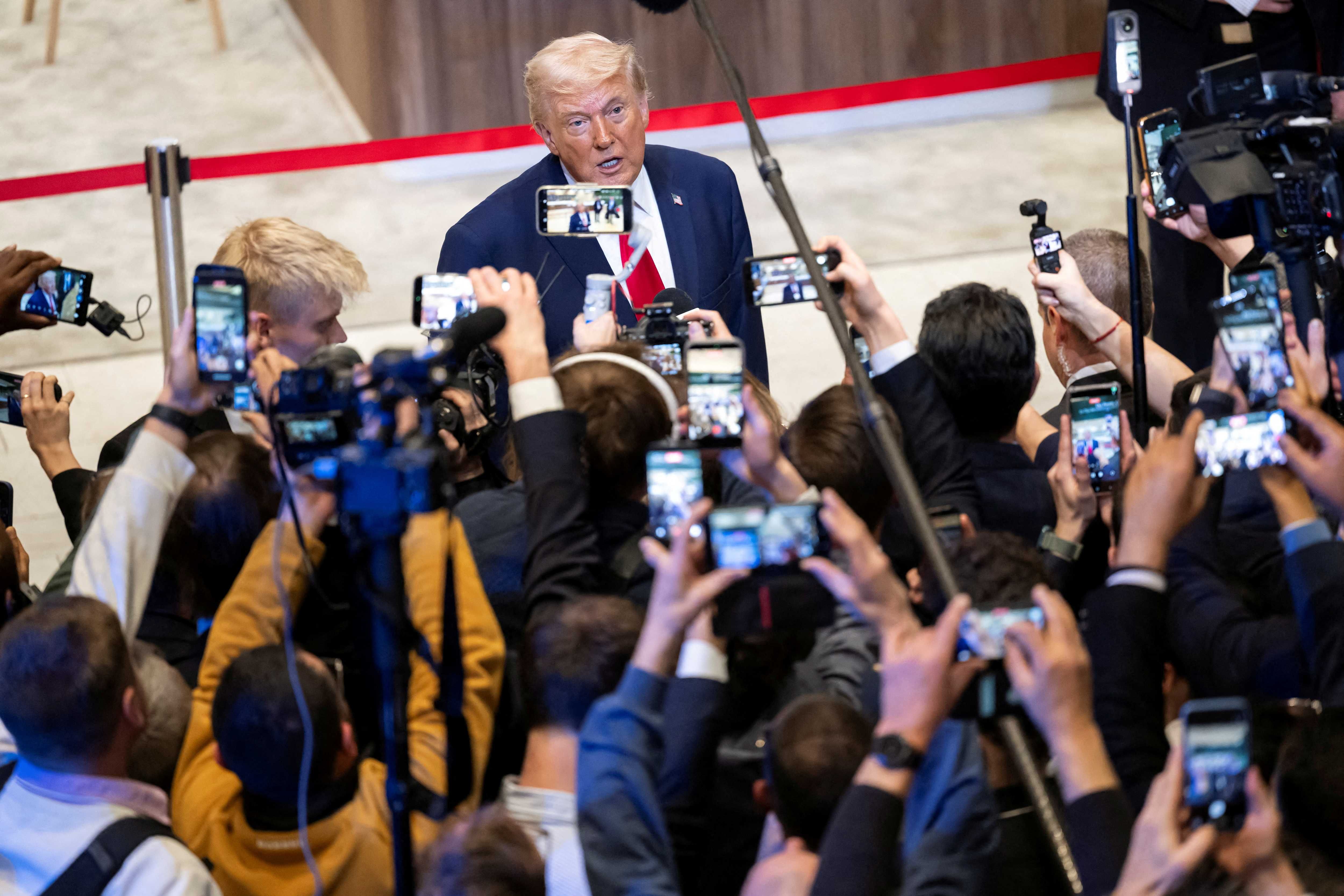
Donald Trump speaks with journalists in Davos, Switzerland. Laurent Gillieron/REUTERS
Europe and Canada must begin preparing — now — for a full strategic break from the United States.
It is draconian. It is extreme. And it is urgently necessary.
This argument is not born of hostility toward America, nor of contempt for Americans. It is driven by necessity and by alarm, and ultimately by compassion for American democracy itself. This is not an anti-American argument. It is a pro-democracy one.
At Davos, Canadian Prime Minister Mark Carney crystallized what many allied leaders now privately acknowledge: the U.S. under Donald Trump is no longer a reliable NATO leader, a trustworthy trade partner, or a safe intelligence ally. The foundation of the postwar order, deep and abiding trust, has collapsed.
For 80 years, that trust underpinned alliances, stabilized markets, and deterred autocracy. Today, it is gone. Trump openly questions NATO’s purpose. At Davos, he claimed Europe would not come to America’s aid. That is simply untrue. Europe has come to America’s aid militarily, diplomatically, economically.
The poignant and tragic irony is that America now needs Europe’s help more than it ever has, and in a way it has never needed it before.
The U.S. crossed oceans to help Europe rid itself of Hitler. Today, Europe must metaphorically cross the Atlantic, not with armies but with economic, financial, and political force, to help the U.S. confront its own authoritarian threat.
This is not about war. It is about preventing one, and preventing the slow-motion collapse of democratic governance in the most powerful country on Earth.
European leaders are understandably cautious. Europe still relies on transatlantic trade, intelligence sharing, and defense coordination. But that caution has hardened into paralysis, and paralysis carries greater danger than action.
Trump has demonstrated repeatedly that trade agreements with the United States under his reign of repugnancy are meaningless. Further, for Europe, intelligence sharing is becoming a liability with an ally that can’t be trusted.
At Davos, Trump openly trashed Europe’s leadership, history, and legitimacy. Europe largely absorbed the insult in silence.
Why?
Because European leaders continue to believe they lack leverage, treating Trump like everyone else does, letting him spiral out of control while coddling him. That is an epic failure.
Inside the U.S., there are no guardrails left. Congress is compliant. The cabinet is obedient. The Supreme Court is deplorably deferential. With three years remaining, the danger is accelerating at lightning speed.
A majority of Americans, according to polling, are fed up with Trump, alarmed by his authoritarianism, and desperate for meaningful resistance. The tragedy is that no one with real power seems willing or able to provide it.
Europe and Canada — yes, admit Canada into the European Union now — may be the last actors capable of interrupting this trajectory.
Symbolic threats and contingency planning are no longer sufficient. Europe must begin preparing for a comprehensive strategic disassociation from the United States. That means developing NATO defense planning that no longer assumes America, and accelerating European defense programs capable of acting independently.
It means building trade frameworks that exclude Washington, insulating European economies from the volatility of Trump’s tariff regime.
It means reassessing intelligence sharing. Cooperation with an increasingly politicized and compromised U.S. national security apparatus is no longer safe. Allies cannot continue exposing sensitive sources, methods, and assessments to an administration that has shown allyship with China and Russia.
Most consequentially, Europe and Canada must prepare for coordinated financial disengagement. Trillions of dollars in European and Canadian capital are embedded in U.S. markets and government bonds.
A phased withdrawal, clearly communicated and collectively executed, would send an unmistakable message that democratic collapse carries consequences. This would not be symbolic. It would strike at Trump’s core source of political protection — markets, money, and the illusion of economic invincibility.
Yes, this would be economically catastrophic for the U.S. — hopefully in the short term — and that is precisely the point.
Markets and money are the only remaining forces capable of forcing a reckoning inside an otherwise paralyzed system. Corporations continue to genuflect to Trump. Like Congress, the administration, and the courts, they have proven unwilling or unable to fight back.
Europe and Canada’s disconnection is dangerous and fraught. But three more years of Trump risks far more. History is unambiguous about the cost of appeasement, and Europe knows that better than anyone else.
European leaders may believe that pacifying Trump, accommodating his demands, and cutting “deals,” will protect Europe’s interests. It will not. Getting close to Trump does not buy safety. It guarantees damage.
In response to Trump’s threats over Greenland, French President Emmanuel Macron has suggested deploying the EU trade “bazooka”: sanctioning U.S. companies, limiting investment. That is not enough. There can be no deal on Greenland. No framework. No compromise. Any concession — any signal that coercion works — would invite escalation and weaken Europe irreversibly.
In 1940, Winston Churchill warned that failure to defeat Hitler would mean “the whole world … will sink into the abyss of a new Dark Age.”
Comparisons to Hitler are often careless and overused, but the warning about unchecked authoritarianism remains relevant.
Churchill also said, “We shall fight him by land; we shall fight him by sea; we shall fight him in the air.”
Today, Europe must fight metaphorically, in banks, in trade, in intelligence, and in markets. Set deadlines. Impose consequences. Demonstrate that Europe, united, can act.
If allies do nothing, they enable America’s democratic collapse and endanger their own future. Separation from the U.S. is not an act of hostility toward the American people. It is an act of solidarity with them.
Churchill concluded his famous “fight” speech with the promise of liberation “until, with God’s help, we have rid the earth of his shadow and liberated its people from his yoke.” The time to liberate all of us is now, before it is too late.