A federal prosecutor in Chicago wanted six ICE protesters indicted. One grand jury told her no. So she went looking for a panel that would say yes — and when a juror on that second panel called her case garbage, she told him to leave the room.
That's the picture painted by grand jury transcripts the court made public Tuesday, an extraordinary window into secret proceedings that almost never see the light of day. U.S. District Judge April Perry ordered the release of records from three days of hearings — Oct. 9, Oct. 16, and Oct. 23, 2025 — that ultimately sank one of the highest-profile prosecutions of the Trump administration's Chicago immigration crackdown.
To understand why the transcripts matter, start with the case.
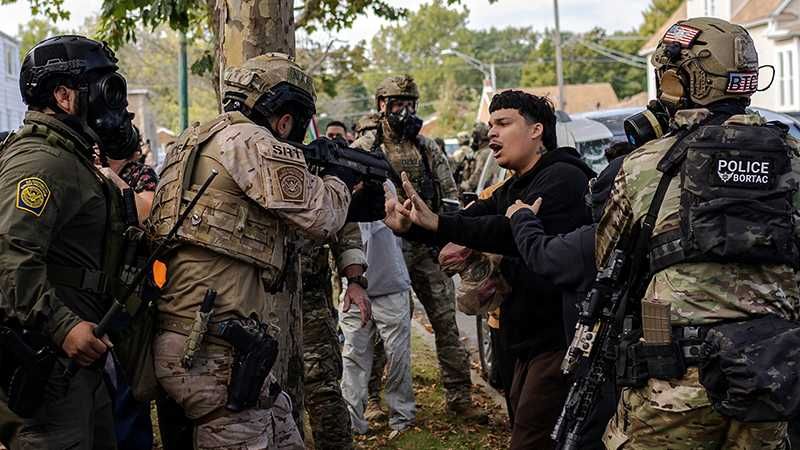
Last September, the Department of Homeland Security launched Operation Midway Blitz, a sweeping deportation surge across the Chicago area. The boarded-up ICE processing facility in suburban Broadview became its flashpoint, drawing near-daily protests, tear gas, and pepper balls. On Sept. 26, 50 to 100 demonstrators surrounded a federal agent's SUV as it drove slowly toward the facility, banging on the hood and windows.
Federal prosecutors charged six people with conspiracy to impede a federal officer. Among them: former congressional candidate Kat Abughazaleh, Oak Park Village Trustee Brian Straw and 45th Ward Democratic Committeeperson Michael Rabbitt. They became the "Broadview Six." Each faced up to seven years in prison.
The case collapsed on May 21, when U.S. Attorney Andrew Boutros took the rare step of appearing in court to drop every charge, conceding the grand jury process had been badly mishandled. Lead prosecutor Sheri Mecklenburg was later fired from a new Justice Department post. Until Tuesday, exactly what went wrong was hidden behind redactions. Now the prosecutor's own words are on the record.
Day one: a "no."
On Oct. 9, Mecklenburg told the first grand jury she had hand-picked them. "I know you, and I trust you, and you know me, and you trust me, and I would never ask you to charge somebody if I didn't think there was probable cause," she said, according to the transcript. She added: "I don't charge people unless I'm absolutely sure."
The panel wasn't sold. Jurors grilled her on whether the agent could have simply stopped his car, whether the damage predated the protest, and whether the protesters were merely bracing against a moving vehicle. They declined to indict.
Day two: a do-over.
A week later, on Oct. 16, Mecklenburg returned to a different panel and opened with a confession of failure. "Between the questions and not getting an indictment, I did not do my job," she said. "I did not explain it to you well enough."
Then came the moment that is now drawing the most scrutiny. When a juror asked whether she was "actually presenting any new actual facts or just a different viewpoint," Mecklenburg asked if he could keep an open mind.
"I — no," he said.
"Okay. Then you have to go," she replied.
The juror didn't go quietly. "I heard this case like last week, and I thought it was a crock of s— then and I still think it is."
"Have a good evening," Mecklenburg said.
Seconds later, she started counting heads. "There is still 16?" she asked — a reference to the minimum jurors required to indict. The foreperson counted 17. When another juror then admitted, "I don't think I can vote," she checked again: "Do we still have 16?" The foreperson said yes. This time, the panel indicted.
Day three: the admission.
The Oct. 16 hearing alone would be damning. The Oct. 23 transcript goes further. Mecklenburg opened that session by offering what the transcript records as a "mea culpa" — her phrasing for a mea culpa.
"I'm the one who knows the rules, and I did something today that I'm not supposed to do," she said. "I had conversations with two Grand Jurors outside of the Grand Jury room. So I need to put it on the record."
She described bumping into one juror in an elevator, where he apologized for walking out the week before. A second juror, she said, approached her separately to promise he could "apply the facts to the law." She assured the panel it wouldn't happen again.
Boutros, listed as present at the Oct. 16 session, has said he didn't learn of the vouching and juror contacts until late April. His junior co-counsel, Matthew Skiba, told the court the behavior was "at a minimum, arguably misconduct."
The charges were dismissed with prejudice. They can never be refiled.