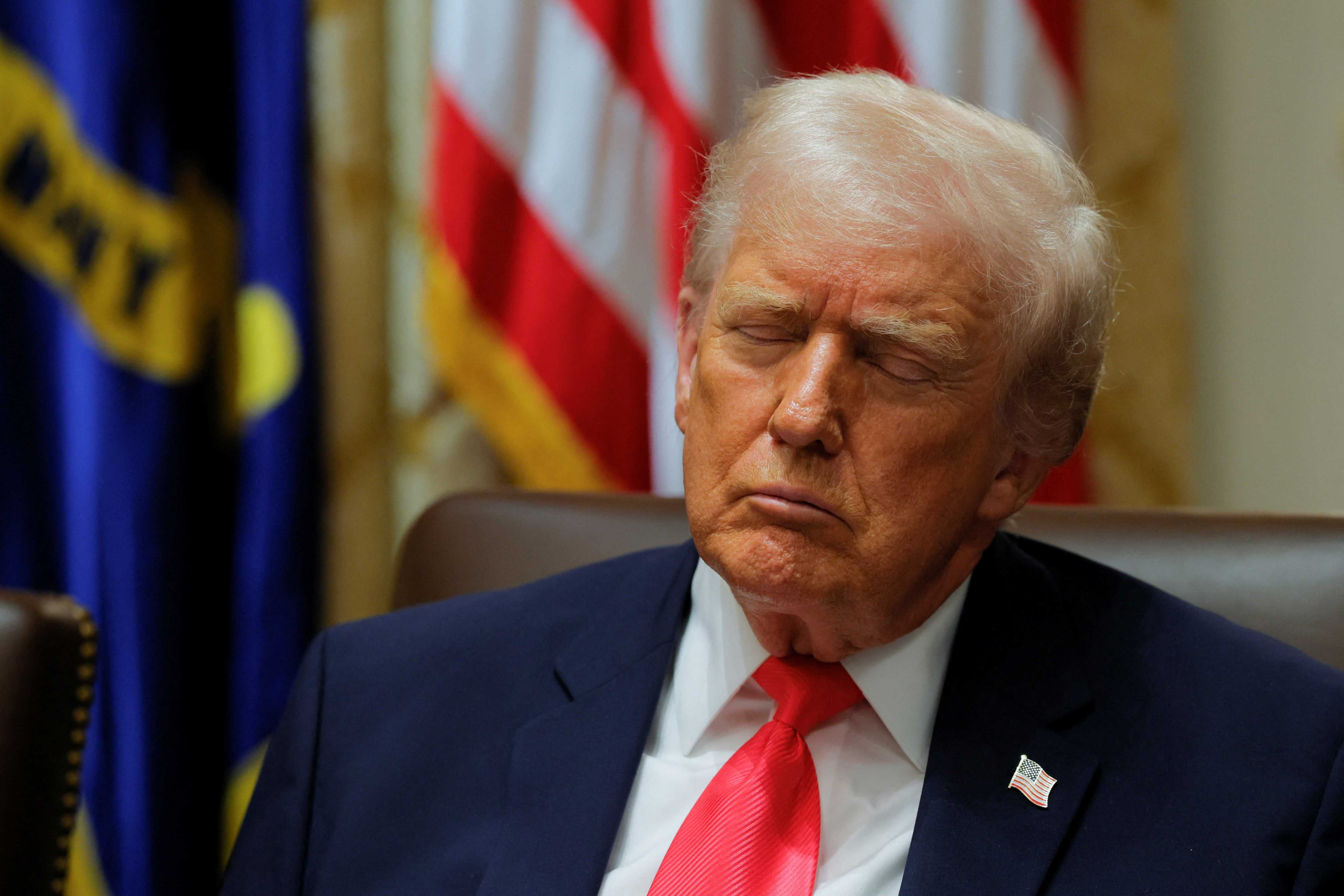
Despite being given powers well beyond previous presidents, President Donald Trump has largely outsourced his duties to advisors who are actually running the White House's day-to-day operations, according to a recent analysis.
In a Wednesday op-ed for the New York Times, columnist Jamelle Bouie argued that Trump is mostly "uninterested in anyone except his most devoted fans, and would rather collect gifts from foreign businessmen than take the reins of his administration." Bouie pointed to White House chief of staff Susie Wiles' recent bombshell profile in Vanity Fair, in which she maintained that despite occupying America's highest office, Trump "doesn't know the details" of the "smallish agencies" that his administration decimated earlier this year.
"The president doesn’t know and never will," Wiles said.
Despite Trump being "practically AWOL," Bouie pointed out that he is president at a time when the Supreme Court of the United States (SCOTUS) has dramatically expanded the powers of the executive branch under the philosophy of "unitary executive theory." Under that system, Trump himself is vested with all the powers of the executive branch as outlined in Article II of the U.S. Constitution, which SCOTUS' conservative majority has clarified includes the ability to fire executive branch employees at will — even those at independent agencies.
However, Bouie asserted that the caveat of SCOTUS's new broad definitions of executive power is that Trump is mostly idle, "rarely meets with ordinary Americans" and "is shuttled from one Trump resort to another to play golf and hold court with donors, supporters and hangers-on." He added that SCOTUS's empowering of Trump to act beyond traditional checks and balances has, by default, meant that his cadre of advisors has free rein to run the White House as they see fit.
"[T]here is something ironic at work in this effort to concentrate executive power in the name of constitutional fidelity. It is being done on behalf of a president who is mostly missing from the business of government," Bouie wrote. "The unitary executive lacks an executive. And the president we have isn’t unitary. He has given his newfound power away to a small set of virtually unaccountable advisers, insulated from public outcry and indifferent to public opinion."
These advisors include Office of Management and Budget Director Russ Vought, who Bouie characterized as the "de facto shadow president for domestic affairs," and White House deputy chief of staff Stephen Miller, whom the Times columnist called the "shadow president for internal security." Bouie noted that the work of foreign policy — which has always traditionally been seen solely as the president's wheelhouse — is largely being handled by Secretary of State and National Security Advisor Marco Rubio and Defense Secretary Pete Hegseth.
Bouie quoted former President John F. Kennedy, who wrote in the foreword of his advisor Ted Sorensen's 1963 book Decision Making in the White House that the “secret of the presidential enterprise is to be found in an examination of the way presidential choices are made."
"What do we make of a president who chooses not to make these choices?" Bouie wrote.
Click here to read Bouie's New York Times column in full (subscription required).