Trump White House cut McConnell out of pandemic stimulus bill negotiations in order to speed them up: report
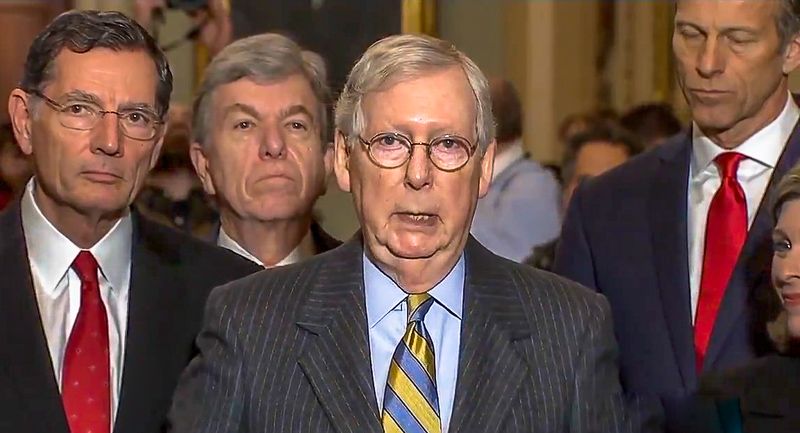
According to a report from the LA Times, Senate Majority Leader Mitch McConnell (R-KY) was taken out of the loop during round-the-clock negotiations to cobble together a desperately needed multi-trillion dollar stimulus bill designed to save the U.S. economy from collapsing due to the COVID-19 pandemic.
That, in turn, angered members of his Republican caucus after he promised them they would have more say in a later version.
According to the Times, "With his mastery of rules and tactics and control over his caucus, McConnell has developed a reputation as one of the Senate’s most powerful majority leaders. But in the talks to shape the massive bailout bill, he was effectively sidelined for much of the final days as Treasury Secretary Steven T. Mnuchin and Democratic leader Charles E. Schumer of New York negotiated."
The report goes on to note that it was McConnell who opened the door to the White House working directly -- in the beginning -- with House Speaker Nancy Pelosi (D-CA) only to see himself sidelined by Mnuchin who took a larger role than usual because the president wanted a quick turnaround due to his growing panic as the pandemic crisis rocked the economy.
"When the coronavirus crisis began to worsen, McConnell initially stuck to that playbook, telling House Speaker Nancy Pelosi (D-San Francisco) to work a deal out with the administration. That led to an initial $8.3-billion spending package, which passed with little problem," the Times reports. "McConnell faced more problems when Pelosi and Mnuchin negotiated a second, larger bill in mid-March. Many Republican senators weren’t happy with that deal, which expanded paid sick leave for workers and pumped billions of dollars to states for food programs and unemployment benefits."
Pointing out that McConnell had to talk his colleagues into voting on that version, the Times reports Republican lawmakers were promised "they would lead on the next effort."
"So, last week, when Congress began drafting a third bill, McConnell took a decisive lead; unveiling a $1-trillion proposal focused on key priorities supported by Republicans and the White House. Those included hundreds of millions of dollars in direct payments to workers, but left out many low-income Americans. When Democrats and some Republicans pushed back, he created four bipartisan task forces and tasked to them to work at 'warp speed to draft language," the report states before adding, "By Saturday, when it was clear a deal wasn’t emerging, McConnell cobbled together a version that combined parts of his original plan with what the task forces had agreed to. He tried to jam the bill through on Sunday by scheduling a procedural vote that he gambled Democrats would be forced to approve out of concern that if the bill appeared stalled, financial markets would crash on Monday morning."
McConnell, as it turned out, gambled wrong.
"He miscalculated. Pelosi had returned to Washington by Saturday night; Democrats were unsatisfied with the bill McConnell had put forward and began talking about introducing one of their own. And the administration, anxious for a deal, was already reaching out to Schumer," the report continues while noting that a Republican revolt about the bill also failed, with Senate Minority Leader Chuck Schumer (D-NY) revealing from the floor of the Senate that he was working with Mnuchin and stating, "The negotiations continue no more than 30 feet away from the floor of the Senate in our offices where the real progress is taking place. Once we have an agreement that everyone can get behind, we are prepared to speed up the consideration of that agreement on the floor.”
"McConnell remained part of the ensuing negotiations, aides say, with Mnuchin shuttling between Schumer’s and McConnell’s offices multiple times a day," the report continues. "But as Senate Republicans publicly objected that the bill had moved too far toward Democratic priorities and urged Trump to oppose it, the president and Mnuchin brushed aside their concerns, publicly praising Schumer as a negotiating partner."
The Times notes, "All but two Senate Republicans voted on Wednesday to strip a key provision expanding unemployment benefits out of the bill, saying it would damage the economy. When that move failed, they unanimously voted to approve the bill."
You can read more here (subscription required).