Welcome to Jupiter! NASA's Juno spacecraft enters orbit around system's largest planet
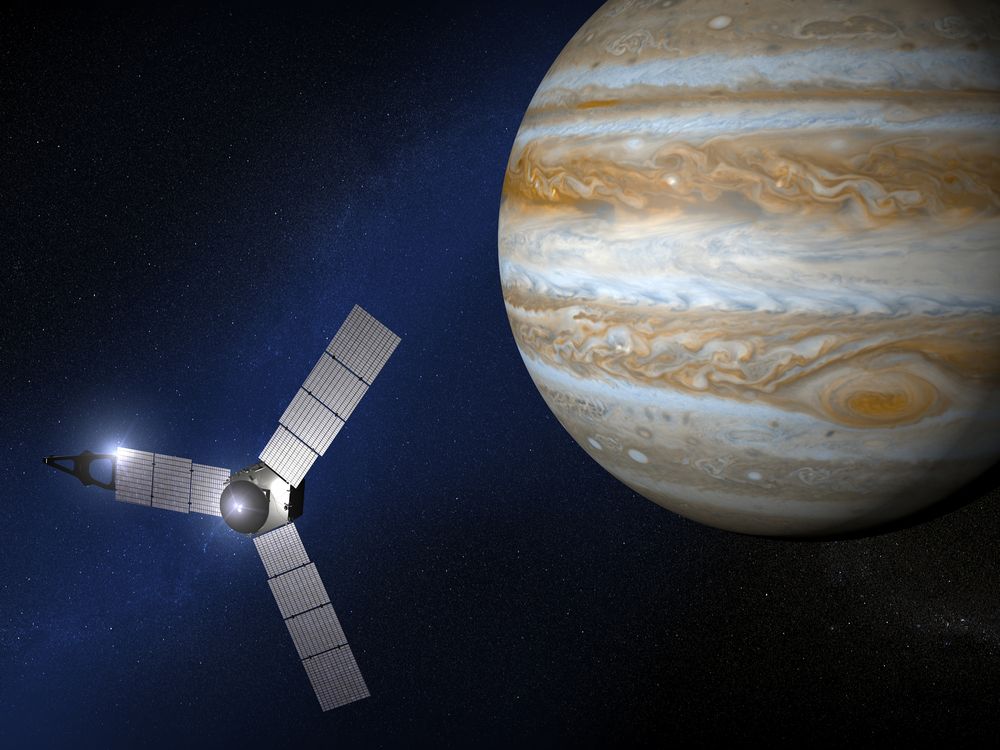
Image: NASA's JUNO probe, which has been traveling through space for five years and is currently approaching Jupiter (Shutterstock.com)
July 04, 2016
After five years in space, the Juno spacecraft is now approaching the planet Jupiter, the largest planet in the solar system and yet one of the most mysterious.
NASA launched the probe on August 5, 2011. Scientists are hopeful that the solar craft will enter the orbit of Jupiter and provide us with information about the planet's composition -- which in turn could lead to information about how the solar system formed.
The first engine burn in scheduled for 11:20 p.m. eastern time.
Live updates from the control center are available at the Guardian.
UPDATE (11:27 p.m. EDT): The NASA team reported the the Juno craft's main engine sequence has successfully fired and will continue for approximately 35 minutes.
UPDATE (12:06 a.m. EDT): from Reuters
NASA'S Juno spacecraft capped a five-year journey to Jupiter on Monday with a do-or-die engine burn that looped it into orbit to probe the origins of the biggest planet in the solar system and how it impacted the rise of life on Earth, the U.S. space agency said.
(Reporting by Irene Klotz at Cape Canaveral; Editing by Kim Coghill)
This video from Wired.com explains the Juno mission as well as the navigational sequence the craft will undertake in hopes of falling into Jupiter's orbit.
UPDATE (11:52 p.m. EDT): The tone for burn cut-off arrived on schedule and the craft has successfully entered orbit.
Watch Bill Nye explain in the video below that Jupiter has some of the most intense radiation of any object in the solar system. Nye also details the measures NASA has taken to protect Juno's instrumentation from the planet's radiation field.