This story was originally reported by Shefali Luthra and Grace Panetta of The 19th. Meet Shefali and Grace and read more of their reporting on gender, politics and policy.
Heading into the 2028 presidential primary, Republicans are looking for a reset after catastrophic midterm losses and Democrats are energized coming off a historic wave.
But what both have in common: They’re still figuring out how to talk about abortion in 2028.
Republicans have long allied themselves with the anti-abortion movement, but the national ban many of those groups back is tremendously unpopular — enough to dissuade many front-runners from endorsing major abortion restrictions. Meanwhile, this year’s blue sweep expanded the number of Democrats who identify as personally “pro-life,” and the party’s moderate wing is encouraging its voters to be open to candidates talking about abortion differently in order to win in deep red states.
For both parties, the field is wide open, and Republican and Democrat contenders alike are beginning to test different messaging to voters.
If Democrats win both the presidency and control of Congress, they could have enough votes to pass a federal law enshrining abortion rights, something party leaders since the fall of Roe v. Wade have repeatedly said would be a top priority if they gained full control of Washington.
Abortion is poised to help shape the 2028 presidential election. Molly Murphy, a longtime pollster and president of Impact Research, said her organization found that abortion, while not the top issue in a midterm cycle dominated by concerns about the economy, was still a factor for over half of voters in battleground congressional districts and in Maine’s Senate race.
“So if it mattered in 2026, it matters more when they're making decisions about who they want to be the president,” she said.
The Republicans’ approach
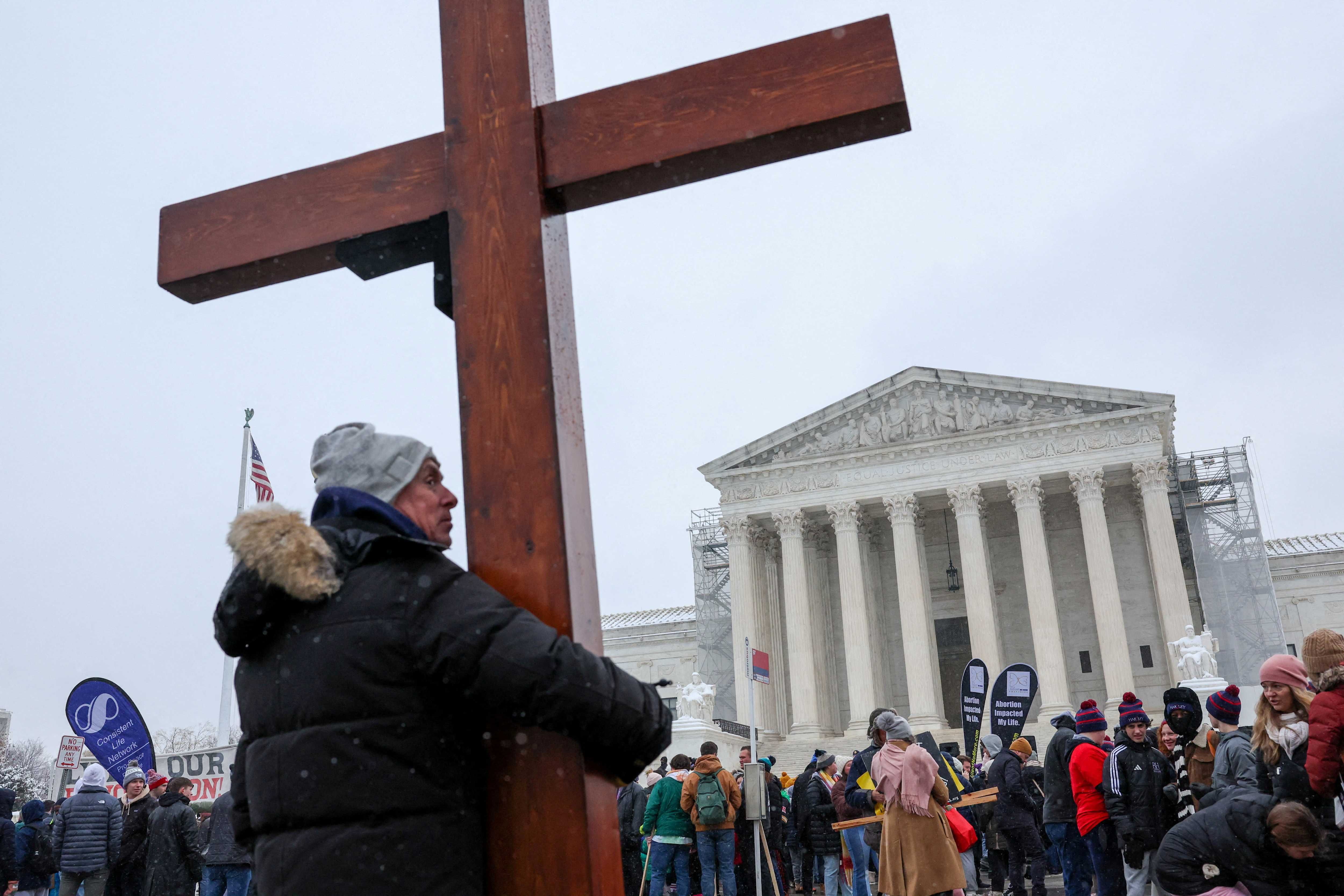
Republicans’ effort to appeal more to national voters could upend the party’s long-standing partnership with the anti-abortion movement.
Polling from The 19th and YouGov shows that a large majority of voters want abortion to be legal. And polling conducted by Impact Research, a Democrat-aligned firm, found that in battleground states, most voters said lawmakers should work to pass federal protections. Anti-abortion ballot measures have repeatedly failed to garner majority support, including in more conservative states such as Ohio, Kansas and Missouri.
As a result, anti-abortion strategists and policy analysts say the GOP — which has for decades backed abortion restrictions — is publicly shifting away from the national bans its members supported just a few years ago. It’s similar to President Donald Trump’s approach; in 2024 he said abortion should be left up to individual states, and he has frustrated anti-abortion activists by ignoring many of their requests for federal limits on abortion medication.
“What we’re seeing is Republicans coming to some kind of grip with reality, when it comes to, OK, you can’t be a total no exceptions — you can’t be a hardliner and hope to have a future at the national level,” said Patrick Brown, a scholar at the Ethics and Public Policy Center, a conservative think tank.
It’s part of a larger Republican effort to find a message that may be more appealing to voters than enacting a strict national ban.
“They know they’re in a losing position, and they are trying to figure out — how do they waffle?” said Celinda Lake, a Democratic pollster and strategist.
Florida Gov. Ron DeSantis, who is reportedly exploring a presidential bid and helped enact a six-week abortion ban in his home state, recently said that the national anti-abortion movement has been caught “flat-footed.” He suggested that an effective conservative message would approach the issue differently based on an individual state’s politics, saying, “Mississippi can have a different message than New Hampshire.”
“I don't really see much of a message at all on this,” DeSantis said days after the midterm elections. “I think the issue has lost a lot of salience, obviously partially because the left has won in most of these states at this point and the pro-life movement really hasn't done much to fight that.”
It’s not yet obvious how other potential Republican presidential contenders might approach the issue. Vice President JD Vance — who has spoken frequently about his opposition to abortion — has been viewed by abortion opponents as a key ally in the White House and possible champion if elected president. But since the GOP’s midterm shellacking, Vance has not yet indicated how he would approach abortion if made the Republican nominee. His post-election remarks have instead focused on immigration policy and the ongoing military conflict in Iran.
Secretary of State Marco Rubio, who is also viewed as a potential 2028 contender, backed national abortion restrictions as a senator from Florida. But in 2022, months after the fall of Roe v. Wade, he told a reporter that he supported a ban in Florida but believed the issue should be left up to individual states.
But there isn’t clear agreement that avoiding the issue is a successful strategy for Republicans. In addition to winning back both chambers of Congress, Democrats also made huge gains at the state level, flipping control of many governorships and state legislative chambers now responsible for setting abortion policy. Susan B. Anthony Pro-Life America, a major national anti-abortion group, blamed Republican leaders and consultants for shying away from the issue, depressing a key segment of the Republican base.
“The only tangible results of this strategy were turnout problems, missed persuasion opportunities, and hundreds of thousands of dead babies in the strongest pro-life states,” the organization said in a post-election memo.
Strategists, activists and analysts agree that the Republican presidential primary represents an existential question for the future of the anti-abortion movement. Andrew Shirvell, founder and executive director at Florida Voice for the Unborn, said the anti-abortion movement as a whole has “soul-searching” to do. He argued that national anti-abortion groups have been overly focused on Congress and trying to get an abortion ban passed at the federal level, which he said is infeasible.
“The same movement leaders go back to the same nonsense,” Shirvell said. “I’m telling you this straight up. We're never going to get a national abortion ban passed through Congress, no matter who the president is.”
Shirvell said he wants to see 2028 GOP presidential candidates who will be “a leader for a culture of life” and can restore morale among the grassroots base of the anti-abortion movement.
“What we need, and what I'd like to see, is somebody that's going to articulate the pro-life cause using their bully pulpit of the presidency to motivate the movement to do the hard necessary work on the state and local level,” he said. “Because that's where I foresee the movement is really going to be focused on for the next 10 to 15 years.”
As Brown put it: “The pro-life movement is not in a good place, and I think we all know that.”
The Democrats’ approach
In 2024, then-Vice President Kamala Harris’ presidential bid was defined by her full-throated embrace of abortion rights as “freedom.” The messaging in 2028 will likely take a bigger tent approach.
Central to that is tying abortion to cost-of-living concerns and, in some cases, a shift away from “culture war” issues or “identity politics.”
Abortion wasn’t a big topic at post-election Democratic gatherings like Crooked Media’s CrookedCon in Washington, D.C., and What’s Next, a conference of party strategists and 2028 hopefuls hosted in Denver by center-left group Majority Democrats.
But Lis Smith, a veteran Democratic strategist and adviser to Majority Democrats, said on a panel at CrookedCon that signaling moderation on the issue helped Democrats who support abortion rights win key midterm races in deep-red and purple states.
Sen. Jon Ossoff speaks to supporters at a canvassing event at the DeKalb History Center Museum in Decatur, Georgia on November 2, 2026. (Kevin D. Liles/The Washington Post/Getty Images)
Sen.-elect Adam Hamilton in Kansas, a Methodist pastor, calls himself “pro-life with a heavy heart” and said he supports keeping abortion legal despite feeling “moral tension” around the issue. Sen.-elect Scott Colom, who pulled off a massive upset victory in Mississippi, says he’s “personally pro-life” but that he believes in reproductive choice.
“The big lesson to me from all of this is not left or right or moderate or populist,” Smith said. “There's no one way to be a Democrat, and a big tent of voters requires a big tent of candidates. And we should stop trying from stages like this to tell people, ‘This is the prescription for the future of the Democratic Party,’ and let people in different places go out and show us what it is.’”
Mini Timmaraju, president of abortion rights group Reproductive Freedom for All, said she wants to see 2028 contenders talking about expanding abortion access on the trail. Timmaraju is hoping to see action “in the first 100 hours” of the new Congress to repeal the Hyde Amendment, which bans federal dollars from funding abortions in most cases, and wants 2028 Democratic presidential contenders to push for its abolishment.
“What we'd like to see is very clear commitments from Democrats across the board on plans to restore abortion rights in all 50 states, plans to remove discriminatory barriers to care, like the Hyde Amendment, and bonus points for comprehensive plans on issues like a right to contraception and IVF protections,” Timmaraju said on a call with reporters.
When Democrats launch their campaigns in South Carolina, the first state scheduled to hold a Democratic primary, many voters will expect to hear about abortion in some form, said Charleston-based political strategist Renee Harvey, pointing to the state’s six-week ban.
“We are the only early state with an abortion ban,” she said. “The first time they talk to voters, they are going to be campaigning in a state where the consequences of Dobbs are not hypothetical.”
But effectively campaigning on the issue will mean tying it to other voter concerns, she said, such as the cost of living and health care availability.
“Reproductive freedom is not separate from those kitchen table issues,” she said. “I don’t think anyone can claim to care about the cost of living while ignoring the cost of forcing women to give birth.”
In that context, some potential 2028 Democratic presidential contenders have begun testing out their own framing on abortion.
Harris, who campaigned heavily on the issue in her failed presidential bid two years ago, appeared at the end of October on a podcast hosted by Reproductive Freedom for All to argue that restoring abortion rights would also require changing political institutions such as the Supreme Court and Electoral College.
A spokesperson for Harris suggested those remarks were part of a larger focus on reproductive health, also pointing to a September appearance at a birth center alongside Sen.-elect Abdul El-Sayed in Detroit, where she criticized the Trump administration’s cuts to diversity, equity and inclusion programs as well as federal cuts to Medicaid, the health insurance program for low-income people.
Sen. Elissa Slotkin, a Michigan Democrat, appeared on another episode of the same podcast to argue that voters perceive support for abortion bans as a sign of extremism — and suggested that the right to end a pregnancy should be considered a cost-of-living issue.
Andy Beshear, the Democratic governor of Kentucky, devoted a chapter of his recent book, “Go and Do Likewise,” to his experience campaigning for exceptions to abortion bans alongside Hadley Duvall, a young woman from the state who had an abortion as a child after being raped by her stepfather.
"In all the debate surrounding the question of abortion, almost all of it cast in religious terms, Hadley speaking out on behalf of others was the most Christlike action I had ever seen," Beshear wrote.
Georgia Sen. Jon Ossoff, who cruised to reelection this fall, highlighted his state’s six-week abortion ban during his campaign, including in a speech where he described women “bleeding out in Georgia labor wards because they didn’t get prenatal care.” Multiple women’s deaths in Georgia have been attributed to the state’s ban.
For Democrats, Lake said, “it’s a winning issue for candidates where there is a contrast.”