EPA staff say the Trump administration is changing their mission from protecting human health
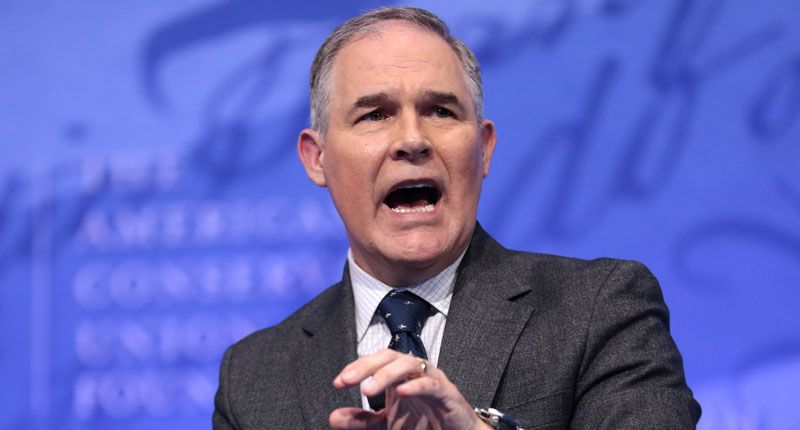
Administrator of the Environmental Protection Agency Scott Pruitt speaking at the 2017 Conservative Political Action Conference (CPAC) in National Harbor, Maryland. (Gage Skidmore/Flickr)
The Environmental Protection Agency made news recently for excluding reporters from a “summit” meeting on chemical contamination in drinking water. Episodes like this are symptoms of a larger problem: an ongoing, broad-scale takeover of the agency by industries it regulates.
We are social scientists with interests in environmental health, environmental justice and inequality and democracy. We recently published a study, conducted under the auspices of the Environmental Data and Governance Initiative and based on interviews with 45 current and retired EPA employees, which concludes that EPA Administrator Scott Pruitt and the Trump administration have steered the agency to the verge of what scholars call “regulatory capture.”
By this we mean that they are aggressively reorganizing the EPA to promote interests of regulated industries, at the expense of its official mission to “protect human health and the environment.”
How close is too close?
The notion of “regulatory capture” has a long record in U.S. social science research. It helps explain the 2008 financial crisis and the 2010 Deepwater Horizon oil spill. In both cases, lax federal oversight and the government’s over-reliance on key industries were widely viewed as contributing to the disasters.
How can you tell whether an agency has been captured? According to Harvard’s David Moss and Daniel Carpenter, it occurs when an agency’s actions are “directed away from the public interest and toward the interest of the regulated industry” by “intent and action of industries and their allies.” In other words, the farmer doesn’t just tolerate foxes lurking around the hen house – he recruits them to guard it.
In our view, Pruitt’s efforts to undo, delay or otherwise block at least 30 existing rules reorient EPA rule-making “away from the public interest and toward the interest of the regulated industry.” Our interviewees overwhelmingly agreed that these rollbacks undermine their own “pretty strong sense of mission … protecting the health of the environment,” as one current EPA staffer told us.
Historical trends in EPA’s budget show a spike during the Carter administration, followed by sharp cuts under President Reagan and an infusion of economic stimulus money in 2009. President Trump has proposed sharp cuts.
A key question is whether regulated industries had an active hand in these initiatives. Here, again, the answer is yes.
Nuzzling up to industry
Pruitt’s EPA is staffed with senior officials who have close industry ties. For example, Deputy Administrator Andrew Wheeler is a former coal industry lobbyist. Nancy Beck, deputy assistant administrator of EPA’s Office of Chemical Safety and Pollution Prevention, was formerly an executive at the American Chemistry Council. And Senior Deputy General Counsel Erik Baptist was previously senior counsel at the American Petroleum Institute.
The former head of EPA’s Office of Policy, Samantha Dravis, who left the agency in April 2018, had 90 scheduled meetings with energy, manufacturing and other industrial interests between March 2017 and January 2018. During the same period she met with one public interest organization.
Circumstantial evidence suggests that corporate lobbying is directly influencing major policy decisions. For example, just before rejecting the chlorpyrifos ban, Pruitt met with the CEO of Dow Chemical, which manufactures the pesticide.
Overturning Obama’s Clean Power Plan and withdrawing from the Paris climate accord were recommended by coal magnate Robert Murray in his “Action Plan for the Administration.” Emails released under the Freedom of Information Act show detailed correspondence between Pruitt and industry lobbyists about EPA talking points. They also document Pruitt’s many visits with corporate officials as he formulated his attack on the Clean Power Plan.
Muting other voices
Pruitt and his staff also have sought to sideline potentially countervailing interests and influences, starting with EPA career staff. In one of our interviews, an EPA employee described a meeting between Pruitt, the home-building industry and agency career staff. Pruitt showed up late, led the industry representatives into another room for a group photo, then trooped back into the meeting room to scold his own EPA employees for not listening to them.
And on April 24, 2018, Pruitt issued a new rule that limits what kind of scientific research the agency can rely on in writing environmental regulation. This step was advocated by the National Association of Manufacturers and the American Petroleum Institute.
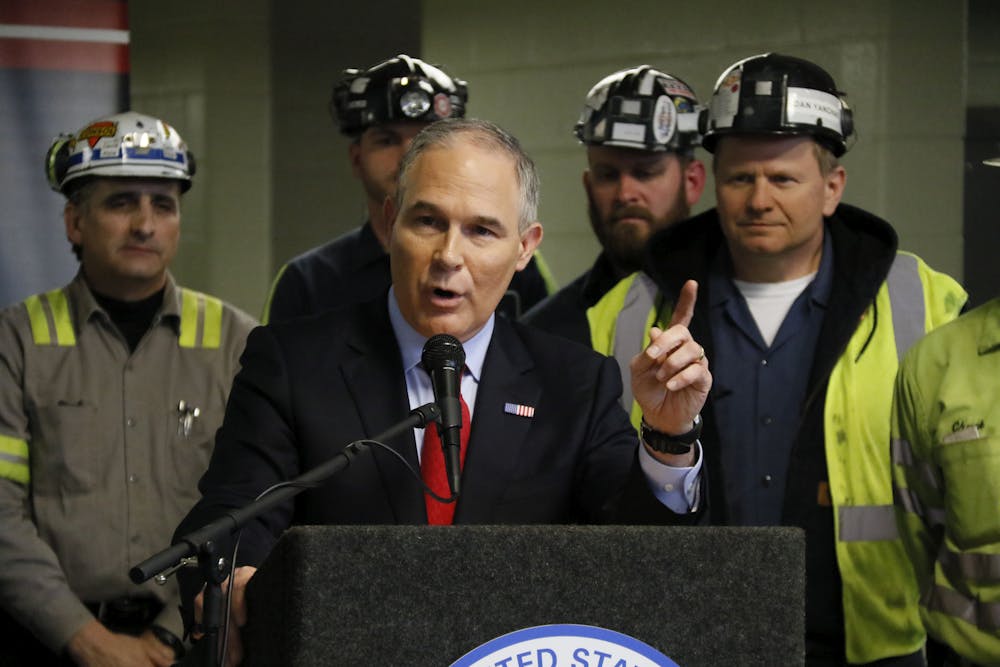
EPA Administrator Scott Pruitt speaks to a group of coal miners in Sycamore, Pa., April 13, 2017.
This is not the first time that a strongly anti-regulatory administration has tried to redirect EPA. In our interviews, longtime EPA staffers recalled similar pressure under President Reagan, led by his first administrator, Anne Gorsuch.
EPA veterans of those years emphasized the importance of Democratic majorities in Congress, which initiated the investigations, and sustained media coverage of EPA’s unfolding scandals. They remembered this phase as an oppressive time, but noted that pro-industry actions by political appointees failed to suffuse the entire bureaucracy. Instead, career staffers resisted by developing subtle, “underground” ways of supporting each other and sharing information internally and with Congress and the media.
Similarly, the media are spotlighting Pruitt’s policy actions and ethical scandals today. EPA staffers who have left the agency are speaking out against Pruitt’s policies. State attorneys general and the court system have also thwarted some of Pruitt’s efforts. And EPA’s Science Advisory Board – including members appointed by Pruitt – recently voted almost unanimously to do a full review of the scientific justification for many of Pruitt’s most controversial proposals.
Still, with the Trump administration tilted hard against regulation and Republicans controlling Congress, the greatest challenge to regulatory capture at the EPA will be the 2018 and 2020 elections..