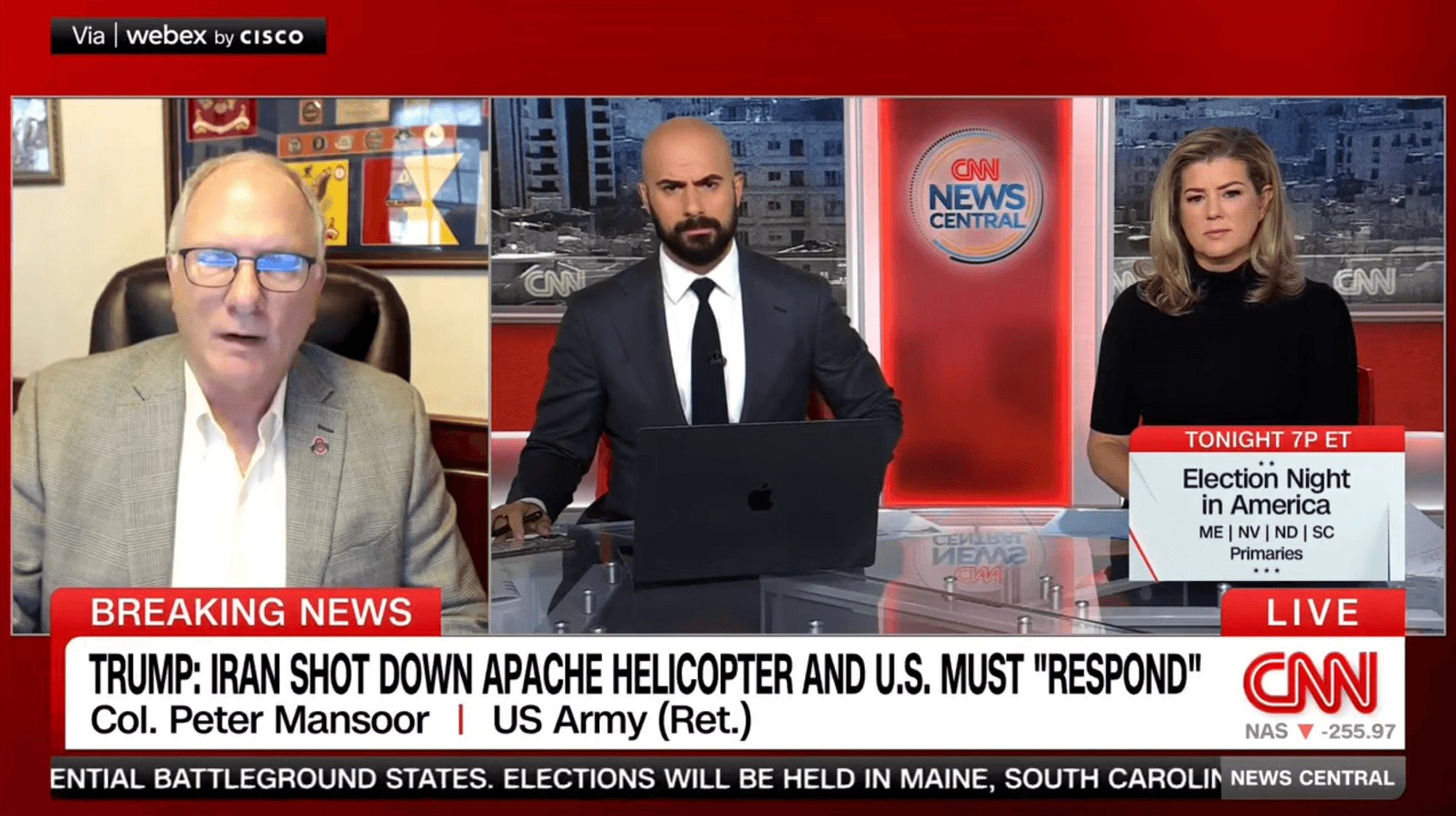
A military expert on Tuesday revealed new details emerging after Iran struck a United States Apache helicopter and how it "changes the entire situation" involving the ongoing conflict.
After reports that a Shahed drone struck the helicopter over the Strait of Hormuz, and it was unclear whether the drone had initially targeted the Apache or if it was an inadvertent strike, Col. Peter Mansoor told CNN that it could change the response.
"I really think thatchanges the entire situationbecause Shahed drones are notair-to-air drones," Mansoor said. "It couldhave been just an accident thatthe drone was aimed at somethingelse and ran into the Apache, you know, by chance. But, if it was actually aimed at the helicopter, this would be a new use for this particular type of drone, which is really an air-to-surface, guided cruise missile rather than an air-to-air missile like Ukraine has developed."
CNN anchor Brianna Keilar cited a recent CNN report that Iran had employed the ceasefire to help rebuild its drone supply and overall military industrial response — and asked Mansoor if that was reflected in the attack this week.
"Well, we never destroyed theentire drone capability of Iranin the first place," Mansoor said. "In fact,much of it survived. And theywere able to dig out the collapsed tunnels and so forth, and reconstitute many of their launch platforms. So I'm notsure they're producing many new drones, but they are recovering those buried by initial strikes andgetting them ready to launch. So there's no doubt that Irantoday is more capable than itwas when the ceasefire began.But it's going to take yearsfor it to recover the sort ofproduction capability that waslost during the airstrikes."