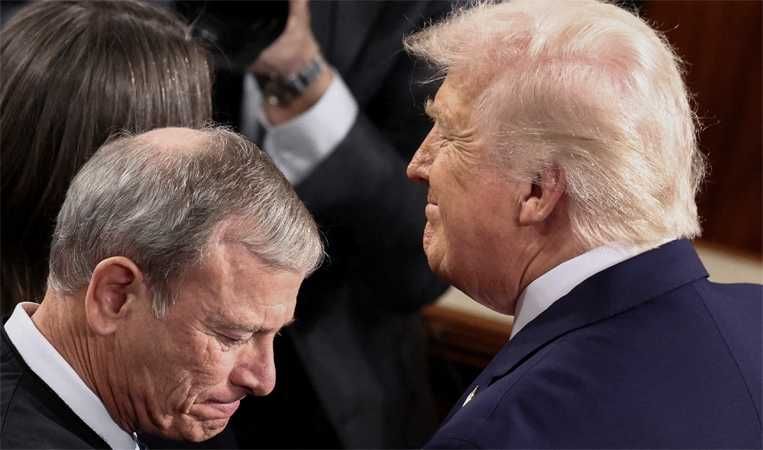
As the Supreme Court issued a slew of decisions before its summer recess, a legal expert sounded the alarm on how corporate influence prevailed in swaying the latest decisions.
Led by Chief Justice John Roberts, the Supreme Court has ruled in favor of President Donald Trump 84 percent of the time, according to analysis from legal watchdog Court Accountability, and when it doesn’t side with Trump, the court sides with corporate interests on Wall Street, said Lisa Graves, Court Accountability's co-founder and executive director of public policy watchdog group True North Research.
“John Roberts is a political player, and in a couple of rare instances where he has not gone along with the White House, … that is not because of a principled position but because of a long-time affinity for the corporate community,” said Graves, who is the author of “Without Precedent: How Chief Justice Roberts and His Accomplices Rewrote the Constitution and Dismantled Our Rights.”
“What I see in John Roberts' record is that he is someone who, in rare instances, where there's a conflict between the president or what the Republicans want … and what Wall Street wants, he chooses Wall Street, but for the most part, he chooses his party overwhelmingly," Graves said.
On Monday last week, the conservative supermajority led the Supreme Court in a 6-3 ruling that determined Trump lawfully fired Federal Trade Commissioner Rebecca Slaughter, giving the president the power to remove independent agency heads at-will.
In the case of the Federal Trade Commission, which oversees investigations of business fraud and reviews mergers and acquisitions of companies, that ruling allows the president to appoint commissioners favorable to his business interests and "creates really inappropriate conditions for the undue influence of Donald Trump on these policies, on how our antitrust laws, for example, are going to be implemented.”
“It also feeds into the sort of pay-to-play approach that Donald Trump has taken to the office of the White House, which is to reward people who have helped him win power or supported his pet projects like the ballroom and his inauguration, and try to punish corporations or law firms or universities that he considers his enemy,” Graves said.
While the Supreme Court conversely decided in a narrow 5-4 ruling to maintain the independence of the Federal Reserve and rejected Trump’s attempts to fire Federal Reserve governor Lisa Cook, that was a decision in line with what the business interests wanted, said Graves, who was chief counsel for nominations with the Senate Judiciary Committee from 2002 to 2005.
“The murmurs from Wall Street, in general, were that they did not want to have Trump have total control over the Fed,” Graves said.
“Wall Street in general did not want Trump to collapse the economy due to arbitrary and capricious edicts or demands about raising the interest rate or lowering the interest rate to serve his political purposes.”
'Fueling the corruption'
In recent weeks, the Supreme Court issued another handful of decisions where justices sided with corporations or issued decisions beneficial to corporate interests, Graves said.
In Wolford v. Lopez the justices voted 6-3 to strike down a Hawaii law requiring gun owners to get permission to bring firearms onto private property accessible to the public.
The gun lobby and trade groups filed numerous amicus briefs, which are “friend of the court” briefs submitted by organizations and individuals — not parties to the lawsuit — seeking to influence a case’s outcome by providing relevant perspectives, research and expertise for consideration.
That decision is representative of the “allegiance with the desires of the gun industry in limiting gun regulations” that has been indicative of the court, Graves said.
“This is an area where there's alignment, in essence, between the extreme ideological agenda of the Roberts Court, of the Republican appointees to the court, and the gun industry, which is a multi-billion dollar industry in the United States and globally,” Graves said.
A Raw Story investigation found that MAGA groups and conservative nonprofits connected to far-right megadonors who filed briefs in support of weakening the Voting Rights Act in Louisiana v. Callais took in record-breaking amounts of dark money.
In Monsanto Co. v. Durnell, the Supreme Court overturned a $1.25 million verdict against the agrochemical company, determining federal pesticide law preempted state lawsuits involving the company’s failure to put a cancer warning on Roundup weed killer.
Justice Clarence Thomas worked for Monsanto as an attorney in the 1970s.
This decision “is making it harder for ordinary people to get their day in court” and “is closing the courthouse door to ordinary consumers” who might bring disability or other liability lawsuits against corporations, Graves said.
“This Roberts Court is loyal or aligned with corporate interests over our interests, over ordinary people's interests in most cases, and the statistics prove how often business interests prevail before this court, even if they lost in decisions below, and this is part of that continuing trend,” Graves said.
FILE PHOTO: Supreme Court justices pose for their group portrait at the Supreme Court in Washington, U.S., October 7, 2022. REUTERS/Evelyn Hockstein/File PhotoA study from economists at Yale and Columbia Universities released in January found that the Supreme Court increasingly favors the rich, with the Republican appointees ruling in favor of the wealthier side 70 percent of the time in 2022.
Since Roberts became the chief justice in 2005, the court ruled in favor of businesses 63 percent of the time, according to a study from researchers at Washington University in St. Louis and the University of Virginia.
By comparison, the court ruled in favor of businesses only 41 percent of the time between 1921 and 2021, and businesses won 29 percent of the time under Chief Justice Earl Warren from 1953 to 1969, the study said.
The Supreme Court’s recent rulings, particularly in Trump v. Slaughter, “represent another instance of the destructiveness of John Roberts himself in destroying longstanding precedents in order to aggrandize presidential power in ways that has that, in my view, is fueling the corruption and pay-to-play practices we've seen thrive under Donald Trump, where industries or CEOs pay tribute to him and numerous cases that were in process are dismissed or concluded,” Graves said.