Summary execution: Does this legal theory hold hope of justice for ICE shooting victims?
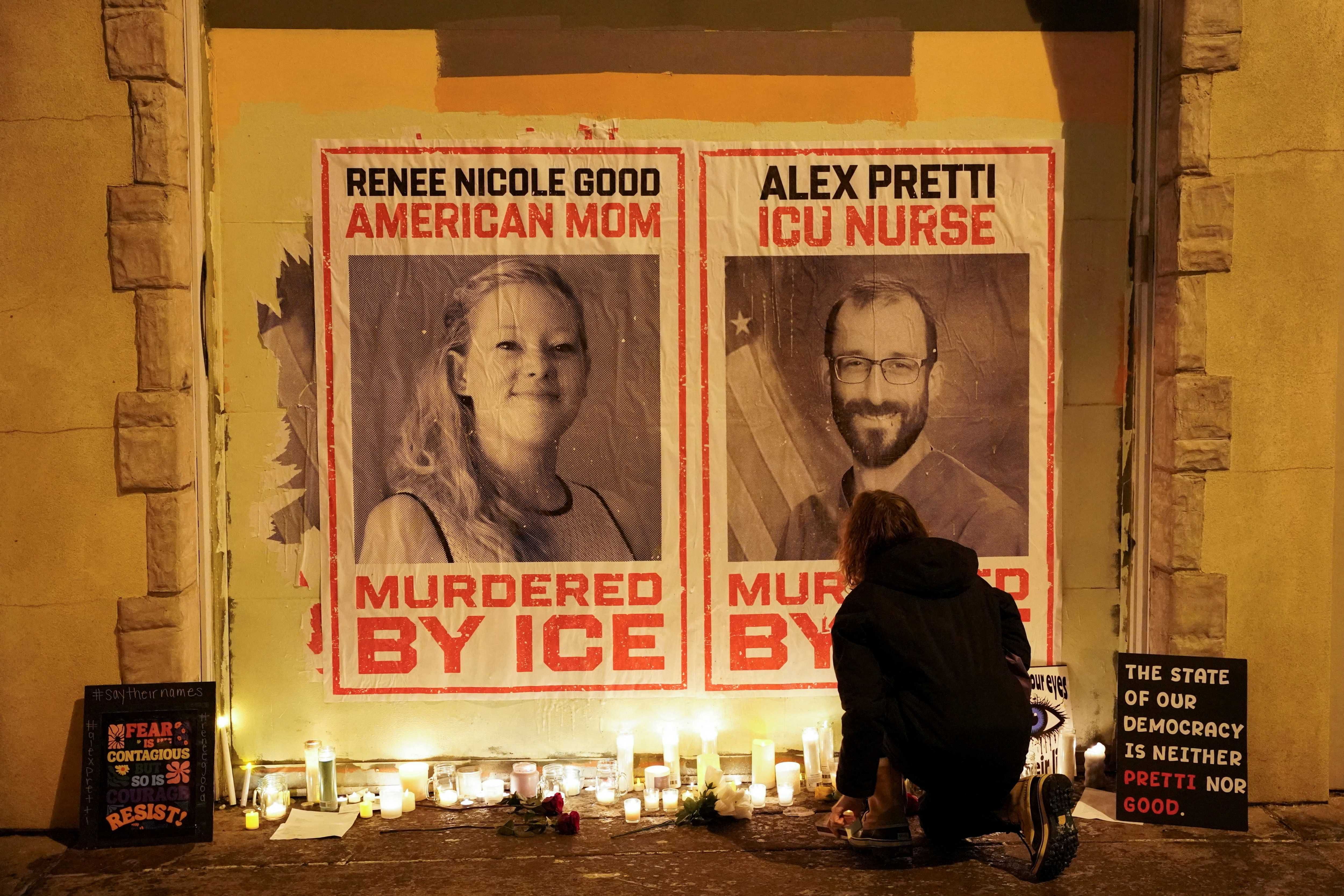
Posters show Renee Good and Alex Pretti, following a vigil in Minneapolis. REUTERS/Seth Herald
January 30, 2026
Lawyers speaking to Raw Story said justice could still prevail in the cases of Renee Good and Alex Pretti, the two people shot dead by federal agents in Minneapolis this month, despite the Trump administration’s refusal to cooperate with state investigations.
Good, a 37-year-old mother of three, was fatally shot by a U.S. Immigration and Customs Enforcement (ICE) officer as she drove her car on Jan. 7.
Pretti, also 37 and an intensive care nurse, was killed on Jan. 24, when agents used pepper spray, beat him, shoved him to the ground, disarmed him, then fired at least 10 shots.
“There were alternatives that did not endanger the lives of these protesters,” Todd Howland, professor at Vermont Law and Graduate School, told Raw Story.
“That's one absolute reason why it was outside the scope of [ICE agents’] duty, because they have a duty to protect the lives of the people of the United States.”
Howland said both Pretti and Good’s deaths should be considered summary executions — a human rights law framework that says a person accused of a crime was killed without a fair trial.
In the immediate aftermath of both shootings, federal officials accused the victims of criminal intent.
Homeland Security Secretary Kristi Noem called Good a “domestic terrorist” and accused her of “stalking and impeding” ICE agents.
In the case of Pretti, Noem accused the deceased of attacking officers, while White House Deputy Chief of Staff Stephen Miller said Pretti tried to “murder federal agents.”
Even were such accusations true, said Howland, a former United Nations official, ICE clearly “could have taken action through the normal justice procedures.
“The fact that then they took further initiative in an aggressive way indicates that they actually weren't, first and foremost, looking for the rights of the individuals, and secondly, there was no absolute necessity, and it was just totally out of proportion in terms of what the officers were doing.”
Howland pointed to an aptly named United Nations mechanism for investigating summary executions: the Minnesota Protocol, so-called because it was drafted by lawyers in the state, and which is meant to be used to deal with potentially unlawful deaths, such as political or state-involved killings, sometimes involving law enforcement.
Good and Pretti “were looking for and contributing to creating a better world, and so it is so important to keep their vision alive and to utilize the summary execution framework to avoid this happening to anybody else,” Howland said.
A summary execution case in regard to Good’s death might have prevented the Pretti shooting, Howland said, because the protocol emphasizes preventing killings from happening again.
“That's why it's important to look a little bit beyond just the more typical forms of justice to a justice that includes that non-reoccurrence or non-repetition.”
Daniel Pi, an assistant professor at the University of New Hampshire School of Law, said the summary execution framework “tends to be relatively toothless in practice” because "international law is very flexibly interpreted.”
But even without cooperation from the U.S. federal government, which holds key evidence in Good’s death, such as the vehicle and testimony of Jonathan Ross, the 10-year ICE veteran accused of killing her, the State of Minnesota “can get to beyond a reasonable doubt using the autopsy report and the video,” Pi said.
Drew Evans, superintendent of the Minnesota Bureau of Criminal Apprehension, said the state has also been “blocked” in conducting its investigation of the shooting of Pretti.
That makes it “a very uphill battle,” to secure justice, Pi said, though he also said that while the odds of prosecution are low — less than 10 percent — it does remain possible.
Civil damages would be challenging to obtain but possibly easier than criminal charges, Howland said.
Matthew Mangino, a defense attorney and former district attorney in Pennsylvania, said the State of Minnesota could still use video and interviews with witnesses to bring charges against the agents who killed Good and Pretti.
“You should be able to reconstruct what happened as a state investigator or prosecutor, and pursue your own criminal prosecution if, in fact, you believe a crime has been committed,” Mangino said.
After the Good shooting, Vice President J.D. Vance, a Yale law grad, falsely claimed that Ross, the shooter, had “absolute immunity.”
In fact, law enforcement and government officials have “qualified immunity” from personal civil liability, if they are found to have acted in good faith and with probable cause, as determined in a landmark 1967 Supreme Court case, Pierson v. Ray.
In order for agents to have immunity from state prosecution, Mangino said, a court would need to rule that the agents are indeed immune from being prosecuted for criminal conduct.
“That result is really unfathomable to me, because what it says then is, ‘Hey, if you're an ICE agent, or you're an FBI agent, or you're a DEA agent, you can shoot and kill people with impunity,’ and I don't think that's the direction that the courts are going to go,” Mangino said.
Mangino said victims’ families could also pursue a federal tort claim, which allows individuals to sue the U.S. government for injury and death due to the negligence of federal employees.
“You're suing the United States government because of their conduct,” Mangino said.
“There's avenues to pursue it. They're not easy, but I don't think it's as easy as saying, ‘Oh, ICE agents have immunity, and you can't sue them and you can't prosecute them.’”
Mangino said the government’s position of not investigating Good’s death was “preposterous,” but noted that political and public pressure led to the government to agreeing to an investigation into the death of Pretti.
“Although the Department of Justice said, ‘We will not bow to political pressure, or we will not bow to public pressure,’ they have, and that's where we are, at least with regard to the second homicide,” Mangino said.
Democratic Minnesota Gov. Tim Walz said President Donald Trump’s claim that he would personally oversee the Pretti investigation was “so wrong on so many levels.”
ICE has undergone a 120 percent hiring expansion as its budget has ballooned to $85 billion, the largest of any U.S. law enforcement agency.
At least 2,000 ICE officers and 1,000 Customs and Border Patrol agents were on the ground in Minneapolis as of Thursday, PBS reported.
“It's absolute incompetence that you're seeing because of the fact that they're expanding so fast,” Howland said.
The federal government, he added, is “putting politics and some ideology in front of actually protecting the lives of people, and that's unacceptable.”
With the public increasingly putting the blame at the feet of Trump and Noem, Howland said, accountability of a sort will be achieved.
“Even if there's problems with the criminal prosecution, even if there's complications with civil law,” Howland said, “eventually, I think that you'll see both through the ballot box and through a change in public opinion that these types of tactics are totally inappropriate, that they aren't based in law, and that you'll see a change or a shift because the people won't take it.”


