Scientists 'hack' tobacco plants to produce much higher yield -- still working on food
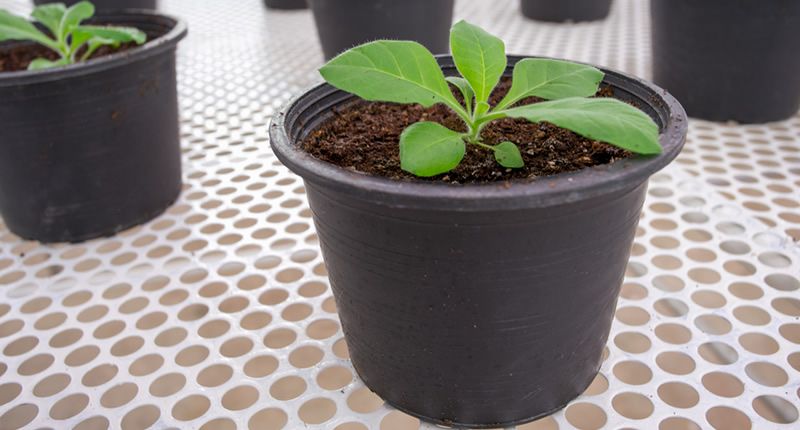
Scientists have "hacked" the photosynthetic process in tobacco plants using enzymes from blue-green algae in a way which will someday allow them to grow faster, more robustly, and without nearly as much as fertilizer, Popular Mechanicsreports.
Geneticists have long known that the photosynthetic abilities of cyanobacteria, or blue-green algae, far outstrip those of terrestrial plants. Cyanobacteria are both faster and more efficient at converting sunlight to energy than any terrestrial grain -- such as corn, wheat, or rice -- and the reason is that they possess an "upgraded" version of the enzyme that converts carbon dioxide into food, called "rubisco."
Along with researchers from Rothamsted in England, Maureen Hanson and her team of biochemists at Cornell have cultivated a tobacco plant with genetically engineered cyanobacteria rubisco.
"Hearing the results of this experiment for the first time was definitely one of those 'Eureka!' moments you live for as a scientist," Hanson said.
The tobacco plant should, in theory, be able to increase crop yield by 35 to 60 percent, and drastically cut down on the amount of fertilizer needed to establish and maintain large fields.
Previous attempts to engineer the rubisco enzyme into terrestrial plants failed because the plants possess a version of the enzyme that frequently mistakes carbon dioxide for oxygen, which not only slows down the carbon dioxide processing, but retards the overall photosynthetic process. So, plants evolved a slow and inefficient form of rubisco in order to prevent the accidental ingestion of oxygen.
Cyanobacteria, however, evolved rubisco with protective capsules that ward off oxygen, creating miniature, carbon dioxide-rich environments for their rubisco to work in. By genetically grafting the cyanobacteria rubisco into the tobacco plants, scientists hope to create plants that process carbon dioxide as efficiently as blue-green algae.
Although the experiment was a success, the researchers did note that the engineered plants grew more slowly than ordinary tobacco.
Still, as Dean Price of the Austrian National University told Popular Mechanics, "this shows that one of important elements toward creating faster [and more efficient crops] has already been achieved."
This is significant, he said, because although the advance of the so-called "green revolution" has allowed food production to keep up with increasingly demand, "the green revolution has basically started to run out of steam."