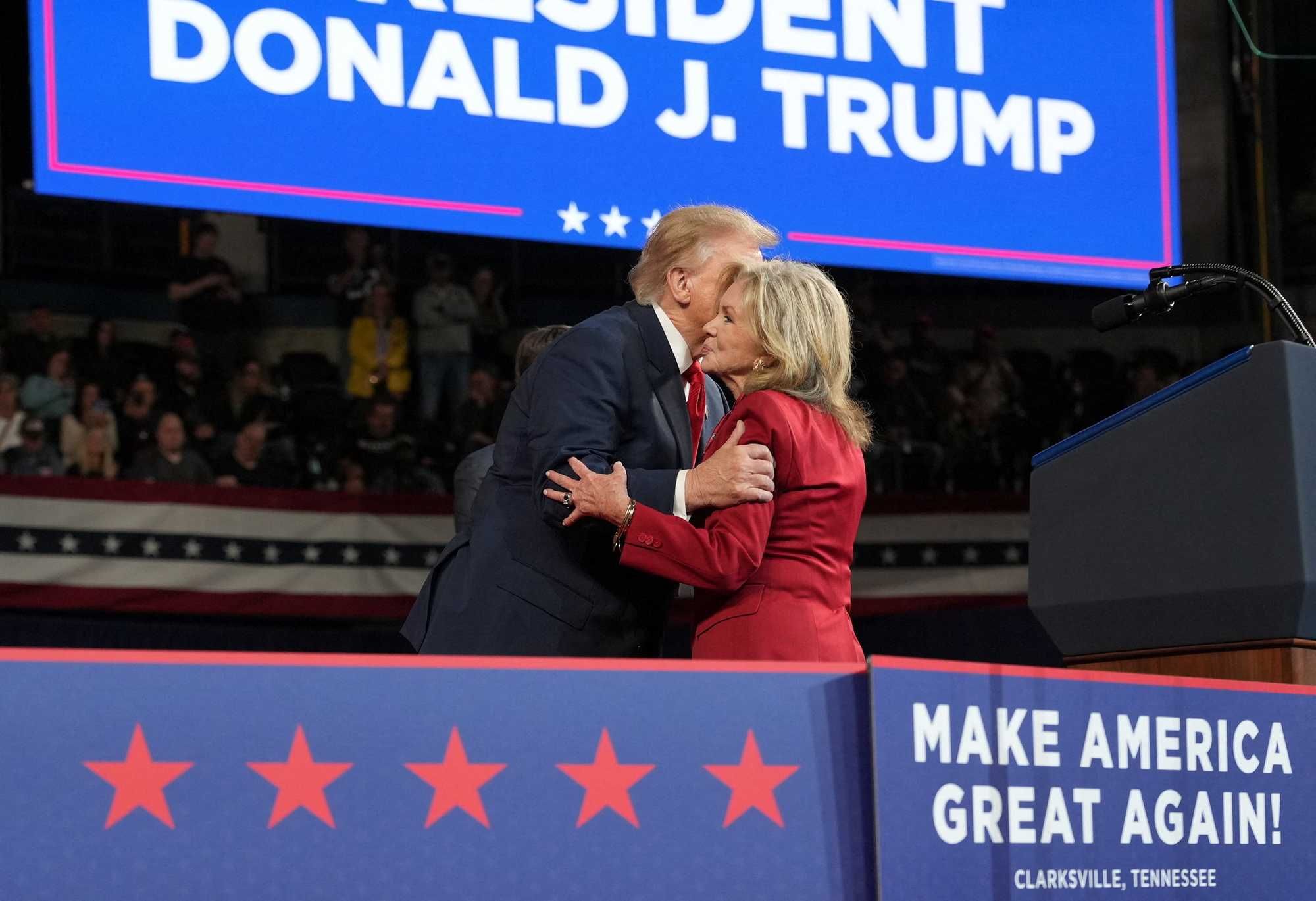
The top Tennessee Republican received nearly 1 million fewer votes in 2026 than 2024, a turnout collapse that reverberated down-ballot, costing the GOP half a dozen state House seats and effectively neutralizing the party’s mid-cycle redistricting of the state’s U.S. House map.
Gov.-elect Marsha Blackburn garnered roughly 1.9 million votes in her landslide reelection victory for U.S. Senate in 2024, but two years later, the coalition powered by President Donald Trump that delivered her an impressive statewide win has almost disappeared.
Blackburn received around 950k votes in the governor’s race, defeating her Democratic challenger by 2.5%, and in the process became the first Tennessee governor to win less than 50% of the vote since before World War II.
Kent Syler, a political science professor at Middle Tennessee State University, said Rutherford County was at the center of the GOP’s long night.
Blackburn, U.S. Sen. Bill Hagerty, and U.S. Rep. Scott DesJarlais, in his likely narrow defeat to Democrat Victoria Broderick, all lost Rutherford County. Democrats also flipped three state House seats in the county.
“It was a complete surprise,” Syler said.
Democrats in Tennessee didn’t receive more votes in any county in 2026 than in 2024. Instead, nearly a million Republican voters chose not to vote for Blackburn, primarily in Tennessee’s urban and suburban counties.
Turnout for midterm elections is typically much lower than for presidential elections, particularly in the Trump era, because Trump drives rural Republican turnout at record levels. Trump and Blackburn won their 2024 elections, each garnering 64% and 63, respectively in Tennessee.
During Tuesday’s election, Blackburn received 45% of the vote, a 19% drop in two years.
Dawn Schluckebier, an advocacy director with the nonpartisan think tank ThinkTennessee, said the narrow margins of victory for Republicans were the biggest takeaway of the night.
“This is something we haven’t experienced in Tennessee in a while,” Schluckebier said. “Overall competitiveness across the board.”
2026 looks a lot like 2018, except for Blackburn
Hagerty won his reelection to the U.S. Senate Tuesday with 55% of the vote, roughly by the same margin Blackburn won her first U.S. Senate election in 2018.
The 2018 midterm election is the closest comparison to 2026 because it featured the same president and an open governor’s race in Tennessee. But turnout in 2018 was slightly higher in total votes and percent of electorate than in 2026.
In Tuesday’s selection, the difference between Blackburn’s narrow gubernatorial victory and Hagerty’s easy win comes down to David Hatley, an independent candidate. Hatley explicitly targeted Blackburn and the conservative vote by spending nearly $12 million of his own cash.
When combined, Blackburn and Hatley received about 1.15 million votes in the governor’s race, and Hagerty received 1.14 million.
State Rep. John Ray Clemmons, a Nashville Democrat who chairs the party’s state House Democratic caucus, said Blackburn was uniquely unpopular.
“Our polling consistently showed four unpopular things in Tennessee were Trump, Blackburn, toll lanes and (private school) vouchers,” Clemmons said.
Visual: The partisan lean of Tennessee’s proposed new U.S. House map
Blackburn, legislative leaders pushed gerrymander that nearly cost Republicans five U.S. House seats
After redrawing Tennessee’s U.S. House map in May, Republicans hoped to increase their advantage from 8-1 congressional seats to 9-0. But after Tuesday’s results, it looks like the party will still hold an 8-1 advantage.
Broderick, the Democratic nominee in Tennessee’s 4th Congressional District, leads DesJarlais, the Republican, by 285 votes, with roughly 700 provisional ballots still to be counted.
Erin Covey, the head of the Cook Political Report’s U.S. House ratings, said Broderick’s win would be “the reddest seat that Democrats flipped last night,” with Trump winning the district by 24% in 2024. Cook is a nonpartisan election-rating organization that analyzes federal and gubernatorial races.
District 4 was one of six seats redrawn in May, as state Republicans, with a push from Blackburn and Trump, tried to gerrymander the state’s congressional map to win every U.S. House seat.
But to do so, Republicans had to shrink their margins in six seats, all of which Republicans won by 5% or less Tuesday.
On a smaller scale, state Republicans’ 2022 redistricting in Rutherford County, designed to increase their state House seats, likely led to the loss of three of the county’s five districts.
The county has been subtly shifting toward Democrats as the population has increased and it’s become a hub for workers who can’t afford to live in Nashville. In August, eight Democrats won seats on the Rutherford County Commission, a harbinger of November’s results.
The state House Democratic caucus actively tried to flip seats in Clarksville, Knoxville and Memphis, but the wins in Rutherford came as a surprise.
Syler said the Republican redistricting effort in 2022 could, in hindsight, be called a mini-dummymander, which refers to when a party goes too far to gerrymander seats so that, in wave elections, it loses districts it otherwise would have safely held under previous maps.
For example, in Rutherford, a packing of Democratic votes probably leads the party to lose one seat, not three.
“Republicans got greedy in Rutherford,” Syler said.
Tennessee Lookout is part of States Newsroom, a nonprofit news network supported by grants and a coalition of donors as a 501c(3) public charity. Tennessee Lookout maintains editorial independence. Contact Editor Holly McCall for questions: info@tennesseelookout.com.