'Extremism cost Republicans': Analysis shows just how much Trump's endorsement hurt GOP candidates
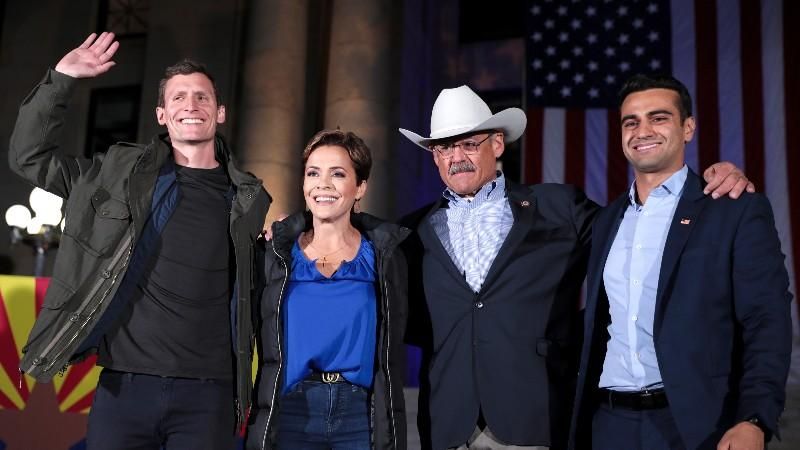
Blake Masters, Kari Lake, Mark Finchem, and Abraham Hamadeh / Shutterstock
November 17, 2022
Republicans have officially retaken the House of Representatives, but they will do so with a razor-thin margin that is a far cry from the "red wave" election they were expecting just over a week ago.
A new election analysis published by The Economist shows that the overriding factor in the GOP's disappointing midterm performance came down primarily to the candidates backed by former President Donald Trump, many of whom spouting conspiracy theories ranging from a belief in QAnon to claims about Democrats selling baby parts.
In fact, the publication estimates that Trump's backing had a negative overall effect on candidates' final vote shares.
"This paper’s modelling of results finds Republican candidates who were endorsed by Mr. Trump in their primary did about 5 percentage points worse in their district than they would have if they had not received the endorsement," writes The Economist. "Election deniers suffered an additional one-point decrease in their margin, after controlling for factors such as the voting history of the seat and whether an incumbent was running. These findings suggest if every Republican candidate had refused Mr. Trump’s endorsement and affirmed the results of the election, the party would have won an additional five seats in the House this year."
READ MORE: Oath Keeper Jessica Watkins loses her cool in court and starts shouting about the election: report
This was no more evident than in Arizona, where three Trump-backed candidates for governor, secretary of state, and United States Senate all went down in defeat, despite the fact that the state's overall voting trends leaned toward the GOP.
Or as The Economist data journalist G. Elliott Morris comments on Twitter, "Extremism cost Republicans a normal midterm."