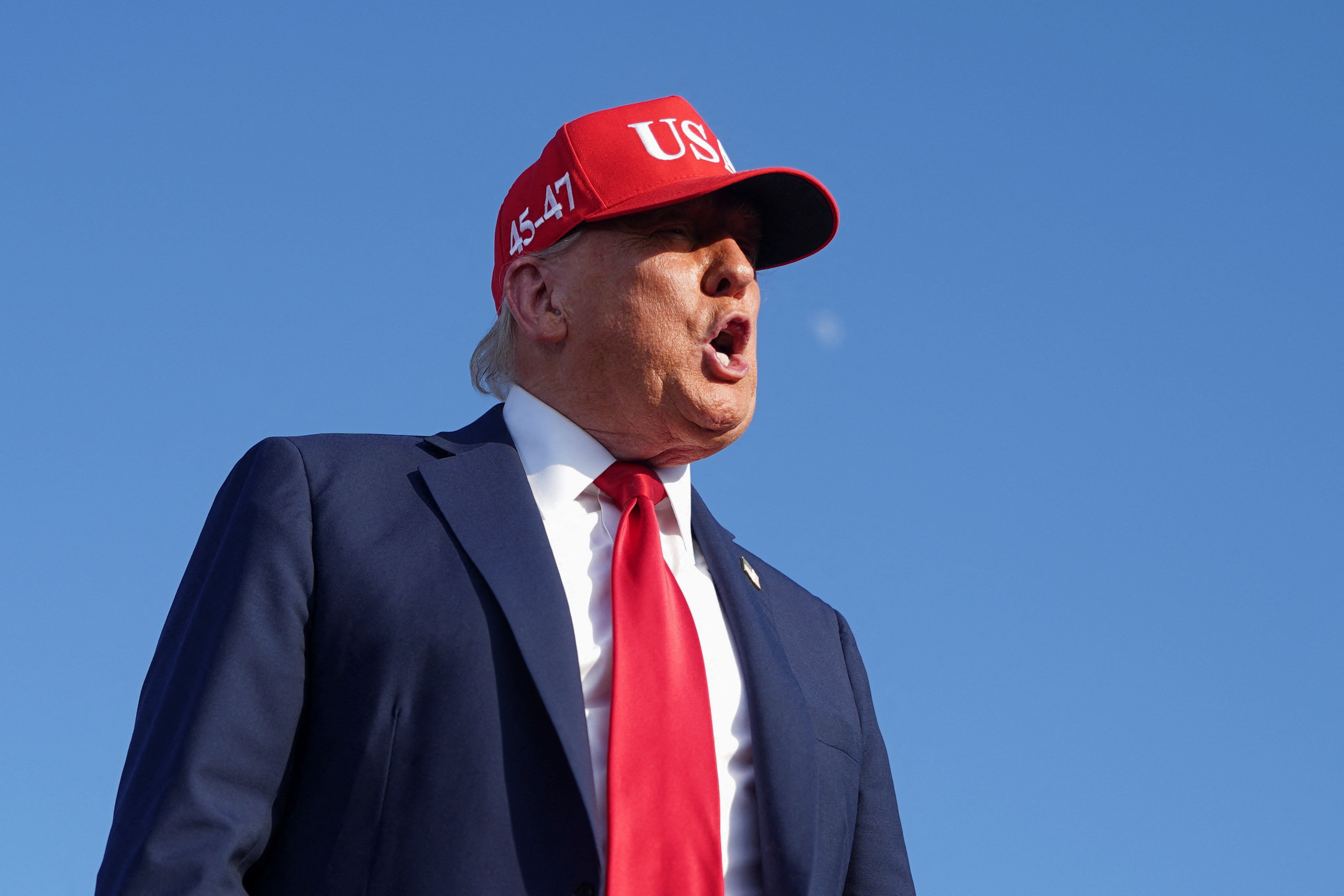
Donald Trump speaks in Des Moines, Iowa. REUTERS/Nathan Howard
President Donald Trump is a desperate man. With the midterms on the horizon and his approval ratings under water, he doesn’t want to talk about affordability. Nor does he want to talk about his war with Iran. And he certainly doesn’t want to talk about Jeffrey Epstein.
What does he want to talk about? Communists.
Over the last two weeks, Trump has ratcheted up his overheated rhetoric in response to democratic socialists’ victories in primary elections in Colorado, New York, Washington, DC, and elsewhere.During a speech to Christian conservatives at a Faith and Freedom Coalition convention in Washington on June 26, he called democratic socialists “animals” and said, “We have to stop this horrible threat of cancer that’s permeating our country called communism.” He went on to say that the “godless” communists in the Democratic Party pose a particular risk for Christians. “They will close your churches in this country,” he warned. “They will kill your people. And that’s what they’re about.”
It’s not as if Trump and his fellow Republicans haven’t hurled the communist epithet before, but over the past six months they have upped the ante.
Heading into the 250th birthday celebration on the National Mall, Trump continued his tirade. Speaking at Mount Rushmore on July 3, he not only besmirched Democrats, but immigrants as well. “There is now a resurgence of the communist menace in our land, including from newcomers to our country who embrace ideas totally opposed to our way of life and our great success,” he said. “...You can be a communist or you can be a patriot. You cannot be both.” He made no secret that he is trying to salvage Republican candidates’ chances in November. “America will never be a communist country,” he said. “We can only lose the midterms if we allow ourselves to lose the midterms if we are foolish, stupid, and unwise.”
Trump was only slightly more restrained on July 4 at the National Mall. After introducing a handful of World War II veterans and lauding them for their heroism, Trump ahistorically declared: “Our warriors did not fight communism on battlefields across the world, only to have that menace rear its ugly head right back here in America. We’re not going to let it happen.” (In fact, American troops, along with troops from Great Britain and communist Soviet Union, defeated fascism in World War II.)
It’s not as if Trump and his fellow Republicans haven’t hurled the communist epithet before, but over the past six months they have upped the ante. According to a recent Washington Postanalysis of statements, social media posts, and podcasts, from January to June, they applied the word “communist” or “communism” to Democrats an average of 626 times per week, 43% more than during the same time frame in 2025.
Right-wing pundits have entered the fray, too. Megan McArdle, a self-described “right-leaning libertarian” columnist at The Washington Post, recently wrote that democratic socialist victories represent “a heady moment for the left, because socialism’s tainted brand has recovered from the vivid failures of the Soviet Union.”
Likewise, historian Arthur Herman, writing for Fox News, disingenuously equated democratic socialists’ policy agenda with that of the Soviet Union in a July 3 column. “In June, Marxist radicals calling themselves democratic socialists swept the New York City primaries...” he wrote. “...Communist-style socialism has brought poverty, mass starvation, and subsistence misery to tens of millions worldwide.”
Such attacks are nothing new. Republicans denounced Franklin Roosevelt’s New Deal as “socialism” and even “communism.” In 1961, then General Electric spokesman Ronald Reaganwarned that government health insurance would lead to socialism. Over the following decades, however, Republicans largely abandoned that mantra in favor of attacks on “big government” and the welfare state.
Trump is a throwback to an earlier time. In his 2020 State of the Union address, Trump attacked socialism, claiming it “destroys nations.” Like Reagan before him, he specifically denounced a “Medicare for All” proposal endorsed by Sens. Bernie Sanders (I-Vt.), Elizabeth Warren (D-Mass.), and 130 other members of Congress at the time, calling it a “socialist takeover of our healthcare system.”
During the last election, Trump often called Democratic presidential candidate Kamala Harris a “Marxist,” tying her to her father’s economic perspective on markets and inequality. More recently, he labeled New York Mayor Zohran Mamdani, a democratic socialist, a “communist,” and dubbed Janeese Lewis George, a democratic socialist who won last month’s Washington, DC, Democratic mayoral primary, a “Communist adherent.”
Democratic socialists in the Democratic Party are not communists. If they are a member of any organization, it likely would be the Democratic Socialists of America, which does not function as a party. Communist organizations still exist in the United States, but they are politically marginal and have no representation in Congress or in any state legislature.
Likewise, democratic socialism is not synonymous with Soviet communism, which fell apart 35 years ago. The countries that democratic socialists in America hold up as models can be found in Western Europe. They are multiparty democracies with market economies, strong unions, and robust social safety programs that include universal healthcare. Their economic models are nothing like the one-party command economy of the Soviet Union and, as I pointed out in detail in a December 2025 essay, they do a much better job of ensuring their citizens live long, healthy, and prosperous lives than the United States does.
While only about 17% of Americans have a favorable view of democratic socialist politicians, their policies are quite popular. For example:
Perhaps what is holding democratic socialists back is how they identify themselves. The term “socialist” just may have too much baggage. After all, many Americans still associate the word with the Soviet Union, whose official name was the Union of Soviet Socialist Republics, even though it was a communist dictatorship.
New York Rep. Alexandria Ocasio-Cortez, a democratic socialist, told The Washington Post earlier this week that political labels should not be an issue. “What matters is the legislation, your proposals, the ideas before us,” she said. “How a person identifies in their economic view of the world is less important to people than if we’re making their groceries more affordable.”
Maybe. But Trump and the GOP are betting that calling Democrats “communists” will matter to enough voters to overshadow their concerns about the cost of food, gasoline, housing and healthcare. November will reveal whether that Cold War strategy still works.