Here’s how Confederacy sympathizers attempt to normalize racism with Christmas ornaments
Decorated with ornaments purchased, created and inherited for years, even generations, Christmas trees are a reflection of a family’s history and tastes. John Morgan/flickr, CC BY-SA
As Christmas approaches, many families undertake a familiar ritual: an annual sojourn to the attic, basement or closet to pull out a box of treasured ornaments bought, created and collected over years, even generations.
Hanging these ornaments on the tree is an opportunity to reconnect with memories of personal milestones, holiday icons and, in many cases, destinations visited.
But, I argue, it may be time to take some of these old travel keepsakes off the tree.
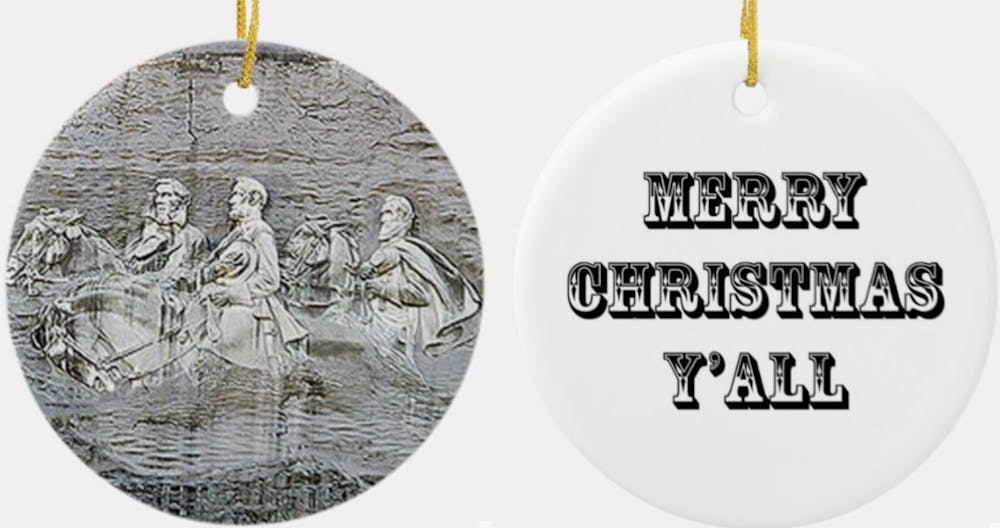
In researching my 2019 book, “Confederate Exceptionalism,” I studied sites throughout the American South whose histories are tied to enslaved labor. Seemingly charming souvenirs are sold to commemorate many of these places – from the White House of the Confederacy in Richmond, Virginia, to Stone Mountain, a Georgia cliffside carved with images of Confederate generals.
Christmas ornaments are among them. And while these keepsakes may seem apolitical, their very circulation enables Confederate myths and symbols to become “normal” features of people’s daily lives. My research suggests they can thus desensitize Americans to the destructive nature of such stories and icons.
The front and back of a Christmas ornament commemorating Georgia’s Stone Mountain, the ‘Mt. Rushmore of the Confederacy,’ screengrab Dec. 17, 2019.
In recent years the U.S. has seen heated conversations about public symbols that commemorate the Confederacy, centered on the Confederate battle flag and statues of Confederate generals.
Statues of Confederate generals that dot courthouse lawns and public plazas across the United States have prompted similar controversy. In 2017 plans to remove a Robert E. Lee statue triggered violence in Charlottesville, Virginia, where a white supremacist at the “Unite the Right” rally killed activist counter-protester Heather Heyer.
Beyond the scope of these national discussions, my research on Confederate myths and memory finds, many unexamined Confederate symbols have made their way into people’s kitchens, bedrooms and living rooms.
People probably don’t reflect on the horrors of slavery when baking an apple pie or purchasing a cuddly toy for their child. They aren’t meant to. But they are participating in that history and its mythologies nonetheless.
In that way, seemingly apolitical objects like cookbooks, toys and Christmas ornaments commemorating Confederate history serve to normalize – rather than problematize – the objects, rituals and stories surrounding the Confederacy.
More than a souvenir
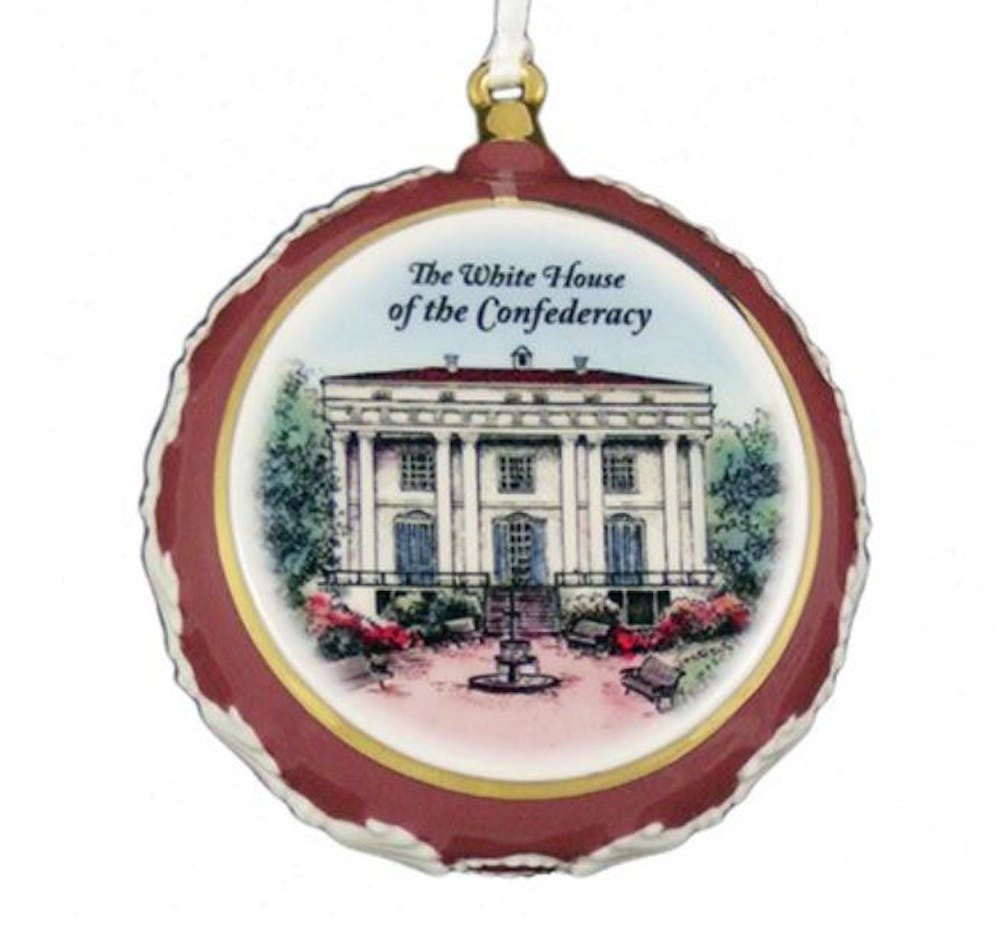
As a result, tree ornaments depicting the White House of the Confederacy, a home of Gen. Robert E. Lee or the carvings of Stone Mountain are not simply mementos of a leisurely visit.
A decorative ornament on sale at the White House of the Confederacy.
These places and people are also icons of the “Lost Cause,” an ideology that romanticizes the Confederacy by portraying the American Civil War as a battle of “states’ rights” rather than a fight to preserve slavery.
The Lost Cause is still taught in some Southern schools, demonstrating that the vestiges of the Confederacy are powerful and lasting. Like Confederate statues and flags, Confederate Christmas ornaments strengthen this myth that the Confederacy – an entity built on white supremacy – was about southern “heritage.”
What appears to be a nostalgic trip reminder, then, is in fact deeply implicated in a complex matrix of memory, history and racism in the United States. It’s just packaged in a seemingly benign way.
So pause to consider whether your Christmas tree represents your values. Does a keepsake from Stone Mountain really belong between an ornament crafted in a kindergarten classroom and a glass nutcracker gifted by your grandmother?