SpaceX's unmanned Dragon cargo ship arrived Monday at the International Space Station, carrying 2.6 tons of food and supplies for the astronauts at the orbiting research laboratory.
"We have captured Dragon," NASA commentator Rob Navias said as the space station's robotic arm, operated by commander Barry "Butch" Wilmore, grappled the spacecraft at 5:54 am (1054 GMT), according to NASA's television broadcast.
Wilmore was assisted by European Space Agency flight engineer Samantha Cristoforetti as they used the station's 17.6-meter (57.7-foot) robotic arm to reach out and capture the Dragon spacecraft.
The rendezvous was "flawless," Navias said.
About two hours after grapple, Dragon will be bolted onto the station's Earth-facing Harmony node.
The cargo ship launched atop a Falcon 9 rocket from Cape Canaveral, Florida on Saturday. It marked the fifth of at least 12 planned official missions for SpaceX which has a $1.6 billion contract with NASA to supply the space station.
The equipment on board includes a NASA-developed system for measuring tiny particles called aerosols in the atmosphere, known as the Cloud-Aerosol Transport System (CATS).
An IMAX camera and tools to help astronauts during spacewalks are also in the payload.
The arrival was about 18 minutes ahead of schedule, NASA said.
Astronauts may begin unloading the spacecraft as early as Monday afternoon.
Dragon will spend about a month there before returning to Earth with over 3,600 pounds (1,600 kilograms) of cargo that is no longer needed by the crew in space, as well as computer equipment and science experiments that need further analysis on Earth.
The spaceship is the only cargo vessel in the world that can return to Earth intact. Other supply ships burn up on re-entry to Earth's atmosphere.
An unlikely pairing of conservative activists is pushing a plan that would allow Florida residents to sell off excess solar power to their neighbors.
The measure would allow business or property owners to produce up to 2 megawatts of solar power and sell that energy directly to other customers without giving utilities a cut, reported the Tampa Bay Times.
State law currently allows only utilities to sell electricity directly to consumers, although 36 other states allow individuals to do so.
Tony Perfett, a Tampa Republican and head of Conservatives for Energy Freedom, is pushing the measure, which he says would promote solar as a clean-energy alternative.
He’s joined in his efforts by some other local Republicans and Democrats, in addition to Georgia Tea Party leader Debbie Dooley.
Dooley successfully pushed for more solar power in her own state, and she said the issue is consistent with conservative free market values.
The Florida Department of State approved the petition Dec. 23, and organizers began circulating it after the holidays.
Utility companies, of course, oppose the measure, arguing that the sale of energy from rooftop solar panels would put more pressure on low-income residents to pay for power plants and other energy infrastructure.
The group must gather more than 683,000 signatures by Feb. 1, 2016, to place the measure on the 2016 ballot.
Then it must win support from 60 percent of voters to pass.
The top U.S. communications regulator on Wednesday endorsed the regulatory standard applied to telephone companies in remarks seen as the strongest indication yet that he planned to side with President Barack Obama on strict "net neutrality" rules.
Comments by Federal Communications Commission Chairman Tom Wheeler at the Consumer Electronics Show in Las Vegas appeared to show he leaned toward regulating Internet service providers (ISPs) more strictly under Title II of the U.S. communications law, as Obama has suggested.
The FCC has been working for nearly a year on new rules governing how ISPs manage Web traffic on their networks, and Wheeler said he will share his latest proposal with fellow commissioners on Feb. 5 and hold the vote on final regulations on Feb. 26.
At stake is whether and how ISPs should be banned from blocking or slowing down websites and applications and from charging content companies for "prioritized" downloads.
"We're going to propose rules that say that no blocking (is allowed), no throttling, no paid prioritization," Wheeler said.
He said companies' behavior should be measured against a yardstick of whether it is "just and reasonable," referring to a standard often applied to public utility companies to make sure they do not hurt consumers or competition.
The FCC last year received some 4 million comments after Wheeler's original proposal left the door open to "commercially reasonable" discrimination.
Obama in November gave net neutrality advocates a boost, calling for strictest rules possible and suggesting the FCC reclassify ISPs as more heavily regulated "telecommunications services," instead of the current "information services."
Net neutrality advocates welcomed Wheeler's new plan. "All afternoon in fact I've received emails and calls from entrepreneurs across the country encouraged by the chairman's remarks, willing to work with him," said Marvin Ammori, a lawyer who represents technology companies.
ISPs say they do not object to parts of Obama's plan but staunchly oppose reclassification, which they say will present a regulatory burden and impede investments and innovation. They are expected to mount a court challenge, and Republicans are expected to counter new rules with legislation.
"The implications of the just and reasonable standard will be years of litigation just as we’ve seen since 1934, when those words were written by Congress for the Ma Bell monopoly," said former FCC Commissioner Robert McDowell, a Republican.
(Reporting by Alina Selyukh and Malathi Nayak; Editing by Andre Grenon and Cynthia Osterman)
Google has managed to map most of the world. Recently, the company offered a behind-the-scenes glimpse into how it’s built the Google Maps application using a combination of technology (the Google Street View car), expansion (the acquisition of satellite-imagery startup Skybox) and algorithms (computer vision, photogrammetry, mapping).
While the company’s initial focus had been on the world’s population centers (in 2006, Google had used high resolution satellite imagery to map 37% of the world’s population; by 2012 that number had risen to 75%), their reach has extended beyond human settlements. In Google Maps' Street View feature, users can now observe penguins in Antarctica, tourists in Machu Picchu, and Himalayan base camps.
While the early focus of Google’s mapping efforts had been on mapping for the world, the company is now jumping on the crowdsourcing bandwagon: to collect mapping data from the world.
With mapping tools like “Google Map Maker” and “Report a Problem,” they try to harness the geographical contributions of “on the ground” users as a way to complement existing content in Google Maps. People from all over the world can now edit information on the Google Maps application to ensure a higher accuracy.
In addition to being editors, users can also become data collectors. They can carry the Street View Trekker (a backpack outfitted with Google’s cameras) to snap images – later to be uploaded on Street View – as they hike through US National Parks and the Galapagos islands, or even take camel rides to map Abu Dhabi’s sand dunes.
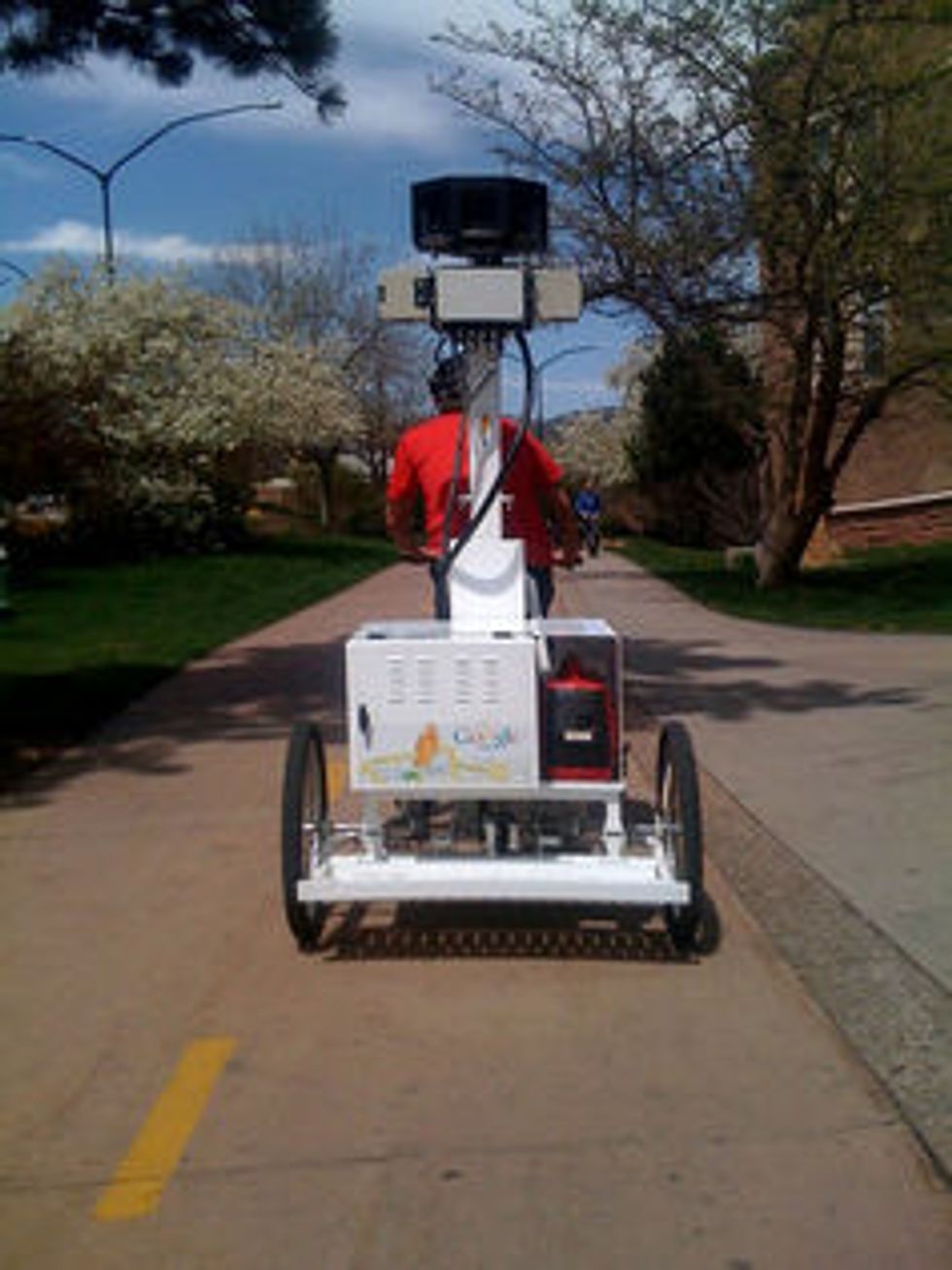
Users have participated in Google’s mapping efforts. Here, a bicycle has been outfitted with Google’s sophisticated Street View camera to map a bike path.
Think of it as a collaborative, Wikipedia-like effort to map the physical world.
But while we know how Google does it, another question has emerged: why is Google devoting so many resources to “paint the world…one pixel to the inch” (as one Google employee put it)?
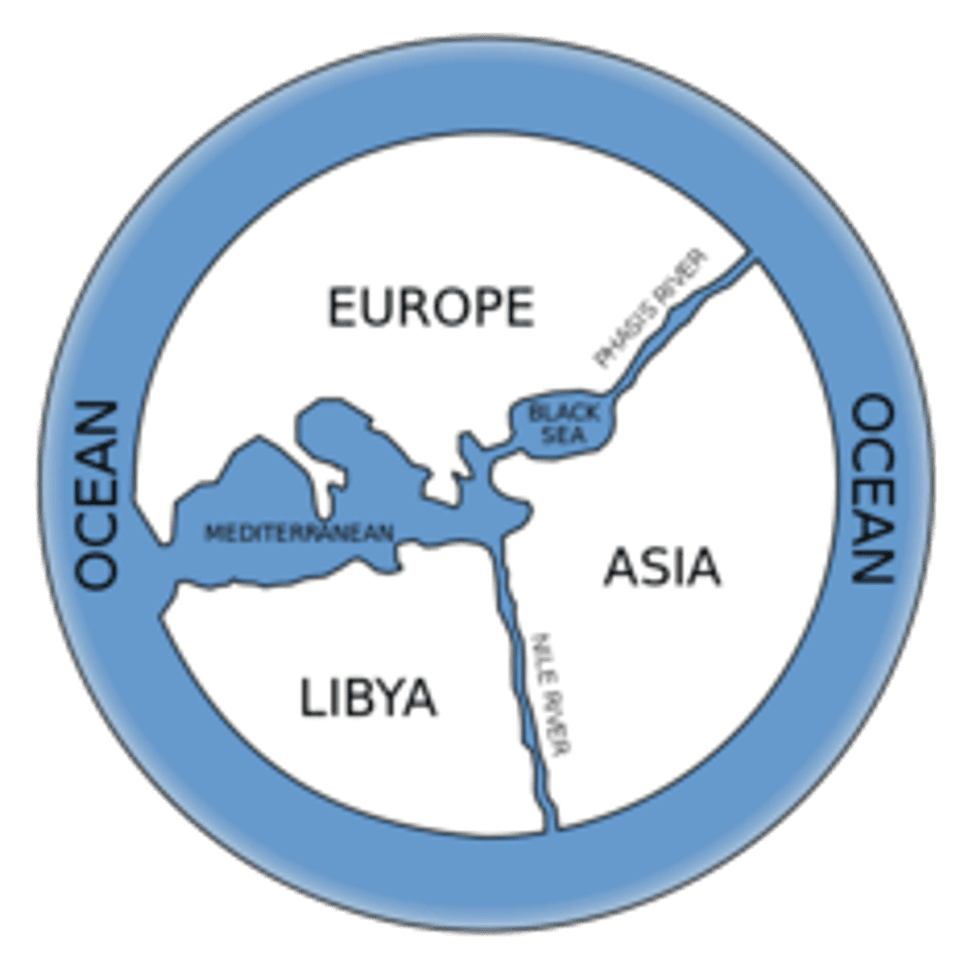
Throughout history, maps evolved as an outgrowth of humankind’s yearning to both explore and record the physical world. First there was a 7,000 BCE wall painting in Catal Huyuk (in southern Anatolia) that depicted an erupting volcano and a map of that settlement’s town plan. More than 6,000 years later, in 600 BCE, Anaximander drew up a world map, followed by the creation of a coordinate system by Eratosthenes and the gazetteer by Ptolemy (300 BCE and 200 AD, respectively).
A recreation of Anaximander’s map, one of the first attempts to map the world.
Maps have always been about depicting the world and helping us navigate through it. And Google Maps does this: it does show us where things are in the world and it does help us navigate. In fact, it already provides such support to an estimated one billion worldwide users.
But other solutions do the same for a much lower cost. OpenStreetMap (OSM) is a nonprofit effort founded around ten years ago as a way to invite the general public to map the world. Tracing the centerlines of roads and the outlines of buildings – and even mapping park benches and bicycle routes – volunteers have generated a mapping product of global coverage, freely available through an Open Database License (ODbL). OSM compares well in terms of accuracy to its more authoritative, better-funded counterparts. A wonderful map produced by Martin Raifer shows the astonishing global coverage offered today by OSM. In a recent New York Times article it was reported that OSM runs on less than $100,000 a year, which is certainly dwarfed by Google Maps' budget.
So why does Google appear to be doing slightly more while spending much, much more? The answer probably lies on the intended use of the product. OSM is a cartographic product. Google Maps is much more that that.
Like older maps, Google Maps also depicts spaces to help users navigate. The company, however, has grander plans.
For Google, cartography is not the end product, but rather the necessary means for future products.
Take, for instance, Google’s autonomous car initiative, which aims to combine sensors, GPS and 3D maps to develop self-driving cars. Then there’s Google’s Project Wing: a drone-based delivery systems that hopes to make use of a detailed 3D model of the world to quickly link supply to demand – and shatter the current retail paradigm.
In both cases, Google Maps serves as the digital framework in which these fledgling technologies operate – a foundation for Google as it seeks to revolutionize the mobility of people, goods, and even ideas. In other words, Google’s mapping data will support a wide variety of its new products, whether they’re self-driving cars or drones.
While OSM is about mapping the world around us, Google Maps takes it a step further: ultimately, Google Maps is about mapping lives and merging the physical and the virtual. The application collects information about us: the physical pathways that we follow – either on foot or in a car – and the digital traces we leave behind: photographs we’ve snapped, purchases we’ve made, and activities we’ve participated in.
This information can then be used to understand how we function in this newly emerging hybrid universe.
In that sense, Google is mapping places rather than simply mapping spaces. Loosely defined in the context of this article, the idea of place is the meaning, or significance, that certain locations hold for us. This could mean our home neighborhood, or a dangerous part of the city where we rarely venture; it could refer to our favorite nightlife hotspots, or where we buy our groceries.
By connecting the geometrical content of its Google Maps databases to digital traces that it collects, Google can assign meaning to space, transforming it into place. While Google’s stated objective is “to organize the world’s information and make it universally accessible and useful,” its Google Maps endeavor allows it to organize your world’s information, making it personally accessible and useful.
Therefore one could argue that Google’s vision for its map goes far beyond the traditional one. Yes, the map serves not only as a way to capture space; but it also exists as a framework for empowering human life and everyday activities. By combining the power of high resolution mapping, digital human traces, and smart machines, Google has the ability to revolutionize the underpinnings of the modern lifestyle: communication, mobility, consumption, and production.
Mapping by machines no longer simply addresses the age-old task of “you are here,” but rather seeks to understand who you are and where you should be heading.
The US intelligence chief revealed Wednesday that he dined with the North Korean general believed responsible for hacking Hollywood studio Sony, during a secret mission to Pyongyang two months ago.
Director of National Intelligence James Clapper gave a riveting account of the visit at a New York conference on cyber security days after the government imposed new sanctions on North Korea in retaliation for the late November attack.
He said it was "the most serious cyber attack ever made against US interests" that could potentially cost hundreds of millions of dollars in damages.
He said on November 7, the first night of his mission to free two Americans, he dined with General Kim, "in charge of the Reconnaissance General Bureau, the RGB, who's the organization responsible for overseeing the attack against Sony."
Clapper did not give the general's full name but he apparently was referring to General Kim Yong-chol, director of the RGB, also known as Unit 586, one of three North Korean entities sanctioned by the United States in response to the Sony hack.
Clapper called the elaborate, 12-course repast "one of the best Korean meals I've ever had" but said the four-star general spent most of the time berating him about American aggression "and what terrible people we were."
"All the vitriol that he spewed in my direction over dinner was real," Clapper said.
"They really do believe they are under siege from all directions and painting us as an enemy that is about to invade their country every day is one of the chief propaganda elements that's held North Korea together."
He said the pair communicated through a North Korean translator who spoke fluent English "with a British accent, which was kind of strange."
Kim kept "pointing his finger at my chest and saying the US and South Korean exercise was a provocation to war and of course not being a diplomat, my reaction was to lean back across the table and point my finger at his chest."
At one point, his assistant suggested Clapper take a "head break" to ease the tension.
At the end, he described presenting Kim with a letter from President Barack Obama, designating Clapper as his envoy and saying that the release of the two US citizens would be viewed as a positive gesture.
He admitted the next day was "kind of nerve-racking" and that he was not sure if they would get the two Americans back or not.
-'Kind of creepy'-
At one point an emissary came to say North Korea no longer considered him a presidential envoy and as such could not guarantee his safety.
But in the afternoon, they were taken to a hotel for an "amnesty-granting ceremony" where the two Americans, still in prison garb, were handed over.
Afterward they headed straight to the airport and took off, he said.
"I can't recall a time when that aircraft with United States of America emblazed across it ever looked as good," he joked.
Clapper, who spent less than 24 hours in North Korea, said the first thing that struck him on arrival was how dark the city and airport were, and how the plane damaged a tire while taxiing because of poor runway construction.
He said people labored with old-fashioned tools and were eerily going about their business dressed in drab clothes.
"It was kind of creepy about how impassive everyone was. They didn't show any emotion, didn't stop to greet each other... I didn't see anyone conversing or laughing," he said.
Hackers attacked Sony Pictures in late November and threatened the company over the looming Christmas release of the comedy film "The Interview," which depicts a fictional CIA plot to kill North Korea's leader.
The threats led worried movie theater owners to drop the film and then Sony cancelled the public debut altogether, before releasing it online.
The FBI said North Korea was behind the Sony intrusion. Pyongyang repeatedly denied involvement but has applauded the actions of the shadowy hacking group.
"They are deadly, deadly serious, no pun intended, about affronts to the supreme leader, whom they consider to be a deity," Clapper said Wednesday.
"I watched 'The Interview' over the weekend and it's obvious to me that North Koreans don't have a sense of humor."
Sony said Tuesday that the film has been its best-grossing online film, making more than $31 million on the Internet and other small-screen formats.
On a dusty stretch of Nevada desert, a quadcopter drone kicks up a small cloud as it takes off. It then trails its operator on a drive across the flat terrain, filming the motion from a short distance above.
The AirDog drone was designed to capture the intensity of extreme sports that have been difficult to access -- surfing, skiing, off-road biking and similar activities.
"We felt we could change the way video is captured in action sports," said Agris Kipurs, co-founder of AirDog, created by a group of Latvian engineers and now based in California, which is starting beta-testing on its products later this year.
AirDog, one of dozens of drones being shown at the Consumer Electronics Show this week in Las Vegas, is aiming for "an unassisted experience, so all you need is the tracking device on your wrist," Kipurs told AFP during a demonstration in the desert outside Las Vegas.
Drones are showing up in a variety of shapes and sizes at the huge electronics fair, which has for the first time a space dedicated to "unmanned systems."
More than a dozen companies are displaying the flying devices, for uses ranging from remote-controlled toys to professional filmmaking to industrial and agricultural applications.
The Hexo+ drone from Franco-American Squadrone System is another drone on display that can be pre-programmed to follow and film a person or object from any conceivable angle using a smartphone.
In a similar category, the show got a look at the Nixie drone, a flying camera which launches from one's wrist and won a competition last year sponsored by Intel for wearable technology.
"We think drones have a possibility to change out lives in positive ways," said Intel chief executive Brian Krzanich at a CES keynote speech where he demonstrated Intel-powered drones from Ascending Technologies that navigated obstacles on stage.
- Fighters, micro drones -
South Korean-based Byrobot is showing its "drone fighter," which enables its users to simulate aerial combat with infrared signals to fire at enemy aircraft.
When one of the drones is hit, its lights flash and hand controller vibrates, signalling it is downed, according to the company, which offers an optional camera with the device.
With US regulations on drone still uncertain, some drone developers are looking for ways to avoid being grounded.
The Zano drone, a so-called nano-drone designed for aerial photography and selfies, weighs in at just 55 grams (two ounces) to be under the current limit of 60 grams to be regulated in the United States, said Thomas Dietrich, design director for the British-based Torquino Group.
"We've squeezed a lot of technology into a very small package," Dietrich said.
"It's a smart device. It's all gesture based and it has obstacle avoidance."
At $279, he said, the drone "is affordable for everyone."
A full lineup of drones is on display from the French electronics group Parrot, which has expanded its offerings over the past year in both consumer and industrial unmanned vehicles.
"The past year was very good" for drone sales, said Parrot marketing director Nicolas Halftermeyer.
Parrot recently introduced its Bebop drone for the consumer segment, which can take high-definition video and be controlled from a tablet or smartphone.
It also sells a professional mapping drone called eBee and another designed for agricultural use called eBee Ag.
"This part of the business is growing very fast," he said.
The Consumer Electronics Association, which organizes the show, said the market for these devices is hitting new heights as the technology previously used for military aircraft is adapted for consumer and industrial activities.
The show includes a panel discussion on the plans for US regulations.
According to CEA research, the global market for consumer drones will approach $130 million in revenue in 2015, up 55 percent from 2014, with unit sales of consumer drones expected to reach 400,000.
Revenue from drone sales is expected to top $1 billion in just five years, CEA said.
Sony chief Kazuo Hirai called the devastating hack on the company "vicious and malicious," in his first public comments about the attack that derailed the launch of controversial comedy "The Interview."
Speaking Monday at a press event on the eve of the Consumer Electronics Show in Las Vegas, Hirai thanked supporters who stood by the company in the face of the massive cyber assault, including employees and movie-goers who saw the film when it finally hit theaters.
"Freedom of speech, freedom of expression, freedom of association -- those are important lifelines of Sony and our entertainment business," Hirai said.
His comments were his first public statements about the attack on the Japanese company's film and television unit.
"We are proud of partners who stood up against extortionist efforts by criminals who attacked Sony," Hirai said.
Sony employees, he added, "were victims of one of the most vicious and malicious cyber attacks we have known, certainly in recent history."
"The Interview" is now showing at 580 independent theaters in the US, in addition to online platforms, according to Hirai.
"I want to thank all the partners who made this possible, media who supported the launch, and those who have gone out to see the movie," Hirai said.
"Thank you for being part of that great event," he added, before ending with a quip referring to another Sony Pictures Entertainment film released during the year-end holidays.
"Annie is a great movie as well," he said.
- Movie plot to kill Kim Jong-Un -
The late-November cyber attack against Sony led to an online leak of employee information, unreleased films and embarrassing in-house emails.
The hackers also mounted threats against Sony over the planned Christmas release of "The Interview," which depicts a fictional CIA plot to assassinate North Korean leader Kim Jong-Un.
Threats by hackers issued after the cyberattack on Sony Pictures initially prompted the movie giant to cancel the film's Christmas Day release, after many large US theater chains got cold feet.
The comedy, starring Seth Rogen and James Franco, eventually opened on December 25 in more than 300 independent movie houses that offered to show the film after Sony came under fire for pulling it.
US investigators have said North Korea, which has repeatedly denied involvement, was behind the attack, but some experts have raised doubts about the conclusions of the FBI probe.
US President Barack Obama last week authorized a new layer of sanctions on several Pyongyang institutions and officials, in retaliation for the alleged cyber attack on Sony Pictures.
North Korea on Sunday lashed out at the fresh sanctions, criticizing Washington for refusing a proposed joint investigation.
The impoverished but nuclear-armed state was already heavily sanctioned following a series of nuclear and missile tests staged in violation of UN resolutions.
Pyongyang, which repeatedly slammed the movie as an "act of terror," praised the hacking attack as a "righteous deed" possibly staged by its sympathizers.
The isolated country last month suffered several mysterious Internet outages. The Obama administration denied comment on whether it was linked to the blackouts.
North Korean military's "cyber army" has boosted its numbers to 6,000 troops, the South Korean Defense Ministry said on Tuesday, double Seoul's estimate for the force in 2013, and is working to cause "physical and psychological paralysis" in the South.
The new figure, disclosed in a ministry white paper, comes after the United States, South Korea's key ally, imposed new sanctions on North Korea for a cyberattack on Sony Pictures Entertainment. Pyongyang has denied involvement in the attack.
For years, North Korea has been pouring resources into a sophisticated cyber-warfare cell called Bureau 121, run by the military's spy agency and staffed by some of the most talented computer experts in the country.
Its long-term target may be telecoms and energy grids in rival nations, defectors from the isolated state said.
"North Korea is currently running its 6,000 (-member) workforce for cyber warfare and performing cyber attacks for physical and psychological paralysis inside South Korea such as causing troubles for military operations and national infrastructures," the South Korean Defense Ministry said.
North Korea has denied involvement in the recent hack into Sony Pictures, which distributed a comedy film featuring an assassination plot against its leader Kim Jong Un and slammed the fresh U.S. sanctions, calling them hostile and repressive policies by Washington.
The reclusive country is also suspected to have carried out a series of other cyber attacks against South Korea, which it is technically at war with.
In 2013, South Korea blamed the North for crippling cyber-attacks that froze the computer systems of its banks and broadcasters for days.
The two Koreas have remained technically at war for more than six decades as the Korean War ended in an armistice, not a peace treaty.
For the consumer who wants a smartphone to make an impression, the Lamborghini nameplate can do that -- for a cool $6,000, shipping included.
Tonino Lamborghini Mobile on Monday announced the global launch of the stainless steel-and-leather handset ahead of the Consumer Electronics Show in Las Vegas.
Despite an uncertain economy and declining prices for mobile devices, the Italian-based company says it may be unable to meet demand.
"Luxury is not a need, but it is a way to stand out," said Bob Hatefi, chief executive at Lamborghini Mobile, a company formed by the son of famed auto designer Ferruccio Lamborghini.
"We provide technology as well as luxury. We are not after volume."
The company is not related to Lamborghini automobiles, which are now produced by a division of Volkswagen, but was created by Tonino Lamborghini, the son of the famed auto designer Ferruccio Lamborghini.
The handset, which sells as an unlocked device accepting dual SIM cards for international travel, has a five-inch high-definition display, 20 megapixel camera and can connect to mobile networks around the world.
The 88 Tauri handset is offered in black, gold and steel silver and is finished with high-grade leather available in five colors. Each phone is assembled by hand and receives a unique device number.
The company also makes headphones and other audio products, and an earlier smartphone selling for around $4,000.
Toyota will give away thousands of patents for its fuel-cell cars, it said Tuesday, in an effort to encourage other automakers into the new industry.
The world's largest vehicle maker said it will allow royalty-free use of about 5,680 patent licenses, including 1,970 related to fuel-cell stacks and 3,350 concerning fuel-cell system control technology.
The firm also said the free patent licenses will include about 290 items related to high-pressure hydrogen tanks.
The cost-free licenses will be allowed "through the initial market introduction period" of fuel cell vehicles (FCV), which the company expects to last until about 2020.
Toyota will also open about 70 patent licenses related to hydrogen stations -- the equivalent of gas stands for internal combustion vehicles, and a vital link in the chain for drivers -- indefinitely for manufacturers and operators.
"By allowing royalty-free use of FCV-related patent licences, Toyota is going one step further as it aims to promote the widespread use of FCVs and actively contribute to the realisation of a hydrogen-based society," the automaker said in a statement.
The announcement came after Toyota last month rolled out the world's first mass market fuel-cell car -- the four-door Mirai sedan -- in Japan.
The car -- whose name means "future" in Japanese -- will hit the U.S. and some European countries, including Britain, Germany and Denmark, in 2015, Toyota has said.
It hopes to sell more than 3,000 units of the car by the end of 2017 in the United States, and up to 100 annually in Europe.
Fuel-cell cars are seen as the Holy Grail of green cars as they are powered by a chemical reaction of hydrogen and oxygen, which produces nothing more harmful than water at the point of use.
But a limited driving range and lack of refueling stations have hampered development of fuel-cell and their cousin, all-electric cars, which environmentalists say could play a vital role in cutting greenhouse gas emissions and slowing global warming.
The Mirai can travel about 650 kilometers (400 miles) without refueling, some three times further than an electric car, and its tank can be filled in a few minutes like gasoline engine vehicles, according to Toyota.
3D printing will revolutionise war and foreign policy, say experts, not only by making possible incredible new designs but by turning the defence industry -- and possibly the entire global economy -- on its head.
For many, 3D printing still looks like a gimmick, used for printing useless plastic figurines and not much else.
But with key patents running out this year, new printers that use metal, wood and fabric are set to become much more widely available -- putting the engineering world on the cusp of major historical change.
The billion-dollar defence industry is at the bleeding edge of this innovation, with the US military already investing heavily in efforts to print uniforms, synthetic skin to treat battlewounds, and even food, said Alex Chausovsky, an analyst at IHS Technology.
Scientists at the Massachusetts Institute of Technology have already invented "4D printing" -- creating materials that change when they come into contact with elements such as water.
One day, that could mean things like printed uniforms that change colour depending on their environment.
In the real world, the baby steps are already being taken.
Late last year, British defence firm BAE Systems put the first printed metal part in a Tornado jet fighter.
The company recently put out an animated video showing where they think such humble beginnings could one day lead.
It imagined a plane printing another plane inside itself and then launching it from its undercarriage.
"It's long term, but it's certainly our end goal to manufacture an aerial vehicle in its entirety using 3D printing technology," Matt Stevens, who heads BAE's 3D printing division, told AFP.
- Revolutionising war and politics -
But the real revolution of 3D printing is less about the things you can make and more about where you make them.
Being able to take printers to a warzone promises a radical shake-up of combat and the defence industry, says Peter W Singer, an expert in future warfare at the New America Foundation.
"Defence contractors want to sell you an item but also want to own the supply chain for 50 years," he says.
"But now you'll have soldiers in an austere outpost in somewhere like Afghanistan who can pull down the software for a spare part, tweak the design and print it out."
This could lead militaries to cut out private defence companies altogether. And by combining 3D printing with assembly line robotics, those that remain will be enormously streamlined.
That sort of disruption carries huge political implications in places like the United States where defence firms are purposefully spread around the country and support millions of jobs.
"The Pentagon and defence industry have an incredibly tough time with innovation, but you don't want to wait to lose a major battle before you do it," says Singer.
3D printing could even change foreign policy, for instance by undermining sanctions.
"The US has sanctioned everything from fighter jet spare parts to oil equipment. 3D printing could turn sanctions -- which have been a crucial part of foreign policy for a generation or more -- into an antiquated notion," says Singer.
Then there are the scarier prospects that come with reducing the barriers to arms manufacturing.
"Think of master bombmakers in the Middle East making new designs that look like everyday products or a lone wolf operator printing a plastic gun he can get past security at the White House," says Chausovsky.
But all of that may pale in comparison to the security risks that 3D printing could trigger by revolutionising economies.
If anyone can print retail goods, economies that rely on cheap factory labour to make things like clothes and toys may find themselves in deep trouble -- with all the security consequences that go with that.
"If you want to know where the big threat of 3D printing is, think about how reliant China is on its low-cost merchandising sector," says Chausovsky.
- 'Can't drill a curved hole' -
3D printing -- invented in the 1980s -- is much older than many realise.
The recent upsurge in interest is tied to the fact that patents on the original technology are expiring -- opening the way for competition that will drive up quality and push down prices.
The first major patents to run out were in 2009 for a system that used plastics known as "fused deposition modelling".
But the next big ones, that expired in the first half of 2014, are related to "selective laser syntering" that prints metals such as aluminium, copper and steel, and with much greater definition.
And rather than working with solid lumps of metal, engineers can create complex new shapes that use much less material without losing any strength.
"You can't drill a curved hole," says Chausovsky. "With 3D printing, you're creating products that would never be possible with traditional methods.
The full implications are still hard to imagine.
"It's the first time in a very long time that there's been such a radical shake up in industrial engineering," says Stevens at BAE. "We're not just improving things -- we're re-writing the rule book."
Police posed as underage teens online to lure men into breaking the law as part of an apparent revenue scheme by Florida law enforcement agencies, according to an investigation of newly released public records.
Emails and other online communications analyzed by WTSP-TV revealed that many of the men who were eventually arrested were not interested in meeting children but were instead seeking adult sex partners – until they encountered undercover officers.
Law enforcement agencies fought open-records requests by the TV station, which eventually gained access to investigation reports from cases that resulted in arrest – but not from those that did not.
Police fought the requests by claiming the investigations remained open, but one agency claimed it had already destroyed records from one sting just one month after it was conducted.
Clearwater police seized 19 cars in January 2014, the station reported, when a joint sting with the Pinellas County Sheriff's Office arrested 35 men in one weekend.
The two departments arrested at least 20 other men three months later and 11 more in September in similar stings that netted 12 more seized vehicles, the station reported.
One of the men arrested in the first sting paid $10,000 to get his 2014 Lexus returned, and the 24-year-old won’t get any of that money back even though all felony charges were eventually dropped in his case.
The station found that many of the men arrested in the stings had posted or responded to personal ads seeking adults, but police often steered the conversation to underage children or posed as adults with younger siblings who were interested in meeting.
These men were arrested if they traveled to meet the adult, even if they expressed no interest in the younger decoys.
In one case, a 27-year-old man arrested in May had posted an ad specifying that he was interested in “18+ women no one under,” but undercover officers sent a reply posing as a 14-year-old girl.
The man repeatedly told detectives he was not interested in meeting anyone underage, according to evidence in the case, but he was arrested as a sexual predator anyway because he did not immediately end the conversation.
Prosecutors eventually determined there wasn’t enough evidence to pursue a case, but the man’s name remains online with the accusations in press releases and online news stories.
Other cases showed that officers violated their own guidelines by repeatedly steering conversations back to underage sex, even when the men said they were not interested.
Law enforcement agencies spent tens of thousands of dollars and hundreds of man-hours on each sting, WTSP reported, but most of the suspects were men in their late teens or early 20s and not considered high risks to children.
One prosecutor trying to build a case wrote that federal authorities had found only five cases nationwide of adults – and none in central Florida -- attempting to meet children online, as the undercover stings were built.
If this is the year you are looking for an online love connection, start today. Why? Because the first Sunday after New Year's Day is annually the busiest day of the year for online dating. Meaning: Tonight's the night! Using data gathered from traffic in previous years, the…