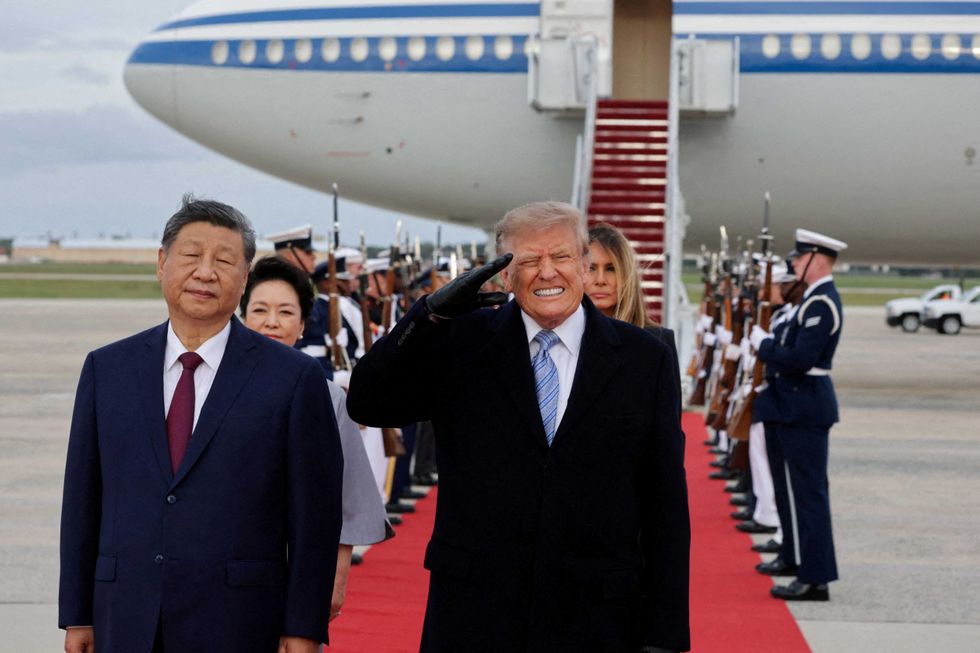
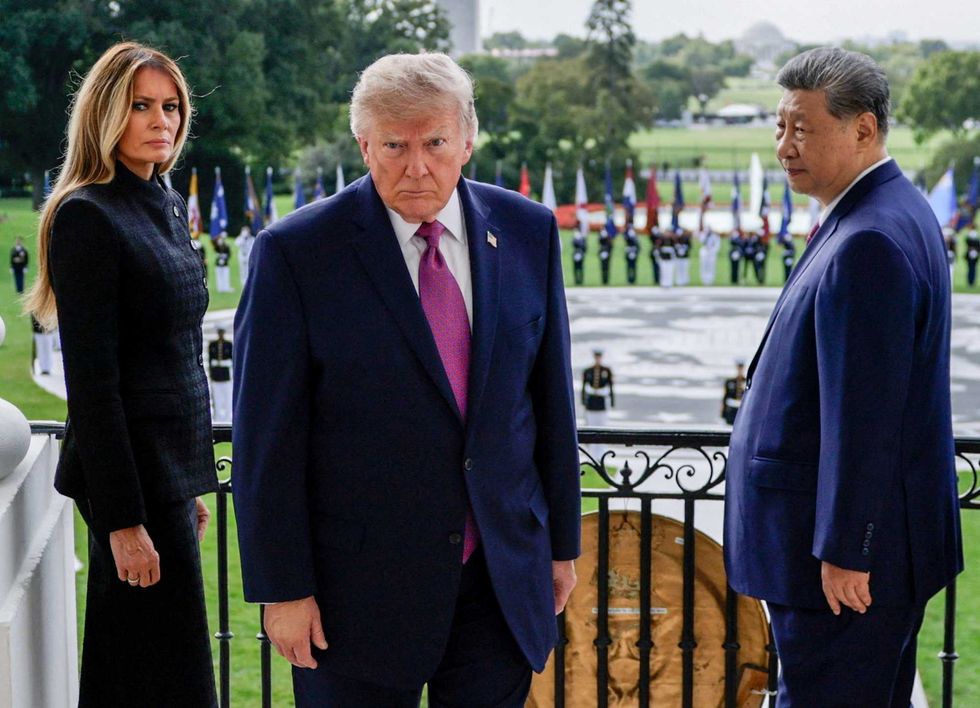
Trump mops up flood of right-wing tears
Nick Anderson is a Pulitzer Prize-winning editorial cartoonist.
I’ve been talking into microphones since I did the morning news on WITL in Lansing Michigan in the late 1960s, and I’ve seen a lot of ugly moments in American politics. But every so often something happens that still takes your breath away, not because it’s surprising, but because it’s so painfully revealing.
This latest racist stunt by Donald Trump — reposting a meme on his Nazi-infested social media site in which the Obamas’ faces are superimposed onto the bodies of primates in the jungle set to the 1961 song “The Lion Sleeps Tonight” by The Tokens — is one of those moments.
That a popular pro-Trump account on X created this video and it has lived on that platform without consequence is disgusting in and of itself. But Trump — as our president, speaking in our voice — made it infinitely worse last night by promoting it to millions around the world.
Promoting a video that depicts Barack and Michelle Obama as non-human primates isn’t a joke. It isn’t satire or an accident. It’s the oldest racist smear in the book, dressed up in a cheap meme and now blasted out by a man who once swore an oath to preserve, protect, and defend the Constitution of the United States.
When the president of the United States does something like this, it doesn’t just insult two people. It tells a story about who, according to the most powerful man in the world, belongs in America and who doesn’t.
For centuries, racism in this country has relied on the lie that some people are less than human. That lie has been used to justify slavery, Jim Crow, lynchings, and mass incarceration.
It’s the lie that made it easier for people to look away while their neighbors were brutalized. It’s the lie that justifies ICE’s brutal, racist behavior. When Trump shares imagery that taps directly into that history, he’s not being edgy: he’s reopening wounds that never fully healed.
When the President of the United States signals that this kind of racism is acceptable, it gives permission to others. It tells the kid being harassed at school, the family being targeted by a hate group, and the voter being pushed out of the polling line that the cruelty they’re experiencing is justified. That it’s their own fault.
It tells the bullies and thugs of ICE as they do their “Kavanaugh Stops” — targeting people based on their race — that they’re on the right side of power.
This isn’t just about harm to minorities, although that harm is real and immediate. It’s about what happens to democracy itself when the presidency becomes a megaphone for dehumanization.
Democracy depends on the idea that we’re all political equals. Once you start suggesting that some Americans are animals, that idea collapses. It becomes easier to justify taking away voting rights, ignore court rulings, or shrug when violence follows hateful rhetoric.
I remember a time, during the era of Eisenhower and Kennedy, when the presidency stood as a kind of moral North Star. Even when presidents like Nixon and Clinton failed to live up to it, there was at least a shared understanding that the office itself mattered. That it should pull us together, not rip us apart.
Trump has spent years doing the opposite, from the 1970s when he was busted along with his father for refusing to rent to Black people to his recent use of words like “vermin” and “shitholes” to describe Hispanic and Black people and majority-Black countries. Last night’s post is another brutally clear example of Trump’s deep, lifelong racism.
What’s even more chilling is the silence from Republican leaders and elected officials. If you can’t bring yourself to condemn something this overtly racist, where exactly is your line?
Silence in moments like this isn’t neutrality: it’s complicity. It tells people of color in America, already dealing with the burden of centuries of institutional racism, that their pain is irrelevant and their dignity a plaything in the hands of white people.
I know some people will say we should ignore it, that reacting “just feeds the outrage machine.” Trump’s propaganda princess, Karoline Leavitt, tried to downplay it by telling reporters:
“This is from an internet meme video depicting President Trump as the King of the Jungle and Democrats as characters from the Lion King. Please stop the fake outrage and report on something today that actually matters to the American public.”
But pretending this doesn’t matter is how we normalize it and weaken our shared sense of humanity. And the end point of that is always disaster.
As California Governor Gavin Newsome posted:
“Disgusting behavior by the President. Every single Republican must denounce this. Now.”
“Denounce” is a bare minimum. This country can do better. We’ve done better before, often after terrible struggle and sacrifice.
But we won’t get there by minimizing moments like this or waving them off as “just another Trump post.” We get there by calling it what it is, by standing up for one another as equals in our humanity, and by insisting that the presidency must reflect our highest ideals, not our ugliest instincts.
If this doesn’t provoke the 13 white billionaires in Trump’s cabinet — who would all instantly fire anybody in any of their companies who posted such an image on their company’s servers — to start 25th Amendment proceedings or endorse impeachment, it’ll tell us everything about who they are, too.
America is stronger when we recognize each other as fully human. The moment we let that slip, we all lose something precious.
It’s difficult to know where to begin with something this absurd, but perhaps the most honest place to start is the tale of a giant golden statue.
An actual, towering, 15-foot, gold-colored colossus of Donald Trump. It was commissioned by a group of cryptocurrency investors, aka "crypto bros,” to promote the $PATRIOT memecoin.
If you didn’t understand that, neither did I.
But if we thought homages to our Dear Leader couldn’t get any worse, I give you an obnoxious two-story Trump with his fist raised, following in the diabolical dictatorial footsteps of Saddam Hussein, Muammar Gaddafi, and Kim Jong-un
Apparently, the Trump family is trying to scuttle quietly away from the statue. But not because it’s offensive. To the contrary. The Trumps aren’t thrilled with the people who commissioned it.
They may be scumbags, as Trump himself might put it, but the irony is that these scumbags are in the muckety-muck with the Trump family.
Regardless, it’s hard to imagine Trump wouldn’t love to marvel at himself so large, even if the colossal statue would be the only thing that is large about him, other than his ass, stomach and bulbous head.
The “Donald Colossus,” as it’s called, is the kind of eyesore historians will hold up and ask, “WTF were these people thinking?”
Yet in that statue, grotesque, gilded, and hollow as it is, you can see the arc of the crypto industry’s Trump-induced delusion.
Tacky and tumultuous, authoritarian in aesthetic, reeking of desperate flattery — the statue and the crypto industry both. The statue is a perfect metaphor for an industry that mistook accessibility to power for stability. Already wobbling under its own contradictions and convoluted logic, Crypto decided the answer was to tie itself to a man whose entire adult life is a tutorial in how to extract value without creating it.
The symmetry is haunting.
As the crypto market shed more than $2 trillion in value, Bitcoin crashing under $61,000, the decentralized blockchain Ethereum crumbling, fear and greed indices collapsing, Trump and his family were not victims of such volatility.
They were beneficiaries of it. While retail investors fled, institutions pulled back, and regulators circled, Trump-branded crypto ventures had already done what Trump ventures always do — get in early, hype relentlessly, cash out strategically, leave others to absorb the damage.
It’s been Trump’s strategy since the 1980s. Some call it “the art of the steal,” instead of the bogus “art of the deal.”
Trump did not merely endorse crypto. He tossed the metaphorical coin into the pond of the presidency. He has erased the line between public office and private enrichment. And the GOP Congress feels no need to stop him.
He’s all over World Liberty Financial. The $TRUMP memecoin. Licensing arrangements. Token allocations. Ownership stakes are accumulating loudly before our eyes. Estimates of the Trump family’s crypto haul suggest upwards of $1 billion, figures so large and so murky that even seasoned financial analysts struggle to pin them down.
That ambiguity — the lies on top of lies — is Trump’s speciality.
Crypto’s great promise was decentralization and transparency. What it got instead was the most centralized, opaque, personality-driven grift apparatus imaginable, run through a president whose brand has always been leveraged without liability.
While the market absorbed inflation shocks, market volatility, withdrawals, and regulatory fear, among other things that are partially understandable, Trump incurred none of the downside.
His wealth ballooned as confidence drained from everyone else. If this sounds familiar, it should to anyone who has the least bit of understanding of Trump.
Everything Trump touches follows the same routine: hype it up, cheat investors early and often, walk away when it collapses. Atlantic City casinos, an airline that never took off, steaks no one ate, vodka no one drank, cologne no one sprayed, suits no one wore. A sham university and foundation. Media companies, real estate investors and the average Joe laborer, all screwed in the end.
Crypto didn’t break that pattern. It’s just the latest failure. And it was always out in the open.
The industry probably told itself that this time would be different because Trump was president. That his power would translate into regulatory and financial protection. That volatility could be managed if the right man’s backside was kissed long and hard enough. Hence the vomit-inducing statue. Oh, and don’t forget the flattering memes and money.
But Trump’s involvement did not flow back to the market.
The wreckage is no longer abstract. Trump Media collapsed by roughly 70 percent. Trump-branded meme coins disintegrated, some losing more than 90 percent of their value, others effectively evaporating.
World Liberty Financial shed nearly half its value. A Trump-backed mining venture stumbled almost immediately. The insiders, i.e. flunky Eric Trump, were insulated. Those faithful to the Trumps were not.
Trump does not build industries or sectors. He deflates them. He sells access, not profit. He monetizes false belief. Unless they are morons (One of Trump’s favorite descriptors), crypto leaders couldn’t possibly have failed to understand Trump’s record. They just chose to ignore it. How foolish.
Say what you want about their volatility, markets do have a way of smoking out a skunk. When you attach a dubious industry to an equally dubious man, his history written in bankruptcies and burn outs, the bottom-line eventually becomes clear.
Crypto’s collapse is being blamed on a litany of factors and fears. But the deeper failure is that it is an industry built on a history of skepticism that banked its legitimacy on the most self-serving “serial fail-preneur” in American finance history.
The result was a foregone conclusion, obvious to everyone except these desperate crypto bros. Trump did to them what he has always done. He got rich. Others paid. The only real mystery is why anyone expected a different ending.
By Brian O'Neill, Professor of Practice, International Affairs, Georgia Institute of Technology.
In separate encounters, federal immigration agents in Minneapolis killed Renée Good and Alex Pretti in January 2026.
Shortly after Pretti’s killing, Homeland Security Secretary Kristi Noem said he committed an “act of domestic terrorism.”
Noem made the same accusation against Good.
But the label “domestic terrorism” is not a generic synonym for the kind of politically charged violence Noem alleged both had committed. U.S. law describes the term as a specific idea: acts dangerous to human life that appear intended to intimidate civilians, pressure government policy or affect government conduct through extreme means. Intent is the hinge.
From my experience managing counterterrorism analysts at the CIA and the National Counterterrorism Center, I know the terrorism label — domestic or international — is a judgment applied only after intent and context are assessed. It’s not to be used before an investigation has even begun. Terrorism determinations require analytic discipline, not speed.
In the first news cycle, investigators may know the crude details of what happened: who fired, who died and roughly what happened. They usually do not know motive with enough confidence to declare that coercive intent — the element that separates terrorism from other serious crimes — is present.
The Congressional Research Service, which provides policy analysis to Congress, makes a related point: While the term “domestic terrorism” is defined in statute, it is not itself a standalone federal offense. That’s part of the reason why public use of the term can outpace legal and investigative reality.
This dynamic — the temptation to close on a narrative before the evidence warrants it — seen most recently in the Homeland Security secretary’s assertions, echoes long-standing insights in intelligence scholarship and formal analytic standards.
Intelligence studies make a simple observation: Analysts and institutions face inherent uncertainty because information is often incomplete, ambiguous and subject to deception.
In response, the U.S. intelligence community codified analytic standards in the aftermath of the Sept. 11, 2001, terrorist attacks. The standards emphasize objectivity, independence from political influence, and rigorous articulation of uncertainty. The goal was not to eliminate uncertainty but to bound it with disciplined methods and transparent assumptions.
The terrorism label becomes risky when leaders publicly call an incident “domestic terrorism” before they can explain what evidence supports that conclusion. By doing that, they invite two predictable problems.
The first problem is institutional. Once a senior official declares something with categorical certainty, the system can feel pressure — sometimes subtle, sometimes overt — to validate the headline.
In high-profile incidents, the opposite response, institutional caution, is easily seen as evasion — pressure that can drive premature public declarations. Instead of starting with questions — “What do we know?” “What evidence would change our minds?” — investigators, analysts and communicators can find themselves defending a superior’s storyline.
The second problem is public trust. Research has found that the “terrorist” label itself shapes how audiences perceive threat and evaluate responses, apart from the underlying facts. Once the public begins to see the term as a political messaging tool, it may discount future uses of the term — including in cases where the coercive intent truly exists.
Once officials and commentators commit publicly to a version ahead of any assessment of intent and context, confirmation bias — interpreting evidence as confirmation of one’s existing beliefs — and anchoring — heavy reliance on preexisting information — can shape both internal decision-making and public reaction.
This is not just a semantic fight among experts. Most people carry a mental file for “terrorism” shaped by mass violence and explicit ideological targeting.
When Americans hear the word “terrorism,” they likely think of 9/11, the 1995 Oklahoma City bombing or high-profile attacks abroad, such as the 2005 London bombings and December 2025 antisemitic attack in Sydney, where intent was clear.
By contrast, the more common U.S. experience of violence — shootings, assaults and chaotic confrontations with law enforcement — is typically treated by investigators, and understood by the public, as homicide or targeted violence until motive is established. That public habit reflects a commonsense sequence: First determine what happened, then decide why, then decide how to categorize it.
U.S. federal agencies have published standard definitions and tracking terminology for domestic terrorism, but senior officials’ public statements can outrun investigative reality.
The Minneapolis cases illustrate how fast the damage can occur: Early reporting and documentary material quickly diverged from official accounts. This fed accusations that the narrative was shaped and conclusions made before investigators had gathered the basic facts.
Even though Trump administration officials later distanced themselves from initial claims of domestic terrorism, corrections rarely travel as far as the original assertion. The label sticks, and the public is left to argue over politics rather than evidence.
None of this minimizes the seriousness of violence against officials or the possibility that an incident may ultimately meet a terrorism definition.
The point is discipline. If authorities have evidence of coercive intent — the element that makes “terrorism” distinct — then they would do well to say so and show what can responsibly be shown. If they do not, they could describe the event in ordinary investigative language and let the facts mature.
A “domestic terrorism” label that comes before the facts does not just risk being wrong in one case. It teaches the public, case by case, to treat the term as propaganda rather than diagnosis. When that happens, the category becomes less useful precisely when the country needs clarity most.
Whenever Donald Trump mucks around in any serious international situation, as the world’s self-anointed savior, odds are things will only get worse. Iran is a good example.
In 2015, the US was part of an international coalition that reached agreement with Iran that imposed restrictions on its civilian nuclear enrichment program in exchange for sanctions’ relief. The Joint Comprehensive Plan of Action (JCPOA) was agreed to by the five permanent members of the United Nations Security Council — China, France, Russia, the United Kingdom and the United States — as well as Germany and the EU, and supported by over 100 nations.
According to the Obama White House, the agreement “blocks every possible pathway Iran could use to build a nuclear bomb while ensuring -- through a comprehensive, intrusive, and unprecedented verification and transparency regime -- that Iran’s nuclear program remains exclusively peaceful moving forward.”
For three years the agreement worked as intended, with regular monitoring and verification of Iranian compliance by the International Atomic Energy Agency (IAEA). Every indication suggested that the agreement would remain in force, given the power of the broad international coalition that negotiated it and the consequences if Iran failed to comply.
Then in 2018, President Donald Trump blew up the agreement, pulling the US out.
Renewing US sanctions, Trump claimed JCPOA was a “terrible agreement” — i.e. because Barack Obama helped negotiate it — and Trump said he would negotiate a much better deal.
Of course, Trump never negotiated a better deal, like the better deal he never negotiated after pulling the US out of the Paris Climate Accord. With US sanctions renewed despite Iran's compliance with the agreement, Tehran unsurprisingly balked at continuing to cooperate, and the JCPOA fell apart.
Had Trump not pulled the US out, the JCPOA could very well have remained in existence today, as President Joe Biden would have maintained US involvement from 2021-2025. Instead, there has been no regular IAEA monitoring of Iran’s uranium enrichment program.
Iran has contended that it has no intention of building nuclear weapons, and US Director of National Intelligence Tulsi Gabbard concurred last year. However, the situation has remained precarious.
What would not have occurred had the JCPOA remained in place with US membership?
First, Trump would have had no rationale for bombing Iran’s nuclear facilities in 2025, in violation of international law. The US would still be part of the international coalition that was ensuring Iran’s nuclear compliance.
Second, Trump would not be threatening more military action if it Iran doesn't come to the negotiating table, using as pretext the lie that Iran is building a nuclear weapon. By pulling the US out of the JCPOA in 2018, Trump has created the very real possibility of yet another illegal US invasion.
With Iran staring down the barrel of a gun, Trump will try and accomplish what was successfully negotiated in 2015, then destroyed by him in 2018. For that, Trump deserves nothing but scorn — no matter where his reckless, irresponsible saber rattling leads.
In addition, since Trump reimposed heavy US sanctions in 2018, the Iranian economy has contracted severely. The sanctions have contributed to soaring inflation and unemployment, a collapsing currency, less accessible and affordable health care, and millions driven to poverty.
The sanctions have played a central role in the economic crisis that helped trigger the current violent protests and the Iranian government’s brutal response. Trump is threatening military action against the government stemming from protests by citizens whose economic woes he helped create.
In dealing with Iran, Trump has leaned heavily into the narcissism, megalomania, duplicity, and power-addiction that define him. By peevishly pulling the US out of the JCPOA, he turned a situation that had been dealt with successfully by the powerful international coalition into an international crisis.
Results also include the possibility of a broader Middle Eastern conflict.
Trump’s high-stakes involvements in the Russian-Ukrainian and Israeli-Palestinian wars have produced similarly disastrous results. By siding with Vladimir Putin and limiting US support to Ukraine, Trump strengthened Putin’s hand tremendously. Russia has continued the killing and devastation in Ukraine with impunity and is now practically assured to be rewarded handsomely for invading a sovereign democratic nation.
By siding with Prime Minister Benjamin Netanyahu, Trump supported Israel’s genocide of the Palestinian people with military aid and refusing to condemn atrocities. Trump ensured that there will never be a two-state solution to the Israeli-Palestinian conflict so long as Netanyahu is in power and that the horrific suffering of the Palestinian people will only worsen.
At the end of F. Scott Fitzgerald’s The Great Gatsby, narrator Nick Carraway comments on how chaos created by Daisy and Tom led to the deaths of Gatsby, Myrtle, and George Wilson.
Nick says, “They were careless people, Tom and Daisy – they smashed up things and creatures and then retreated back into their money or their vast carelessness … and let other people clean up the mess that they made.”
It will take the American people and freedom-loving nations of the world years to clean up the mess Trump is making. It will be left to history to reflect on the incalculable human damage that Trump has inflicted, and he is only getting started.
Turns out the Border Patrol officers who murdered Alex Pretti are of Hispanic lineage. Their names and ages are Jesus Ochoa, 43, and Raymundo Gutierrez, 35, according to Pro Publica.
This appears to be causing some confusion among people of good faith. How can men of Hispanic lineage work for a paramilitary organization dedicated to terrorizing Hispanics?
The news is also, I presume, being used by people of bad faith. Donald Trump’s critics say ICE and CBP are purging Latinos in order to achieve his real goal — to make America white again. His defenders can point to this news to say the “crackdown” has nothing to do with race. See? Latinos want what Trump wants.
While racism is real, race isn’t. Talking about a thing that isn’t real can cause real confusion. Confusion provides opportunities for bad actors who search for ways to exploit it. So let’s clarify our terms: White doesn’t mean white race. It means white power.
Specifically, it means an unequal and unjust racial caste system with rich white men at the very top. They are protected the most by the law. They benefit the most from the economy. Everyone else in this pyramid-shaped hierarchy is subject to decreasing degrees of protection and economic benefit, going all the way down to the bottom where everyone is Black or brown, no one is protected by the law and no one benefits from the economy.
Sadly, this is what some Hispanics want, no matter how long their families have been in the US. They want to be white, that is, to stake a claim on white power. Instead of fighting oppression, they aim to sit with the oppressors, as if they were equals. They seek for themselves a warped, corrupt version of the American Dream.
However, they have to prove themselves. Immigrant history is full of stories of nonwhites gaining access to positions of authority and using them to demonstrate to people they believed were their superiors (ie, white people) that they were not only “good immigrants,” but also deserving of the blessings of whiteness.
So it’s not ironic that Jesus Ochoa and Raymundo Gutierrez work for Donald Trump’s paramilitary. It’s in keeping with American history. They’re like some Irish cops in 19th-century New York who beat down other Irish to prove they left behind the Old World to be loyal to the whiteness that was assimilating them.
In the case of Alex Pretti, this dynamic has another dimension. According to the either/or logic of white power, the ICU nurse was disloyal. He rejected his birthright by choosing to fight for people brutalized by an unequal and unjust racial caste system.
In defying CBP, Pretti thought he was being true to the soul of America. According to the logic of white power, however, patriotism isn’t loyalty to one’s country. It’s loyalty to one’s race.
“You feel bad for this race traitor?” said white supremacist Nick Fuentes. “We are thoroughly in the Trump era. If you don't get it at this point, you're irredeemable. If you're out there throwing yourself in front of ICE to die for these dirt bags, let them.”
(Nick Fuentes is also of Hispanic lineage. His dad is a biracial Mexican. Fuentes speaks fluent Spanish. He works harder than any other white supremacist to prove he’s truly white, because the white race is, for him, a thing of such importance that it must reign supreme over every other thing, including self-love.)
As for Ochoa and Gutierrez, the CBP officers who murdered Pretti, what better way to prove you are worthy of whiteness than by punishing a privileged white man for turning his back on the social order that gave him so much? Pretti was not worthy.
But Ochoa and Gutierrez are.
I suppose the real irony is that this pursuit of the blessings of whiteness by Hispanic men in positions of authority is demonstrating to their fellow Hispanics a stone-cold truth: No matter what they do, how hard they work, how obedient they are, or how much excellence they achieve, they will never be white enough to white people invested in the orders of white power.
Poll after poll suggests that the inroads Trump made with Hispanic voters in the 2024 election (as well as with other minorities) have been wiped out since unleashing ICE and CBP on America. Back then, he said only violent criminals would be targeted. This week, he said the same thing (“really hard criminals”). The difference is few people of Hispanic lineage believe him.
Virtually everyone now understands the “illegal” part of “illegal immigrants” has nothing to do with legal status and everything to do with whiteness, as in: if you’re not white, you’re “illegal.” Even if you are white, you might still be “illegal,” as was evidenced by the murders of Renee Good and Alex Pretti. They were guilty of treason against their “country” (ie, their race), a crime undeserving of due process, instead straight to execution.
In an interview today, JD Vance was asked if he would apologize to Pretti’s family after an official investigation of his death had been completed. The vice president responded: “For what?”
But perhaps the biggest irony is what the pursuit of the blessings of whiteness is doing to white people, especially respectable white people who usually avoid the appearance of being political.
It’s forcing them into greater awareness of their race, which is something respectable white people hate thinking about. And it’s building future conditions in which they may end up consciously choosing between whiteness and the values that make it possible for respectable white people to be respectable white people.
Their status and race are increasingly in conflict.
No one knows how that’s going to go.
Over the past decade, I’ve been one of those crazy conspiracy theorists who believes our elections have been rigged, all right … but not by the Democrats, as Donald Trump persistently claims.
Who knows what Elon Musk was able to pull off with his Starlink satellite system in 2024? It seems to me the 2016 and ‘24 elections could well have been manipulated at the electronic level, to hand victory to Trump. It honestly isn’t so far-fetched. Will it ever be provable? Probably not. But that doesn’t make it any less possible/probable.
Beyond that, it’s downright miraculous how every time the Dems win, it’s only through “voter fraud,” but when the Republicans win it’s all perfectly legit — according to them. And this is how you murder democracy. When neither side trusts election results, that’s pretty much the end.
What’s interesting this time are the great lengths to which Trump and his enablers are going to pre-rig the 2026 midterms, taking no chances on making it happen after the fact. They learned that lesson the hard way after losing the White House in 2020 and then turning the earth upside-down to try to change that result, over and over and over, without success.
About those great lengths. This week, we saw subtle hints that may soon metastasize into lawless action.
“We should take over the voting in at least 15 places,” Trump told right-wing podcaster (and ex-FBI Deputy Director] Dan Bongino. “The Republicans ought to nationalize the voting.”
The supposed need for this lay in Trump’s claim without evidence that in 2024 there were “states that are so crooked … that I won that show I didn’t win.”
Trump doubled down in an interview from the Oval Office, saying the federal government should “get involved” in elections and usurp state laws by exerting control.
If states “can’t count the votes legally and honestly, then somebody else should take over,” Trump said.
Nationalizing voting would enable the Republican party to falsify ballots as it saw fit. And after the FBI seizing ballots in Fulton County, Georgia, and Attorney General Pam Bondi making turning over the voter database from Minnesota a condition for pulling ICE out of the state, it’s clear that part of the strategy this time is to control the voting apparatus, on the pretext of protecting the system.
It is of course the Republicans that are perpetrating the swindle, knowing all too well they stand little to no chance of winning the midterms in a straight fight. So they’re trying to take it away from the states and put the fate of the republic in the hands of a corrupt and compromised Department of Justice.
Let’s say there are enough complaints about election results that the DOJ orders U.S. Marshals to confiscate all voting machines and paper ballots for “review.” Claims of fraud, sabotage, or concocted “irregularities” could stop results being certified.
The goal seems to be to throw the midterms into chaos, sparking a barrage of litigation that will wind up in the hands of that group of partisan bozos known as the Supreme Court.
We all know how things have turned out with them lately.
The table is being set. Congressional districts continue to be gerrymandered, so far with limited success. But there’s talk of placing armed and masked ICE agents at polling places in Blue States, as a way to intimidate voters. And there is Trump’s persistent threat to invoke the Insurrection Act — the looming danger of martial law as a ploy to cancel elections outright.
It's a pre-response to the near certainty that the Republicans lose the House and possibly the Senate. It’s nearly always the case that the party out of power dominates the midterms, and that goes quadruple under an administration working so hard to perpetrate a fascist takeover.
What’s particularly alarming is that Trump leads a group of sycophantic dolts and MAGA cultists who will do anything for Dear Leader and pay no attention to what might be legal, the rule of law being so quaintly outdated.
Who is going to stop them from interfering with the elections?
Let’s say the Supreme Court makes one of its famous shadow docket decisions, except this time the ruling aims to stop Trump grabbing voting apparatus state by state?
He will insist it’s being done to “save the country” — and continue.
Furthermore, Republican incumbents who lose House and Senate races might simply refuse to step down, backed by Trump, because the vote was “fraudulent.” There will be no evidence, of course, and such an action would invalidate the nation’s entire political structure — but that seems to be the abuser-in-chief’s goal anyway.
Who is going to enforce things from going off the rails? If the judiciary’s decisions are ignored, it would be left to decent Republicans to do the right thing, and intervene.
I hear you laughing from here.
I say all of this not to spread despair, but to appeal for everyone to be on red alert. This is where things look to be heading.
The only things that might prevent this are:
Trump can be successfully opposed. The truth-telling opposition must be active on all fronts, including social media and the street. The louder and more insistent it gets, the greater Trump’s decline will accelerate.
On Thursday, Trump addressed the 2026 National Prayer Breakfast in Washington, D.C., a tradition President Dwight Eisenhower began in 1953 to solemnify the confluence of faith, gratitude, and public service. At Eisenhower’s ceremony, after he swore the oath of office, he delivered an unscripted and spontaneous prayer of humility, calling on God to “make full and complete our dedication to the service of the people.”
Seventy-odd years later, at this year’s breakfast, Trump met Eisenhower’s prayer of humility and raised him one.
Instead of somber reflection or words to soothe an anxious nation, Trump delivered a blasphemous meditation on Trump: 77 minutes of self-indulgence, grievance and hatred of others.
Trump opened by maligning the press, complaining that he never gets “a fair break from the fake news, which is (points dismissively) back there.” By the third sentence he was referring to himself reverentially as “Sir” while calling everyone else by their first name.
Claiming he’d “done more for religion than any other president,” Trump announced that Democrats were anti-religion, and said anyone who votes for Democrats must be Godless.
Treating prayer like a stump ad, Trump claimed Democrats oppose voter identification because “they cheat,” and fondly reminisced over his election win like it was a good game.
“Beating these lunatics was incredible, right, what a great feeling, winning every swing state, winning the popular vote...”
Forgetting the prayer theme of the breakfast, Trump bantered about murdering people in fishing boats off the coast of Venezuela like it was locker room talk.
“I was just talking to a great leader from El Salvador and he said, man, that was some attack, I've never seen anything like that one. Right? Right?” Going in for the brag, Trump joked to the murderous Nayib Bukele from across the room, laughing, “That was good even by your high standard, right? That was a hell of an attack.”
Only ghouls or morons would think that was funny. In a rule of law world, Trump would be hauled into the International Criminal Court on multiple charges of murder.
He also used his remarks to admire El Salvador’s torture prison, CECOT, saying President Bukele (“so incredible, such a great ally”) operates “prisons so large you can't see from one side to the other.”
Trump said he’d sent CECOT “a lot of the people that we capture, the murderers, the drug dealers, the people that came into our country illegally and have already committed massive crimes… We had 11,888 murderers and many of them are in (Bukele’s) prisons right now.”
Eleven thousand murderers? Drug dealers?? Massive crimes??? Reports from CBS News and the Cato Institute found that under 12 percent of the 250 men illegally sent to CECOT had any prior criminal convictions, even minor. Meanwhile, Trump skipping due process to have innocent people tortured will go down as one of the worst abuses of government power in American history.
After lying about who he is having deported, and why, Trump continued his un-Christlike tirade against immigrants as "monsters" and "vicious people" who "only gave us the worst."
Encouraging Christians to fear immigrants, Trump said, “You can’t have people going to church and coming out and have criminals taking advantage, and doing things that nobody even wants to describe.” In response to calls from Pope Leo XIV for Trump to deal with immigrants “humanely” and with “dignity,” Trump reverted to, "we have to get the bad ones out."
On brand, he then segued to his ICE crackdown in Washington, D.C., claiming it removed more than 2,000 “monsters” from the streets. Federal arrest data show that over 80 percent of the immigrants arrested in D.C. under Trump’s “crime emergency” campaign had no prior criminal records. None at all, not even unpaid traffic tickets.
During Trump’s first term, one analyst counted more than 30,000 specific falsehoods. At least his National Prayer Breakfast remarks offered continuity. When he wasn’t lusting after violence and cruelty, every sentence out of Trump’s mouth was an easily disproved lie. In his national push to target law-abiding immigrants, Trump is bearing false witness.
The Bible doesn’t mince words about lying liars who lie.
But Trump’s flock, lavishing him with praise at the prayer breakfast, willingly overlooks lies from their golden calf.
That Christo-nationalists continue to idolize Trump as “Chosen” while he governs by falsehood proves that Christianity in the time of Trump is not about Christ. It’s not about loving thy neighbor, helping the poor, or peace. It’s about power: God’s name appears in the Bible 4,000 times, while Trump’s name appears in the Epstein files more than 38,000 times. Trumpers don’t care. There could be videos of Trump raping children in those files, it wouldn’t matter to MAGA’s “Christians.”
After erecting golden statutes of himself, Trump is now planning to build a 250 foot arch that will dwarf the Lincoln Monument. Trump’s arch, by design, scale, and metaphor, will shrink American history. Next to Trump’s imposing arch (let’s name it “Sir”), sacred monuments to the world’s greatest experiment will be reduced to doll-like replicas.
Christianity under Trump has rotted into unadulterated power-cult worship. It won’t end well. Someone should remind MAGA that God executed the Israelites who worshipped a golden calf, then sent them a plague for good measure.
By Yohuru Williams, Professor of History, University of St. Thomas and Michael J. Lansing, Professor of History, Augsburg University.
Forcibly entering homes without a judicial warrant. Arresting journalists who reported on protests. Defying dozens of federal orders. Killing U.S. citizens for noncompliance. Asking constitutionally protected observers this chilling question: “Have you not learned?”
This is daily life in Minnesota. Operation Metro Surge, ostensibly an immigration enforcement initiative, has become something more consequential: a constitutional stress test. Can constitutional protections withstand the actions of a federal government seemingly intent on aggressively violating the rule of law?
In Minneapolis, a city still reckoning with its own grim history of policing, the federal operation raises fundamental questions about law enforcement and the limits of executive power.
Legal scholars and civil rights advocates are especially worried about ongoing violations of the First, Second, Fourth and 10th amendments, as are other observers, including historians like us.
First Amendment concerns stem from reports that agents from ICE — described by some scholars as a paramilitary force — and the Border Patrol have deployed excessive force as well as advanced surveillance methods on suspects, observers and journalists. When enforcement activity impedes the rights to assemble, document and criticize government action, that chills those rights, and the consequences extend beyond any single demonstration. These rights are not peripheral to democracy. They are central to it.
Second Amendment issues erupted following the fatal shooting of a legally armed Alex Pretti in Minneapolis. Highly placed administration officials claimed Americans could not bring firearms to protests, despite a long-standing interpretation that in most states, including Minnesota, a person who was legally permitted to carry a firearm could bring it to such events. The assertion was in fact contrary to the Trump administration’s support for gun rights.
Thanks to the videos flooding social media, Fourth Amendment concerns are the most familiar. Allegations include entering homes without warrants, stopping, intimidating and seizing legal observers, and detaining suspects by virtue of their appearance or accent. Those are clear violations of the Fourth Amendment’s safeguards against unreasonable searches and seizures, which were adopted to prevent the exercise of arbitrary government power.
Finally, the 10th Amendment lies at the heart of Minnesota’s legal cases against the federal government.
One lawsuit contests the federal government’s refusal to allow the Minnesota Bureau of Criminal Apprehension to investigate the killings of Renee Good and Alex Pretti. Another challenges efforts to pressure local governments into assisting federal immigration enforcement. These disputes implicate federalism itself — the constitutional division of authority between states and the federal government that is the foundation of the American system.
The massive and rapid accumulation of these alleged constitutional violations – now working their way through the courts – in a single geographic locale is striking. So are the mass resignations from the state’s U.S. attorney’s office, which is responsible for representing the federal government in these cases.
And so is the deeper historical context.
Starting in 1994, federal intervention became a powerful corrective whenever local police violated constitutional rights.
From Newark to New Orleans, federal oversight was not always welcomed, but it was frequently necessary to enforce equal protection and due process.
Federal oversight has been essential in enforcing civil rights when municipalities would not. Active monitoring of policing in those cities kept officers and administrators accountable and encouraged officers to follow constitutional standards. At its core, what experts call “constitutional policing” requires that government’s use of authority to ensure order be justified, limited and subject to oversight.
In that vein, after the 2020 murder of George Floyd by a Minneapolis policeman, the 2023 U.S. Department of Justice report on policing in Minneapolis identified questionable patterns and practices. Those problems included the “unreasonable” use of deadly force, racial profiling and retaliation against journalists. The Department of Justice’s proposed consent decree – grounded in constitutional policing – offered a way forward.
But in May 2025, the Department of Justice, under the leadership of President Donald Trump’s appointee Pam Bondi, withdrew the recommended agreement.
Seven months later, Operation Metro Surge deployed thousands of federal agents to Minnesota with a markedly different enforcement philosophy.
Indeed, the recent expansion of federal enforcement authority in Minnesota followed a retreat from federal constitutional oversight.
A presidential executive order, signed by Trump in late April 2025 and titled “Strengthening and Unleashing America’s Law Enforcement to Pursue Criminals and Protect Innocent Citizens,” pledged to remove what were described as “handcuffs” on police.
Soon thereafter, the administration deployed the National Guard to Los Angeles amid immigration protests.
Though a federal judge later rejected the legal rationale for that deployment, in August 2025, the president sent National Guard forces to Washington, D.C., purportedly to reduce crime. In September 2025, Trump described American cities as potential “training grounds” for the military to confront what he called the “enemy from within.”
Each episode reflects an increasingly expansive view of executive branch authority.
Whether Operation Metro Surge ultimately withstands judicial scrutiny remains to be seen. Numerous lawsuits continue to wind their way through the courts.
But the broader question is already clear: When, in the name of security, the executive branch directly challenges so many Bill of Rights protections at once, how much strain can the American legal system absorb? Will basic constitutional rights survive this moment?
What is unfolding in Minnesota is not simply a local enforcement story. It is a test of whether the Constitution as we know it will survive.
Notwithstanding Donald Trump’s criminalization of the Departments of Justice and Homeland Security, with their avalanche of state-organized violations of the first, fourth, and tenth amendments as well as the due process rights of citizens and noncitizens alike, ordinary crime still dropped last year.
Traditional crimes against person or property have been trending downward since 2023. Financial illegalities, however, have continued to rise, in the areas of digital, white-collar, and corporate crime. We are talking hundreds of billions of dollars of fraudulent accumulation annually, dwarfing accumulated ordinary property crime, all the way back to the beginning of this nation.
While downward trends in “street crimes” have not yet been impacted by Trump’s federal crackdown in Democratic cities, or his unprecedented cuts to DOJ grants for community-based prevention and safety initiatives, such moves could very well have an effect.
On the other hand, Trump’s corrupt economic policies and reductions in regulatory controls result in fewer resources, investigations, and general focus on “suite crimes.” According to a recent report from TRAC, this contributes to an ongoing decline in federal prosecutions of corporate crime since the 2008 Wall Street implosion.
Like the Council on Criminal Justice, the New York Times, NPR, and other publications, the Atlantic has reported on the issue, in its case under a striking headline: “The Great Crime Decline Is Happening All Across the Country.”
“Even cities with understaffed police departments have made record gains,” the Atlantic said.
However, to most politicians, the public, and mass media, talking about crime is usually done without any regard for, let alone discussion of, crimes committed in the suites or by elites.
Let’s try to explain why street crime trends in general and against the person — such as homicide, which fell an average 21 percent in major U.S. cities last year — are going down, and why such trends are unrelated to Trump’s federal interventions in Los Angeles, Washington, D.C., Chicago, Portland, Ore, and Minneapolis.
Here is the data for homicides in 2025 compared to 2024, as well as for some city-specific trends for the same period:
In the context of longer trends in rising and declining rates of “criminality,” in relation to the changing nature and shifting kinds of “crime” over time, most criminologists would agree that short-term declines in “crime control” or even longer-term trends concerning crimes against the person or property, are caused by better policing, community-based services, and myriad social, political, and economic conditions.
Specifically, declines that nationally began in 2023 were due to post-pandemic normalization; increased federal funding for police and community violence intervention programs; targeted policing to remove illegal guns in high-crime areas; and a stabilizing reprieve from the social and economic stressors of 2020-21, mostly due to President Joe Biden’s economic policies that had a positive effect on labor markets, curbed job losses, and re-opened schools and restaurants.
Trump’s policies of chaos, disorder, and brutality, coupled with defunding crime- and safety related programs, prominently including civil rights oversight of criminal justice workers, mean drops in street crime could yet reverse.
But there are a host of other counter- or mediating factors. One set of such factors revolves around what criminologists have identified as “insulators” from crime. Part of social control theory, “insulation” refers to those social-psychological elements that explain why individuals conform to social norms and refrain from criminal behavior despite internal “pushes” and external “pulls” towards crime.
In the digital age, insulating factors can be robust. They can explain, for example, why community-based organizing and infrastructural development involving thousands of Minnesotans in resistance to the ICE murders and invasion of the Twin Cities, helps not only to suppress violent protests against state-organized lawlessness but also reduces the potential number of individual offenders targeting other community members.
This occurs through democratic and communal solidarity and anti-authoritarian resistance that transcends politics of identity and cultural difference. Demonstrated by Minnesotans, this kind of social-political bonding has been spreading in other Democratic cities.
More generally, when inequality is growing, whether through racial and sexual discrimination or during hard economic times, the oppressed or immiserated and semi-immiserated are more likely to identify and connect.
Media and digital communities may also serve as insulating mechanisms, helping the unprivileged find common ground, share resources, and vent grievances collectively rather than through individual criminal acts.
All the unconstitutional behavior or enforcement illegality perpetrated by Trump — and therefore the galvanizing positive reaction to “Operation Metro Surge” in Minneapolis — has only been experienced because the Supreme Court anointed Trump as someone “above the law.”
Had it not been for that anti-constitutional decision, Trump would not have returned to the White House. Most importantly, this hideous decision empowered the racketeer- and insurrectionist-in-chief, enabling him to neuter the Republican Congress and neutralize the “checks and balances” that are supposed to govern our federal republic.
Perhaps Trump’s two most amazing “accomplishments” are:
In sum, what is and is not a “crime” is being defined by a certifiable sociopath. But that definition cannot last forever.
There should be absolutely, positively no confusion about what happened this week. When Donald Trump shared a video depicting Barack and Michelle Obama as apes, he didn’t “make a mistake,” "instigate controversy,” or “post something offensive.”
He reached for one of the oldest, ugliest, and most dangerous racist tropes in American history. The dehumanization of Black people as animals.
And not just animals: apes. It was vulgar, vile, disgusting and unacceptable. It was seditious.
That trope Trump menacingly shared has justified enslavement, lynching, segregation, and state violence for centuries. It is not accidental. It is not humorous — at all. It is violent in its intent and impact.
When Trump was asked if he would apologize to the Obamas, he said: “No. I didn’t make a mistake.”
He’s right. It wasn’t a mistake. It’s embedded in his being. Racism boils in Trump’s blood. It festers on his lily white skin. It marinates through his demented mind. He voice croaks white power. Racism slithers out of his fingers.
This is the same man who took out full-page ads calling for the execution of the Central Park Five, teens who were later exonerated. The same man who led the racist birther conspiracy against the first Black president.
The same man who spoke of “very fine people on both sides” after white supremacists marched in Charlottesville, chanting “Jews will not replace us.” The same man who broke bread at Mar-a-Lago with Nick Fuentes, an open white nationalist.
The pattern is not subtle. It is intentional. The escalation is not surprising. And with Trump, as in everything else, it will be compounded. And it needs to stop.
Because it cannot ever be tolerated..
What is intolerable, and what must now be confronted, is the silence and complicity of those who continue to support him. The monsters who feed the beast of bigotry.
Racism does not operate in a silo. It requires enablers. It requires money. It requires whitewashing reputations. And today, some of the most powerful corporations, CEOs, and cultural figures in America are providing exactly that. They are complicit in a crime that threatens the moral fabric of our society.
Enough is enough. And these monsters need to be stopped.
If you kneel before power while that power spreads racism, you are not neutral. You are complicit.
When CEOs and billionaires line up at the White House bearing gifts, when they bankroll inaugurations, when they fund vanity projects like a $300 million White House ballroom, they are not just currying favor. They are endorsing the behavior that comes with that power. And when that power openly traffics in racist dehumanization, their money becomes an accomplice. It funds torture. It funds danger. It funds death.
Here’s a list of businesses that support Trump, courtesy of Newsweek. And, here’s how you help some of them spread racism through their association with the Beast of Bigotry:
And the list doesn’t stop with individuals.
Major corporations — tech giants, defense contractors, energy conglomerates, financial firms — have poured money into Trump’s 2025 inauguration and into constructing a lavish White House ballroom. Amazon. Google. Meta. Microsoft. Apple. Palantir. Nvidia. Coinbase. Lockheed Martin. Boeing. Chevron. Comcast. And many others across tech, crypto, defense, energy, and manufacturing.
This is not passive participation. This is active sponsorship of racism. Trump is the metaphorical David Duke of American racism in 2026. These names and companies are giving money to the modern day iteration of the Ku Klux Klan, led by Grand Wizard Trump.
When corporations fund a bigot, they legitimize him. When they remain silent in the face of overt racism, they send a message louder than the crackling of burning crosses.
To them, profits matter more than the sanctity of lives. Access matters more than tolerance. Comfort matters more than harassment. We need to remove the white hoods from these white men who remain silent and supplicant in the face of tyranny and bigotry.
Not one of these donors has condemned the racist attack on the Obamas. Not one has drawn a line. Not one has said, this is unacceptable. Not one. Is that acceptable to you?
Silence, in this moment, is consent for the barbaric Neo-Nazi who spews Black hate with the press of a button.
Racism in America does not survive on hatred alone. It survives because powerful people decide it is tolerable, or at least profitable. Because they believe the outrage will pass. Because they assume consumers will keep buying, cheering, streaming, and investing.
They are wrong. Or they should be.
Boycott them.
Picket them.
Call them out by name.
Send letters.
Withdraw your money, your attention, your clicks, your brand loyalty.
Make racism expensive again. Take a stand. Collectively. Together. No one should be silent any longer. What was done to the Obamas should be a wake-up call. This is what hatred looks like when it feels invincible.
Trump is responsible for his racism. But everyone who props him up, funds him, normalizes him, profits alongside him, and shares responsibility for the damage he causes.
Racism has accomplices. And America needs to start treating them like the klansmen criminals that they are.
Last Aug. 18, Donald Trump sat across from Ukrainian President Volodymyr Zelensky in the Oval Office and posed a “question” that seemed, at the time, like nothing more than Trump being Trump.
“So you say during the war, you can’t have elections. So let me just say three and a half years from now. So you mean, if we happen to be in a war with somebody — no more elections?”
Zelensky laughed nervously. Some in the media laughed too.
I cited that exchange in an Oct. 26 post titled “Why the 2026 Elections May Not Happen.” My argument: Trump simply cannot withstand Democrats regaining control of the House in the midterm elections — neither politically nor psychologically.
It follows that Trump would indeed do everything in his power to cancel or postpone elections for the first time in U.S. history, rather than succumb to defeat. My prediction wasn’t that he’d succeed, but that he’d at least try if backed against the wall.
Twice in the past week, evidence has emerged that Trump’s efforts to thwart democracy this Nov. 3 have evolved to the point of going public.
Last week, FBI agents raided the Fulton County elections office in Georgia, seizing boxes of 2020 voting records. Director of National Intelligence Tulsi Gabbard was present.
Gabbard is a dangerous individual, her cult wiring too easily obscured by others in the crackpot collective surrounding Trump. The DNI has no role whatsoever in the administration of elections.
The revival of seditious lies from the 2020 election — now central to Gabbard's Trump-imposed mission — deserves far more than the fleeting one-news-cycle coverage it received.
And here’s the latest: Trump has personally and publicly validated that warning. The New York Times reported:
During an extended monologue about immigration on a podcast released on Monday by Dan Bongino, his former deputy F.B.I. director, Mr. Trump called for Republican officials to “take over” voting procedures in 15 states, though he did not name them. “The Republicans should say, ‘We want to take over,’” he said. “We should take over the voting, the voting in at least many — 15 places. The Republicans ought to nationalize the voting.”
Nationalize the voting.
Those three words have never been spoken by an American president until now. If that strikes you as nothing more than noise, you’ve lost perspective.
It does not require investigative skill to place this in context. To those who “both sides” gerrymandering — a bipartisan tradition — note that Trump’s motivations have been stated publicly, brazenly and unapologetically.
At least both political parties in the past have pretended to connect gerrymandering to a legal purpose. That Trump feels no such need speaks volumes about his confidence in having subjugated “his” U.S. Supreme Court justices.
Meanwhile, Trump’s Justice Department has sued 24 states demanding their voter rolls — lawsuits that federal judges in Oregon and California rejected as unauthorized overreach. When Minnesota refused to comply, Attorney General Pam Bondi tried outright blackmail: hand over voter data or we won’t withdraw ICE agents from Minneapolis.
Minnesota Secretary of State Steve Simon called it “an outrageous attempt to coerce” the state into violating federal privacy law. So far, he has stared down the bully.
The Times described Trump's Monday’s comments as “an aggressive rhetorical step that was likely to raise new worries about his administration’s efforts to involve itself in election matters.” That understatement bound to journalistic convention was most unhelpful in this case.
When I warned about this last October, here’s how I concluded the piece:
“It’s a critical first step to discard any notion that canceled or postponed elections cannot happen here. We’re already traveling down a dark and perilous authoritarian road with Donald Trump; this would barely represent a speed bump. We’d best not take the midterms for granted.”
Consider it warned again.
Copyright © 2026 Raw Story Media, Inc. PO Box 21050, Washington, D.C. 20009 |
Masthead
|
Privacy Policy
|
Manage Preferences
|
Debug Logs
For corrections contact
corrections@rawstory.com
, for support contact
support@rawstory.com
.