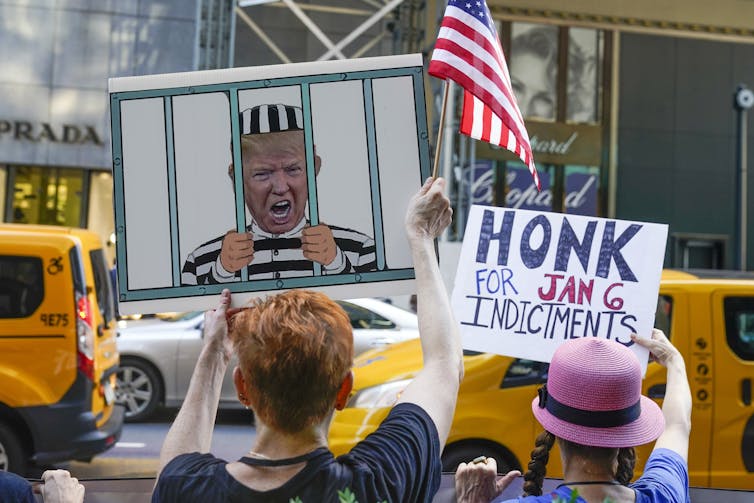
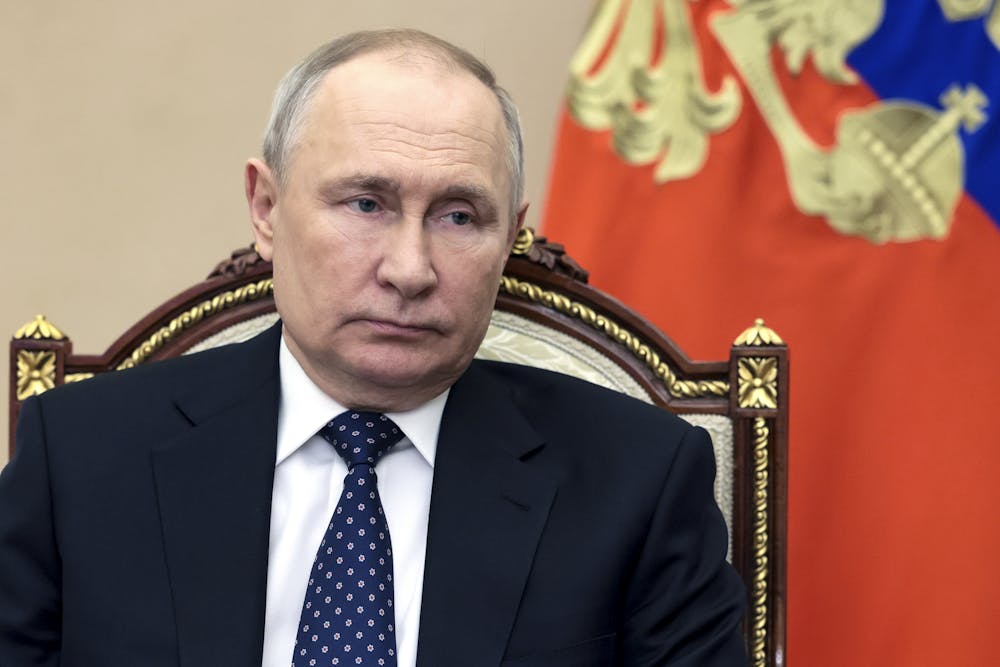
Also on Saturday, Donald Trump whined on his Nazi-infested social media site that he was going to be arrested this week for paying off Stormy Daniels and thus stealing the 2016 election (with help from Putin).
Republican candidates for president committing treason to get into or stay in the White House has been the norm since 1968: it’s time to seriously discuss the five-decade-long problem we have with treasonous and illegitimate GOP presidents.
It started in 1968, when President Lyndon Johnson was desperately trying to end the Vietnam war. It had turned into both a personal and political nightmare for him, and his vice president, Hubert Humphrey, who was running for President in the election that year against a “reinvented” Richard Nixon.
Johnson spent most of late 1967 and early 1968 working back-channels to North and South Vietnam, and by the summer of 1968 had a tentative agreement from both for what promised to be a lasting peace deal they’d both sign that fall.
But Richard Nixon knew that if he could block that peace deal, it would kill VP Hubert Humphrey’s chances of winning the 1968 election. So, Nixon sent envoys from his campaign to talk to South Vietnamese leaders to encourage them not to attend upcoming peace talks in Paris.
Nixon promised South Vietnam’s corrupt politicians that he’d give them a richer deal when he was President than LBJ could give them then (just like Reagan would later do with the Iranians).
The FBI had been wiretapping South Vietnam’s US agents and told LBJ about his effort to prolong the Vietnam War. Thus, just three days before the 1968 election, Johnson phoned the Republican Senate leader, Everett Dirksen, (you can listen to the entire conversation here):
President Johnson: Some of our folks, including some of the old China lobby, are going to the Vietnamese embassy and saying please notify the [South Vietnamese] president that if he’ll hold out ’til November 2nd they could get a better deal. Now, I’m reading their hand. I don’t want to get this in the campaign. And they oughtn’t to be doin’ this, Everett. This is treason.
Sen. Dirksen: I know.
Those tapes were only released by the LBJ library in the past decade, and that’s Richard Nixon who Lyndon Johnson was accusing of treason.
At that point, for President Johnson, it was no longer about getting Humphrey elected. By then Nixon’s plan had already worked and Humphrey was being wiped out in the polls because the war was ongoing.
Instead, Johnson was desperately trying to salvage the peace talks to stop the death and carnage as soon as possible. He literally couldn’t sleep.
In a phone call to Nixon himself just before the election, LBJ begged him to stop sabotaging the peace process, noting that he was almost certainly going to win the election and inherit the war anyway. Instead, Nixon publicly said LBJ’s efforts were “in shambles.”
But South Vietnam had taken Nixon’s deal and boycotted the peace talks, the war continued, and Nixon won the White House thanks to it.
An additional twenty-two thousand American soldiers, and an additional million-plus Vietnamese died because of Nixon’s 1968 treason, and he left it to Jerry Ford to end the war and evacuate American soldiers.
Nixon was never held to account for that treason, and when the LBJ library released the tapes and documentation long after his and LBJ’s deaths it was barely noticed by the American press.
Gerald Ford, who succeeded Nixon, was never elected to the White House (he was appointed to replace VP Spiro Agnew, after Agnew was indicted for decades of taking bribes), and thus would never have been President had it not been for Richard Nixon’s treason. He pardoned Nixon.
Next up was Ronald Reagan.
During the Carter/Reagan election battle of 1980, then-President Carter had reached a deal with newly-elected Iranian President Abdolhassan Bani-Sadr to release the fifty-two hostages held by students at the American Embassy in Tehran.
Bani-Sadr was a moderate and, as he explained in an editorial for The Christian Science Monitor, successfully ran for President that summer on the popular position of releasing the hostages:
“I openly opposed the hostage-taking throughout the election campaign…. I won the election with over 76 percent of the vote…. Other candidates also were openly against hostage-taking, and overall, 96 percent of votes in that election were given to candidates who were against it [hostage-taking].”
Carter was confident that with Bani-Sadr’s help, he could end the embarrassing hostage crisis that had been a thorn in his political side ever since it began in November of 1979.
But behind Carter’s back, the Reagan campaign worked out a deal with the leader of Iran’s radical faction — Supreme Leader Ayatollah Khomeini — to keep the hostages in captivity until after the 1980 Presidential election. Khomeini needed spare parts for American weapons systems the Shah had purchased for Iran, and Reagan was happy to promise them.
This is the story that was finally confirmed just this past weekend with The New York Times’ reporting that we now know how the deal was conveyed to the Ayatollah and by whom.
This was the second act of treason by a Republican wanting to become president.
The Reagan campaign’s secret negotiations with Khomeini — the so-called “October Surprise” — sabotaged President Carter’s and Iranian President Bani-Sadr’s attempts to free the hostages.
As President Bani-Sadr told The Christian Science Monitor in March of 2013:
“After arriving in France [in 1981], I told a BBC reporter that I had left Iran to expose the symbiotic relationship between Khomeinism and Reaganism.
“Ayatollah Khomeini and Ronald Reagan had organized a clandestine negotiation, later known as the ‘October Surprise,’ which prevented the attempts by myself and then-US President Jimmy Carter to free the hostages before the 1980 US presidential election took place. The fact that they were not released tipped the results of the election in favor of Reagan.”
And Reagan’s treason — just like Nixon’s treason — worked perfectly.
The Iran hostage crisis continued and torpedoed Jimmy Carter’s re-election hopes. And the same day Reagan took the oath of office — to the minute, as Reagan put his hand on the bible, by way of Iran’s acknowledging the deal — the American hostages in Iran were released.
Keeping his side of the deal, Reagan began selling the Iranians weapons and spare parts in 1981, and continued until he was busted for it in 1986, producing the so-called “Iran Contra” scandal.
But, like Nixon, Reagan was never held to account for the criminal and treasonous actions that brought him to office.
After Reagan — Bush senior was elected — but like Jerry Ford — Bush was really only President because he served as Vice President under Reagan. And, of course, the naked racism of his Willie Horton ads helped boost him into office.
The criminal investigation into Iran/Contra came to a head with independent prosecutor Lawrence Walsh subpoenaing President George HW Bush after having already obtained convictions for Weinberger, Ollie North and others.
Bush’s attorney general, Bill Barr, suggested he pardon them all to kill the investigation, which Bush did.
The screaming headline across the New York Times front page on December 25, 1992, said it all:
“THE PARDONS; BUSH PARDONS 6 IN IRAN AFFAIR, ABORTING A WEINBERGER TRIAL; PROSECUTOR ASSAILS 'COVER-UP’”
And if the October Surprise hadn’t hoodwinked voters in 1980, you can bet Bush senior would never have been elected in 1988. That’s four illegitimate Republican presidents.
Which brings us to George W. Bush, the man who was given the White House by five right-wing justices on the Supreme Court.
In the Bush v. Gore Supreme Court decision in 2000 that stopped the Florida recount — and thus handed George W. Bush the presidency — Justice Antonin Scalia wrote in his opinion:
“The counting of votes … does in my view threaten irreparable harm to petitioner [George W. Bush], and to the country, by casting a cloud upon what he [Bush] claims to be the legitimacy of his election.”
Apparently, denying the presidency to Al Gore, the guy who actually won the most votes in Florida and won the popular vote nationwide by over a half-million, did not constitute “irreparable harm” to Scalia or the media.
And apparently it wasn’t important that Scalia’s son worked for a law firm that was defending George W. Bush before the high court (with no Scalia recusal).
Just like it wasn’t important to mention that Justice Clarence Thomas’s wife worked on the Bush transition team — before the Supreme Court shut down the recount in Florida — and was busy accepting resumes from people who would serve in the Bush White House if her husband stopped the recount in Florida…which he did. (No Thomas recusal, either.)
More than a year after the election a consortium of newspapers including The Washington Post, The New York Times, and USA Today did their own recount of the vote in Florida — manually counting every vote in a process that took almost a year — and concluded that Al Gore did indeed win the presidency in 2000.
As the November 12th, 2001 article in The New York Times read:
“If all the ballots had been reviewed under any of seven single standards and combined with the results of an examination of overvotes, Mr. Gore would have won.”
That little bit of info was slipped into the seventeenth paragraph of the Times story so that it would attract as little attention as possible because the 9/11 attacks had happened just weeks earlier and journalists feared that burdening Americans with the plain truth that George W. Bush actually lost the election would further hurt a nation already in crisis.
To compound the crime, Bush could only have gotten as close to Gore in the election as he did because his brother, Florida Governor Jeb Bush, had ordered his Secretary of State, Kathrine Harris, to purge at least 57,000 mostly-Black voters from the state’s voter rolls just before the election. Thousands of African Americans showed up to vote and were turned away from the polls in that election in Florida that Bush “won” by fewer than 600 votes.
So, for the third time in 4 decades, Republicans took the White House under illegitimate electoral circumstances. Even President Carter was shocked by the brazenness of that one. And Jeb Bush and the GOP were never held to account for that crime against democracy.*
To get re-elected, Bush used an old trick: become a “wartime president.” In 1999, when George W. Bush’s family decided he was going to run for president in the 2000 election, his parents hired Mickey Herskowitz to write the first draft of Bush’s autobiography, A Charge To Keep.
Although Bush had gone AWOL for about a year during the Vietnam war and was thus apparently no fan of combat, he’d concluded (from watching his father’s “little 3-day war” with Iraq) that being a “wartime president” was the most consistently surefire way to get reelected and have a two-term presidency.
“I'll tell you, he was thinking about invading Iraq in 1999,” Herskowitz told reporter Russ Baker in 2004.
“One of the things [Bush] said to me,” Herskowitz said, “is: ‘One of the keys to being seen as a great leader is to be seen as a commander-in-chief. My father had all this political capital built up when he drove the Iraqis out of (Kuwait) and he wasted it.
“[Bush] said, ‘If I have a chance to invade Iraq, if I had that much capital, I'm not going to waste it. I’m going to get everything passed I want to get passed and I'm going to have a successful presidency.’”
This week is also the 20th anniversary of Bush lying us into that war, an act of treason against America that cost 900,000 Iraqi lives, over 7,000 American lives (on the battlefield: veterans are still committing suicide daily), and over $8 trillion added to the national debt.
Which brings us to the first Republican president who may actually be held accountable for the crimes he committed to get into the White House.
In 2016, Trump ally Kris Kobach and Republican Secretaries of State across the nation used Interstate Crosscheck to purge millions of legitimate voters — most people of color — from the voting rolls just in time for the Clinton/Trump election.
Meanwhile, Russian oligarchs and the Russian state, and possibly pro-Trump groups or nations in the Middle East, are alleged to have funded a widespread program to flood social media with pro-Trump, anti-Clinton messages from accounts posing as Americans, as documented by Robert Mueller’s investigation.
It was so blatant that it provoked the U.S. Intelligence Community’s assessment of their similar actions during the 2020 election (done while Trump was still president but released in March, 2021) pretty much declaring him a “Russian asset.”
It was a repeat, in many ways (albeit unsuccessful this time) of the Russian efforts in 2016. Then, you’ll remember, Republican campaign data on the 2016 election, including which states needed a little help via phony influencers on Facebook and other social media, was not only given to Konstantin Kilimnik by Paul Manafort, but Kilimnik transferred it to Russian intelligence.
Trump had recently been wounded politically by the “grab ‘em by the pussy” comment he’d made on the Access Hollywood videotape, and if the Stormy Daniels affair (just 4 months after Melania had given birth to Barron) had become public Hillary Clinton would have wiped the floor with him.
But he paid Stormy off to keep quiet, a check delivered by Michael Cohen who was then sentenced to three years in prison (and served one) for corruptly violating campaign finance and tax laws with that check to help Trump get into the White House.
Donald Trump still lost the national vote by nearly 3 million votes, but came to power in 2016 through the electoral college loophole designed to keep slavery safe in colonial America.
If the news about Stormy Daniels had gotten out in the weeks before the election, there never would have been a January 6th; 300,000 Americans wouldn’t have died unnecessarily from Covid; Iran would still be in compliance with the nuclear deal; Putin wouldn’t have invaded Ukraine; and our country wouldn’t have given the morbidly rich another $2 trillion in tax cuts while gutting the social safety net.
Thus, New York DA Alvin Bragg is about to prosecute the crime that set the stage for all of Trump’s other crimes in office.
One can only wonder how much better off America would be if six Republican Presidents hadn’t stolen or inherited a stolen White House and used it to put rightwing cranks on the Supreme Court and other federal benches while cutting taxes on the morbidly rich, destroying unions, and offshoring over 16,000 factories and 15 good-paying union million jobs.
Now, finally, there may be an opportunity for some accountability for our most recent criminal Republican president.
The depth and breadth of Trump’s involvement in the January 6th attempt to destroy our form of government and replace it with single-party strongman rule is becoming more and more obvious. As a result, the pressure is building to hold him and many of those in his administration to account.
America has ignored GOP crimes to seize and hold the White House long enough. The immunity Ford gave Nixon has echoed down through the decades, leading to a packed Supreme Court and two unnecessary and illegal wars (not to mention tax cuts for billionaires that have gutted our middle class).
It’s time, at long last, to put this one in prison.
*For more detail, this is extensively documented and footnoted in my book The Hidden History of the Supreme Court and the Betrayal of America.
**This is covered in depth in my book The Hidden History of the War On Voting.





 Lars Nootbaar, pictured here in 2018, has become an unlikely star of the 2023 World Baseball Classic — for Japan. Jeffrey Hyde/Creative Commons