For years, small groups of astronomy enthusiasts have traveled the globe chasing the rare solar eclipse. They have embarked on cruises to the middle of the ocean, taken flights into the eclipse’s path and even traveled to Antarctica. In August 2017, millions across the U.S. witnessed a total solar eclipse visible from Oregon to South Carolina, with a partial eclipse visible to the rest of the continental U.S.
The interest in astronomical events that this eclipse sparked will likely return with two eclipses visible in the U.S. during the next year – the annular solar eclipse on Oct. 14, 2023, and the total eclipse on April 8, 2024. But astro-tourism – traveling to national parks, observatories or other natural, dark-sky locations to view astronomical events – isn’t limited just to chasing eclipses.
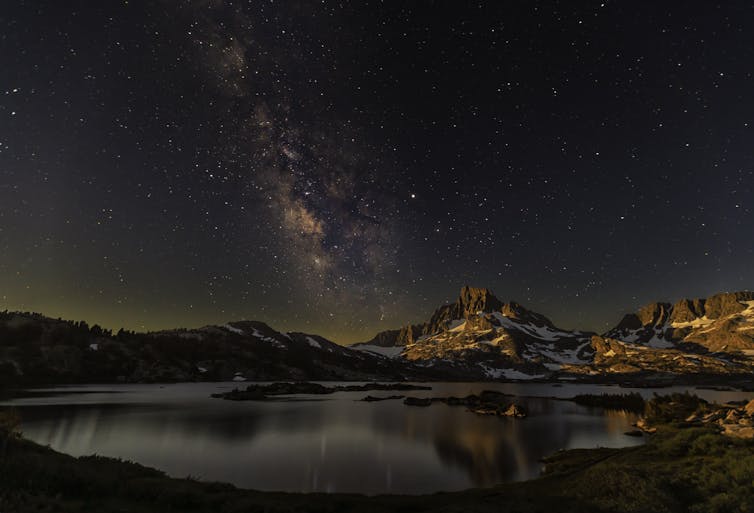
I am a space scientist with a passion for teaching physics and astronomy and photographing the night sky. Every summer I spend several nights backpacking in the Sierra Nevada mountains of California, where the skies are sufficiently dark to allow the Milky Way to be seen with the naked eye. My son and I also like to take road trips – often along U.S. 395, the Eastern Sierra Scenic Byway – that coincide with eclipses and meteor showers.
Natural locations, removed from city light, can be great places for astro-tourism. Vahe Peroomian
Can’t miss astronomical events
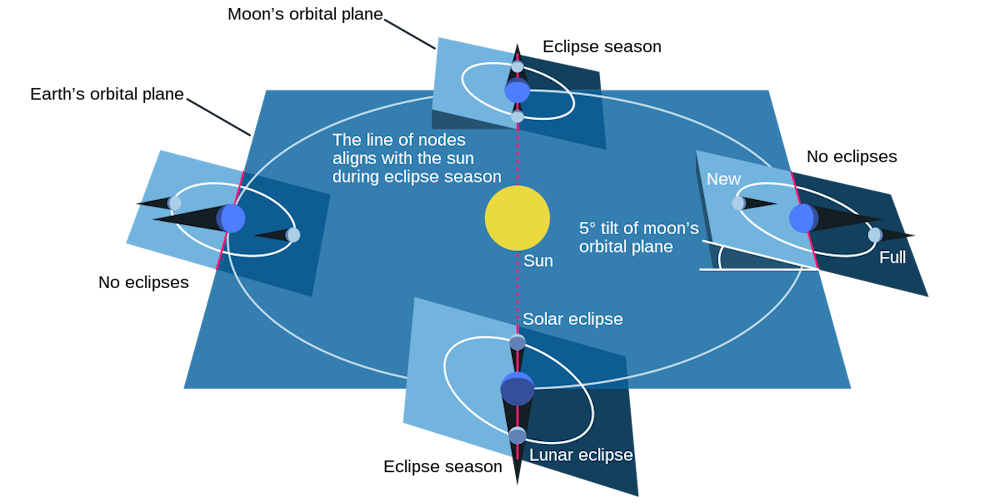
There are two types of eclipses. Lunar eclipses occur when the full moon passes through Earth’s shadow. Solar eclipses occur when the new moon briefly blocks the Sun.
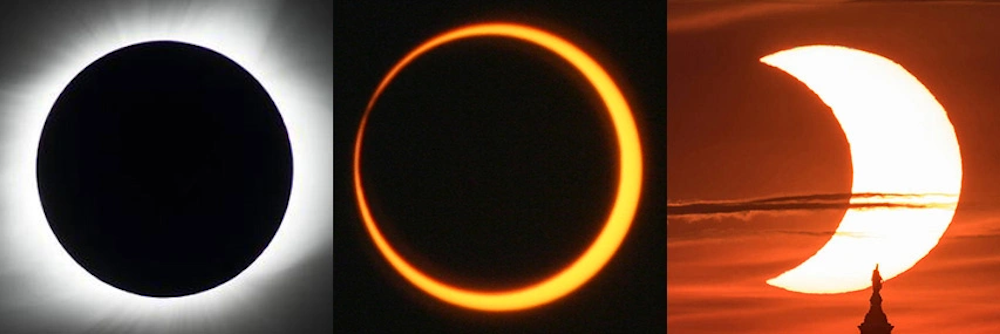
There are three types of solar eclipses. During a total eclipse, the Moon completely covers the Sun, with totality, or the time during which the Sun is completely eclipsed, lasting as long as seven minutes. During totality, those in the path of the eclipse will see the Sun’s corona, or its outer atmosphere, behind the Moon’s silhouette.
The Moon’s orbit around the Earth is an ellipse, so the Moon can appear to be 15% smaller when it’s at its farthest point from Earth, its apogee, compared with its size when it is at its closest point to Earth, its perigee. An annular eclipse occurs when the Moon doesn’t cover the entire disk of the Sun, leaving a ring of sunlight around the Moon.
Finally, a partial eclipse occurs when the Moon blocks only a part of the Sun’s disk, as the name implies.
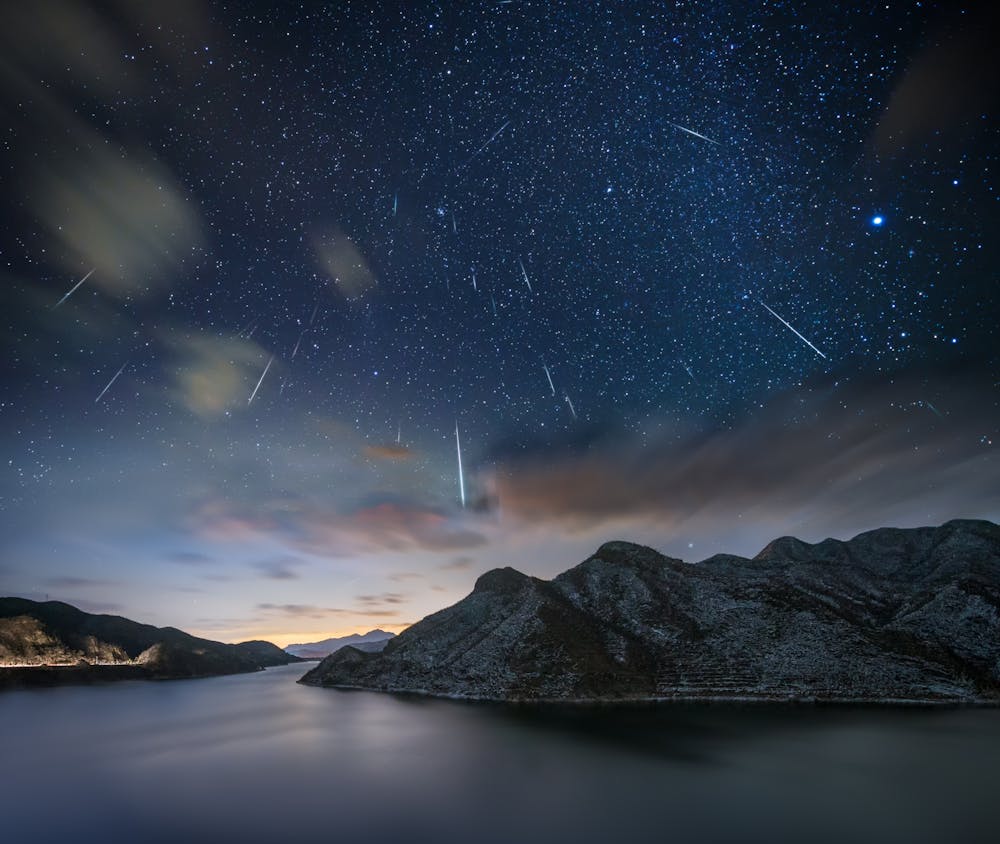
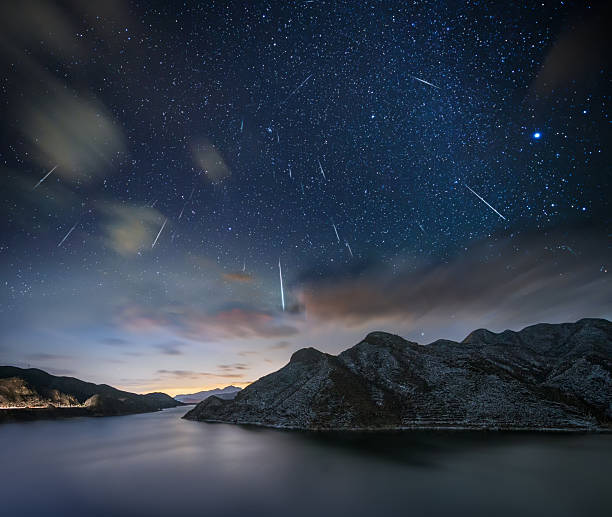
Meteor showers are a far more common astronomical event than eclipses, and they are visible from any dark-sky location on Earth. Meteor showers occur when Earth’s orbit around the Sun takes it through the dust left behind by a comet. The Earth sweeps up the dust like a car speeding through a cloud of insects on the highway.
Meteor showers are named for the constellations from which the meteors seem to emanate, though it’s not necessary to stare in that direction to see meteors. The most prominent meteor showers, occurring on approximately the same dates every year, are the Perseids, named for the constellation Perseus and peaking on the night of Aug. 12-13; the Geminids, named for the constellation Gemini, on Dec. 14-15; and the Lyrids, named for the constellation Lyra, on April 21-22. The night sky will be mostly moonless for the first two this year, but a nearly full moon will make the Lyrid shower of 2024 difficult to see.
Meteor showers happen around the same time each year, and on cloudless nights can be stunning to watch. Haitong Yu/Moment via Getty Images
Tips for aspiring astro-tourists
One of the most important factors to consider when planning an outing to stargaze or to watch a meteor shower is the phase of the Moon. The full moon rises at about 6 p.m. and sets at 6 a.m., making stargazing all but impossible because of its brightness. For ideal stargazing conditions, the Moon should be below the horizon, and the best viewing conditions are during new moon. You can use a moonrise/moonset calculator to determine the phase of the Moon and its rise and set times for any location on Earth.
Another important factor is weather. Amateur astronomers always joke that the sky is cloudy during the most interesting astronomical events. For example, most major cities in the U.S. that are in the path of the April 2024 eclipse have had cloudy skies on April 8 60% of the time since the year 2000.
Most Americans live in heavily light-polluted areas. A light pollution map such as lightpollutionmap.info can help identify the nearest dark-sky location, which, in my case, is hours away. These maps often use the Bortle dark-sky scale, which reports 1 for extremely dark skies to 9 for highly light-polluted city centers.
Though you may still see the brightest meteors from city suburbs, the darker your sky, the more meteors you’ll see. In general, expect to see fewer than 25 meteors per hour. To see the complex structure of the Milky Way with the naked eye, look for a location with a Bortle index of 3 or below.
It’s important to arrive at your chosen site early, preferably during daylight hours. Stumbling around in the dark at an unfamiliar site is a recipe for disaster and may also disturb others who are already at the site. Arriving early also gives time for your eyes to adapt to the dark as night falls, as it typically takes 30 minutes or even longer for your eyes to reach their full dark-adapted potential.
Make sure to carry a headlamp or flashlight that has a red light setting, as red light doesn’t ruin night vision. Avoid using your phone, as even a glance at the screen can ruin your eyes’ dark adaptation. If you’re using a sky-viewing app, switch the app to night mode.
Plan ahead if you’re thinking of traveling to view one of the eclipses visible in the U.S. next year. If you’re in the path of the eclipse, stay put! If you’re traveling, staying at the same location overnight before and after the eclipse can help avoid the hourslong traffic jams experienced by eclipse watchers in 2017.
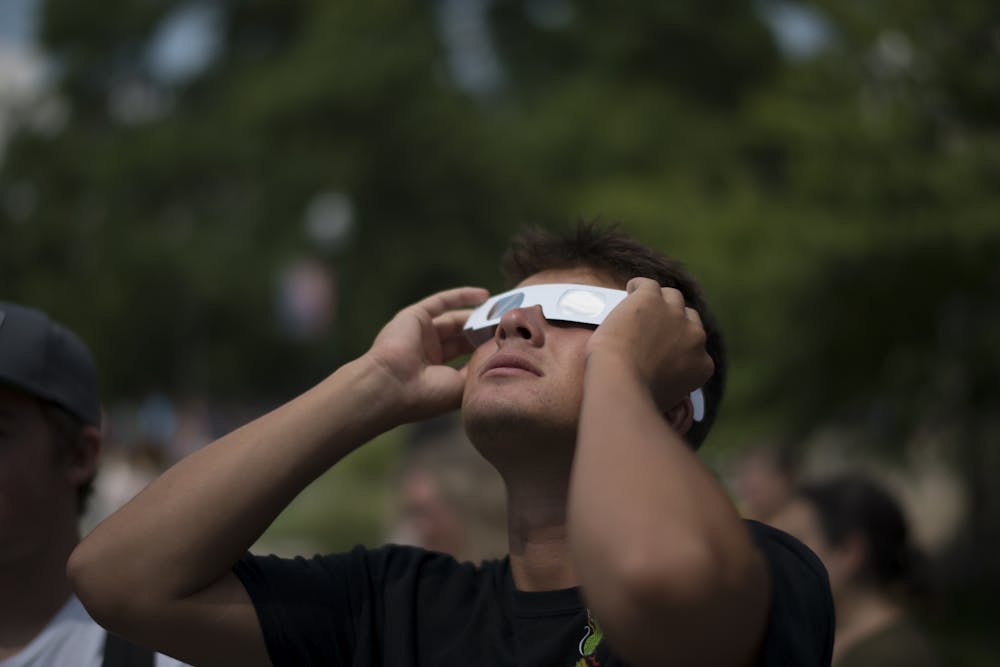
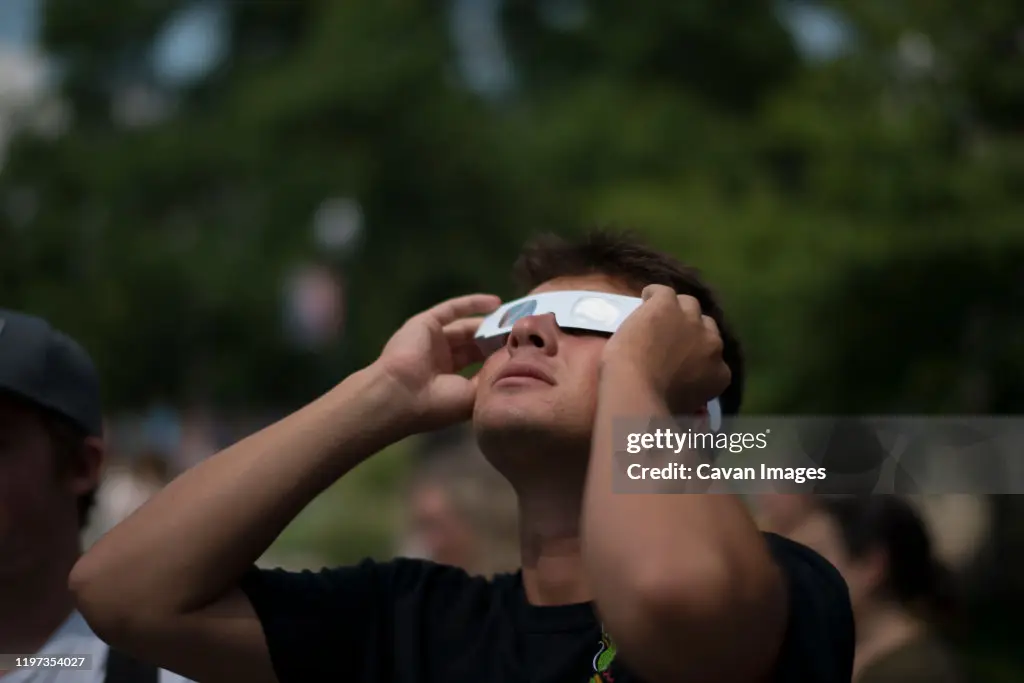
Eclipse glasses protect your eyes while viewing an eclipse. You should never look directly at the sun. Cavan Images/Cavan via GettyImages
Also, you should never look at the Sun directly with the naked eye, even during a total eclipse. You’ll need a pair of inexpensive eclipse glasses to watch and fully enjoy the eclipse, but get yours early, as many stores ran out of glasses during the 2017 eclipse.
No matter where you travel during the next year, don’t forget to look up at night and marvel at the beauty of the night sky away from city lights.
Florida Gov. Ron DeSantis has left two major public health offices vacant, reported NBC News, potentially jeopardizing the ability to track infectious disease as cases of malaria have begun to spread in the state.
"Two of the top public health officials in Florida Gov. Ron DeSantis' administration — responsible for tracking and preventing the spread of communicable diseases — have left their positions in recent months," reported Matt Dixon. "The departures come as public health is increasingly being politicized, and some experts say it leaves the state facing a 'serious health risk.'"
"The openings are in the Florida Health Department’s Bureau of Epidemiology, which plays a key role in monitoring and combating the spread of disease in the state," continued the report. "The open positions include the head of the bureau, which oversees many of the state’s core public health functions. It has been vacant since last month, when former bureau chief Clayton Weiss transferred to the Florida Department of Corrections."
This comes as the Centers for Disease Control posted an alert on four cases of malaria -- a treatable but potentially life-threatening mosquito-borne illness largely controlled in the United States -- in Florida.
DeSantis largely defined his career by defiance of public health measures in the COVID-19 pandemic, closing the state beaches only reluctantly after weeks of pressure and then reopening them almost immediately. Florida saw some of the worst death rates from COVID during some of the outbreaks, although exactly how much of this was attributable to DeSantis' loose lockdown policies is debated because of the state's large and uniquely vulnerable elderly population.
Even Trump, who himself publicly attacked the idea of public gathering restrictions during the COVID pandemic, has lately gone after DeSantis' public health record as they compete in the 2024 primary, noting that New York saw a less severe mortality under former Democratic Gov. Andrew Cuomo.
The world saw its hottest June on record last month, the EU's climate monitoring service said Thursday, as climate change and the El Nino weather pattern looked likely to drive another scorching northern summer.
The announcement from the EU monitor Copernicus marked the latest in a series of records for a year that has already seen a drought in Spain and fierce heat waves in China and the United States.
"The month was the warmest June globally at just over 0.5 degrees Celsius above the 1991-2020 average, exceeding June 2019 -– the previous record -– by a substantial margin," the EU monitor said in a statement from its C3S climate unit.
Temperatures reached June records across northwest Europe while parts of Canada, the United States, Mexico, Asia and eastern Australia "were significantly warmer than normal", Copernicus noted.
On the other hand it was cooler than normal in western Australia, the western United States and western Russia, it said.
- 'Hottest day ever' -
It was the latest in a series of heat records over recent years, reflecting the impact of global warming driven by greenhouse gases released from human activity.
Preliminary readings published Wednesday by US meteorologists indicated Tuesday was the hottest day ever recorded, based on data from the US National Oceanic and Atmospheric Administration's National Centers for Environmental Prediction.
Copernicus noted that sea surface temperatures were higher globally than any previous June on record, with "extreme marine heatwaves" around Ireland, Britain and the Baltic.
Antarctic sea ice reached its lowest extent for June since satellite observations began, at 17 percent below average.
C3S scientist Julien Nicolas told AFP the June record was driven largely by "very warm ocean surface temperatures" in the Pacific and Atlantic due to El Nino, a periodic warming phenomenon.
"On top of that is this warming trend of the ocean absorbing 90 percent of heat released by human activity," he added.
The global temperature was 0.53 C above the 30-year average at an average of 16.51C (61.72F), he calculated.
"June 2023 is way above the others. This is the kind of anomaly we are not used to," Nicolas said.
Petteri Taalas, secretary-general of the UN's World Meteorological Organization, warned on Monday that El Nino "will greatly increase the likelihood of breaking temperature records and triggering more extreme heat in many parts of the world and in the ocean."
He urged governments "to mobilize preparations to limit the impacts on our health, our ecosystems and our economies."
- Heatwave deaths -
El Nino is a naturally occurring pattern associated with increased heat worldwide, as well as drought in some parts of the world and heavy rains elsewhere.
In addition, human activity –- mainly the burning of fossil fuels -– is continuing to emit roughly 40 billion tonnes of planet-warming CO2 into the atmosphere every year.
As well as withering crops, melting glaciers and raising the risk of wildfires, higher-than-normal temperatures also cause health problems ranging from heatstroke and dehydration to cardiovascular stress.
In the United States, local officials said last week that at least 13 people died from an extreme heat wave in Texas and Louisiana.
China issued its highest-level heat alert for northern parts of the country as Beijing baked in temperatures around 40 degrees Celsius (104 Fahrenheit).
After a record hot June in Britain, water use restrictions were imposed in parts of southeastern England, and Scotland put regions on water scarcity alert.
The world has warmed an average of nearly 1.2 C since the mid-1800s, unleashing extreme weather including more intense heatwaves, more severe droughts in some areas and storms made fiercer by rising seas.
As he dipped a net into a big cylindrical tub in the dimly lit fish laboratory at the University of Minnesota’s Hodson Hall, Dr. Peter Sorensen scooped a half dozen small silvery fish and gazed at the wiggling, bug-eyed creatures with a look of benevolence.
“I don’t hate them, I really don’t,” said Sorensen. “It’s not their fault they’re here.”
Sorensen, a longtime researcher and professor at the university’s Department of Fisheries, Wildlife and Conservation Biology, restricts the diet of his captives to stunt their growth. If he didn’t, he explained, the fingerling-size fish would already weigh 10 or 15 pounds — an unwieldy size for lab experiments.
The fish in question — silver carp — have occupied Sorensen’s professional attention for over a decade. It’s an outgrowth of rising concerns that the highly invasive species is inexorably moving up the Mississippi River from Iowa.
While the fishes’ northward march has been slowed by the existence of barriers in the river — the locks and dams that enable navigation — the carp can pass through spillway gates during times of high water, as well as the lock chambers during normal operations.
In 2012, lawmakers in St. Paul responded to the looming crisis and funded a new entity at the University of Minnesota, the Minnesota Aquatic Invasive Species Research Center. Sorensen, who had developed an expertise in the control of two other harmful invasive fish, the common carp and sea lamprey, was tapped as its first director.
Sorenson didn’t last long in the leadership post — “I’m a scientist, not a manager,” he said — but he has continued his research in the field of invasive carp, a catch-all term that describes silver carp, the closely related bighead carp, grass carp and black carp. His cluttered office is adorned with a trio of taxidermied silver, bighead and common carp.
In the course of his investigations, Sorensen has developed respect for the silver carp. For one thing, he notes, they are far more elusive than our native fish, with a wariness that makes them difficult to capture. “They are smart, skittish fish. They hear you coming. Traditional fishing gear doesn’t work very well. These are not walleyes,” he said, adding with a laugh: “Honestly, our native fish are pretty stupid.”
Silver carp are also not fish anyone, least of all a fisheries scientist like Sorensen, wants to see in Minnesota’s lakes and rivers.
“They have no ecological value, they take food from other fish, and they destroy water quality,” Sorensen said flatly. “They are just bad news.”
The other ‘silver tsunami’
Silver and bighead carp escaped into the Mississippi River in the 1970s after they were originally imported from Asia to Arkansas to control algal blooms in fish farms and sewage ponds (and widely touted as a green alternative to common chemical treatments).
In the years since, they have relentlessly expanded their range. Along the way, the fish — voracious, fast growing filter feeders that hoover up the phytoplankton and plankton that is base of the food chain — have devastated native fisheries. In some stretches of the Illinois River, silvers and bigheads account for as much as 90% of the fish biomass.
It’s not just anglers and fish biologists who are disturbed by this development. Silver carp, which can reach weights in excess of 90 pounds, have a strange habit of leaping high out of the water when startled. This has created a new hazard in many lakes and rivers, as schools of leaping carp, triggered by the sound of motors, occasionally collide with and injure people in passing boats.
The unusual behavior has given rise to some novel fishing tactics. To kill silver carp, some people deliberately drive through pods and, when the fish leap from the water, they shoot them with bow and arrow. The made-for-YouTube spectacle serves as a gruesome comedic counterpoint to the dire environmental calamity the fish represent.
In Minnesota, the first documented bighead was netted in Lake St. Croix, a wide spot in the St. Croix River in 1996. The first silver was discovered in the Mississippi near the Iowa border in 2008. In the years since, the fish — especially the silvers — have been spotted with increasing frequency in Minnesota waters, including in the Mississippi River in St. Paul.
While the appearance of the occasional stray is not necessarily worrisome, evidence that fish are here in substantial numbers is; that’s because both silvers and bigheads are wildly prolific spawners.
“At some point, they will reproduce. And if they start to reproduce, I don’t see any hope,” Sorensen said. “The females can produce a million eggs. They are moving upstream. If they reproduce, it will destroy half the fish in the river.”
That’s why Sorensen has focused his research on technologies that can stop — or at least slow — the carps’ upriver passage. The approach that he has long endorsed is called a bio-acoustic fish fence. The BAFF, as it is commonly referred to, combines strobing lights with underwater audio speakers and a curtain of bubbles.
While it sounds like a Rube Goldberg device (or an underwater disco), Sorensen said the BAFF, manufactured by a British company called Fish Guidance Systems, has been shown to be remarkably effective at repelling silver and bighead carp. Under laboratory conditions, Sorensen found that the BAFF deterred 90% of fish from passing the gauntlet. Real world experiments have been similarly encouraging. (Sorensen served as a co-leader of an ongoing BAFF demonstration project in Kentucky, where the device has been placed in a lock in highly infested waters).
Sorensen pointed out that he has published two peer-reviewed scientific papers that validate the efficacy of the approach. Long ago, he came to the conclusion that he knew the ideal spot to install a BAFF to best protect Minnesota waters: Lock and Dam #5, just upriver from Winona.
Frustration at the Legislature
Over his years working on the carp problem, Sorensen has become a regular figure at the Capitol, where he has testified in support of funding for carp research. In more recent years, he has repeatedly advocated for the construction of a BAFF in the lock at Winona.
“I think I’ve tried to get it funded five or six times now. I’ve lost count,” Sorensen said. “By 2015, when we were first looking at this, it was very clear to me that Lock #5 was the best spot.” In part, that’s because the spillway gates at the dam — the easiest means for fish to move upriver — are rarely open.
As part of his research, Sorensen has implanted receivers in common carp in the waters below the lock. Not once in two years of data collection has he recorded an upriver passage through the spillway. To the south, he said, the dams and spillways are “like Swiss cheese.” To his thinking, that makes clear that a deterrent in Lock # 5 is the best — and maybe last — bet to hold the fish back.
If reproducing populations of silver carp become established upriver of Winona, it would expose some of Minnesota’s most iconic waters to ecological catastrophe. The fish would almost certainly prosper in Lake Pepin, the nutrient-rich 22-mile long wide spot in the Mississippi south of Red Wing. The St. Croix River below the dam at Taylors Falls and the Minnesota River could easily be overrun soon afterwards.
In March, Sorensen appeared before the Senate’s Environment, Climate and Legacy Committee to testify in support of $17 million appropriation to fund the BAFF, along with monies for contracted netting operations and further research that the DNR sought.
Despite past failures at the Legislature, Sorensen was optimistic. Among other things, he came armed with a freshly completed 128-page feasibility study from Barr Engineering Company, which endorsed Lock #5 as the most suitable site for the BAFF.
According to the company’s analysis, a BAFF could be installed at a cost between $8.2 and $16.5 million, depending on whether the state chose to purchase or rent. Combined with other measures, including netting of fish below the lock, Barr endorsed Sorenesen’s findings that the BAFF could prevent the upstream passage of 99% of carp.
This year’s legislative push was spearheaded by the group Friends of the Mississippi River, with support from a bevy of other conservation organizations operating under the banner of the Stop Carp Coalition. It had the full-throated support of several lawmakers, including chief author, Sen. John Hoffman, DFL-Champlin. “This proposal is the only plan we have,” Hoffman told fellow lawmakers. If the fish begin to reproduce upriver from Winona, Hoffman warned, the state would likely be forced to spend millions on netting programs every year.
In one notable regard, the timing of the Senate hearing could not have been better. In past years, experts like Sorensen had cautioned that the carp were on their way. But on the very day of the hearing, the DNR announced that a commercial crew had just netted 30 silver carp just below Lock #5. It was the largest single capture of the fish that far north on the Mississippi.
In her testimony, Colleen O’Connor Toberman of Friends of the Mississippi highlighted the significance of that event. She also pointed to a political reality of the moment: With the state coffers awash in a record $17 billion surplus, there would probably be no better opportunity to fund a BAFF than 2023. “We will invest now or we will pay more later,” she told lawmakers.
Despite the prevailing enthusiasm for the BAFF, one key voice was conspicuous in its silence: the Department of Natural Resources. In testimony that day, Heidi Wolf, the supervisor of the DNR’s invasive species unit, touted the agency’s emphasis on carp capture and research. She also told lawmakers that the agency was ramping up plans to commence “a structured decision making” process, which would bring key stakeholders, including the U.S. Army Corps of Engineers, DNR and the state of Wisconsin, together to settle on the best path forward.
Wolf did not expressly oppose the BAFF proposal but did not endorse it either. And she offered what seemed to be a measure of reassurance to senators anxious to get moving: There is no evidence, she said, that silver or bighead carp are successfully reproducing in Minnesota. (In Sorensen’s view, the absence of evidence of reproduction does not mean much, given the difficulty of sampling a big, fast flowing river like the Mississippi).
Still, both Sorensen and Toberman left the hearing convinced that there was a good chance the BAFF funding would be included in the committee’s big budget bill. They were wrong.
Due diligence or undue delay?
A few days later, when the language of the Senate’s environmental spending bill was unveiled, Whitney Clark, the executive director of Friends of the Mississippi, was “shocked” to see the BAFF money stripped out, with just $1.7 million left for more research, more targeted netting and, possibly, a study of potential modifications to the operation of the spillway at Lock #5.
After consulting with FMR’s lobbyist, as well as the chair of the Senate environment committee, Sen. Foung Hawj, DFL-St Paul, Clark concluded that the BAFF funding had been excised at the behest of DNR Assistant Commissioner Bob Meier. “Bob Meier went to Sen. Hawj and told him it was unworkable, that there would be cost overruns, and they had big questions about the viability, efficacy, and ongoing costs,” Clark said.
Clark felt sandbagged. Through the fall and winter, FMR had consulted regularly with the DNR about the bill. Before that, the group had repeatedly prodded the DNR to update its 2011 carp action plan (a process that is now underway). While the BAFF wasn’t included in the agency’s budget proposal, Clark said Meier and others in the agency seemed encouraging in the discussions. “I wanted it to be a collaborative effort,” said Clark. “I thought we were in a really good place.”
Reached for comment, Meier eschewed the notion that he single-handedly tanked the BAFF funding. That said, Meier contended that there are too many lingering questions to proceed with the BAFF before getting answers. “We were just concerned about putting the cart before the horse,” he said.
Some of the hurdles are jurisdictional. Lock #5 is federal property, he noted, which raises the question of whether it makes sense for the state to own and operate equipment. He believes the Army Corps of Engineers is more suited to the task. Further, Meier said the costs of the maintenance and operations remain uncertain. He also questioned whether the BAFF could withstand flood conditions and what, if any, effect it might have on native fish.
As part of the DNR’s structured decision-making process, which kicked off this June, Meier expects to have more answers by the end of the year. If there is a consensus among the agencies and stakeholders, he said, the Legislature could come up with the money for the BAFF. Twenty million dollars may be a lot of money, he noted, but it is less daunting against the backdrop of a $72 billion state budget
“If it’s important enough to do, and it makes sense, I don’t see that being a real excuse,” Meier said. As to the criticisms he has received from Sorensen and Clark, Meier was unruffled. “I don’t take those things personally,” he said. “I do my job and I do what’s best for the state of Minnesota.”
Asked whether the BAFF would have been funded had the DNR offered institutional support, Hawj was diplomatic. “I don’t want to be absolute on that,” he said of the agency’s role. “They’re not against it, but they want to have a good foundation for support.”
That said, Hawj insisted that the BAFF will be one of his priorities moving into the next session, adding: “I trust Dr. Sorensen’s research.”
For his part, Sorensen is unlikely to have much involvement in the fight over the BAFF going forward. At 68, he is moving into phased retirement. If the DNR funds the spillway study, he may go on emeritus status and work on that piece of the puzzle. But he has little appetite for further tracking the upriver spread of silver carp — a prospect he finds depressing.
In the months since the BAFF proposal died at the Legislature, Sorensen had visited Lock #5 regularly to track the movements of common carp that he has tagged with receivers. On several occasions, he said, silver carp were conspicuous in their presence, leaping out of the water.
By mid-June, Sorensen had an undergraduate disassembling his lab at Hodson Hall as he readied himself for a vacation at his off-the-grid summer home in British Columbia. He was not inclined to offer the DNR the benefit of the doubt, referring to the lack of urgency at the agency as “dereliction” and “ineptitude.”
In the course of his long career, Sorensen has worked on an array of vexing issues involving invasive fish, from the control of sea lamprey in the Great Lakes to the control of common carp in Tasmania. Many of those experiences were validating, as various state, federal and other government agencies coordinated to take swift action. “You’re not seeing any of that here,” he said. “It’s embarrassing.”
While no solutions are perfect, Sorensen said, aggressive action can bear results. After the sea lamprey devastated populations of lake trout, scientists have managed to curtail their numbers, and the trout have largely rebounded, even though the lamprey have not been completely eliminated.
Sorensen said that the level of collaboration to achieve such goals — and the willingness to take decisive, if imperfect action — has been missing since the alarms were sounded over the invasion of silver carp in Minnesota. In 2005, when the carp were beginning to appear in large numbers below a Mississippi River dam in Keokuk, Iowa, the DNR’s now-retired invasive species coordinator broached the idea of installing a BAFF at the dam there. Nothing came of it.
While no single approach is likely to be 100% effective in stopping the movement of the silver carp, in Sorensen’s view, that’s no excuse for not trying the best available option and buying time.
“My analogy is, if you are in a boat and it’s sinking because there is a hole and you don’t have a perfect plug but you have an old T-shirt, you stuff that old T-shirt in the hole. You fix the hole. Then maybe you go on Amazon and get a better plug,” Sorensen said. “I don’t know why that isn’t intuitive.”
Minnesota Reformer is part of States Newsroom, a network of news bureaus supported by grants and a coalition of donors as a 501c(3) public charity. Minnesota Reformer maintains editorial independence. Contact Editor Patrick Coolican for questions: info@minnesotareformer.com. Follow Minnesota Reformer on Facebook and Twitter.
Here’s something that will send a shiver up the spine of anyone who has battled termites — meaning just about every homeowner in Florida. Termites get hungrier as temperatures get hotter, according to a new study, with their appetites for wood somehow whetted by rising temperatures. That finding comes from more than 100 researchers across six continents who measured how fast termites ate blocks of dead wood left outside for at least a year in different regions with varying temperatures and rainfall. The results were eye-opening, said Amy Zanne, a University of Miami biology professor who led t...
Cinde Warmington, a Democrat running for governor of New Hampshire next year, has sought to prioritize fighting the opioid epidemic. In one ad, she promises to “finally tackle the mental health crisis and fentanyl crisis in a real way, so that families can get the help they need.”
There's just one problem, reported The Daily Beast: two decades ago, Warmington was a lobbyist for Purdue Pharma, defending their right to sell OxyContin, a powerful opioid painkiller that helped trigger the crisis in the first place.
"Speaking before the state legislature in 2002, Warmington defended Oxycontin as a 'miracle drug' with 'very few side effects,'" reported Jake Lahut. "She suggested the opioid was being unfairly maligned. 'Oxycontin has been abused — it certainly has been in the press,' Warmington told a state Senate committee in April 2002. 'I think we can all say that it is a drug of abuse as are all narcotics.'"
Purdue Pharma has been accused of being one of the most important progenitors of the epidemic, and pushed hard for overprescription of OxyContin despite knowing how dangerous the addiction risk was; the company declared bankruptcy in 2019 as part of an effort to settle lawsuits over harm and death caused by the drug. A controversial court ruling earlier this year cleared the way for the company to pay out billions of dollars in settlements, in return for shielding its owners, the Sackler family, from any legal responsibility.
One Democratic operative told The Beast that Warmington's lobbying work makes her campaign a nonstarter. “The ads clearly write themselves,” said the source. “It’s potentially a death knell in a general election.”
Warmington is the only Democratic candidate who has formally declared in the gubernatorial election, where Democrats hope to challenge longtime Republican Gov. Chris Sununu, long one of the most conservative governors in the Northeast. However, others could enter the race; Manchester mayor Joyce Craig has formed an exploratory committee, and both of New Hampshire's representatives, Chris Pappas and Annie Kuster, have also been floated as possible candidates.
Monday, July 3, was the hottest day ever recorded globally, according to data from the U.S. National Centers for Environmental Prediction.
The average global temperature reached 17.01 degrees Celsius (62.62 Fahrenheit), surpassing the August 2016 record of 16.92C (62.46F) as heatwaves sizzled around the world.
The southern U.S. has been suffering under an intense heat dome in recent weeks. In China, an enduring heatwave continued, with temperatures above 35C (95F). North Africa has seen temperatures near 50C (122F).
And even Antarctica, currently in its winter, registered anomalously high temperatures. Ukraine's Vernadsky Research Base in the white continent's Argentine Islands recently broke its July temperature record with 8.7C (47.6F).
"This is not a milestone we should be celebrating," said climate scientist Friederike Otto of the Grantham Institute for Climate Change and the Environment at Britain's Imperial College London.
"It's a death sentence for people and ecosystems."
Scientists said climate change, combined with an emerging El Nino pattern, were to blame.
"Unfortunately, it promises to only be the first in a series of new records set this year as increasing emissions of [carbon dioxide] and greenhouse gases coupled with a growing El Nino event push temperatures to new highs," said Zeke Hausfather, a research scientist at Berkeley Earth, in a statement.
Wine, or at least a glass or two too many, has sometimes been thought of as a guilty pleasure. Chief guilt-tripper these days is surely Ireland's government, which in May 2023 became the first European state to mandate health warning labels on bottles of booze, sparking the ire of the alcohol industry across the continent, Ireland's own included. For those who like to kick back after work, glass of Merlot in hand, there could now be yet another reason to worry about the downside of wine. That's because it has been shown that wild birds are "highly susceptible" to contamination by triazole fung...
A new study of patients with glaucoma in Russia reported a strong association between the level of retinal ganglion cell loss and the severity of depression symptoms. Loss of ganglion cells that happens as the result of glaucoma compromises the perception of light and thus results in deterioration of eyesight quality. The study was published in the Journal of Affective Disorders. Glaucoma is a group of eye conditions that harm the optic nerve, which sends visual information from the eye to the brain. Increased pressure within the eye, known as intraocular pressure, is often associated with thi...
An international team of astronomers has detected a faint signal of gravitational waves reverberating through the universe. By using dead stars as a giant network of gravitational wave detectors, the collaboration – called NANOGrav – was able to measure a low-frequency hum from a chorus of ripples of spacetime.
Though members of the team behind this new discovery aren’t yet certain, they strongly suspect that the background hum of gravitational waves they measured was caused by countless ancient merging events of supermassive black holes.
Pulsars are spinning dead stars that emit strong beams of radiation and can be used as accurate cosmic clocks.
Using dead stars for cosmology
Gravitational waves are ripples in spacetime caused by massive accelerating objects. Albert Einstein predicted their existence in his general theory of relativity, in which he hypothesized that when a gravitational wave passes through space, it makes the space shrink then expand periodically.
The NANOGrav collaboration is also trying to detect spacetime ripples, but on an interstellar scale. The team used pulsars, rapidly spinning dead stars that emit a beam of radio emissions. Pulsars are functionally similar to a lighthouse – as they spin, their beams can sweep across the Earth at regular intervals.
The NANOGrav team used pulsars that rotate incredibly fast – up to 1,000 times per second – and these pulses can be timed like the ticking of an extremely accurate cosmic clock. As gravitational waves sweep past a pulsar at the speed of light, the waves will very slightly expand and contract the distance between the pulsar and the Earth, ever so slightly changing the time between the ticks.
Pulsars are such accurate clocks that it is possible to measure their ticking with an accuracy to within 100 nanoseconds. That lets astronomers calculate the distance between a pulsar and Earth to within 100 feet (30 meters). Gravitational waves change the distance between these pulsars and Earth by tens of miles, making pulsars easily sensitive enough to detect this effect.
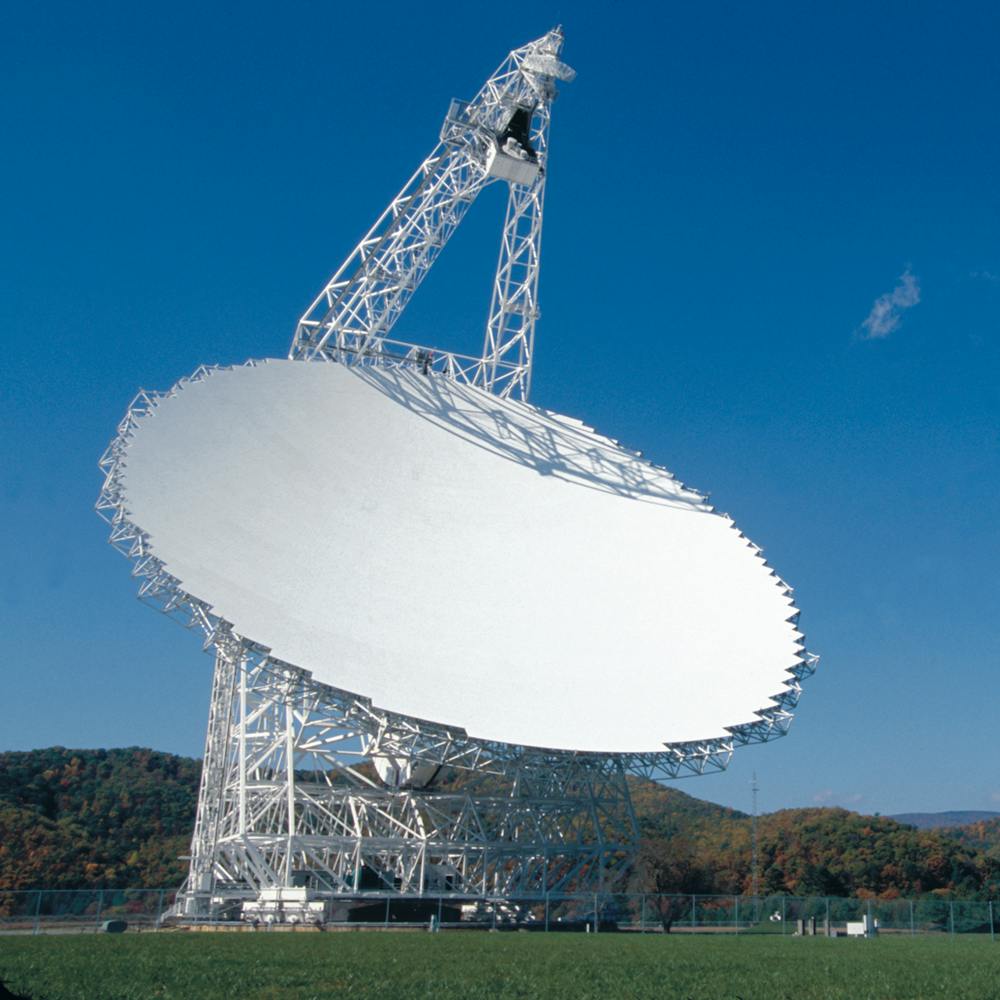
The NANOGrav team used a number of radio telescopes, including the Green Bank Telescope in West Virginia, to listen to pulsars for 15 years. NRAO/AUI/NSF, CC BY
Finding a hum within cacophony
The first thing the NANOGrav team had to do was control for the noise in its cosmic gravitational wave detector. This included noise in the radio receivers it used and subtle astrophysics that affect the behavior of pulsars. Even accounting for these effects, the team’s approach was not sensitive enough to detect gravitational waves from individual supermassive black hole binaries. However, it had enough sensitivity to detect the sum of all the massive black hole mergers that have occurred anywhere in the universe since the Big Bang – as many as a million overlapping signals.
In a musical analogy, it is like standing in a busy downtown and hearing the faint sound of a symphony somewhere in the distance. You can’t pick out a single instrument because of the noise of the cars and the people around you, but you can hear the hum of a hundred instruments. The team had to tease out the signature of this gravitational wave “background” from other competing signals.
The team was able to detect this symphony by measuring a network of 67 different pulsars for 15 years. If some disruption in the ticking of one pulsar was due to gravitational waves from the distant universe, all the pulsars the team was watching would be affected in a similar way. On June 28, 2023, the team published four papers describing its project and the evidence it found of the gravitational wave background.
The hum the NANOGrav collaboration found is produced from the merging of black holes that are billions of times more massive than the Sun. These black holes spin around one another very slowly and produce gravitational waves with frequencies of one-billionth of a hertz. That means the spacetime ripples have an oscillation every few decades. This slow oscillation of the wave is the reason the team needed to rely on the incredibly accurate timekeeping of pulsars.
These gravitational waves are different from the waves LIGO can detect. LIGO’s signals are produced when two black holes 10 to 100 times the mass of the Sun merge into one rapidly spinning object, creating gravitational waves that oscillate hundreds of times per second.
If you think of black holes as a tuning fork, the smaller the event, the faster the tuning fork vibrates and the higher the pitch. LIGO detects gravitational waves that “ring” in the audible range. The black hole mergers the NANOGrav team has found “ring” with a frequency billions of times too low to hear.
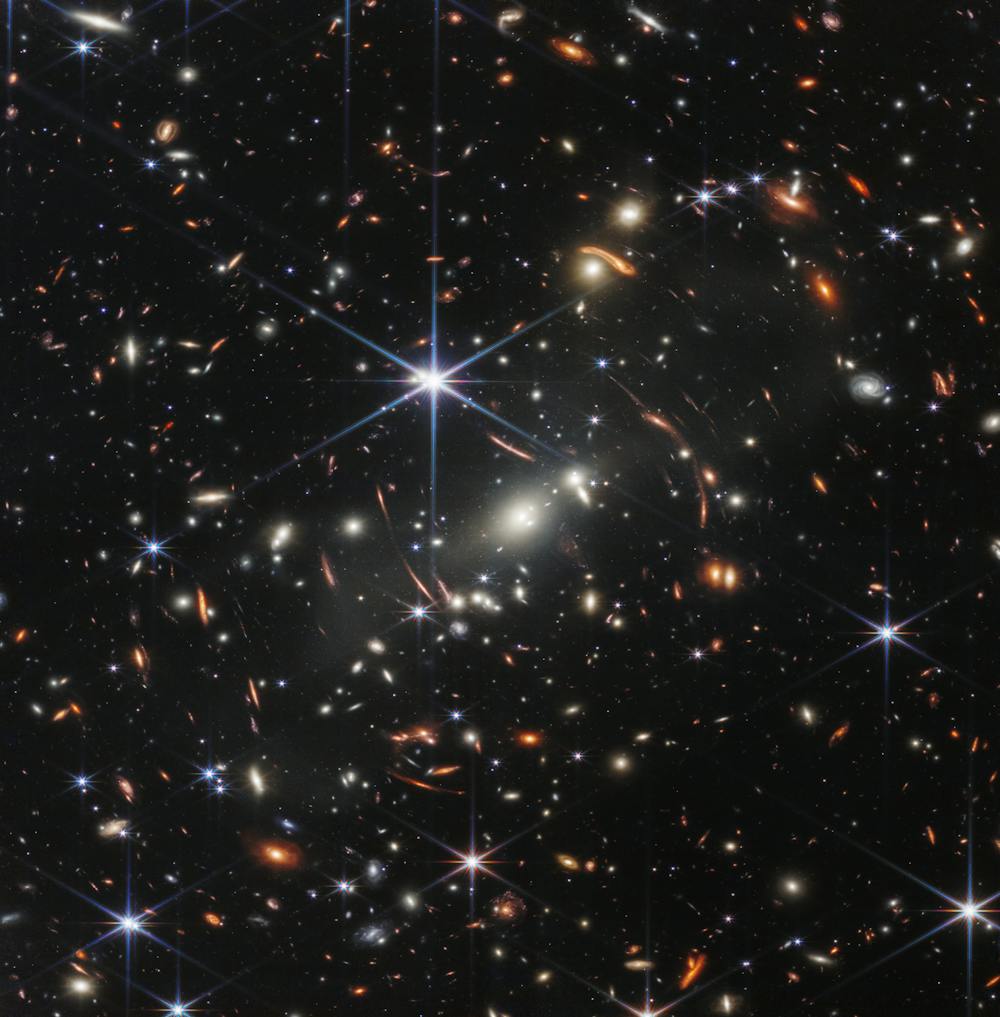
The James Webb Space Telescope has allowed astronomers to peer back in time and study the first galaxies to form after the Big Bang. NASA, ESA, CSA, STScI
Giant black holes in the early universe
Astronomers have long been interested in studying how stars and galaxies first emerged in the aftermath of the Big Bang. This new finding from the NANOGrav team is like adding another color – gravitational waves – to the picture of the early universe that is just starting to emerge, in large part thanks to the James Webb Space Telescope.
A major scientific goal of the James Webb Space Telescope is to help researchers study how the first stars and galaxies formed after the Big Bang. To do this, James Webb was designed to detect the faint light from incredibly distant stars and galaxies. The farther away an object is, the longer it takes the light to get to Earth, so James Webb is effectively a time machine that can peer back over 13.5 billion years to see light from the first stars and galaxies in the universe.
It has been very successful in the quest, having found hundreds of galaxies that flooded the universe with light in the first 700 million years after the big bang. The telescope has also detected the oldest black hole in the universe, located at the center of a galaxy that formed just 500 million years after the Big Bang.
These findings are challenging existing theories of the evolution of the universe.
The problem is that the objects James Webb has been finding are far bigger than current theory says they should be.
These new results from the NANOGrav team emerged from astronomers’ first opportunity to listen to the gravitational waves of the ancient universe. The findings, while tantalizing, aren’t quite strong enough to claim a definitive discovery. That will likely change, as the team has expanded its pulsar network to include 115 pulsars and should get results from this next survey around 2025. As James Webb and other research challenges existing theories of how galaxies evolved, the ability to study the era after the Big Bang using gravitational waves could be an invaluable tool.
Fiber might just be the key to healthy weight management – and nature packages it in perfectly balanced ratios with carbs when you eat them as whole foods. Think unprocessed fruits, vegetables, whole grains, beans, nuts and seeds. Research suggests that carbohydrates are meant to come packaged in nature-balanced ratios of total carbohydrates to fiber. In fact, certain types of fiber affect how completely your body absorbs carbohydrates and tells your cells how to process them once they are absorbed.
Fiber slows the absorption of sugar in your gut. It also orchestrates the fundamental biology that recent blockbuster weight loss drugs like Wegovy and Ozempic tap into, but in a natural way. Your microbiome transforms fiber into signals that stimulate the gut hormones that are the natural forms of these drugs. These in turn regulate how rapidly your stomach empties, how tightly your blood sugar levels are controlled and even how hungry you feel.
It’s as if unprocessed carbohydrates naturally come wrapped and packaged with their own instruction manual for your body on how to digest them.
Different types of carbs have different effects on the body.
Carbohydrates without their wrappers
Unfortunately, most Americans get the majority of their carbohydrates stripped of their natural fibers. Modern processed grains like white rice and white flour as well as many ultraprocessed foods like some sugary breakfast cereals, packaged snacks and juices have removed these fibers. They essentially come unwrapped and without instructions for the body on how much it should absorb and how it should process them. In fact, only 5% of Americans eat the recommended amount of carbohydrates with enough of their natural packaging intact. Guidelines recommend at least 25 to 30 grams of fiber a day from food.
One popular approach to mitigating some of the ill health effects of low fiber and high refined carbohydrates has been to limit carbohydrate intake. Such approaches include the low-carb, keto, paleo and Atkins diets. Each diet is a variation on a similar theme of limiting carbohydrates to varying amounts in different ways.
There is scientific backing to the benefits of some of these diets. Research shows that limiting carbohydrates induces ketosis, a biological process that frees energy from fat reserves during starvation and prolonged exercise. Low-carbohydrate diets can also help people lose weight and lead to improvements in blood pressure and inflammation.
That said, some keto diets may have negative effects on gut health. It is also unknown how they may affect heart health, some forms of cancer and other conditions in the long term.
Even more confusing, research shows that people with diets high in plant-sourced carbohydrates, like the Mediterranean diet, tend to lead the longest and healthiest lives. How can this be reconciled with studies that suggest that low-carbohydrate diets can benefit metabolic health?
Is a carb a carb?
The answer may have to do with the types of carbohydrates that studies are evaluating. Limiting simple sugars and refined carbohydrates may improve certain aspects of metabolic health, as these are some of the most easily digested and absorbed calories. But a more sustainable and comprehensive way of improving health may be increasing the percentage of unprocessed, more complex and slowly absorbed carbohydrates that come with their natural packages and instructions intact – those that have fiber.
These natural carbohydrates can be found in whole grains, beans, nuts, seeds, fruits and vegetables. They come in ratios of total carbohydrate to fiber that rarely exceed 10-to-1 and are often 5-to-1 or lower. Eating mostly whole foods is a simple way to ensure you’re consuming quality carbohydrates with the right ratios.
But who doesn’t like to have a big bowl of pasta or cake with ice cream on occasion? Focusing on packaged processed foods that maintain carb-to-fiber ratios of at least as low as 10-to-1 or ideally 5-to-1 can help you make the best choices when picking more processed foods at the store. Take a look at the nutrition facts label and simply divide total carbohydrates by dietary fiber.
On occasions when you’re eating out or celebrating someone’s birthday, consider taking a fiber supplement with your meal. One pilot study found that a supplement containing a blend of fibers decreased the blood sugar spike – an increase in glucose levels in the blood that if too high can damage the body over time – after a meal in healthy individuals by roughly 30%.
Listen to your body
While almost all fiber is generally good for health in most people, not all fiber affects the body in the same way. Consuming a range of different types of fiber generally helps ensure a diverse microbiome, which is linked to gut and overall health.
But certain medical conditions might preclude consuming certain types of fiber. For example, some people can be particularly sensitive to one class of fiber called FODMAPS – fermentable oligosaccharides, disaccharides, monosaccharides and polyols – that are more readily fermented in the upper part of the gut and can contribute to symptoms of irritable bowel syndrome like bloating and diarrhea. High-FODMAP foods include many processed foods that contain inulin, garlic powder and onion powder, as well as whole foods including those in the onion family, dairy products, some fruits and vegetables.
Listen to how your body responds to different high-fiber foods. Start low and go slow as you reintroduce foods like beans, seeds, nuts, fruits and vegetables to your diet. If you have trouble increasing your fiber intake, talk with your health care provider.
Tools like this online calculator I’ve created can also help you find the highest-quality foods with healthy fiber and other nutrient ratios. It can also show you what proportions of fiber to add back to sugary foods to help achieve healthy ratios.
I wouldn’t endorse eating sweets all the time, but as my three daughters like to remind me, it’s important to enjoy yourself every once in a while. And when you do, consider putting the carbs back in their fiber wrappers. It’s hard to improve upon nature’s design.
According to our best understanding of physics, the fact space is expanding should influence the apparent flow of time, with the distant Universe appearing to run in slow motion.
But observations of highly luminous and variable galaxies, known as quasars, have failed to reveal this cosmic time dilation – until now.
In a new study published in Nature Astronomy, we use two decades of observation to untangle the complex flickering of almost 200 quasars. Buried within this flickering is the imprint of expanding space, with the Universe appearing to be ticking five times slower when it was only a billion years old.
This shows quasars obey the rules of the cosmos, putting to bed the idea they represented a challenge to modern cosmology.
Time is a funny thing
In 1905, Albert Einstein, through his special theory of relativity, told us the speed of clocks’ ticking is relative, dependent on how the clocks are moving. In his 1915 general theory, he told us gravity too can influence the relative rates of clock ticks.
By the 1930s, physicists realized the expanding space of the cosmos, which is described in the language of Einstein’s general relativity, also influences the universe of ticks and tocks.
Due to the finite speed of light, as we look through our telescopes, we are peering into the past. The further we look, the further back into the life of the Universe we see. But in our expanding Universe, the further back we look, the more time space has had to stretch, and the more the relative nature of clock ticks grows.
The prediction of Einstein’s mathematics is clear: we should see the distant universe playing out in slow motion.
Tick-tock supernova clock
Measuring this slow-motion universe is difficult, as nature does not provide standard clocks across the cosmos whose relative ticks could be compared.
It took until the 1990s for astronomers to discover and understand the tick of suitable clocks: a particular kind of exploding star, a supernova. Each supernova explosion was surprisingly similar, brightening rapidly and then fading away over a matter of weeks.
Supernovae are similar, but not identical, meaning their rate of brightening and fading was not a standard clock. But by the close of the 20th century, astronomers were taking another look at these exploding stars, using them to chart the expansion of the Universe. (This expansion turned out to be accelerating, leading to the unexpected discovery of dark energy.)
To achieve this goal, astronomers had to iron out peculiarities of each supernova, putting them on an equal footing, matching them to a standard intrinsic brightness and a standard clock.
They found the flash of more distant supernovae was stretched precisely in line with Einstein’s predictions. The most distant observed supernovae, exploding when the Universe was half its present age, brightened and faded twice as slowly as more recent supernovae.
The trouble with quasars
Supernovae are not the only variable objects in the cosmos.
Quasars were discovered in the 1960s, and are thought to be supermassive black holes, some many billions of times more massive than the Sun, lurking at the hearts of galaxies. Matter swirls around these black holes on its journey to oblivion inside, heating up and glowing brightly as it does so.
Quasars are extremely bright, some burning furiously when the Universe was an infant. Quasars are also variable, varying in luminosity as matter turbulently tumbles on its way to destruction.
Because quasars are so bright, we can see them at much greater distances than supernovae. So the impact of expanding space and time dilation should be more pronounced.
However, searches for the expected signal have turned up blank. Samples of hundreds of quasars observed over decades definitely varied, but it seemed that the variations of those nearby and those far away were identical.
Some suggested that this demonstrated that the variability of quasars is not intrinsic but is instead due to black holes scattered through the Universe, magnifying some quasars by the action of gravity. More outlandishly, others have claimed that the lack of the expected cosmological signal is a clear sign that we have cosmology all wrong and need to go back to the drawing board.
New data, new approaches
In 2023, a new set of quasar data was published. This presented 190 quasars originally identified in the highly successful Sloan Digital Sky Survey but observed over two decades in multiple colors – green, red and infrared light.
The data sampling was mixed, with lots of observations over some times, and less over others. But the wealth of this data meant the astronomers, led by graduate student Zachary Stone at the University of Illinois, could statistically characterize each quasar’s variability as what is known as a “damped random walk”. This characterization assigned a time scale, a tick, to each quasar.
Like each supernova, each quasar is different, and the observed variability can depend upon their intrinsic properties. But with this new data, we could match similar quasars with each other, removing the impact of these differences. As had been done for supernovae before, we had standardized the tick-tock of quasars.
The only remaining influence on the observed variability of quasars was the expansion of space, and we unambiguously revealed this signature. Quasars obeyed the rules of the Universe exactly as Einstein’s theory predicted.
Due to their brightness, however, the influence of this cosmic time dilation could be seen much further. The most distant quasars, seen when the Universe was only a tenth of its present age, were ticking away time five times more slowly than today.
At its heart, this is a story about how Einstein is right again, and how his mathematical description of the cosmos is the best we have. It puts to rest ideas of a sea of cosmic black holes, or that we truly inhabit a static, unchanging universe. And this is precisely how science advances.
Pastor Philip Schmitter waited more than 20 years for the Environmental Protection Agency to do its job. In 1992, he’d filed a civil rights complaint to halt the construction of a power station that would spew toxic lead into the air of his predominantly Black community in Flint, Michigan. Decades passed without a response, so he joined four other groups around the country in a lawsuit to compel the agency to address their concerns.
The case hinged on the EPA’s duty to enforce Title VI, a provision of the landmark Civil Rights Act of 1964. Title VI allows federal agencies to take action against state policies that discriminate by disproportionately harming groups protected by the Act — the discriminatory policy being, in this case, Michigan’s permitting of a plant that would pollute Black neighborhoods. After the EPA lost the suit in 2020, agency officials finally began timely investigations of civil rights complaints and made some of the EPA’s first-ever findings of discrimination.
That progress, however, could be short-lived.
Last week, the EPA abruptly terminated three of its highest-profile open civil rights complaints. The move deals a major blow not only to the majority-Black communities that filed them but also to the EPA’s own authority to enforce Title VI in places with some of the nation’s worst air quality. The cases originated in the region widely known as “Cancer Alley,” an 85-mile industrial corridor in southeast Louisiana, and were voluntarily closed after the state’s Republican attorney general sued the federal government for alleged abuses of power during the complaint negotiations.
Grist obtained copies of two draft agreements from the now-defunct negotiations, which reveal efforts by EPA officials to institute profound changes to Louisiana’s permitting process, which has historically concentrated chemical plants near Black communities. One of the most substantial terms of the resolution would have required state regulators to assess whether a community is already exposed to disproportionately high levels of pollution before permitting new plants there. With the cases closed, the prospect of those changes has all but vanished.
“This is basically the EPA not using the full power of its environmental laws,” said Adam Kron, a senior attorney at Earthjustice who worked on the case. He described Title VI as one of the clearest ways to advance environmental justice, a goal that Biden EPA has repeatedly called a priority. “It’s disappointing to see EPA acquiesce to what seems like a lawsuit that really doesn’t have much grounding to it.”
The Title VI statute states that no person should, on the basis of race, color, or national origin, be subject to discrimination under any program that receives federal funding. The provision is wide-reaching, covering hundreds of thousands of programs across the country and governing decisions as diverse as where a road can go or who can get treatment at a hospital. But in the environmental space, it’s been largely underutilized, with the EPA routinely failing to respond to dozens of cases within the 180-day period required by the law.
The 2020 federal court ruling on Schmitter’s case gave communities in Louisiana’s St. James and St. John the Baptist parishes hope that Title VI could finally help limit pollution in their backyards. Together, their complaints alleged a number of negligent actions by state regulators, including a failure to curb cancer-causing emissions that violate federal safety standards and to consider pre-existing pollution when permitting new industrial plants. A formal resolution of their cases would have likely addressed these concerns.
The draftagreements that Grist obtained include sweeping measures to change the way the state of Louisiana approves new industrial facilities, like folding community involvement into critical moments of the decision-making process and requiring officials to prove, both before and after plants begin operating, that their emissions will not disproportionately harm people of color. In Louisiana, majority-Black communities are exposed to at least 7 times the emissions, on average, as predominantly White communities in industrial areas.
“We were hoping to get systemic change,” said Kimberly Terrell, a research scientist at the Tulane Environmental Law Clinic, who worked on the complaints. “For decades, people have been fighting against individual polluters and individual facilities, but when the decision-making process itself is flawed, you need something that seeks to improve it.”
Louisiana officials did not respond to a request for comment.
Despite progress with the agreements, testimony in Louisiana’s legal filings suggests that, at some point during the negotiation process, things between state and federal officials began to sour. Then, in late May, the state’s attorney general, Jeff Landry, sued the EPA.
The case hinged on the EPA’s ability to pursue actions based on “disparate impacts,” or the idea that a policy or agency decision can disproportionately harm a specific group of people, regardless of whether or not that harm is intentional. These standards have always been unpopular with some state officials who view them as evidence of federal agencies meddling in matters beyond their authority. The Supreme Court’s conservative majority is sympathetic to these concerns, ruling in numerouslandmark cases over the past few years to vastly restrict the powers of federal regulators.
But multiple lawyers that Grist interviewed argued that Louisiana’s legal arguments would have ultimately been unlikely to undermine Title VI, raising the question of why the EPA appears to have preemptively conceded on the matter.
“It was unripe — there was no action by the EPA that Louisiana could challenge,” said Kron. “So it seems like a strange lawsuit for [the federal government] to take as a serious enough threat to just undo this whole process that’s been going on for over a year.”
Environmental advocates and residents in Louisiana also decried the decision to close the complaints.
“I often feel like our communities are left to fight on our own,” said Joy Banner, an activist and long-time resident of the region. “It’s disappointing when we have organizations at the federal level who aren’t willing to step in to fight along with us for our basic human right to survive.”
EPA spokesperson Khanya Brann told Grist that the agency remains “fully committed” to improving the environmental conditions in the communities that filed the complaints.
“Community participation has been critical to identifying both problems and solutions, and we look forward to our continued partnership with the residents in both parishes as we continue our joint efforts to improve public health and the environment,” she said.
The EPA wrote in its letters announcing the closure of the complaints that it would address residents’ concerns through other means, like its pending litigation against one of the region’s most infamous chemical plants and its proposed rules for tightening standards for certain types of facilities operating in the region. But residents told Grist that those measures do not cover the totality of their concerns, and that a major benefit of the Title VI process is its speedy timeline: While court cases can drag on and emissions standards can take years to implement, a resolution of the complaints may have granted communities much faster relief from toxic emissions.
Claire Glenn, a criminal defense attorney with a background in civil rights law, compared EPA’s use of Title VI to other federal agencies’ more robust implementation of the law. The Department of Transportation, for example, requires regulators to consider whether a project will disproportionately impact a group of people before it’s ever constructed. However, she added, deciding where a transit line goes is often less controversial than approving a multi-billion dollar company’s new industrial complex.
“I think the reason EPA’s Title VI program is so hamstrung is because it is so directly butting up against corporate interests,” she said.
Advocates told Grist that they are exploring other options to advance residents’ concerns, and called the EPA’s actions this week a setback but not a roadblock. Residents said that they are determined not to give up.
“We come from a long line of people who fought,” said Banner. “This is just one little hill that we have to overcome — but ultimately I see us heading to the mountain, and victory is the mountain.”
Editor’s note: Earthjustice is an advertiser with Grist. Advertisers have no role in Grist’s editorial decisions.
Grist is a nonprofit, independent media organization dedicated to telling stories of climate solutions and a just future. Learn more at Grist.org