Abusive parents, divorce, estrangement, early introduction to to drugs and alcohol: Any of all of these contribute to a tough childhood, which in turn can cause premature aging and relatively poor health later in life.
A team of US academics undertook a study of almost 900 people over two decades and found "adverse childhood experiences" to be associated with age acceleration.
The study used data - starting from 1985, taken with participants’ consent - from the US Coronary Artery Risk Development in Young Adults (CARDIA) study, which entailed eight follow-up assessments until 2016.
Participants were asked whether they had in their own eyes been subjected to various forms of negligence, physical violence, household substance abuse, verbal and emotional abuse or household dysfunction.
The researchers, who were led by Lifang Hou and Brian Joyce of Northwestwern University’s medical school, came to their conclusions after controlling for demographics, behaviour and socio-economic status.
Published by the American Medical Association’s JAMA Open Network, the study followed what it said were previous findings showing individuals with a high burden of adverse childhood experiences to be "more likely to engage in risky health behaviors" which can be in turn "associated with various age-related health outcomes."
Meanwhile research published recently in the British Medical Journal suggested that babies who were breastfed and cuddled by their mothers did better in exams as teenagers.
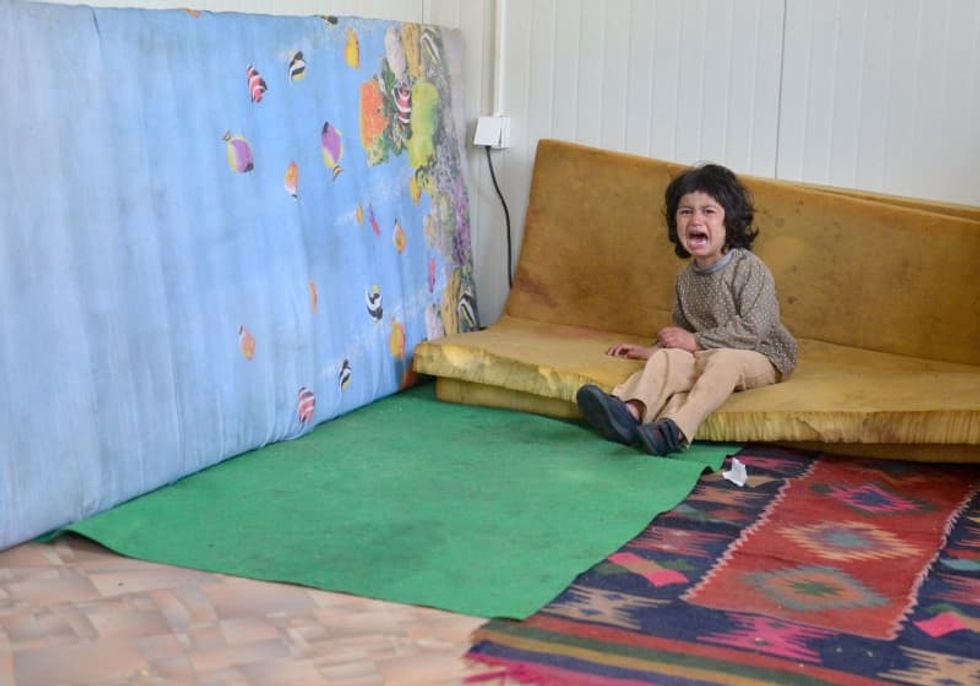
A child in a housing container in a settlement near Belgrade. Researchers now believe that being exposed to negligence, physical violence and emotional abuse as a child can accelerate ageing later in life. Britta Pedersen/dpa
Groups of killer whales have rammed hundreds of small boats off the coast of Spain in recent years in "terrifying" behavior that has baffled scientists.
"They directly attacked the rudder, not swimming around the boat, not playing with anything," Friedrich Sommer told AFP as he recalled how his sailboat Muffet was damaged earlier this year by "three or four" killer whales.
"They rammed at full speed against the rudder," the German sailor told AFP as he waited for his vessel to be fixed in Barbate, a coastal town in Spain's southern Cadiz province.
Rafael Pecci, manager of the shipyard where it is being repaired, is already busy repairing another sailboat that was attacked by killer whales, also called orcas.
"It has completely lost the rudder," he said, pointing to the damaged part of the vessel.
On Barbate's main beach, the mast of a sailboat that sank after it was rammed by killed whales in early May juts out of the water, a reminder of the danger ships face.
The attacks began in 2020 and they have taken place mainly between Cadiz and the port of Tanger in northern Morocco, near the Strait of Gibraltar.
Killer whales are drawn to these waters by the presence of their favourite prey -- bluefin tuna that migrate through the Strait of Gibraltar to breed in the warmer Mediterranean.
So far this year, Spain's coast guard has recorded 28 "interactions" between orcas and sailboats.
Between 2020 and 2022, there were nearly 500 such encounters, according to data released by the Atlantic Orca Working Group, known by its Spanish abbreviation GTOA, which researches orcas in the region.
'Fury'
Jose Luis Garcia Varas, who heads the oceans program at WWF Spain, told AFP that "very little is known about the causes of these interactions".
One theory is that a killer whale, christened Gladis, had a bad run-in with a boat in the past and is now teaching other killer whales to attack vessels in turn.
Gladis is the matriarch of a pod of killer whales that has been blamed for several boat attacks.
Stories and videos of the attacks have been widely shared on social media, turning the orca into a meme.
Killer whales "are group-oriented, they are very intelligent and are able to transmit knowledge orally", Garcia Varas said.
The species live, hunt and move in very closely connected family pods.
These tightly knit, matriarch-led groups have in some populations been shown to have their own pod-specific dialects.
Maria Dolores Iglesias, head of the environmental group Agrupacion Voluntarios de Trafalgar, believes Gladis has died and her descendants have continued their attacks out of anger.
One of Gladis's granddaughters has shown "fury" in her encounters with boats, Iglesias added.
'Quite terrifying'
But Renaud de Stephanis, a biologist with the Spanish conservation group CIRCE who has been investigating the boat encounters, said they could be a form of "play".
"We don't have a final conclusion," he said.
De Stephanis is putting tracking devices on killer whales that will allow the authorities to locate them and hopefully minimize their encounters with boats.
Killer whales can measure up to nine meters (30 feet) and weigh up to six tonnes as adults.
While not all their collisions with boats lead to damage, when it does often it is a vital part that is destroyed like the rudder or mast.
"It is quite terrifying," April Boyes wrote on her Instagram account after her boat was attacked by killer whales while crossing from Portugal's Azores Islands to Gibraltar.
"We turned off the engine and waited, they started to bump into the rudder continuously for over an hour," she said, also posting a video showing crew members removing water from the boat to prevent it from sinking.
Artificial intelligence tools will revolutionize education like calculators did, but will not supplant learning, ChatGPT's founder Sam Altman told students in Tokyo on Monday, defending the new technology.
"Probably take-home essays are never going to be quite the same again," the OpenAI chief said in remarks at Keio University.
"We have a new tool in education. Sort of like a calculator for words," he said. "And the way we teach people is going to have to change and the way we evaluate students is going to have to change."
ChatGPT has captured the world's imagination with its capacity to generate human-like conversations, writing and translations in seconds.
But it has raised concern across many sectors, including in education, where some worry students will abuse the tool or turn to it rather than producing original work.
Altman was in the Japanese capital as part of a world tour where he is meeting business and political leaders to discuss possibilities and regulations for AI.
He has regularly urged politicians to draft regulations for AI, warning "if this technology goes wrong, it can go quite wrong".
"The tools we have are still extremely primitive relative to tools we are going to have in a couple of years," he said Monday, again urging safety measures and regulation.
He said he felt "positive" about new regulatory frameworks for AI after meeting world leaders, without offering details, but reiterated his fears.
"We will feel super responsible, no matter how it goes wrong," he said.
He also repeated previous attempts to calm fears that AI could make many existing jobs obsolete, though he conceded that "some jobs will go away".
"I don't think it is going to quite have the employment impact that people expect," he added, insisting that "new classes of jobs" will emerge.
"Almost all of the predictions are wrong," he said.
DETROIT — Sterling Heights, Michigan-based pizza chain Jet's already uses artificial intelligence as part of its ordering technology, and now it's using AI to come up with new menu ideas. The "ranch veggie pizza" was developed using an AI-powered chatbot. The pizza has the chain's famous ranch dressing, plus mozzarella, feta cheese, mushrooms, onions, green peppers, black olives and tomatoes. "Though an interactive exchange, the chatbot AI contributed unique insights and innovative ideas," according to a Thursday press release. "We're in the era of AI and Jet's is continually exploring ways to...
Hundreds of thousands of fish washed up dead along Texas beaches over the weekend as a "perfect storm" of weather, water, and temperature conditions depleted the oxygen they needed to survive.
While die-offs like these are naturally occurring, the climate crisis can make them ever more likely.
"As we see increased water temperatures, certainly this could lead to more of these events occurring," Katie St. Clair, who manages the sea life facility at Texas A&M University at Galveston, toldThe New York Times Sunday, "especially in our shallow, near-shore or inshore environments."
"You could literally see a straight-across mass of fish floating on the water."
Thousands of dead fish began washing up on local beaches in Texas' Brazoria County Friday, Quintana Beach County Park wrote on Facebook. The park wrote that the fish were mostly Gulf menhaden.
The carcasses continued to wash in on Saturday. Park supervisor Patty Brinkmeyer toldCNN that the dead fish numbered in the "hundreds of thousands" since Friday morning.
In her 17 years at the park, Brinkmeyer said this was "by far" the largest of the three die-offs she had observed.
"You could literally see a straight-across mass of fish floating on the water," she told CNN. "It looked like a big blanket."
In the near-term, Brazoria County Parks Department director Bryan Frazier told The New York Times that the fish kill was caused by a "perfect storm" of conditions.
These were cloudy skies, calm waters, and warm temperatures, Quintana Beach County Park explained on Facebook.
"Cooler water is capable of holding much more oxygen than warmer water, and fish that find themselves in warm water can end up in big trouble," the park said. "When water temperature rises above 70 degrees Fahrenheit, it becomes hard for menhaden to receive enough oxygen to survive."
Because both water mixing and photosynthesis can add oxygen to the water, calm and cloudy days can also mean less oxygen for the fish to breathe.
In the longer term, a 2019 report from the Intergovernmental Panel on Climate Change found that the climate crisis was increasing low-oxygen events, also known as hypoxia, in coastal waters.
The Gulf of Mexico already has one of the largest low-oxygen areas in the world—known as a "dead zone" because fish and other marine life cannot survive there—caused by nutrient pollution from agricultural and urban runoff into the Mississippi River.
When oxygen gets too low near the sea floor, "fish and shrimp leave the area and anything that can't escape—like crabs, worms, and clams—dies," the National Oceanic and Atmospheric Administration (NOAA) said.
The Gulf is also extremely vulnerable to other climate impacts like sea level rise and more intense hurricanes.
"I would say all of those things, put together, are going to create enormous pressure on the coastlines in the Gulf of Mexico—leading to the potential loss of wetlands and damage to inshore communities," Dr. Lisa Levin, an oceanographer at University of California, San Diego, and one of the authors of the 2019 report, toldWWNO at the time.
Additional die-offs of menhaden specifically could add to those pressures, as St. Clair told the Times that the fish play an important role in the ecosystem.
"You could see cascading impacts if we continue to have these large fish kills," she said.
In the immediate future, things are looking up for the Texas coast.
"It appears the last of the fish have washed in. The most recent are deteriorated to the point of being shredded skeletons. Our beach crew should have the pedestrian beach cleared today and begin the Quintana public beach tomorrow," Quintana Beach County Park wrote on Facebook Sunday.
NOAA also predicted June 5 that this summer's Gulf dead zone would be smaller than average, at approximately 4,155 square miles rather than 5,364 square miles.
However, for some, the incident remains a sign of a mounting emergency.
"Another example of how the fossil fuel industry destroys the planet's life-nourishing ecosystems," lawyer and human rights advocate Steven Donziger tweeted Sunday.
An AI camera reflects the light from a lamp in the Kleinfeldchen indoor swimming pool. The indoor pool uses the Lynxight surveillance system, which uses cameras and artificial intelligence to send warnings if a swimmer is drowning. Sebastian Gollnow/dpa
When people drown, there is rarely a lot of splashing and screaming, despite what films show.
It is not always easy to tell when someone runs into serious trouble in the water.
One German swimming pool is testing a monitoring system using artificial intelligence (AI) to try and save swimmers' lives.
There are indoor and outdoor pools at he western city of Wiesbaden's Kleinfeldchen swimming baths. They started using the new system in August 2020.
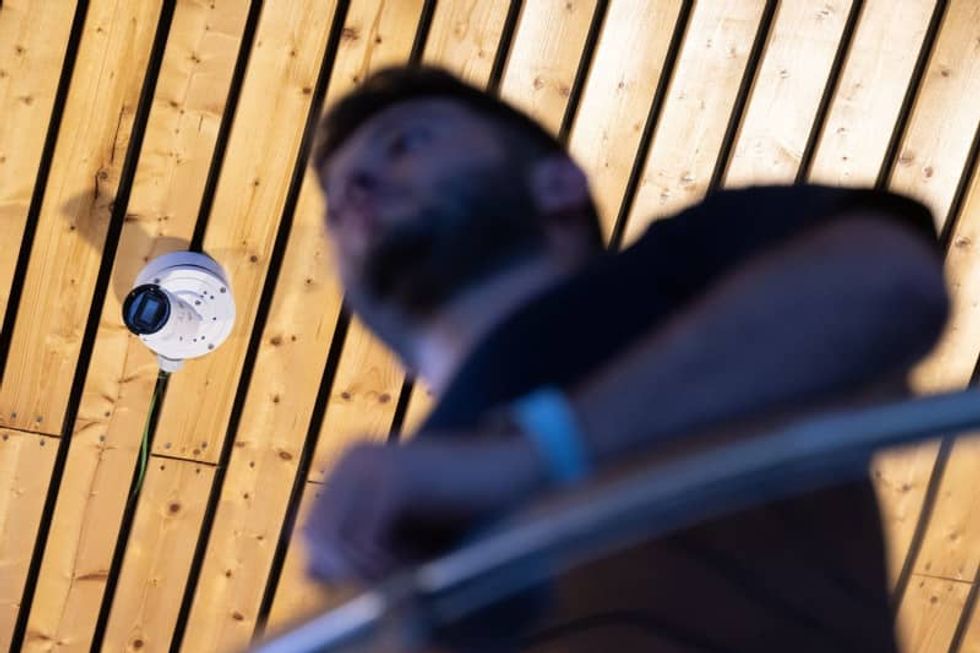
Invented by an Israeli start-up, the AI mechanism has four cameras forming a monitor attached to the ceiling above the indoor pool, that measures 25 by 15 metres.
"The cameras detect movements in the water and record a movement profile that is analysed using AI," says Thomas Baum, operations manager at Mattiaqua, the regional pool operator.
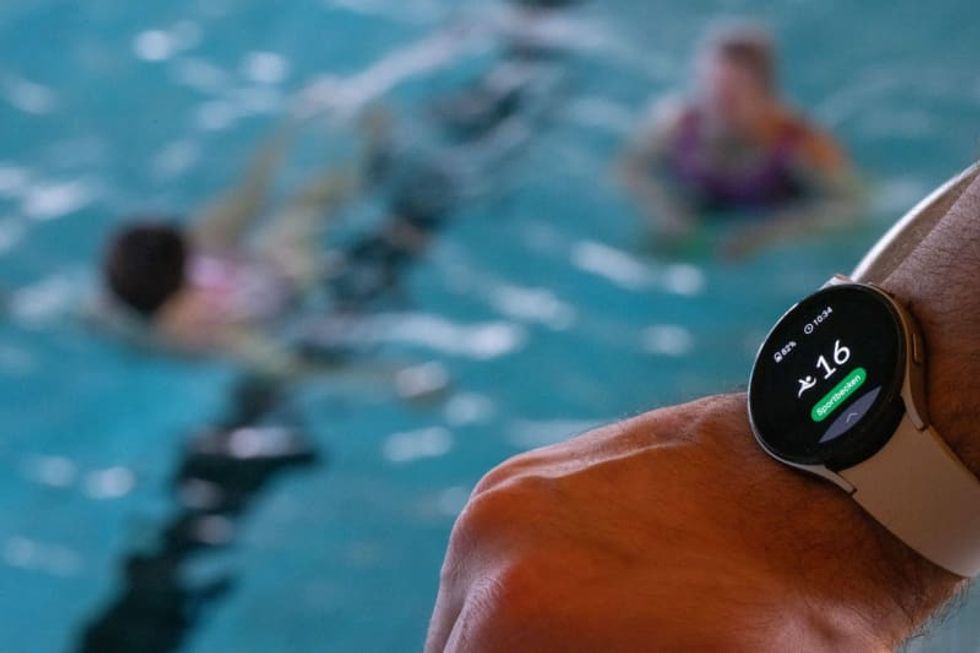
If the patterns are not deemed to be normal, the system alerts the staff at the pool, notifying them through their smartwatches. The watch emits a loud beep and vibrates, says Shahabeddin Khatibi, a pool attendant who has been working with the system since its outset. The watch display also shows a red dot to indicate the exact position of the person in trouble, along with three pictures.
At the start, there were several false alarms when swimmers did a roll turn, for example.
"Over time, the artificial intelligence has learned which movements are normal for swimmers and when a person is having problems," says Khatibi, who reports back to the system after each alarm, to help it learn whether it assessed the situation correctly.
After the end of the test and learning phase, Baum now wants to use the system in other pools and baths in Wiesbaden. "In the next step, we want to equip the non-swimmers' area and the outdoor pools. Next year, the thermal pool will follow," says Baum.
The costs vary depending on the size of the pool and the number of cameras, but for the current pool, the cost is around $32,000 to $42,000 per year, says Baum.
The AI isn't aiming to replace staff or water rescue services, but it helps as a safeguard for staff and swimmers alike.
"If it works only once in ten years and saves a person's life, then every cent invested was worth it," says Baum.
Swimming supervision also benefits from the operation. "The system is our third eye. Especially when there are 4,000 to 6,000 guests in the pool at once in summer, it helps us a lot to keep an overview," says swimming supervisor Khatibi.
Alongside spotting people in danger of drowning, the technology can also detect and sound an alarm if small children get separated from their parents while swimming.
The AI system also analyses how many people are in the pool at any one time and shows the number of swimmers in the water on the smartwatch.
Those concerned about data protection, meanwhile need not worry as the cameras only recognize peoples' outlines.
"It's not about monitoring people, but about the safety of the bathers," says Baum.
In addition to the system used in Wiesbaden, manufacturers also offer AI systems with cameras in the pools.
"This kind of technology cannot replace the staff in the swimming pool, but it can certainly be a valuable addition to support them and thus also to save lives," says a spokesperson for the German Life Saving Association (DLRG).
Staff cannot see all bathers at once, especially in large and deep pools or on a busy day, the spokesperson says. Since drowning often occurs silently, the AI can help to draw attention to a person faster.
Meanwhile the nearby city of Darmstadt also plans to buy an AI system in the Nordbad in the course of the year, a spokesperson says.
However, not all nearby pools are convinced.
In Fulda, also in Hesse, no such systems are yet in use at the city's three municipal outdoor and indoor swimming pools, operator RhönEnergie Fulda told dpa.
Stadtwerke Gießen, the operator of three swimming pools, also does not use an AI-based system for pool monitoring in its pools and does not yet plan to do so, says a spokesperson.
The same applies to the four municipal pools in Kassel. "From our point of view, the safety standard of the previous systems is not yet mature enough for us to rely on them," says a spokesperson for Städtische Werke Kassel. In order to guarantee safety in the pools, they rely on trained staff, he adds.
AI is not yet being used in the Taunus Therme in Bad Homburg either. "Since we are a relatively manageable thermal bath with a pool depth of 1.35 metres, this would definitely make sense. However, the costs are currently disproportionate," a spokeswoman says, adding that for now, the spa is "far away" from taking such a step.
Shahabeddin Khatibi, a pool supervisor, wears a smartwatch in the Kleinfeldchen indoor pool that shows him how many people are currently swimming in the sports pool. The indoor pool uses the Lynxight monitoring system, which uses cameras and artificial intelligence to send warnings if a swimmer is drowning. Sebastian Gollnow/dpa
Shahabeddin Khatibi, a pool attendant, stands under an AI camera in the Kleinfeldchen indoor pool. The indoor pool uses the Lynxight monitoring system, which uses cameras and artificial intelligence to detect if someone is drowning. Sebastian Gollnow/dpa
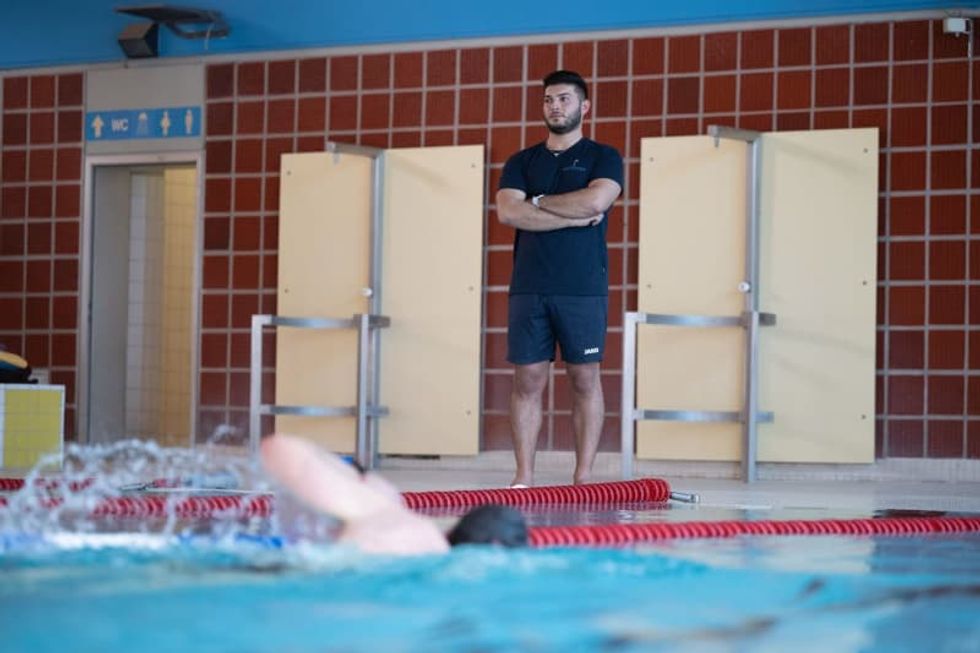
Shahabeddin Khatibi, a pool supervisor, stands at the edge of the Kleinfeldchen indoor pool. The pool employs the Lynxight monitoring system, which uses cameras and artificial intelligence to detect if someone is drowning. Sebastian Gollnow/dpa
How common are encounters between sharks and humans off California’s coast? According to new research conducted by California State University, Long Beach’s Shark Lab, there’s a surprisingly high amount of overlap between the places people and sharks hang out. The research team — led by Chris Lowe, professor of marine biology at CSU Long Beach — used drones to document human water activity and shark distribution. Researchers conducted more than 1,500 drone surveys from 2019 to 2021 across 26 different southern California beaches — going as far north as Santa Barbara and as far south as San Die...
A new study has found that both Christian nationalism and biblical literalism are independently associated with a greater tendency to believe in conspiracy theories. When people believed in both Christian nationalism and biblical literalism, their distrust of government officials increased significantly. The findings, published in the Journal for the Scientific Study of Religion, provide insight into the sociocultural factors that contribute to the spread and persistence of conspiracy beliefs in certain populations. The researchers were motivated by the growing concern over the harmful effects...
David Smith, a retired print technician from the north of England, was pursuing his hobby of looking for interesting shapes when he stumbled onto one unlike any other in November.
When Smith shared his shape with the world in March, excited fans printed it onto T-shirts, sewed it into quilts, crafted cookie cutters or used it to replace the hexagons on a soccer ball -- some even made plans for tattoos.
The 13-sided polygon, which 64-year-old Smith called "the hat", is the first single shape ever found that can completely cover an infinitely large flat surface without ever repeating the same pattern.
That makes it the first "einstein" -- named after the German for "one stone" (ein stein), not the famed physicist -- and solves a problem posed 60 years ago that some mathematicians had thought impossible.
After stunning the mathematics world, Smith -- a hobbyist with no training who told AFP that he wasn't great at maths at school -- then did it again.
While all agreed "the hat" was the first einstein, its mirror image was required one in seven times to ensure that a pattern never repeated.
But in a preprint study published online late last month, Smith and the three mathematicians who helped him confirm the discovery revealed a new shape -- "the spectre."
It requires no mirror image, making it an even purer einstein.
- 'It can be that easy' -
Craig Kaplan, a computer scientist at Canada's Waterloo University, told AFP that it was "an amusing and almost ridiculous story -- but wonderful".
He said that Smith, a retired print technician who lives in Yorkshire's East Riding, emailed him "out of the blue" in November.
Smith had found something "which did not play by his normal expectations for how shapes behave", Kaplan said.
If you slotted a bunch of these cardboard shapes together on a table, you could keep building outwards without them ever settling into a regular pattern.
Using computer programs, Kaplan and two other mathematicians showed that the shape continued to do this across an infinite plane, making it the first einstein, or "aperiodic monotile".
When they published their first preprint in March, among those inspired was Yoshiaki Araki. The Japanese tiling enthusiast made art using the hat and another aperiodic shape created by the team called "the turtle", sometimes using flipped versions.
Smith was inspired back, and started playing around with ways to avoid needing to flip his hat.
Less than a week after their first paper came out, Smith emailed Kaplan a new shape.
Kaplan refused to believe it at first. "There's no way it can be that easy," he said.
But analysis confirmed that Tile (1,1) was a "non-reflective einstein", Kaplan said.
Something still bugged them -- while this tile could go on forever without repeating a pattern, this required an "artificial prohibition" against using a flipped shape, he said.
So they added little notches or curves to the edges, ensuring that only the non-flipped version could be used, creating "the spectre".
'Hatfest'
Kaplan said both their papers had been submitted to peer-reviewed journals. But the world of mathematics did not wait to express its astonishment.
Marjorie Senechal, a mathematician at Smith College in the United States, told AFP the discoveries were "exciting, surprising and amazing".
She said she expects the spectre and its relatives "will lead to a deeper understanding of order in nature and the nature of order."
Doris Schattschneider, a mathematician at Moravian College in the US, said both shapes were "stunning".
Even Nobel-winning mathematician Roger Penrose, whose previous best effort had narrowed the number of aperiodic tiles down to two in the 1970s, had not been sure such a thing was possible, Schattschneider said.
Penrose, 91, will be among those celebrating the new shapes during the two-day "Hatfest" event at Oxford University next month.
All involved expressed amazement that the breakthrough was achieved by someone without training in maths.
"The answer fell out of the sky and into the hands of an amateur -- and I mean that in the best possible way, a lover of the subject who explores it outside of professional practice," Kaplan said.
"This is the kind of thing that ought not to happen, but very happily for the history of science does happen occasionally, where a flash brings us the answer all at once."
The Pacific El Nino phenomenon, which is responsible for recurring extreme weather events worldwide, looks set to be particularly intense as it returns this year after a six-year hiatus.
Climate experts predict that the ocean current pattern, which moves from the West to East Pacific, will have profound environmental and economic effects across the globe.
“The early signs are already there,” French climatologist Professor Benjamin Pohl, of the national CNRS research institute, told FRANCE 24.
“Surface waters are already 0,5°C to 1°C warmer than usual, from which we can predict that they will rise to 2°C above the average as El Nino peaks. This is a considerable rise in temperature.”
The El Nino weather phenomenon translates as “little one” and was named after the baby Jesus by fishermen, as it seemed to peak around Christmas time. Warmer sea currents led to an absence of fish, which prefer cooler nutrient-rich water.
It takes place periodically, in cycles of between two and seven years. The last one happened five years ago.
Particularly severe
Scientists predict that the massive warm Pacific currents heading for the Peruvian and Equatorial coasts will be particularly severe this year.
The knock-on effects of the warmer ocean currents are expected to create an upsurge in dense rainclouds that impacts much of North and South America, bringing heavy rain and flooding even in desert regions.
And while this might seem like good news, especially for drought-hit areas such as California, these rain storms are often fast, brutal downpours.
The storms are predicted to be so severe, in fact, that Peru has cancelled the Paris-Dakar rally that had been due to take place there in January 2024.
On the other side of the Pacific, the weather pattern is usually inverted, with lower rainfall and droughts expected as far west as South East Asia, India and West Africa.
“Droughts are especially feared in these countries that are particularly dependent on agriculture,” according to Professor Pohl.
The dry periods are also often the cause of devastating bush fires: the El Nino of 1982-1983 destroyed 335,000 hectares of Australian forest and agricultural land.
Fishing will also be badly affected, the last El Nino events having wiped out 90% of sardine and anchovy stocks on the on the north-west coast of South America.
Global warming?
Across the Pacific, the warmer current will have an irreversible effect on coral reefs. The last big El Nino event, in 1997-1998, caused the worst coral bleaching (where the coral is killed and turns white) on record. The Maldives lost 90% of their coral, and in total 16% or the world’s reefs were wiped out.
The only good news is for the other side of the Americas, where Atlantic hurricanes are normally less severe during an El Nino event.
While El Nino is a naturally-occurring event, with evidence from fossils showing that the weather cycle has been in evidence for at least 10,000 years, “we can see that in the last three decades the phenomenon has become particularly intense”, said Professor Pohl.
“It is likely, even if it hasn’t been proved outright, that global warming linked to human activity is driving these changes,” he said.
KANSAS CITY, Mo. — An invasive fish species last seen in Missouri in 2019 is now back, and there are concerns it could continue to spread throughout the state. A northern snakehead fish was captured May 19 in Wayne County in the foothills of the Ozarks, according to the Missouri Department of Conservation. It’s the second ever sighting of the fish in Missouri, with the first being in 2019. According to the National Invasive Species Information Center, the northern snakehead is a concern because it preys on and competes with native species. If you see one, you’re advised to kill it immediately ...
A historical dream team of five master sculptors, including Michelangelo, Rodin and Takamura, have trained artificial intelligence (AI) to design a sculpture dubbed "the Impossible Statue", now on show in a Swedish museum.
"This is a true statue created by five different masters that would never have been able to collaborate in real life," said Pauliina Lunde, a spokeswoman for Swedish machine engineering group Sandvik that used three AI software programmes to create the artwork.
Shaking up traditional conceptions about creativity and art, the stainless steel statue depicts an androgynous person with the lower half of the body covered by a swath of material, holding a bronze globe in one hand.
On show at Stockholm's National Museum of Science and Technology, the statue measures 150 centimeters (4 feet 11 inches) and weighs 500 kilograms (1,100 pounds).
The idea was to create a mix of styles from five famed sculptors who each made their mark on their era: Michelangelo (Italy 1475-1564), Auguste Rodin (France 1840-1917), Kathe Kollwitz (Germany 1867-1945), Kotaro Takamura (Japan 1883-1956) and Augusta Savage (US 1892-1962).
"Something about it makes me feel like this is not made by human being," Julia Olderius, in charge of concept development at the museum, told AFP.
Visitors will note the muscular body inspired by Michelangelo, and the hand holding the globe inspired by Takamura.
Sandvik's engineers trained the AI by feeding it a slew of images of sculptures created by the five artists.
The software then proposed several images in 2D which it believed reflected key aspects from each of the artists.
"In the end we had 2D images of the sculpture in which we could see the different masters reflected. Then we put these 2D images into 3D modeling," Olderius said.
But is it art, or technological prowess?
"I don't think you can define what art is. It's up to every human being to see, 'this is art, this is not art'. And it's up to the audience to decide," Olderius said.
Amid debate about the role of AI in the art world, Olderius said she was optimistic.
"I don't think you have to be afraid of what AI is doing with creativity or concepts or art and design," she said.
"I just think you have to adapt to a new future where technology is a part of how we create concepts and art."
Uncommon Courses is an occasional series from The Conversation U.S. highlighting unconventional approaches to teaching.
Title of course:
“From Magic Mushrooms to Big Pharma”
What prompted the idea for the course?
I’m from the foothills of the Appalachians in southern Ohio, where my Grandma Mildred would go out into the woods, which she called her medicine cabinet, to find herbs to use as medicine. I grew up to be an anthropologist, interested in how people around the world heal themselves. In the 1990s, I did my dissertation research in Ecuador and learned how Indigenous people in the Choco region used ayahuasca and other medicines from the forest to assist in the grieving process.
With the legalization of cannabis in many states and increased research on how “nontraditional” drugs can assist people with post-traumatic stress disorder, depression and addiction issues, it seemed like an opportune time to create this course. It’s part of a new interdisciplinary minor at Western Illinois University called “Cannabis & Culture” that offers students a foundation for understanding the social and cultural context, history and politics of nature-based medicine use in the United States and around the globe.
What does the course explore?
The course looks at how different peoples and cultures use nature-based medicines to heal themselves. First we establish that there are many ways of knowing the world around us, just as there are many ways to heal ourselves. Some of us rely on Western medicine, others pray, yet others turn to Indigenous or traditional ways of healing that are rooted in nature.
Kambô frog medicine is a shamanic medicinal ritual that originates among Amazonian tribes who use the poisonous excretion from the Phyllomedusa bicolor tree frog to cure illness. GummyBone/iStock via Getty Images Plus
Using the Amazonian giant leaf frog, or kambô (Phyllomedusa bicolor), as a case study, students learn that at least 15 Indigenous groups have long histories of using the frog’s secretion for its analgesic, antibiotic and wound-healing properties. Eleven patents related to P. bicolor have been granted – all of them in rich countries. Indigenous people have not been compensated for their knowledge.
Why is this course relevant now?
The current generation of young people are open about mental health issues, and many people are looking for new ways to deal with anxiety, grief, PTSD and depression. My students can discuss their health concerns and learn about alternatives to what they may be accustomed to.
Over the course of the semester, students begin to recognize that there is no one right way of healing. More importantly, there is no one right way of being human. It is my hope that students leave seeing that everything is connected, integrally linked to humanity’s relationship to nature.
Scientific materials provided by the Multidisciplinary Association for Psychedelic Studies, a nonprofit that provides some of the only scientific research on psychedelics in the U.S. and promotes awareness of these drugs
Studying how different cultures approach problems that plague all humans, like being sick and healing our ill, demonstrates to students that there are many ways the world over to solve problems. This course views different approaches not as a problem to be overcome but as a resource that can yield new ways of thinking and new opportunities – a definite advantage in the professional world. I hope students also learn to become advocates for their own health and well-being.