Adults who doubt they have been fully vaccinated against polio should talk to their doctors about getting additional shots, experts say. A confirmed case of polio in New York state has renewed a sense of urgency to make sure everyone is fully vaccinated against the potentially fatal virus, said Duke infectious disease expert Dr. Cameron Wolfe. “We never really worried about that because so many people had been vaccinated effectively that the disease was gone from the U.S. for decades,” Wolfe said. “Until now.” This is especially true for children who may have fallen behind on their vaccine ser...
As NASA's ambitions for lunar exploration are returning, Washington is regaining one of the continent's biggest landmarks for fans of space travel and aviation in general.
The US capitol is gearing up to reopen its National Air and Space Museum to visitors after a six-month closure for renovation work to add several new exhibitions.
Known for its collection of space travel artefacts from the fabled Mercury, Gemini and Apollo missions, the museum is home to exhibits from the history of aviation and space travel, distributed over eight exhibition worlds.
It's not only historic airplanes and space travel to which the museum pays homage. A major highlight for Star Wars fans is likely to be the sight of a full-size, real-life X-Wing star fighter, which is one of the newly added exhibits.
"This is one of the most exciting times in the National Air and Space Museum's history," said Chris Browne, director of the museum.
"When we open the first reimagined galleries, we hope all visitors are inspired by artefacts on display for the first time, favourite icons of aerospace presented in new ways and diverse storytelling."
The museum, located on Washington's National Mall, is set to be open again from October 14. Admission is free, but tickets must be reserved online in advance, which will be possible from one month before the reopening (September 14).
Fuel leaks and a possible crack discovered during final liftoff preparations delayed the launch of NASA’s mighty new moon rocket Monday morning on its shakedown flight with three test dummies aboard.
As precious minutes ticked away, NASA repeatedly stopped and started the fueling of the Space Launch System rocket with nearly 1 million gallons of super-cold hydrogen and oxygen because of a leak. The fueling already was running nearly an hour late because of thunderstorms off Florida’s Kennedy Space Center.
The leak appeared in the same place that saw seepage during a dress rehearsal in the spring.
Then a second apparent leak in a valve turned up, officials said.
Later in the morning, a crack or some other defect was spotted on the core stage – the big orange fuel tank with four main engines on it – with frost appearing around the suspect area, NASA officials said. Engineers began studying the buildup.
The rocket was set to lift off on a mission to put a crew capsule into orbit around the moon. The mission represents a major milestone in America's quest to put astronauts back on the moon for the first time since the Apollo program ended 50 years ago.
The next launch attempt would not be until Friday at the earliest.
The 98-meter rocket is the most powerful ever built by NASA, out-muscling even the Saturn V that took the Apollo astronauts to the moon.
No astronauts were inside the Artemis rocket's Orion capsule. Instead, three test dummies were aboard for the six-week mission, which was scheduled to end with the capsule's splashdown in the Pacific in October.
The launch will be the first flight in NASA’s 21st-century moon-exploration program, named Artemis after Apollo’s mythological twin sister.
The problems seen Monday were reminiscent of NASA's space shuttle era, when hydrogen fuel leaks disrupted countdowns and delayed a string of launches back in 1990.
Launch director Charlie Blackwell-Thompson and her team also had to deal with a communication problem involving the Orion capsule.
Engineers scrambled to understand an 11-minute delay in the communication lines between Launch Control and Orion that cropped up late Sunday. Although the problem had cleared by Monday morning, NASA needed to know why it occurred before committing to a launch.
Paleontologists in Portugal have unearthed the fossilized skeleton of what could be the largest dinosaur ever found in Europe.
The remains are thought to be those of a sauropod, a herbivorous dinosaur 12 meters (39 feet) tall and 25 meters long that roamed the Earth around 150 million years ago.
"It's one of the biggest specimens discovered in Europe, perhaps in the world," paleontologist Elisabete Malafaia, from the Faculty of Sciences at Lisbon University, told AFP on Monday.
The bones were uncovered by Portuguese and Spanish scientists in the garden of a house near Pombal in central Portugal at the beginning of August.
Among the bones collected, they found the remains of a rib about three meters long, Malafaia said.
Fossil fragments were first noticed at the site in 2017, when the owner was digging up his garden to make way for an extension.
He contacted paleontologists, who unearthed part of the dinosaur skeleton earlier this month and have been examining it ever since.
Sauropods have characteristically long necks and tails and are among the largest animals to have ever lived.
The fossils discovered at the Monte Agudo site in Pombal are thought to be those of a brachiosaurid who lived during the Upper Jurassic period.
The fact that the vertebrae and ribs were found at the same location and in the position they would have been in the dinosaur's anatomy is "relatively rare", Malafaia said.
The team may conduct more digs in the coming months at the site and in the surrounding area.
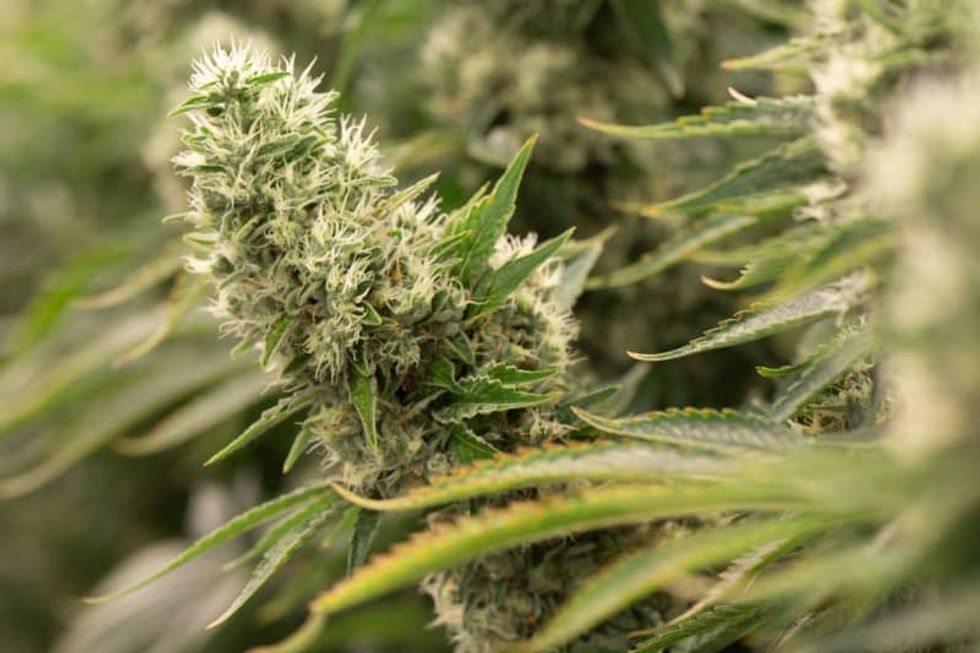
Growers worldwide experiment with a number of seeds to find the right mix of sativa or indica. They look for the desired level of THC, the main psychoactive ingredient in weed (33% would be very high), and terpenes, chemical compounds that produce unique combinations of flavor, aroma, and color. Sebastian Kahnert/dpa-Zentralbild/dpa
Volley Hayhurst had just finished donning a disposable lab coat when he glanced at his mobile phone and let out an enthusiastic “Yes!”
“My phone is blowing up. The results just came back,” said Hayhurst, vice president of operations at Columbia Care’s new 270,000-square-foot cannabis growing and packaging facility in Vineland, New Jersey. “We have something fun and new for the market.”
It’s THC-infused salt water taffy, a Shore favorite that the company will launch soon in Delaware, likely to follow eventually in New Jersey.
Demand has proved so strong for recreational weed in New Jersey since sales began in April 2021 that there are still lines each day outsidemost of the 17 stores that sell it. Adults are allowed to buy up to one ounce of cannabis in a visit. They can buy dried flower, concentrated oils, resin, vape formulas, tinctures, topicals, syringes, lozenges and soft chews. But perishable edibles like brownies are not allowed. Another nine stores sell marijuana only for medical use.
By state law, all marijuana sold in New Jersey must be grown in state by licensed growers; homeowners can’t cultivate their own.
For Columbia Care, plants get their start at the publicly traded company’s two facilities in Vineland, Cumberland County: Its original 50,000-square-foot plant and the one that opened in June that’s the equivalent of just under five football fields.
Most commercial pot is grown indoors where security, cleanliness, temperature, humidity, light and water flow can all be controlled with precision.
Columbia Care, a publicly traded company based in New York, describes itself as one of the largest and most experienced cultivators and manufacturers in the industry, operating in both the U.S. and Europe. It is currently being bought by Chicago-based Cresco Labs, which has cannabis operations in 10 states.
Columbia Care sells through its Cannabist stores in Deptford and Vineland, with plans to open a third in Mays Landing.
Other marijuana companies operating in New Jersey include the Apothecarium, founded in San Francisco, which operates three stores. Curaleaf operates two stores, and Miami-based Ayr Wellness operates three stores under the Garden State Dispensary Brand.
Hayhurst, along with Cori Griffith, operations manager, and Alex Anthony, cultivation manager, gave The Inquirer a tour of the Columbia Care plant at the end of July to explain the growing process. The Inquirer agreed to not shoot pictures or video of certain proprietary methods or machinery.
The first literal step inside the Columbia Care includes a shoe bath.
All workers and visitors must wear lab coats, hair nets, and shoe protectors to keep out contamination. And each steps into a sterilizing bath before entering any of the cavernous rooms. The inside of the facility resembles a clean computer chip plant, or even a hospital with long, wide, white corridors and secure doors.
Anthony, who studied agriculture at Iowa State University, said fungi, viruses and other contaminants can sneak into the building. And once they’re in, he said, they are difficult to remove.
If someone, for example, stepped on a cigarette butt outside, Anthony said, “it could be a vector for the tobacco mosaic virus.”
That virus is known to attack and stunt the growth of plants and is often spread by agricultural workers. Once a plant is infected, there is no chemical cure.
And there’s a lot of ground for shoes to cover: The former shipping and logistics warehouse on West Park Avenue has been renovated specifically for weed operations and employs 35 people full-time. About 50,000 square feet is currently being used, with about 20,000 square feet now devoted to plants as the company ramps up its production.
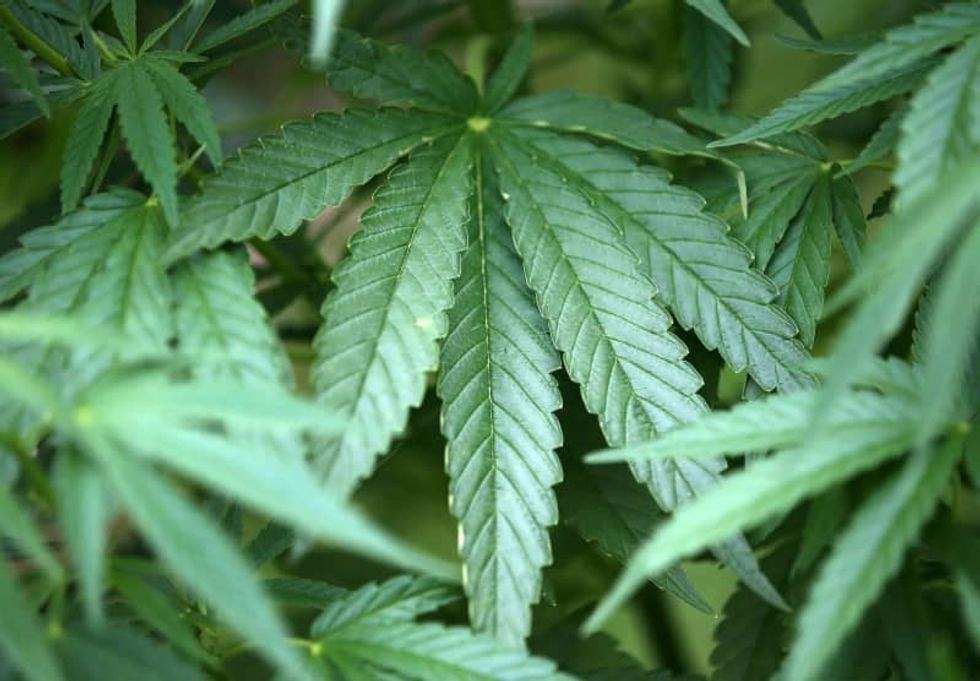
All the weed-related products start as a combination of two cannabis species: sativa, known for a stimulating high, or indica, known for a more mellow experience.
Growers experiment with a number of seeds to find the right mix of sativa or indica. They look for the desired level of THC, the main psychoactive ingredient in weed (33% would be very high), and terpenes, chemical compounds that produce unique combinations of flavor, aroma, and color. For example, 10 seeds might yield one plant that has the genetic qualities a grower wants or customers demand.
That seed grows into a mother plant — a mature marijuana plant that can become part of a grower’s proprietary strain and can yield hundreds of clones.
At Columbia Care’s facility, workers examine rows and rows of mother plants, stored on movable, white, steel framed, multitiered racks, resembling something used inside a library archive. Workers take small cuttings off the plants and place them in a nutrient solution as clones.
Eventually, the cuttings are transplanted to soil in plastic terrariums and labeled by strain, or genotypes known to produce traits unique to a brand. Anthony said using cuttings from a mother plant ensures customers get the same experience for a particular strain each time. The company grows up to 12 strains but mostly relies on four to eight.
Mother plants typically grow about 3 feet tall in the facility, Anthony said.
Workers are careful not to take too many cuttings from the same tree, but eventually, the genetic properties of a mother plant degrades, and the cycle starts over with a new mother plant.
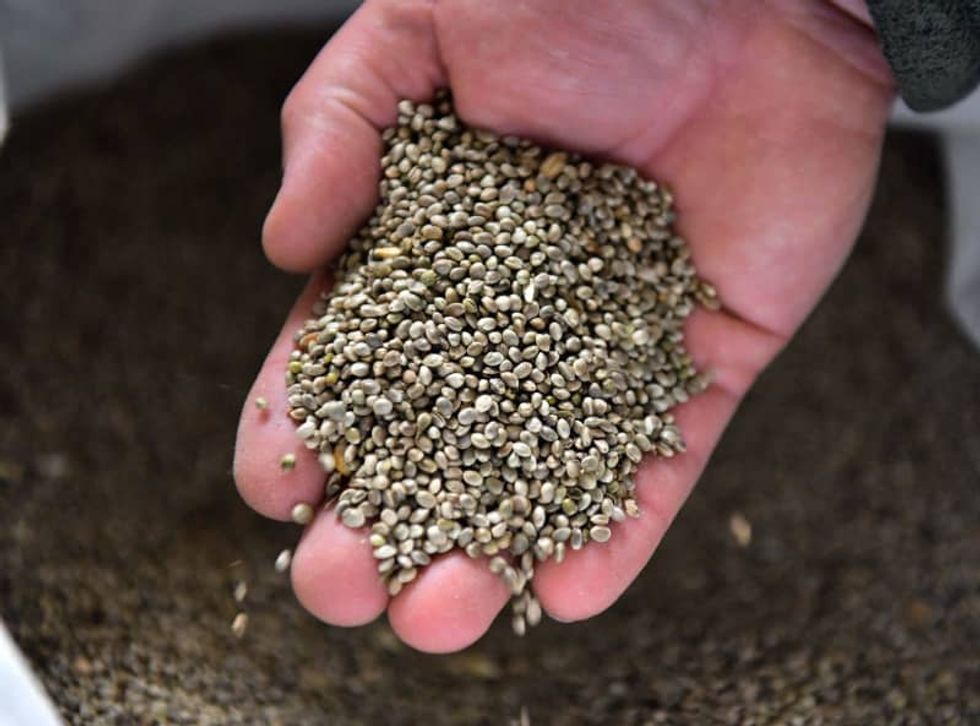
Griffith said that in larger states with well established markets, a single mother plant can be worth millions because of all the cuttings it yields and are sold to other companies. Licensed cultivators in New Jersey can transport seeds across state lines because they do not contain TCH, but any plant or cutting must remain within state borders.
Consider that a 3.5 gram jar (1/8 ounce) of Runtz Muffin flower, used to roll joints, was selling last week at the Columbia Care’s Cannabist store in Vineland for about $47. It’s part of the company’s Triple 7 line, which includes other hybrids such as Hot Rod, and, the newest, Watermelon Sorbet.
Cuttings from the mother tree are moved to a room equipped with powerful grow lights that shine eight to 14 hours a day.
“This is where the light cycle starts to change everything,” Anthony said.
The light is calibrated to ensure the proper amount of photosynthesis for the plants to flower. Workers part racks by turning cranks, allowing them to reach upper tiers. It can take eight to 12 weeks for a flower to achieve the size and color needed for harvesting.
The flowers are taken to a high-tech sorting and packaging machine where they are dropped in a silver steel hopper that resembles a futuristic disco chandelier. The hopper contains 14 scales that sorts flowers by size and weight down to the gram.
During the tour, they were being manually sorted and packaged as the machine was being reset.
The flowers drop into jars, which are capped, sealed and labeled.
The machine “was originally made for other food packaging,” Griffith said. “It’s been sort of tweaked a little bit to do cannabis as well. These do flower, and they can do gummies and tablets. ... This is usually running all day every day.”
As he spoke, a line at least 10-deep had formed outside the company’s store on Delsea Drive in Vineland to buy the finished product.
Pot growers from Germany to the US experiment with a number of seeds to create the right marijuana plant. A seed then grows into a mother plant that can become part of a grower’s proprietary strain and can yield hundreds of clones. Martin Schutt/dpa-Zentralbild/dpa-tmn
All weed-related products start as a combination of two cannabis species: sativa, known for a stimulating high, or indica, known for a more mellow experience. Oliver Berg/dpa
Hunting for massive pythons in the dead of night doesn’t sound particularly relaxing. But for a group of Florida veterans coping with PTSD, it’s a form of therapy. The Swamp Apes - an association of python hunters founded 15 years ago - disappear deep into the Florida Everglades each night. They’re searching for Burmese pythons - an invasive species that has devastated the delicate wetland ecosystem. "The pythons have left a great impact - negative impact - in the environment here,” says Tom Rahill, python hunter and founder of Swamp Apes. “Where once there were thousands of animals, now it’s ...
CAPE CANAVERAL, Fla. (Reuters) - Launch teams at the Kennedy Space Center in Florida spent a final full day of preparations ahead of Monday's planned liftoff of NASA's giant next-generation rocket on its debut test flight, kicking off the agency's Artemis moon-to-Mars program 50 years after the end of Apollo.
NASA officials said on Sunday that all systems appeared "go" for liftoff, and weather forecasts called for an 80% chance of favorable conditions at the top of Monday's two-hour launch window, starting at 8:33 a.m. EDT (12:33 GMT), diminishing to 60% toward the end of that period.
"Everything to date looks good from a vehicle perspective," said Jeff Spaulding, senior NASA test director for the landmark mission, called Artemis I. "We are excited, the vehicle is ready, it looks great."
Although lightning rods at the launch site were struck during a storm on Saturday, Spaulding said he has not "seen anything on the ground systems that give us any concerns." NASA said there was no damage to the spacecraft or launch facilities.
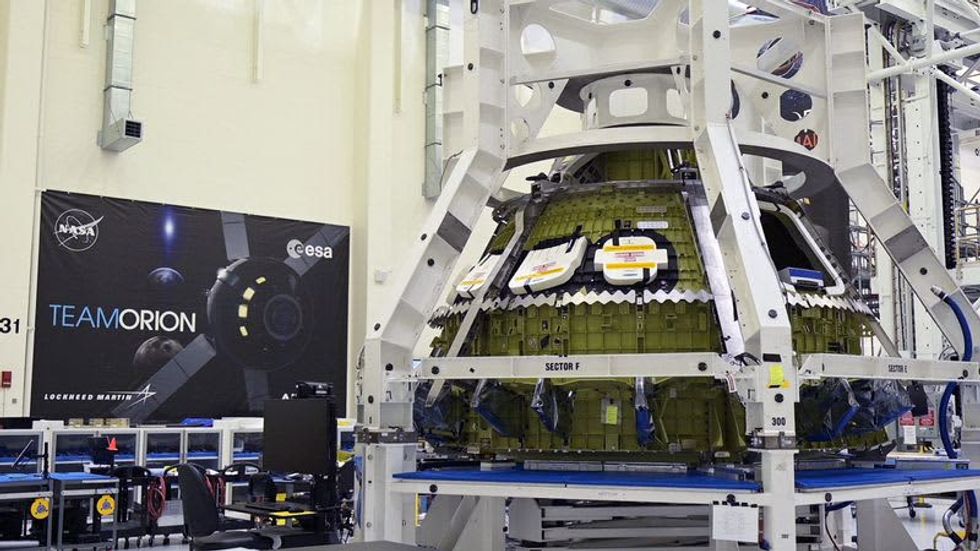
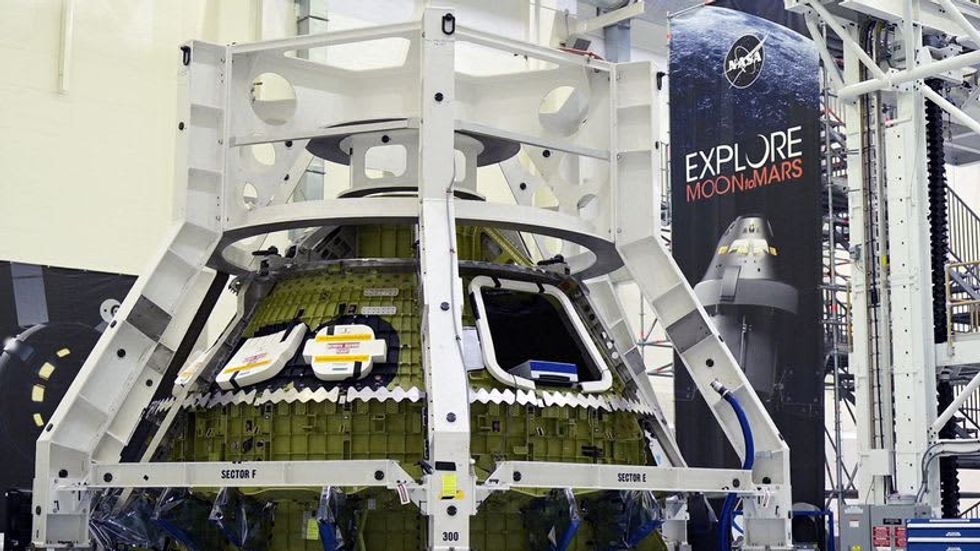
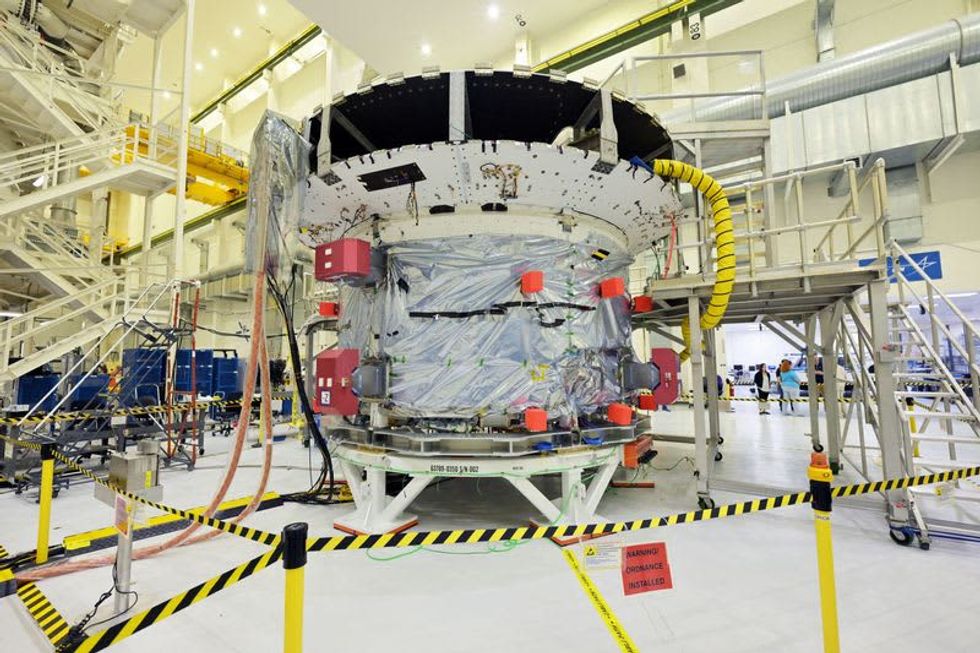
The Space Launch System (SLS) rocket is set to propel an uncrewed capsule named Orion around the moon and back on a six-week test flight designed to put both vehicles through their paces before flying astronauts in a subsequent mission targeted for 2024. The SLS-Orion combo, standing 322 feet (98 meters) tall, form the centerpiece of the U.S. space agency's successor to the Apollo moon program of the 1960s and 1970s.
If those two missions are successful, NASA is aiming to land astronauts back on the moon, including the first woman to set foot on the lunar surface, as early as 2025, though many experts believe that time frame is likely to slip by a few years. The last humans to walk on the moon were the two-man descent team of Apollo 17 in 1972, following in the footsteps of 10 other astronauts during five earlier missions beginning with Apollo 11 in 1969.
The Artemis program seeks to eventually establish a long-term lunar base as a stepping stone to even more ambitious astronaut voyages to Mars, a goal that NASA officials have said will probably take until at least the late 2030s to achieve.
SLS has been under development for more than a decade, with years of delays and cost overruns. But the Artemis program also has generated tens of thousands of jobs and billions of dollars in commerce under the primary contractors Boeing Co for SLS and Lockheed Martin Corp for Orion.
The one issue NASA officials were eyeing on Sunday before the maiden flight of SLS concerned a potential - but minor - helium leak in launch pad equipment, though Spaulding told reporters during a launch-eve news conference that he did not expect any technical show-stoppers to the countdown.
"This is a test flight, remember that," NASA chief Bill Nelson said in a Reuters interview that was interrupted by an unexpected phone call from U.S. Vice President Kamala Harris, who will be in Florida to see the rocket launch in person.
"She's excited!" Nelson said after the call.
(Reporting by Joey Roulette in Cape Canaveral, Fla.; Editing by Steve Gorman and Paul Simao)
KENNEDY SPACE CENTER, Fla. — Artemis I isn’t just a mission to orbit the moon. It’s the beginning of a new era for NASA that promises to not just return humans to the lunar surface, but to press on to Mars. “We are explorers and adventurers as a species,” said NASA Administrator Bill Nelson at a news conference Saturday. “That basically is the fulfillment of our destiny. But in that exploration, we’re going to learn new things and develop new things that are going to improve ― just as it’s been under our space program — our lives here on Earth.” That’s the high-minded end goal of the Artemis p...
From the COVID-19 pandemic to the war in Ukraine, misinformation is rife worldwide. Many tools have been designed to help people spot misinformation. The problem with most of them is how hard they are to deliver at scale.
But we may have found a solution. In our new study we designed and tested five short videos that “prebunk” viewers, in order to inoculate them from the deceptive and manipulative techniques often used online to mislead people. Our study is the largest of its kind and the first to test this kind of intervention on YouTube. Five million people were shown the videos, of which one million watched them.
We found that not only do these videos help people spot misinformation in controlled experiments, but also in the real world. Watching one of our videos via a YouTube ad boosted YouTube users’ ability to recognise misinformation.
As opposed to prebunking, debunking (or fact-checking) misinformation has several problems. It’s often difficult to establish what the truth is. Fact-checks also frequently fail to reach the people who are most likely to believe the misinformation, and getting people to accept fact-checks can be challenging, especially if people have a strong political identity.
Studies show that publishing fact-checks online does not fully reverse the effects of misinformation, a phenomenon known as the continued influence effect. So far, researchers have struggled to find a solution that can rapidly reach millions of people.
The big idea
Inoculation theory is the notion that you can forge psychological resistance against attempts to manipulate you, much like a medical vaccine is a weakened version of a pathogen that prompts your immune system to create antibodies. Prebunking interventions are mostly based on this theory.
Most models have focused on counteracting individual examples of misinformation, such as posts about climate change. However, in recent years researchers including ourselves have explored ways to inoculate people against the techniques and tropes that underlie much of the misinformation we see online. Such techniques include the use of emotive language to trigger outrage and fear, or the scapegoating of people and groups for an issue they have little-to-no control over.
An example of a social media post (which we used as one of the stimuli in our study) that makes use of a false dichotomy (or false dilemma), a commonly used manipulation technique.
Online games such as Cranky Uncle and Bad News were among the first attempts to try this prebunking method. There are several advantages to this approach. You don’t have to act as the arbiter of truth as you don’t have to fact-check specific claims you see online. It allows you to side-step emotive discussions about the credibility of news sources. And perhaps most importantly, you do not need to know what piece of misinformation will go viral next.
A scalable approach
But not everyone has the time or motivation to play a game – so we collaborated with Jigsaw (Google’s research unit) on a solution to reach more of these people. Our team developed five prebunking videos, each lasting less than two minutes, which aimed to immunise viewers against a different manipulation technique or logical fallacy. As part of the project, we launched a website where people can watch and download these videos.
Screenshots from one of the videos.
We first tested their impact in the lab. We ran six experiments (with about 6,400 participants in total) in which people watched one of our videos or an unrelated control video about freezer burn. Afterwards, within 24 hours of viewing the video, they were asked to evaluate a series of (unpublished) social media content examples that either did or did not make use of misinformation techniques. We found that people who saw our prebunking videos were significantly less liable to manipulation than the control participants.
But findings from lab studies do not necessarily translate to the real world. So we also ran a field study on YouTube, the world’s second-most visited website (owned by Google), to test the effectiveness of the video interventions there.
For this study we focused on US YouTube users over 18 years old who had previously watched political content on the platform. We ran an ad campaign with two of our videos, showing them to around 1 million YouTube users. Next we used YouTube’s BrandLift engagement tool to ask people who saw a prebunking video to answer one multiple-choice question. The question assessed their ability to identify a manipulation technique in a news headline. We also had a control group, which answered the same survey question but didn’t see the prebunking video. We found the prebunking group was 5-10% better than the control group at correctly identifying misinformation, showing that this approach improves resilience even in a distracting environment like YouTube.
One of the prebunking videos (“false dichotomies”)
Our videos would cost less than 4p per video view (this would cover YouTube advertising fees). As a result of this study, Google is going to run an ad campaign using similar videos in September 2022. This campaign will be run in Poland and the Czech Republic to counter disinformation about refugees within the context of the Russia-Ukraine war.
When you are trying to build resilience, it is useful to avoid being too direct in telling people what to believe, because that might trigger something called psychological reactance. Reactance means that people feel their freedom to make decisions is being threatened, leading to them digging their heels in and rejecting new information. Inoculation theory is about empowering people to make their own decisions about what to believe.
At times, the spread of conspiracy theories and false information online can be overwhelming. But our study has shown it is possible to turn the tide. The more that social media platforms work together with independent scientists to design, test and implement scalable, evidence-based solutions, the better our chances of making society immune to the onslaught of misinformation.
Conspiracy theorist and US far-right media personality Alex Jones was recently ordered to pay US$45 million (£37 million) damages to the family of a child killed in the 2012 Sandy Hook school shooting.
Jones had claimed that being banned or “deplatformed” from major social media sites for his extreme views negatively affected him financially, likening the situation to “jail”. But during the trial, forensic economist Bernard Pettingill estimated Jones’s conspiracy website InfoWars made more money after being banned from Facebook and Twitter in 2018.
So does online deplatforming actually work? It’s not possible to measure influence in a scientifically rigorous way so it’s difficult to say what happens to a person or group’s overall influence when they are deplatformed. Overall, research suggests deplatforming can reduce the activity of nefarious actors on those sites. However, it comes with a price. As deplatformed people and groups migrate elsewhere, they may lose followers but also become more hateful and toxic.
Typically, deplatforming involves actions taken by the social media sites themselves. But it can be done by third parties like the financial institutions providing payment services on these platforms, such as PayPal.
Closing a group is also a form of deplatforming, even if the people in it are still free to use the sites. For example, The_Donald subreddit (a forum on the website Reddit) was closed for hosting hateful and threatening content, such as a post encouraging members to attend a white supremacist rally.
Stickied Post on The_Donald subreddit, August 2017.
A frame of the anti-CNN GIF tweeted by Donald Trump.
Does deplatforming work?
Research shows deplatforming does have positive effects on the platform the person or group was kicked out of. When Reddit banned certain forums victimising overweight people and African Americans, a lot of users who were active on these hateful subreddits stopped posting on Reddit altogether. Those who stayed active posted less extreme content.
Plots by Jhaver at al. Posting activity levels and severe toxicity scores of the supporters of three deplatformed Twitter celebrities pre- and post-deplatforming.
But the deplatformed group or person can migrate. Alex Jones continues to work outside mainstream social networks, mainly operating through his InfoWars website and podcasts. A ban from big tech may be seen as punishment for challenging the status quo in an uncensored manner, reinforcing the bonds and sense of belonging between followers.
Gab was created as an alternative social network in 2016, welcoming users who have been banned from other platforms. Since the US Capitol insurrection, Gab has been tweeting about these bans as a badge of honour, and said it’s seen a surge in users and job applications.
My team’s research looked at the subreddits The_Donald and Incels (a male online community hostile towards women), which moved to standalone websites after being banned from Reddit. We found that as dangerous communities migrated onto different platforms, their footprints became smaller, but users got significantly more extreme. Similarly, users who got banned from Twitter or Reddit showed an increased level of activity and toxicity upon relocating to Gab.
Timelines of creation, quarantining, and banning of the Incels and The_Donald subreddits.
Other studies into the birth of fringe social networks like Gab, Parler, or Gettr have found relatively similar patterns. These platforms market themselves as bastions of free speech, welcoming users banned or suspended from other social networks. Research shows that not only does extremism increase as a result of lax moderation but also that early site users have a disproportionate influence on the platform.
The unintended consequences of deplatforming are not limited to political communities but extend to health disinformation and conspiracy theory groups. For instance, when Facebook banned groups discussing COVID-19 vaccines, users went on Twitter and posted even more anti-vaccine content.
Alternative solutions
What else can be done to avoid the concentration of online hate that deplatforming can encourage? Social networks have been experimenting with soft moderation interventions that do not remove content or ban users. They limit the content’s visibility (shadow banning), restrict the ability of other users to engage with the content (replying or sharing), or add warning labels.
Examples of soft moderation on Twitter: warning labels and shadow banning.
However, there is potential for popularity bias (acting on or ignoring content based on the buzz around it) about what subjects platforms like Twitter decide to intervene on. Meanwhile, warning labels seem to work less effectively for fake posts if they are right-leaning.
It is also still unclear whether soft moderation creates additional avenues for harassment, for example mocking users that get warning labels on their posts or aggravating users who cannot re-share content.
Looking forward
A crucial aspect of deplatforming is timing. The sooner platforms act to stop groups using mainstream platforms to grow extremist movements, the better.
Rapid action could in theory put the brakes on the groups’ efforts to muster and radicalise large user bases.
But this would also need a coordinated effort from mainstream platforms as well other media to work. Radio talk shows and cable news play a crucial role in promoting fringe narratives in the US.
We need an open dialogue on the deplatforming tradeoff. As a society, we need to discuss if our communities should have fewer people exposed to extremist groups, even if those who do engage become ever more isolated and radicalised.
At the moment, deplatforming is almost exclusively managed by big technology companies. Tech companies can’t solve the problem alone, but neither can researchers or politicians. Platforms must work with regulators, civil rights organisations and researchers to deal with extreme online content. The fabric of society may depend upon it.
The fossil record represents an amazing window into the endless forms of life that have existed across countless ages. By studying ancient species and ecosystems we can increase our understanding of what lived in the past and how the Earth was different compared to today. We can also use fossils to understand how evolution works and what is most likely to evolve under particular sets of circumstances.
This context is what makes Meraxes gigas, a newly named theropod dinosaur, so important for our understanding of dinosaur evolution and biodiversity.
I was part of the international team of palaeontologists, led by Juan Canale of the Ernesto Bachmann Palaeontological Museum, that named and described Meraxes gigas. The specimen was collected between 2012 and 2014 near Villa El Chocón in Argentina, in rocks of the ~95 million year old Huincul Formation.
Top predator
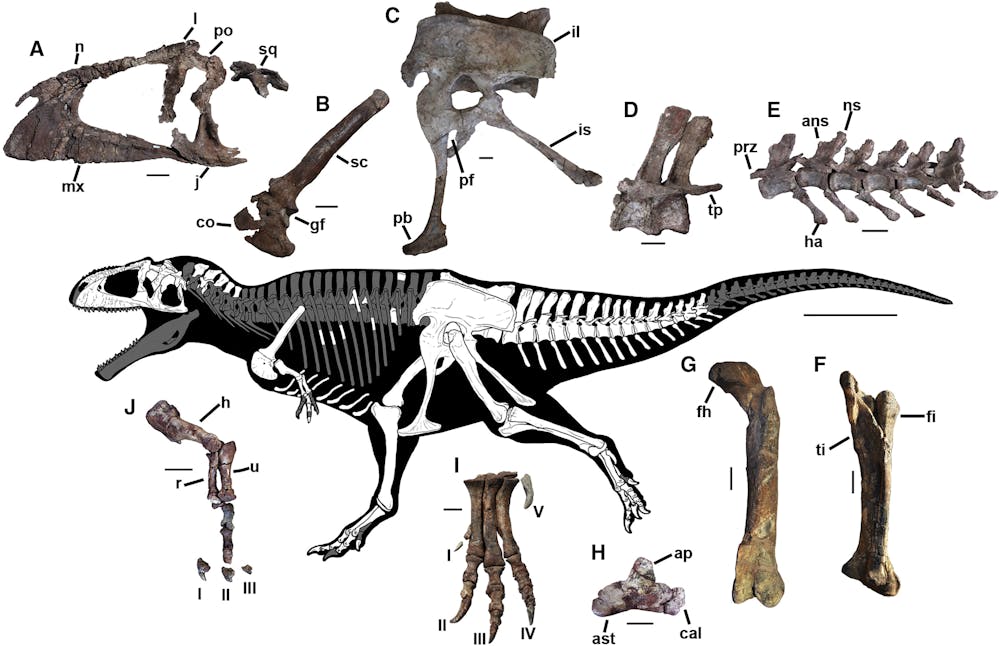
Meraxes is a large theropod, the group of bipedal, often meat-eating, dinosaurs which also includes birds, and a member of the Carcharodontosauridae family, making it a relative of dinosaurs like Carcharodontosaurus, Giganotosaurus and Acrocanthosaurus.
The discovered specimen is approximately 11 metres long, and its weight is estimated as approximately 4,200 kg. It has a proportionally large skull featuring a rather fearsome set of teeth, along with long legs and large clawed feet, a powerful tail, and small arms and hands.
Meraxes is particularly notable in what it tells us about the evolution of large size in dinosaurs. Its body plan — a large head and small arms — is very similar to that seen in tyrannosaurids like Tyrannosaurus rex, and abelisaurids like Carnotaurus.
These three groups of theropod dinosaurs are all distant relatives. Each independently evolved both large body size and the combination of a large head and small arms.
We analyzed the evolution of these changes in these three groups by examining changes in arm size relative to other body measurements, such as leg and body size. We found that not only did each group experience similar changes through evolution, but there appears to be a lower limit for how small the arms can be relative to the rest of the body. This may represent a developmental or mechanical constraint: the arm can only get so small relative to the body, regardless of other evolutionary pressures in this context.
There are several potential explanations for the size of the arms; the forelimbs themselves may have retained some function despite their reduced size. Our data most directly support the idea that arm reduction in these dinosaur groups is more likely tracking other traits rather than being the subject of evolutionary selective pressure itself. In other words, as the relative size of the skull increased over evolution, the arms decreased proportionally in size as an evolutionary trade-off.
Growth charts
Another important thing Meraxes can tell us about dinosaur evolution concerns its growth and age. As a palaeontologist, one of my areas of expertise is in using bone microstructure to understand growth in extinct animals like dinosaurs. I also study how bone growth varies across individuals within and between species.
This involves cutting a bone in half (typically one of the long bones of the hind limb, like a femur or tibia), mounting a piece to a slide, and grinding that piece down to be thin enough that you can pass light through it and view the bone microstructure using a microscope.
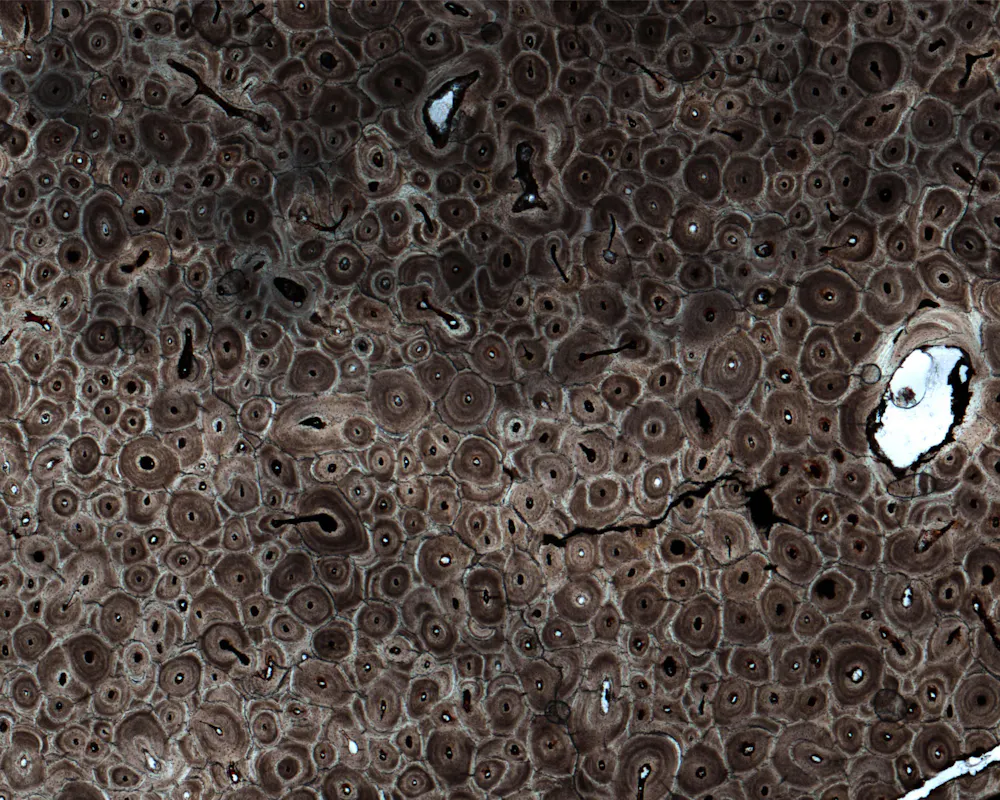
From here, changes in bone tissue can be observed, telling us about physiology and relative maturity. We can also see annual growth marks, similar to tree rings. By counting these growth marks, measuring their positions across the bone and analyzing them using statistical growth models, we can estimate not only how much an animal grew from year to year, but also how old it was when it died.
Close-up image of the bone microstructure of the fibula of Meraxes gigas, showing the extensive secondary bone growth associated with this animal’s skeletal maturity.
(Thomas Cullen), Author provided
Using this approach to study Meraxes, we were able to determine that it was likely around 50 years old at death, and its skeleton had stopped growing about four years before it died. This would make it the oldest non-avian theropod dinosaur currently known, and one of the oldest known dinosaurs.
We also discovered that Meraxes, compared to other gigantic theropods like Tyrannosaurus, reached a large size through very different changes to their growth. Meraxes continued growing for a longer period of time when compared to its smaller relatives. Tyrannosaurus had a greater relative growth rate than smaller tyrannosaurid species, but reached adult size in a similar amount of time.
Independent evolution
As a result, Meraxes and Tyrannosaurus provide a complex example of evolutionary convergence: they both reached very large size when compared to their relatives, and independently evolved the combination of large skulls and small arms. But they achieved this through very different modifications to their growth pattern through life.
As we continue to study Meraxes and other dinosaurs, we’ll further increase our understanding of the amazing biodiversity and changes throughout the Earth’s history. And in doing so, we’ll also gain a greater understanding of the mechanisms of evolution itself.
The timing and intensity of the seasons shapes life all around us, including tool use by birds, the evolutionary diversification of giraffes, and the behaviour of our close primate relatives.
Some scientists suggest early humans and their ancestors also evolved due to rapid changes in their environment, but the physical evidence to test this idea has been elusive – until now.
After more than a decade of work, we’ve developed an approach that leverages tooth chemistry and growth to extract information about seasonal rainfall patterns from the jaws of living and fossil primates.
We share our findings in a collaborative study just published in Proceedings of the National Academy of Sciences.
Teeth are environmental time machines
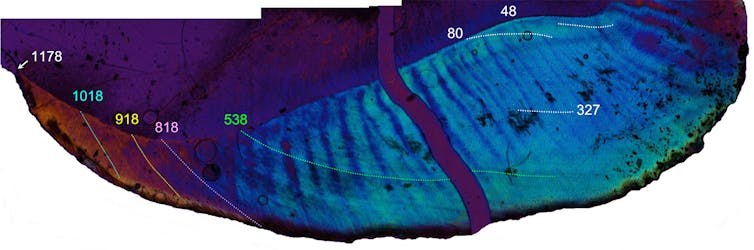
During childhood our teeth grow in microscopic layers similar to the growth rings found in trees. Seasonal changes in the world around us, such as droughts and monsoons, influence our body chemistry. The evidence of such changes is recorded in our teeth.
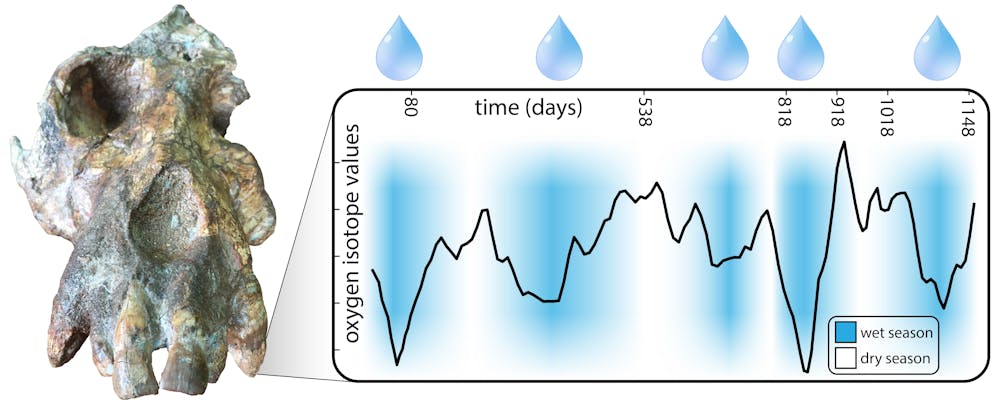
That’s because the oxygen isotope composition of drinking water naturally varies with temperature and precipitation cycles. During warm or dry weather, surface waters accumulate more heavy isotopes of oxygen. During cool or wet periods, lighter isotopes become more common.
These temporal and climatic records remain locked inside fossilised tooth enamel, which can maintain chemical stability for millions of years. But the growth layers are generally so small that most chemical techniques can’t measure them.
To get around this problem, we teamed up with geochemist Ian Williams at the Australian National University, who runs the world-leading Sensitive High Resolution Ion Microprobe (SHRIMP) facilities.
In our study, we collected detailed records of tooth formation and enamel chemistry from slices of more than two dozen wild primate teeth from equatorial Africa.
We also analysed two fossil molars from an unusual large-bodied ape called Afropithecus turkanensis that lived in Kenya 17 million years ago. Diverse groups of apes inhabited Africa during this period, roughly 10 million years before the evolution of our early ancestors, the hominins.
Thin slice of a 17-million-year-old Afropithecus tooth illuminated with polarised light reveals progressive growth (right to left). We microsampled oxygen isotopes weekly for over three years, or 1148 days, in this tooth.
Tanya M. Smith
Diving into an ancient African landscape
Several aspects of our research are helpful for understanding the link between environmental patterns and primate evolution.
First, we observe a direct relationship between historic African rainfall patterns and primate tooth chemistry. This is the first test of a highly influential idea in archaeological and earth sciences applied to wild primates: that teeth can record fine details of seasonal environmental change.
We are able to document annual west African rainy seasons and identify the end of east African droughts. In other words, we can “see” the storms and seasons that occur during an individual’s early life.
And this leads into another important aspect. We provide the largest record of primate oxygen isotope measurements collected so far, from diverse environments in Africa that may have resembled those of ancestral hominins.
Lastly, we’ve been able to reconstruct annual and semi-annual climate cycles, and marked environmental variation, from information held within the teeth of the two fossil apes.
Our observations support the hypothesis that Afropithecus developed certain features to adapt to a seasonal climate and challenging landscape. For example, it had specialised dental traits for hard object feeding, as well as a longer period of molar growth compared with earlier apes and monkeys – consistent with the idea that it consumed more seasonally varied foods.
Oxygen isotopes from the teeth of Afropithecus reveal wet and dry seasons that occurred 17 million years ago in eastern Africa.
Daniel R. Green & Tanya M. Smith
We conclude our work by comparing data from Afropithecus to earlier studies of fossil hominins and monkeys from the same region in Kenya. Our detailed microsampling shows just how sensitive tooth chemistry is to fine-scale climate variation.
Previous studies of more than 100 fossil teeth have missed the most interesting part of oxygen isotope compositions in teeth: the huge seasonal variation on the landscape.
Research potential closer to home
This novel research approach, coupled with our fossil ape findings and modern primate data, will be crucial for future studies of hominin evolution – especially in Kenya’s famous Turkana Basin.
For example, some researchers have suggested that seasonal differences in foraging and stone tool use helped hominins evolve and coexist in Africa. This idea has been hard to prove or disprove, in part because seasonal climatic processes have been hard to tease out of the fossil record.
Our approach could also be extended to animal remains from rural Australia to gain further insight into historic climate conditions, as well as the prehistoric environmental changes that shaped Australia’s unique modern landscapes.
Coffee – one bean with many possibilities. A big choice is how to brew it: espresso, filter, plunger, percolator, instant and more. Each method has unique equipment, timing, temperature, pressure, and coffee grind and water needs.
Our choices of brewing method can be cultural, social or practical. But how much do they really impact what’s in your cup?
Which is the strongest brew?
It depends. If we focus on caffeineconcentration, on a milligram per millilitre (mg/ml) basis espresso methods are typically the most concentrated, able to deliver up to 4.2 mg/ml. This is about three times higher than other methods like Moka pot (a type of boiling percolator) and cold brewing at about 1.25 mg/ml. Drip and plunger methods (including French and Aero-press) are about half that again.
Espresso methods extract the most caffeine for a few reasons. Using the finest grind means there is more contact between the coffee and water. Espresso also uses pressure, pushing more compounds out into the water. While other methods brew for longer, this doesn’t impact caffeine. This is because caffeine is water soluble and easy to extract, so it’s released early in brewing.
But these comparisons are made based on typical extraction situations, not typical consumption situations.
So, while espresso gives you the most concentrated product, this is delivered in a smaller volume (just 18–30ml), compared to much larger volumes for most other methods. These volumes of course vary depending on the maker, but a recent Italian study defined a typical final serve of filter, percolator and cold brews as 120ml.