Top Stories Daily Listen Now
RawStory

Science

NASA is pulling a 'Deep Impact': New spacecraft will test asteroid deflection methods

Among existential threats to humanity, asteroid impacts rank high — in part because they've caused extinction-level events on Earth so many times before. Indeed, the dinosaurs perished 66 million years ago as a result of an impact from an asteroid or comet; and it's a matter of when, not if, another strike.

This article first appeared in Salon.

Keep reading... Show less

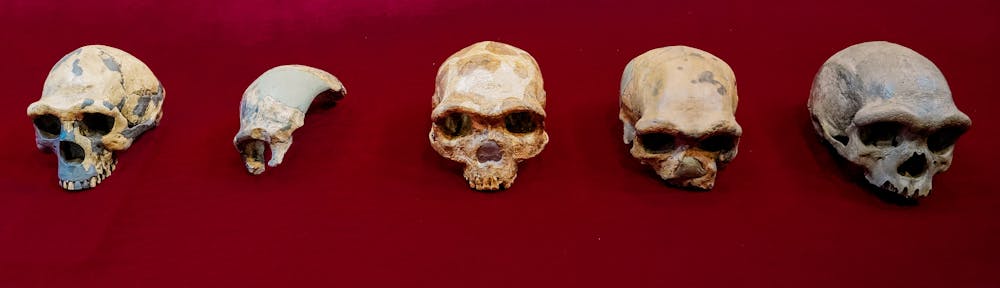
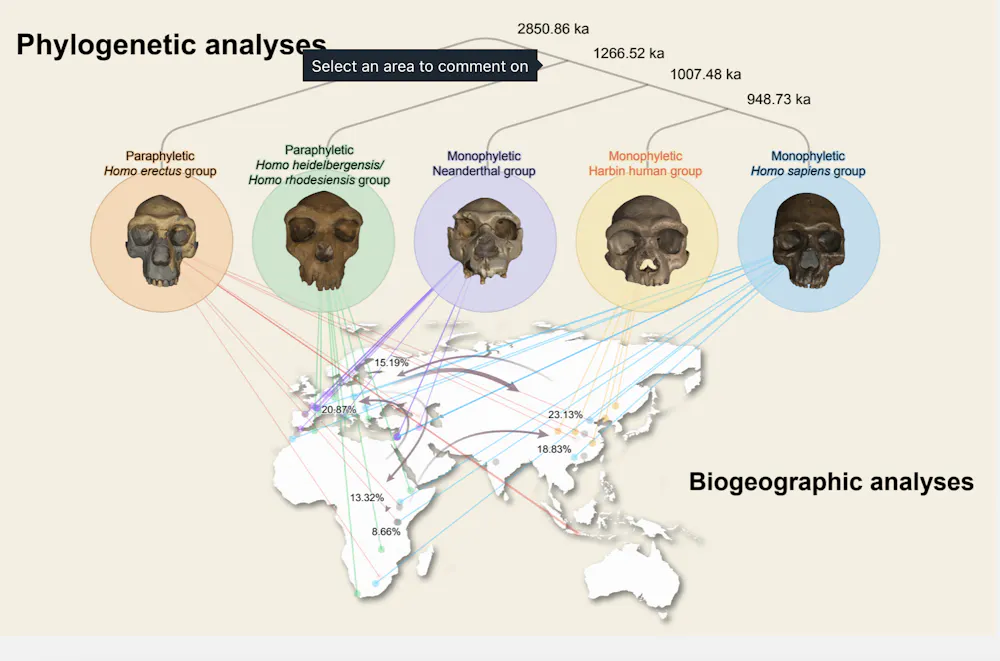
Homo longi: extinct human species that may replace Neanderthals as our closest relatives found in China

In 1933 a mysterious fossil skull was discovered near Harbin City in the Heilongjiang province of north-eastern China. Despite being nearly perfectly preserved – with square eye sockets, thick brow ridges and large teeth – nobody could work out exactly what it was. The skull is much bigger than that of Homo sapiens and other human species – and its brain size is similar to that of our own species. Historical events left it without a secure place of origin or date, until today.

Now a team of Chinese, Australian and British researchers has finally solved the puzzle – the skull represents a previously unknown extinct human species. The research, published as three studies in the journal Innovation, suggests this is our closest relative in the human family tree.

Keep reading... Show less

Space debris 'event' forces ISS crew to take evasive action

The United States said Monday it was investigating a "debris-generating event in outer space" after astronauts on the International Space Station were forced to prepare for a possible evacuation.

It came amid unconfirmed reports that Russia had carried out an anti-satellite weapon (ASAT) test -- rare show-of-force demonstrations criticized by the space community because of the risk they create for crews in low Earth orbit.

Keep reading... Show less

New class of drug reverses paralysis in mice

US scientists have developed a new form of drug that promotes the regeneration of cells and reversed paralysis in mice with spinal injuries, allowing them to walk again within four weeks of treatment.

The research was published in the journal Science on Thursday, and the team of Northwestern University scientists behind it hope to approach the Food and Drug Administration as early as next year to propose human trials.

Keep reading... Show less

Ron DeSantis’ surgeon general got his medical license approved in just two days

It's been just a few days since Florida Surgeon General was attacked by former colleagues at UCLA for inflating his resume and lying about his work during the COVID-19 crisis in Los Angeles hospitals.

The Florida Ledger reported Wednesday that Dr. Joseph Ladapo's medical license was approved in just two days, a process that normally takes 2-6 months, the board's website says. The fact was also confirmed by medical and legal professionals who know the process. The report also noted that all of the members of the 15 person Board of Medicine were approved by Gov. Ron DeSantis (R-FL). The governor has been criticized for more than a year for his handling of the pandemic, concealing data about how many people in the state got the virus or died from it and other concerns.

Keep reading... Show less

Horrifying report exposes the seedy underworld of lethally botched butt-injection operations

An extensive new report by Rolling Stone reveals the tragic story of Karissa Rajpaul, who is one of an untold number of people who have found themselves victims of lethally botched butt-injection surgeries.

The story begins in 2016 when a pair of newlyweds named Marco and Karissa Rajpaul moved to Los Angeles after suffering a tragic miscarriage.

Keep reading... Show less

Desperate US bid to engineer corals for climate change

A bit of coral shimmers like gold in a US lab as part of urgent work to help the species protect itself from climate change, an effort even skeptical experts see as sadly justifiable.

Researchers in Florida are aiming to determine whether coral can be saved from rising water temperatures and acidification by transplanting stem cells from resistant varieties to those more vulnerable to climate impacts.

Keep reading... Show less

Astronomers plan to double-down on the search for extraterrestrial life

Just as God handed down the ten commandments to Moses at Mt. Sinai, astronomers are having their ten commandments moment this week — in the form of a much-anticipated 614-page report, handed down from a committee assembled by the US National Academies of Sciences, Engineering, and Medicine.

This article first appeared in Salon.

Keep reading... Show less

NASA to deflect asteroid in test of 'planetary defense'

In the 1998 Hollywood blockbuster "Armageddon," Bruce Willis and Ben Affleck race to save the Earth from being pulverized by an asteroid.

While the Earth faces no such immediate danger, NASA plans to crash a spacecraft traveling at a speed of 15,000 miles per hour (24,000 kph) into an asteroid next year in a test of "planetary defense."

Keep reading... Show less

Astronomers say it’s time to start looking for another planet we can live on

Every ten years the National Academies of Sciences, Engineering, and Medicine publish the Decadal Survey on Astronomy and Astrophysics, which outlines the most significant priorities that astronomers should focus on in the following decade. This time around, they're talking about finding the next Earth that could sustain life.

The 500-page report was released Thursday explaining that there are many things that scientists could address, but the one that sticks out is finding Earth 2.0. To do it, scientists have proposed that NASA fund a new massive telescope that can look at infrared, optical light, and ultraviolet to see distant planets outside of the solar system. In the past, scientists have been forced to use observations of planets passing in front of stars to indicate whether a planet is present.

Keep reading... Show less

Fireworks erupt at Senate hearing as Fauci clashes with 'egregiously incorrect' Rand Paul over 'gain of function' research

Sen. Rand Paul (R-KY) continued his feud with Dr. Anthony Fauci over the conspiracy theory that the National Institute of Health somehow funded the Chinese creation of the coronavirus.

At a Senate hearing on Thursday, Paul began with an attack on Fauci, saying that Americans don't believe him anymore. Paul's statistics come from a conservative poll done online to fewer than 1,000 registered voters.

Keep reading... Show less

'Sad sight': Astronaut reports back on Earth's climate disaster

A French astronaut reported back on Earth's climate change damage as seen from space on Thursday, calling it a "sad sight" in a conversation with President Emmanuel Macron.

Thomas Pesquet, on his second tour at the International Space Station (ISS) orbiting the planet, told Macron by video link that the destructive impact of human activity was becoming more and more visible, even from 400 kilometres (250 miles) away.

Keep reading... Show less

Parasitic wasps turn other insects into 'zombies' -- saving millions of humans along the way

Wasps have a reputation for being jerks because of their perceived aggressiveness and ability to sting repeatedly. They're often negatively compared with the honey production and agricultural pollination of bees.

If wasps are jerks, however, they are positively saintly compared to their parasitic brethren.

Parasitic wasps sting to inject their eggs into a host, often accompanied by venom and a virus. Their larvae grow and eventually emerge from the unwitting host — usually killing it. Then they becoming adults and fly off to continue the cycle.

Some wasps go further, controlling their host's behaviour, effectively “zombifying" them to help the larva survive. After studying the behaviour of ichneumon wasps, which lay their eggs in moth larvae, naturalist Charles Darwin wrote that they were so evil that they were proof against the idea that God was directing evolution:

I cannot persuade myself that a beneficent & omnipotent God would have designedly created the Ichneumonidæ with the express intention of their feeding within the living bodies of caterpillars."

While no wasps are known to lay eggs in humans (although some flies do), they have inspired films like the Alien franchise and the recently released monster survival video game House of Ashes.

Ridley Scott's 1979 movie 'Alien' centred on a parasitic alien species.


But whether inspiring horror or metaphysical questions, parasitic wasps also save millions of human lives.

Parasitic wasps to the rescue

In the 1970s, the cassava mealybug (Phenacoccus manihoti) entered Western and Central Africa as an invasive pest species from Brazil. It rapidly spread across cassava fields causing crop losses as high as 80 per cent. The cassava plant is a staple food crop because it is drought-resistant. The mealybug invasion threatened the food base of 200 million people.

The Swiss entomologist Hans Rudolf Herren, who was conducting research in the area, found a wasp parasitizing the mealybug (Epidinocarsis lopezi). The parasitic wasp posed little risk to sub-Saharan species.

After rearing the wasps and gathering funding, Herren bought planes and co-ordinated strategic airdrops and ground release of wasp cocoons to areas affected by the mealybug. From those locations, the wasp populations grew and spread on their own, reducing the mealybug population to manageable levels for years.

This effort saved an estimated 20 million lives, billions in crops and avoided the use of pesticides. Herren received the World Food Prize in 1995 for his efforts.

David Attenborough describes the habits of parasitic wasps for BBC Earth.


Biocontrol heroes

Biocontrol is the use of one organism to combat a pest, and this was far from the only successful case of wasps as biocontrol. Wasps have successfully defended against many crop pests in Chinese agriculture.

The samurai wasp (Trissolcus japonicus) was being studied for potential use against the brown marmorated stinkbug, a threat to many crops across the continental United States. However, the wasp preempted this, moving into stinkbug territories on its own.

Wasps are even being deployed to prevent moths from damaging historical sites and their artifacts. Here in Canada, at least four wasp species have been released to control the emerald ash borer, a cause of deforestation across Canada.

Keep reading... Show less