Fox News host Brian Kilmeade asserted incorrectly that NASA had sent a probe outside the Milky Way Galaxy to observe an object called Ultima Thule.
Although Ultima Thule is located within our Solar System's Kuiper belt, Kilmeade repeatedly insisted on Fox & Friends that the New Horizons spacecraft left the "galaxy" during the journey.
"NASA believes it was formed during the birth of the Solar System," a Fox & Friends newsreader announced on Thursday.
"Those are ice crystals that look like a snowman," co-host Steve Doocy commented upon seeing a photo of Ultima Thule.
"How great is it that we left our galaxy?" Kilmeade asked, leaving his co-host speechless.
"We are so bored with our galaxy, we've left," he added. "We're beyond Pluto."
"Where do you think we are right now?" Doocy wondered.
"No, we haven't left," Kilmeade said, failing to clear up the confusion.
"We're sending pictures from other galaxies!" Kilmeade exclaimed. "We've left. I mean, how great is that?"
"Beam me up!" Doocy complained.
"Space exploration," co-host Ainsley Earhardt added. "Thank you for that insight, Brian."
For the record, Ultima Thule, which is located inside our Solar System, is about 4 billion miles from the Sun. Our Solar System is located as much as 70,000 light years inside the Milky Way Galaxy, making travel outside the galaxy impossible with current technologies. The nearest galaxy is millions of light years away from the Milky Way.
But those who expect Droegemeier to provide any sort of counterweight to administration policies will likely be disappointed. The recent departures of Defense Secretary James Mattis and White House Chief of Staff John Kelly tell the tale, yet again, of the fate of those who push back against this president, however tough-minded they may be. Perhaps more importantly, a historical perspective on presidential science advising shows that the advisors’ effectiveness is determined not by how much they know, but by how closely they are in step with the political priorities of the administration they serve.
Science advisers are on the team
The role of presidential science adviser was formalized in the shadow of the Sputnik launch, when President Eisenhower named MIT president James R. Killian to the newly created post of “special assistant to the president for science and technology” in November 1957. Killian, who in fact was not a scientist but had a mere bachelor’s degree in management, was expected not only to lend expertise to the White House but, according to a New York Times article at the time, to “allay public fears concerning scientific achievements by the Soviet Union.”
Killian helped to oversee a rapid expansion of government investment in science, an agenda that satisfied both his scientific colleagues and the political aims of President Eisenhower. But such alignment of science advice and presidential politics is far from inevitable.
Jerome Wiesner had a seat at the table (second from left) in the Kennedy White House.
Several years later, President Kennedy’s science adviser, Jerome Wiesner, advised against sending a man to the moon, counsel that was decisively rejected, with momentous historical consequences. A decade later, President Nixon got so fed up with advice he was getting on missile defense and supersonic transport that in 1973 he eliminated the science adviser post.
With the support of Congress, Nixon’s successor, Gerald Ford, reestablished the position of science adviser in 1976, as head of a newly created Office of Science and Technology Policy. But the age of innocence was over, and only the most naïve observers could continue to believe that presidential science advice could somehow be held separate from national politics.
Under President Reagan, science adviser George Keyworth II, a nuclear physicist, aggressively advocated for the president’s highly controversial “star wars” missile defense system and notably attacked the news media as “a narrow fringe element on the far left of our society” because of alleged bias against administration policies.
More recently, President Obama’s science adviser, John Holdren, also a physicist, was an outspoken advocate for the president’s energy and environmental policies. In their times, KeyworthandHoldren were both subjected to energetic critique from those in politics and the media who disagreed with the positions that each advanced.
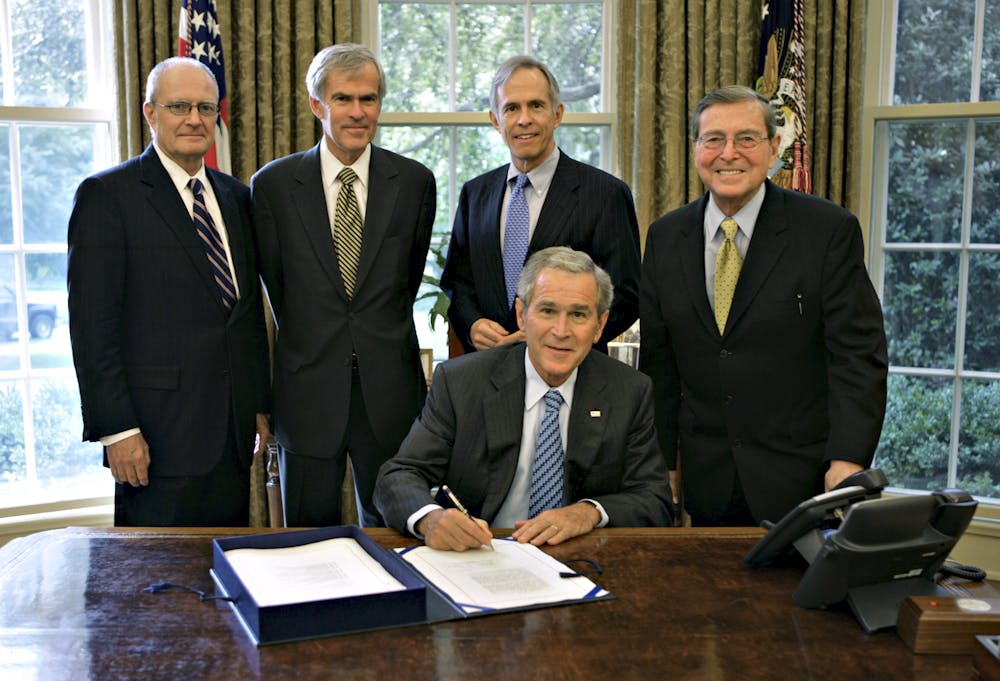
John Marburger (left) knew his job was to back up the president.
Most notable in this regard, however, was John Marburger, also a physicist, and science adviser to Republican President George W. Bush. Marburger in fact was a Democrat, a respected scientist and university administrator, and unlike Keyworth and Holdren was a low-profile player in White House politics. But he was skewered by Democrats in Congress and their allies in the scientific community for failing to oppose Bush policies on issues such as stem cell research and climate change – even though he would surely have been fired had he done so.
Science advisers are not apolitical nerds, high-level versions of Bill Nye the Science Guy on tap to answer a president’s questions about why the sky is blue or how a bar-code scanner works. Science advisers are political players on a political team, and above all, Trump’s choice of Droegemeier must be understood in that vein.
A challenge ahead for nominee
Yet Droegemeier represents a somewhat bizarre choice. Trump could have chosen a science adviser with expertise relevant to administration policy priorities, such as defense buildup, restoring the manufacturing base or undoing environmental regulations. Given his skepticism about climate change, Trump could even have chosen a science adviser with similar views. Early rumors suggested he would do just that.
Instead, in Droegemeier he has selected an expert on weather and climate who seems – although his public statements on the matter are few – to agree with most other climate scientists that human activities are contributing to a changing climate. So Droegemeier comes into his job holding a view that sharply contradicts a conspicuous public position taken by the president. As we have seen, this is not a proven formula for success.
Perhaps vouching for now NASA Administrator James Bridenstine paid political dividends.
Why did Trump pick Droegemeier, then? For one thing, within the Trump administration he likely has the support of NASA director and fellow Oklahoman Jim Bridenstine, at least in part because Droegemeier supported Bridenstine’s nomination for the NASA directorship by providing public assurances that Bridenstine was not a climate skeptic. For another, Droegemeier has the endorsement of Oklahoma Sen. James Inhofe, a powerful Trump ally who is a climate skeptic.
So perhaps Droegemeier’s selection was just a matter of smart political triangulation: A man who has the confidence of political leaders of a state where Trump won with more than 65 percent of the vote, and also just happens to have unimpeachable scientific credentials, is a rare political commodity.
Now that he’s confirmed by the Senate, whatever role Droegemeier ends up playing will be one of service to the political agenda of the Trump administration. Given that Democrats have over the past 15 years or more sought to portray themselves as the party of science, Droegemeier will find it difficult to maintain his stellar reputation as a scientist while also advocating policies that Democrats and their allies in the scientific community oppose. He should expect severe political weather for the next few years. Perhaps the most interesting question is whether the fiercest gales will come from the Democrats, now that they are back in charge of the House of Representatives, or from Droegmeier’s unpredictable boss in the White House.
This is an updated version of an article originally published on Aug. 17, 2018.
China announced that it successfully landed a probe on the far side of the moon Thursday.
“This space mission shows that China has reached the advanced world-class level in deep space exploration,” said Zhu Menghua, a professor at the Macau University of Science and Technology, the New York Times quoted. “We Chinese people have done something that the Americans have not dared try.”
Menghua also claimed it was something "that the Americans have not dared try."
China landed a rover on the moon in 2013 but this is the first for a probe to land on the side of the moon that faces away from the Earth.
The country said that it plans to fully operate a third space station by 2022 and to put their astronauts in a lunar base no later than 2032. They also intend to begin sending probes to Mars.
“This is a major achievement technically and symbolically,” the Times quoted Namrata Goswami, an independent analyst who wrote about space for the Defense Department’s Minerva Research Institute. “China views this landing as just a steppingstone, as it also views its future manned lunar landing, since its long-term goal is to colonize the moon and use it as a vast supply of energy.”
Four billion miles from the sun floats Ultima Thule, an icy celestial body that NASA scientists announced Wednesday is aptly shaped like a giant snowman.
The first detailed images beamed back from the US agency's New Horizons mission allowed scientists to confidently determine the body was formed when two spheres, or "lobes," slowly gravitated towards each other until they stuck together -- a major scientific discovery.
The New Horizons spacecraft on Tuesday flew past Ultima Thule, which was discovered via telescope in 2014 and is the farthest and potentially oldest cosmic body ever observed by a spacecraft.
Before that flyby, the only image scientists had was a blurry one showing Ultima Thule's oblong shape, resembling something like a bowling pin or a peanut.
NASA/Johns Hopkins University Applied Physics Laboratory/Southwest Research Institute/AFP / HO NASA rang in the New Year with a historic flyby of the farthest, and quite possibly the oldest, cosmic body ever explored by humankind -- a tiny, distant world called Ultima Thule -- in the hopes of learning more about how planets took shape
"That image is so 2018... Meet Ultima Thule!" said lead investigator Alan Stern, doing little to hide his joy as he revealed a new sharper image of the cosmic body, taken at a distance as close as 17,000 miles (about 27,000 kilometers) with a resolution of 140 meters per pixel.
"That bowling pin is gone -- it's a snowman if anything at all," Stern said during a NASA briefing.
"What this spacecraft and this team accomplished is unprecedented."
Ultima Thule's surface reflects light about as much as "garden variety dirt," he said, as the sun's rays are 1,600 times fainter there than on Earth.
The body is roughly 19 miles long and completes its own rotation in about 15 hours. NASA dubbed the larger lobe Ultima, and the other, which is about three times smaller, Thule.
Carly Howett, another researcher of the mission, noted that "we can definitely say that Ultima Thule is red," perhaps due to irradiation of ice.
Unlike the effervescent bubbles that stream to the top of champagne flutes on New Year’s Eve, what I call brain bubbles are far from celebratory. These bubbles are metaphorical rather than physical, and they distort the stream of reality processed by our brains. Like a real estate bubble that reflects an inflated perception of home values, a brain bubble twists your perception of the world around you. And when either of these bubbles bursts, the results can be devastating.
Problems arise when distorted information results in flawed decisions that negatively affect our lives. As a neuroscientist who’s worked closely with laboratory rats for over three decades, I’ve gleaned from them a few good strategies people can use to burst brain bubbles and enhance well-being in the year ahead. Rat brains are small but have the same general areas and neurochemicals we have, so these rodents are valuable laboratory models for human behavior.
Plugging in can mean you’re untethered from reality.
Psychoactive drug use, aspects of privilege and poverty, psychiatric illness and, in some cases, religious and political beliefs can all create brain bubbles. Even daily excursions to the virtual world of apps, social media and cybergames sever our connections to concrete aspects of the real world and let distorting brain bubbles develop.
This is especially problematic for children’s brains that are still developing. An ongoing National Institutes of Health study suggests that two hours of screen time each day distorts language and thinking abilities in these junior digital users.
As our attention is hijacked by the closest screen while a Roomba cleans the floor and Alexa orders pizza to be delivered to the front door, what’s left for our brains to do? Sure, we likely face cognitive challenges at work each day, but human brains are built for sophisticated and complex activity – even though we’re often lulled into mindlessly scrolling through a virtual feed. In fact, a brain area often associated with reward and pleasure, the nucleus accumbens, is smaller in people who spend more time checking Facebook posts on their smartphones.
Obviously, some of these distortion-generating circumstances are out of our control. But a heightened awareness of our authentic world can move us toward a more reality-based, well-grounded brain – free of those brain bubbles.
The rats that my students and I train in our studies to physically work for coveted treats (Froot Loops cereal is a favorite) develop healthier emotional responses than the animals we call “trust-fund rats” because they’re merely given their sweet rewards. The harder-working rats have healthier stress hormone levels and engage in more sophisticated search strategies when they encounter a surprise challenge – such as when we move their expected Froot Loop rewards. They’re more persistent as they spend time trying to solve the problem, rather than quickly giving up and walking away.
So whereas one popular New Year’s resolution involves saving up to build financial capital, we can keep our brains in peak condition for the year ahead by building up experiential capital. Real-world experiences represent the best currency for our brain circuits, providing neural security for our future decisions in the coming year. Spending time engaged in hobbiessuch as knitting or gardening, for example, with complex movements and rich sensory experiences, provides a valuable yield for our brains.
Looking forward to it can be just as good as the experience.
When the calendar flips to a new year, it’s common to reflect on the past and look to the future. According to the neuroscience literature, this anticipation could be one of the most pleasurable – and healthy – tasks our brains engage in all year long.
Dopamine is the poster neurotransmitter for the cognitive endeavor of anticipating. Traditionally known for its role in pleasure, this neurochemical system can be hijacked by psychoactive drugs such as cocaine that serve as potent creators of reality-distorting brain bubbles.
Rodent research provides fascinating insights here, however. Researchers use sophisticated techniques to measure dopamine activity as rats press laboratory levers that reward them with drugs. Surprisingly, this neurochemical system surges when the animal merely anticipates taking the drug as it approaches the drug lever, as well as when the drug is actually infused into the brain.
Anticipating a new start and a new year may be a scaled-down version of approaching the experimental lever for a hit of cocaine – a legal and healthy dopamine dose in this case. You can try to keep this emotional high going through the year by amping up the anticipation in your daily life: Focus more on delayed than immediate gratification. Buying and planning for experiences is more satisfying than material purchases. Mapping out a menu, shopping for ingredients and cooking a meal provides more dopamine time – and brain-engaging behaviors – than nuking a frozen meal and eating it three minutes later.
Rats in the lab suggest active minds are better able to overcome stress and surprise adversity.
Another way to enhance our well-being through the year is to gain some sense of control over the stress in our lives. Real-time and authentic interactions with the environment can help us gain a sense of control over the inevitable uncertainty and unpredictability we face each day.
I see evidence of this in the lab. When I furnish my rats’ housing with natural elements such as dirt, hollowed-out logs and rocks, they’re busier and less likely to sit around the edge of the cage than animals in boring empty cages. After building their experiential capital, these enriched rats have healthier stress and resilience hormone profiles and engage in bolder behaviors, such as diving to the bottom of swim tanks instead of staying on the top doing their best impression of a dog paddle. As I watch these animals in various tasks, they appear to be gaining control over the challenges they encounter.
Perhaps this is why retired U.S. four-star admiral William McRaven emphasized simple life strategies in his 2014 University of Texas commencement speech, declaring that “if you want to change your life and maybe the world, start off by making your bed.” Then, even if you have a terrible day, you will come home to a made bed, evidence that you had a positive impact in at least one area of your life that day.
Lessons from the laboratory rats also provide potential explanations for some of my own personal favorite New Year’s Day traditions – including the mundane tasks of cooking a familiar southern meal, cleaning my closet and watching HGTV’s Dream House giveaway with my family while we all declare what we would do if we won the beautiful house. Move in? Sell it? Make it an Airbnb rental?
Thinking like a neuroscientist, I know that cooking and cleaning are active endeavors with clear outcomes that allow me to gain a small sense of control, decreasing stress hormones. Playfully anticipating winning a new home taps into that feel-good dopamine system as we contemplate more serious options for the new year. And, perhaps the best neurochemical hit of all is the spike in oxytocin, the neurochemical involved in positive social connections, as I spend time with loved ones.
Although it’s common to turn to pharmaceuticals to lift our emotions and improve our mental health, the emotional benefits of many New Year’s traditions remind me that basic responses can serve as what I call “behaviorceuticals” that enhance well-being. New Year’s resolutions may take the form of New Year’s Rx’s as we consider healthy lifestyle choices for the coming year: Shrink those distorting brain bubbles and build realistic connections to enrich life’s simple pleasures.
NASA rang in the New Year on Tuesday with a historic flyby of the farthest, and quite possibly the oldest, cosmic body ever explored by humankind -- a tiny, distant world called Ultima Thule -- in the hopes of learning more about how planets took shape.
A series of anxiously awaited "phone home" signals arrived after 10:30 am (1530 GMT), indicating that the spacecraft had made it, intact, through the risky, high-speed encounter.
"We have a healthy spacecraft," said mission operations manager Alice Bowman, as cheers erupted in the control rooms at Johns Hopkins Applied Physics Laboratory in Maryland.
About 10 hours earlier, NASA celebrated the New Year's flyby, as mission managers -- alongside kids dressed in space costumes -- blew party horns to mark the moment at 12:33 am (0533 GMT) when the New Horizons spacecraft aimed its cameras at the space rock four billion miles (6.4 billion kilometers) away in a dark and frigid region of space known as the Kuiper Belt.
More images and data will start arriving later Tuesday, offering scientists the first up-close look at an ancient building block of planets, Bowman said.
The flyby took place about a billion miles beyond Pluto, which was until now the most faraway world ever visited up close by a spacecraft.
Hurtling through space at a speed of 32,000 miles per hour, the spacecraft made its closest approach within 2,200 miles of the surface of Ultima Thule.
"This is a night none of us are going to forget," said Queen guitarist Brian May -- who also holds an advanced degree in astrophysics -- and who recorded a solo track to honor the spacecraft and its spirit of exploration.
Lead planetary scientist for New Horizons, Alan Stern, said Ultima Thule is unique because it is a relic from the early days of the solar system and could provide answers about the origins of other planets.
"The object is in such a deep freeze that it is perfectly preserved from its original formation," he said.
"Everything we are going to learn about Ultima -- from its composition to its geology to how it was originally assembled, whether it has satellites and an atmosphere and those kinds of things -- are going to teach us about the original formation conditions of objects in the solar system."
- Coming into focus -
AFP / Jonathan WALTER NASA's New Horizons spacecraft is heading for a January 1 flyby of Ultima Thule, an icy object in the Kuiper Belt on the outer limits of the solar system
Scientists are not sure exactly what Ultima Thule (pronounced TOO-lee) looks like -- whether it is cratered or smooth, or even if it is a single object or a cluster.
But a new, though still blurry image released Tuesday showed its oblong shape resembles something like a bowling pin or a peanut, and its dimensions are about 22 miles long and nine miles wide (35 by 15 kilometers).
Stern said his bet is that the object is a single body, not two pieces orbiting each other, but he would wait until more, clearer images arrive Wednesday to say for sure.
The highest resolution images are expected in February, Stern said.
Ultima Thule was discovered in 2014 with the help of the Hubble Space Telescope.
Scientists decided to study Ultima Thule with New Horizons after the spaceship, which launched in 2006, completed its main mission of flying by Pluto in 2015, returning the most detailed images ever taken of the dwarf planet.
Stern said the goal was to take images of Ultima that are three times the resolution the team had for Pluto.
- Frontier of planetary science -
Ultima Thule is named for a mythical, far-northern island in medieval literature and cartography, according to NASA.
Project scientist Hal Weaver of the Johns Hopkins Applied Physics Laboratory said humans didn't even know the Kuiper Belt -- a vast ring of relics from the formation days of the solar system -- existed until the 1990s.
"This is the frontier of planetary science," said Weaver.
Another NASA spacecraft, OSIRIS-REx, also set a new record on Monday by entering orbit around the asteroid Bennu, the smallest cosmic object -- about 1,600 feet (500 meters) in diameter -- ever circled by a spacecraft.
NASA said the orbit some 70 million miles (110 million kilometers) away marks "a leap for humankind" because no spacecraft has ever "circled so close to such a small space object -- one with barely enough gravity to keep a vehicle in a stable orbit."
The twin planetary feats coincided with the 50th anniversary of the first time humans ever explored another world, when US astronauts orbited the Moon aboard Apollo 8 in December, 1968.
"As you celebrate New Year's Day, cast an eye upward and think for a moment about the amazing things our country and our species can do when we set our minds to it," Stern wrote in the New York Times on Monday.
Editor’s note: As we close the books on one year and begin a new one, Conversation editors take a look back at the stories that – for them – exemplified 2018.
One of best things about my job as a science editor is that any crazy idea I start wondering about – whether triggered by something I see on my commute, a current event that’s in the news, or best of all a conversation with my young kids – I can call up an expert and ask her or him to break it down for me, and you.
It seems like our readers enjoy this type of “I’ve always wondered … ” article too. My most-read story of the past year was by an entomologist making the case to bug-haters that by killing a spider they might actually be making their homes more hospitable to insects the spider would have eaten and eliminated for them.
Below, a handful of my favorites from 2018. But curiosity isn’t bound by the calendar, so here’s to a new year of everyday science.
1. Seven pet years equals one human year?
This one came from my being a cat lover. Is my 12-year-old furry friend really (quick math, 7x12) equivalent to an 84-year-old woman? Luckily Mississippi State University’s Jesse Grady was at the ready. The 7-to-1 age equation is not quite right, he wrote, but “determining a pet’s ‘real’ age is actually important because it helps veterinarians like me recommend life-stage specific healthcare for our animal patients.”
2. The word you don’t know for a smell you do
Walking home as the first drops of rain fell was the genesis of this article. Texas A&M atmospheric scientist Tim Logan was the factoid guide this time. “Of course rain itself has no scent,” he wrote. “But moments before a rain event, an ‘earthy’ smell known as petrichor does permeate the air.” He goes on to describe its fragrant chemical compounds and where they come from.
3. A more personal question of scent
Perhaps this says a lot about the company I keep, but not infrequently in my travels does the topic of asparagus pee come up. Sarah Coseo Markt from Harvard’s School of Public Health did the honors on this one, explaining that after you eat asparagus, your body breaks down one of its constituents into two compounds that “when voided from the body … become foul-smelling gas, wafting up from your asparagus pee.” And in the event you have no idea what we’re talking about, Sarah cautions, “just because you don’t smell it doesn’t mean you’re not making it.”
4. Even blue blood readers have red blood
Here’s an example of corrective journalism. The record had to be set straight after I’d read a book to my children that suggested human blood is blue as it courses through your veins. “The bluish color of veins is only an optical illusion,” wrote University at Albany chemists Marisia Fikiet and Igor Lednev. They explained the basics of hemoglobin, the iron-rich molecule that carries oxygen around your body, and why blood always has that distinctive red color – in humans, anyway.
5. Please switch to Airplane Mode
Has any air traveler not wondered if forgetting to switch off your phone would bring down the jet? Penn State engineer Sven Bilén explained why talking on your cellphone at 40,000 feet is more of service issue than a safety one these days.
And if there’s anything that you’ve been wondering about … let me know! I have academic experts across the country on speed dial and at the ready.
A new species combining wolves, coyotes and dogs is evolving before scientists' eyes in the eastern United States.
Wolves faced with a diminishing number of potential mates are lowering their standards and mating with other, similar species, reported The Economist.
The interbreeding began up to 200 years ago, as European settlers pushed into southern Ontario and cleared the animal's habitat for farming and killed a large number of the wolves that lived there.
That also allowed coyotes to spread from the prairies, and the white farmers brought dogs into the region.
Over time, wolves began mating with their new, genetically similar neighbors.
The resulting offspring -- which has been called the eastern coyote or, to some, the "coywolf" -- now number in the millions, according to researchers at North Carolina State University.
Interspecies-bred animals are typically less vigorous than their parents, The Economist reported -- if the offspring survive at all.
That's not the case at all with the wolf-coyote-dog hybrid, which has developed into a sum greater than the whole of its parts.
At about 55 pounds, the hybrid animal is about twice as heavy as a standard coyote, and its large jaws, faster legs and muscular body allow it to take down small deer and even hunt moose in packs, and the animal is skilled at hunting in both open terrain and dense woodland.
An analysis of 437 hybrid animals found that coyote DNA dominates its genetic makeup, with about one-tenth of its DNA from dogs, usually larger dogs such as Doberman pinschers and German shepherds, and a quarter from wolves.
The animal's cry starts out as a deep-pitched wolf howl that morphs into higher-pitched yipping -- like a coyote.
Its dog DNA may carry an additional advantage.
Some scientists think the hybrid animal is able to adapt to city life -- which neither coyotes or wolves have managed to do on their own -- because its dog ancestry allows it to tolerate people and noise.
The coywolves have spread into some of the nation's largest cities -- including New York, Boston and Washington -- using railway corridors.
The interbreeding allows the animal to diversify its diet and eat discarded food, along with rodents and smaller mammals -- including cats, which coywolves eat skull and all -- and they have evolved to become nocturnal to avoid humans.
The animals are also smart enough to learn to look both ways before crossing roads.
Not all researchers agree the animal is a distinct species, arguing that one species does not interbreed with another -- although the hybrid's existence raises the question of whether wolves and coyotes are distinct species in the first place.
But scientists who have studied the animal say the mixing of genes has been much faster, extensive and transformational than anyone had noticed until fairly recently.
“(This) amazing contemporary evolution story (is) happening right underneath our nose," said Roland Kays, a researcher at North Carolina State.
Watch this report on coywolves posted online by THIRTEEN:
A NASA spaceship is zooming toward the farthest, and quite possibly the oldest, cosmic body ever photographed by humankind, a tiny, distant world called Ultima Thule some four billion miles (6.4 billion kilometers) away.
The US space agency will ring in the New Year with a live online broadcast to mark historic flyby of the mysterious object in a dark and frigid region of space known as the Kuiper Belt at 12:33 am January 1 (0533 GMT Tuesday).
A guitar anthem recorded by legendary Queen guitarist Brian May -- who also holds an advanced degree in astrophysics -- will be released just after midnight to accompany a video simulation of the flyby, as NASA commentators describe the close pass on www.nasa.gov/nasalive.
Real-time video of the actual flyby is impossible, since it takes more six hours for a signal sent from Earth to reach the spaceship, named New Horizons, and another six hours for the response to arrive.
But if all goes well, the first images should be in hand by the end of New Year's Day.
And judging by the latest tweet from Alan Stern, the lead scientist on the New Horizons mission, the excitement among team members is palpable.
"IT'S HAPPENING!! Flyby is upon us! @NewHorizons2015 is healthy and on course! The farthest exploration of worlds in history!" he wrote on Saturday.
- What does it look like? -
AFP / Jonathan WALTER
Scientists are not sure what Ultima Thule (pronounced TOO-lee) looks like -- whether it is round or oblong or even if it is a single object or a cluster.
It was discovered in 2014 with the help of the Hubble Space Telescope, and is believed to be 12-20 miles (20-30 kilometers) in size.
Scientists decided to study it with New Horizons after the spaceship, which launched in 2006, completed its main mission of flying by Pluto in 2015, returning the most detailed images ever taken of the dwarf planet.
"At closest approach we are going to try to image Ultima at three times the resolution we had for Pluto," said Stern.
"If we can accomplish that it will be spectacular."
Hurtling through space at a speed of 32,000 miles (51,500 kilometers) per hour, the spacecraft aims to make its closest approach within 2,200 miles (3,500 kilometers) of the surface of Ultima Thule.
The flyby will be fast, at a speed of nine miles (14 kilometers) per second.
Seven instruments on board will record high-resolution images and gather data about its size and composition.
Ultima Thule is named for a mythical, far-northern island in medieval literature and cartography, according to NASA.
"Ultima Thule means 'beyond Thule' -- beyond the borders of the known world -- symbolizing the exploration of the distant Kuiper Belt and Kuiper Belt objects that New Horizons is performing, something never before done," the US space agency said in a statement.
According to project scientist Hal Weaver of the Johns Hopkins Applied Physics Laboratory, mankind didn't even know the Kuiper Belt -- a vast ring of relics from the formation days of the solar system -- existed until the 1990s.
"This is the frontier of planetary science," said Weaver.
"We finally have reached the outskirts of the solar system, these things that have been there since the beginning and have hardly changed -- we think. We will find out."
Despite the partial US government shutdown, sparked by a feud over funding for a border wall with Mexico between President Donald Trump and opposition Democrats, NASA administrator Jim Bridenstine vowed that the US space agency would broadcast the flyby.
Normally, NASA TV and NASA's website would go dark during a government shutdown.
NASA will also provide updates about another spacecraft, called OSIRIS-REx, that will enter orbit around the asteroid Bennu on New Year's Eve, Bridenstine said.
A SpaceX rocket carrying a U.S. military navigation satellite blasted off from Florida’s Cape Canaveral on Sunday, marking the space transportation company’s first national security space mission for the United States.
The Falcon 9 rocket carrying a roughly $500 million GPS satellite built by Lockheed Martin Corp (LMT.N) lifted off from Cape Canaveral at 8:51 a.m. local time (1351 GMT). Four previous scheduled launches in the last week, including one on Saturday, were canceled due to weather and technical issues.
The successful launch is a significant victory for billionaire Elon Musk’s privately held rocket company, which has spent years trying to break into the lucrative market for military space launches dominated by Lockheed and Boeing Co (BA.N).
SpaceX sued the U.S. Air Force in 2014 over the military’s award of a multibillion-dollar, non-compete contract for 36 rocket launches to United Launch Alliance, a partnership of Boeing and Lockheed. It dropped the lawsuit in 2015 after the Air Force agreed to open up competition.
The next year, SpaceX won an $83 million Air Force contract to launch the GPS III satellite, which will have a lifespan of 15 years.
The satellite is the first to launch out of 32 in production by Lockheed under contracts worth a combined $12.6 billion for the Air Force GPS III program, according to Lockheed spokesman Chip Eschenfelder.
The launch was originally scheduled for 2014 but has been hobbled by production delays, the Air Force said.
The next GPS III satellite is due to launch in mid-2019, Eschenfelder said, while subsequent satellites undergo testing in the company’s Colorado processing facility.
Additional reporting by Eric M. Johnson and Gina Cherelus; Editing by Hugh Lawson and Daniel Wallis
Once a month for the last decade, Pepe Casanas, a 78-year-old Cuban farmer, has hunted down a scorpion to sting himself with, vowing that the venom wards off his rheumatism pains.
His natural remedy is no longer seen as very unusual here.
Researchers in Cuba have found that the venom of the blue scorpion, whose scientific name is Rhopalurus junceus, endemic to the Caribbean island, appears to have anti-inflammatory and pain relief properties, and may be able to delay tumor growth in some cancer patients.
While some oncologists abroad say more research is needed to be able to properly back up such a claim, Cuban pharmaceutical firm Labiofam has been using scorpion venom since 2011 to manufacture the homeopathic medicine Vidatox.
The remedy has proven popular.
Labiofam Business Director Carlos Alberto Delgado told Reuters sales were climbing 10 percent annually. Vidatox already sells in around 15 countries worldwide and is currently in talks with China to sell the remedy there.
In Cuba, where tens of thousands of patients have been treated with Vidatox, each vial costs under a dollar. On the black market abroad it can cost hundred times that - retailers on Amazon.com are seen selling them for up to $140.
“I put the scorpion where I feel pain,” Casanas said while demonstrating his homemade pain relief with a scorpion that he found under a pile of debris on the patch of land he cultivates in Cuba’s western province of Pinar del Rio.
After squeezing it long enough, it stung him and he winced.
“It hurts for a while, but then it calms and goes and I don’t have any more pain,” he said.
Casanas, a leathery-skinned former tobacco farmer who now primarily grows beans for his own consumption, said he sometimes keeps a scorpion under his straw hat like a lucky charm.
It likes the shade and humidity, he says, so it just curls up and sleeps.
FROM FARM TO LAB
In a Labiofam laboratory in the southern Cuban city of Cienfuegos, workers dressed in scrubs and hairnets tend to nearly 6,000 scorpions housed in plastic containers lined up on rows of metal racks.
Every few days they feed and water the arachnids that sit on a bed of small stones. Once a month, they apply an 18V electrical jolt to their tails using a handcrafted machine in order to trigger the release of a few drops of venom.
The venom is then diluted with distilled water and shaken vigorously, which homeopathic practitioners believe activates its “vital energy.”
The scorpions are caught in the wild as Labiofam workers believe their venom - which is not dangerous - is not as potent when raised in captivity.
After two years of exploitation in the “escorpionario,” they are released back into the wild.
Dr. Fabio Linares, the head of Labiofam’s homeopathic medicine laboratory who developed the medicine, said Vidatox stimulates the body’s natural defense mechanisms.
“After four to five years (of taking it), the doctor whose care I was in told me that my cancer hadn’t advanced,” said Cuban patient Jose Manuel Alvarez Acosta, who was diagnosed with prostate cancer in 2008.
Still, Labiofam recommends Vidatox as a supplemental treatment and says it should not replace conventional ones.
The concept of time travel has always captured the imagination of physicists and laypersons alike. But is it really possible? Of course it is. We’re doing it right now, aren’t we? We are all traveling into the future one second at a time.
But that was not what you were thinking. Can we travel much further into the future? Absolutely. If we could travel close to the speed of light, or in the proximity of a black hole, time would slow down enabling us to travel arbitrarily far into the future. The really interesting question is whether we can travel back into the past.
I am a physics professor at the University of Massachusetts, Dartmouth, and first heard about the notion of time travel when I was 7, from a 1980 episode of Carl Sagan’s classic TV series, “Cosmos.” I decided right then that someday, I was going to pursue a deep study of the theory that underlies such creative and remarkable ideas: Einstein’s relativity. Twenty years later, I emerged with a Ph.D. in the field and have been an active researcher in the theory ever since.
Now, one of my doctoral students has just published a paper in the journal Classical and Quantum Gravity that describes how to build a time machine using a very simple construction.
Closed time-like curves
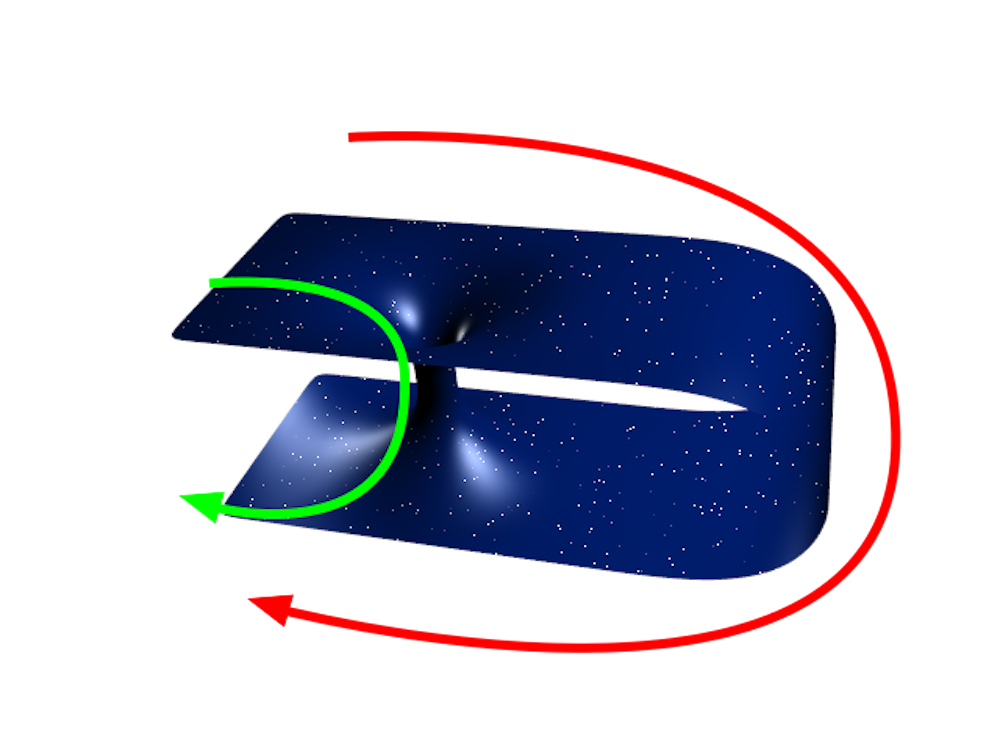
Einstein’s general theory of relativity allows for the possibility of warping time to such a high degree that it actually folds upon itself, resulting in a time loop. Imagine you’re traveling along this loop; that means that at some point, you’d end up at a moment in the past and begin experiencing the same moments since, all over again – a bit like deja vu, except you wouldn’t realize it. Such constructs are often referred to as “closed time-like curves” or CTCs in the research literature, and popularly referred to as “time machines.” Time machines are a byproduct of effective faster-than-light travel schemes and understanding them can improve our understanding of how the universe works.
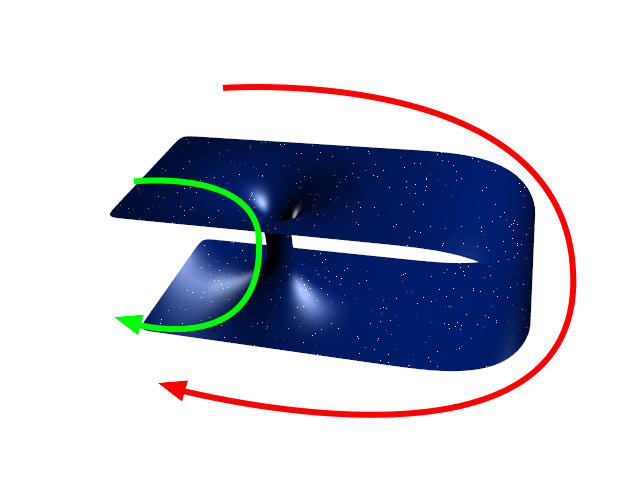
Here we see a time loop. Green shows the short way through wormhole. Red shows the long way through normal space. Since the travel time on the green path could be very small compared to the red, a wormhole can allow for the possibility of time travel.
Over the past few decades well-known physicists like Kip Thorne and Stephen Hawking produced seminal work on models related to time machines.
The general conclusion that has emerged from previous research, including Thorne’s and Hawking’s, is that nature forbids time loops. This is perhaps best explained in Hawking’s “Chronology Protection Conjecture,” which essentially says that nature doesn’t allow for changes to its past history, thus sparing us from the paradoxes that can emerge if time travel were possible.
Perhaps the most well-known amongst these paradoxes that emerge due to time travel into the past is the so-called “grandfather paradox” in which a traveler goes back into the past and murders his own grandfather. This alters the course of history in a way that a contradiction emerges: The traveler was never born and therefore cannot exist. There have been many movie and novel plots based on the paradoxes that result from time travel – perhaps some of the most popular ones being the “Back to the Future” movies and “Groundhog Day.”
Exotic matter
Depending on the details, different physical phenomena may intervene to prevent closed time-like curves from developing in physical systems. The most common is the requirement for a particular type of “exotic” matter that must be present in order for a time loop to exist. Loosely speaking, exotic matter is matter that has negative mass. The problem is negative mass is not known to exist in nature.
Caroline Mallary, a doctoral student at the University of Massachusetts Dartmouth has published a new model for a time machine in the journal Classical & Quantum Gravity. This new model does not require any negative mass exotic material and offers a very simple design.
Mallary’s model consists of two super long cars – built of material that is not exotic, and have positive mass – parked in parallel. One car moves forward rapidly, leaving the other parked. Mallary was able to show that in such a setup, a time loop can be found in the space between the cars.
An animation shows how Mallary’s time loop works. As the spacecraft enters the time loop, its future self appears as well, and one can trace back the positions of both at every moment afterwards. This animation is from the perspective of an external observer, who is watching the spacecraft enter and emerge from the time loop.
So can you build this in your backyard?
If you suspect there is a catch, you are correct. Mallary’s model requires that the center of each car has infinite density. That means they contain objects – called singularities – with an infinite density, temperature and pressure. Moreover, unlike singularities that are present in the interior of black holes, which makes them totally inaccessible from the outside, the singularities in Mallary’s model are completely bare and observable, and therefore have true physical effects.
Physicists don’t expect such peculiar objects to exist in nature either. So, unfortunately a time machine is not going to be available anytime soon. However, this work shows that physicists may have to refine their ideas about why closed time-like curves are forbidden.
For many, the holidays are indeed the most wonderful time of the year. Families and friends come together and enjoy food, good cheer – and, often, alcohol.
Commercially speaking, alcohol and the holidays seem to be made for each other. Alcohol can be a quick and easy way to get into the spirit of celebration.
And, it feels good. After two glasses of wine, the brain is activated through complex neurobiochemical processes that naturally release dopamine, a neurotransmitter of great importance.
When the dopamine molecule locks on to its receptor located on the surface of a neuron, or basic brain cell, a “buzz” occurs. It is often desirably anticipated before the second glass is empty.
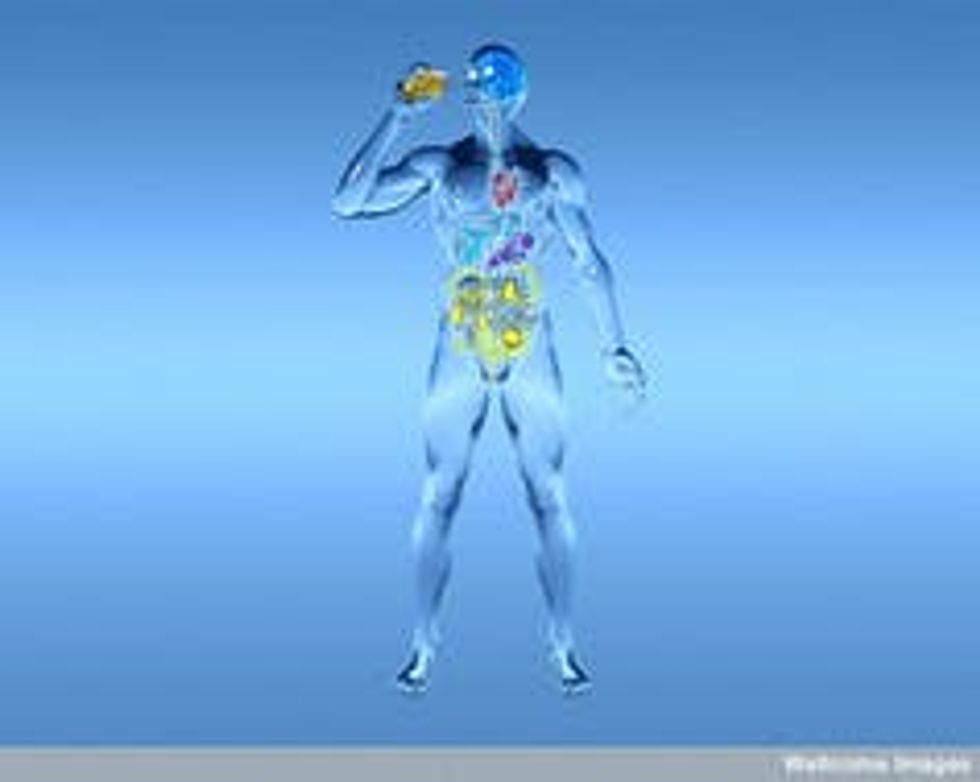
This image shows an illustration of a man drinking a pint of beer, indicating how the body metabolizes alcohol and the organs that this alcohol affects.
There are those, however, who drink right past the buzz into intoxication and, often, into trouble. For them, the brain starts releasing the same enjoyable dopamine, no different than what happens in the casual drinker’s, but it doesn’t stop there. A compulsion to binge drink can result.
As someone who has studied alcohol use disorder for over 15 years and who has treated thousands of patients who have it, I think it’s a major, yet often poorly understood, public health problem. Our culture seems to be moving beyond the point of labeling those with opioid addictions as “weak,” and I hope we can do the same for those with alcohol use disorder, too, which is more widespread than people may appreciate. Excessive drinking accounted for one in 10 deaths among working-age adults in the United States.
The consequences to the individual and the family are staggering, affecting physical and mental health, an increased spread of infectious disease, reduced quality of life, increased motor vehicle crashes and abuse and neglect of children, to mention a few.
Scientific study of the brain has helped explain binge drinking even if it may be hard for family and friends to understand. It’s defined as drinking five or more drinks for men and four for women on the same occasion on at least one day in the past 30 days.
Binge drinking is a medical condition. It happens through no fault of the individual, who is victimized by the comparative malfunction of the pleasure circuits in the brain. This causes the drinker to want more and more alcohol. Brains of binge drinkers have a disease, acknowledged by the American Medical Association since the 1950s, yet binge drinkers are often vilified.
Americans typically want to know and are willing to make some lifestyle changes out of fear and common sense when it comes to diseases such as heart disease, obesity and cancer. We as a society are not quite at the same point with substance abuse disorders, but researchers are desperately trying to bring that same willingness for prevention and treatment to substance use disorders.
Science understands the cause well enough to explain it and treat it so that lives can be saved and spared the devastating consequences for the millions who suffer with these conditions, their families and communities. This has become an urgent matter of national importance for scientists and medical practitioners.
The three stages of addiction
The alcohol addiction process involves a three-stage cycle: Binge-Intoxication, Withdrawal-Negative Affect, and Preoccupation-Anticipation.
It begins in the neurons, the basic type of brain cell. The brain has an estimated 86 billion of these cells, which communicate through chemical messengers called neurotransmitters.
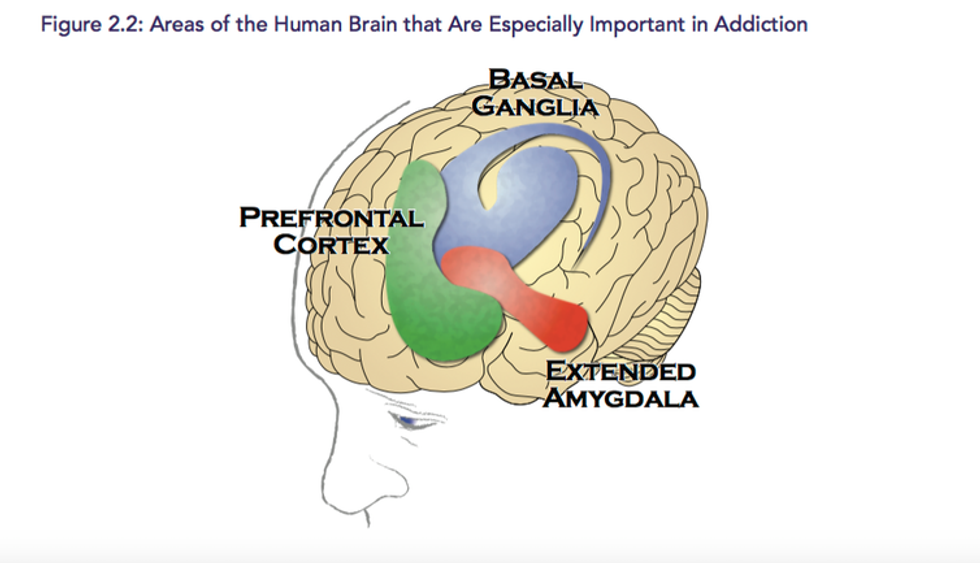
Neurons can organize in clusters and form networks or circuits in order to perform specific functions such as thinking, learning, emotions and memory. The addiction cycle disrupts the normal function of some of these networks in three areas of the brain – the basal ganglia, the extended amygdala and the prefrontal cortex.
The disruptions do several things that contribute to continued drinking. They enable alcohol or drinking-associated triggers (cues) which lead to seeking alcohol. They also reduce the sensitivity of the brain systems, causing a diminished experience of pleasure or reward, and heighten activation of brain stress systems. Last, they reduce function of brain executive control systems, the part of the brain that typically helps make decisions and regulate one’s actions, emotions and impulses.
These networks are critical for human survival. Unfortunately for the binge drinker, they become “hijacked,” and the bingeing continues even after the harmful effects have begun.
With continued bingeing, the “habit circuity” is repeatedly activated in another part of the basal ganglia called the dorsal striatum. It contributes to the compulsive seeking of more alcohol. This explains the intense desire (craving) which is triggered while a binge drinker is driving by a favorite bar and can’t resist pulling in, even after a promise to go directly home after work.
During the Withdrawal-Negative Affect Stage, there is a break from drinking. Because the reward circuit has a diminished ability to deliver a dopamine reward, there is far less pleasure with natural (safe) experiences – such as food and sex – compared to alcohol.
During abstinence from alcohol, stress neurotransmitters such as corticotropin-releasing factor (FRC) and dynorphin are released. These powerful neurochemicals cause negative emotional states associated with alcohol withdrawal. This drives the drinker back to alcohol in order to gain relief and attempt to reestablish the rewards of intoxication.
Regions of the brain are affected differently by alcohol.
Surgeon General's Report on Addiction
After a period of abstinence from alcohol, which may last only hours, the drinker enters the Preoccupation-Anticipation Stage. This involves the prefrontal cortex, where executive decisions are made about whether or not to override the strong urges to drink. This part of the brain functions with a “Go system” and “Stop system.”
When the Go circuits stimulate the habit-response system of the dorsal striatum, the drinker becomes impulsive with a craving and seeks a drink, perhaps even subconsciously. The Stop system can inhibit the activity of the Go system and is important especially preventing relapse after being triggered by stressful life events.
Most importantly, it is important to know that alcohol use disorder is a brain disorder causing a chronic illness. It is no different from diabetes, asthma or hypertension. When comprehensive continuing care is provided, the recovery results improve, and the binge drinker has the hope of remaining sober as long as lifelong treatment and maintenance of sobriety become a dedicated lifestyle choice.







 NASA/Johns Hopkins University Applied Physics Laboratory/Southwest Research Institute/AFP / HO



 AFP / Jonathan WALTER