



Curious Kids is a series for children of all ages. If you have a question you’d like an expert to answer, send it to curiouskidsus@theconversation.com.
How can there be ice on the Moon?

I have a question about ice on the Moon. How is this possible? – Olaf, age 9, Hillsborough, North Carolina
UK beekeepers and scientists tackle sticky problem of honey fraud
Lynne Ingram cuts a peaceful figure as she tends to a row of humming beehives in a leafy corner of Somerset, southwest England.
But the master beekeeper, who has been keeping hives for more than 40 years, has found herself in a fight against a tricky and evolving foe -- honey fraudsters.
The practice of adulterating honey is well known, and historically adulterants such as ash and potato flour have been used.
Now, advancements in technology and science have made it much easier, with "bespoke, designer or bioengineered" syrups used as diluting agents capable of fooling authenticity tests, Ingram said.
She founded the UK Honey Authenticity Network (HAN UK) in 2021 to raise awareness about natural honey and warn of the threat posed by fraud.
"One of the impacts we're seeing all over the world is beekeepers going out of business," she said.
Adulterated honey can be sold to retailers for a price several times lower than genuine producers can afford.
As well as producing their own honey, many larger-scale beekeepers have crop pollination contracts with farmers, delivering thousands of colonies to growers across the country.
If they go out of business due to unfair competition, this vital natural method of pollinating crops is reduced and food production suffers.
The British Beekeepers Association, which represents more than 25,000 producers and where Ingram is a honey ambassador, wants the risk of fraud to be recognized to protect the industry and consumers.
"I'd like to see an acknowledgement that there is actually an issue here," she said.
- Better labelling -
In May, the European Union updated its honey regulations to ensure clearer product labelling and a "honey traceability system" to increase transparency.
On the labelling for blended honeys, for example, all countries of origin are now required to appear near a product's name, where previously it was only mandatory to state whether blending had occurred.
Labelling in the UK, which has now left the EU, is not as stringent and Ingram believes consumers are "being misled" by vague packaging.
Behind the EU action is an apparent increase in adulterated honey arriving in the 27-nation bloc.
The substandard adulterates can have adverse effects on consumers' health, such as raising the risk of diabetes, obesity, and liver or kidney damage.
Between 2021 and 2022, 46 percent of the honey tested as it entered the EU was flagged as potentially fraudulent, up from 14 percent in the 2015-17 period.
Of the suspicious consignments, 74 percent were of Chinese origin.
Honey imported from the UK had a 100-percent suspicion rate.
The EU said this honey was probably produced in third countries and blended again in the UK before being sent to the bloc.
The UK is the second largest importer of honey in terms of volume in the whole of Europe. China is its top supplier.
Not all of the UK's imported honey leaves the country, however. Considerable quantities stay on the domestic market.
"We think there's an awful lot of it on the shelves," said Ingram, adding that adulterated honey was "widely available" in big supermarkets.
- Lasers -
Behind the closed blinds of a research laboratory at Aston University in Birmingham, central England, researchers fighting honey fraud are harnessing cutting-edge technology.
Aston scientists and beekeepers, including Ingram, are using light to reveal the contents of honey samples at the molecular level.
The technique -- known as Fluorescence Excitation-Emission Spectroscopy (FLE) -- involves firing lasers into samples.
The light frequencies re-emitted are then collated into a three-dimensional image -- or "molecular fingerprint" -- of the honey tested.
Alex Rozhin, the project lead and a reader in nanotechnology, said the test "can trace different molecules through the spectrum and confirm which type of biochemicals are present".
In the darkened lab, the light from different honeys is clearly visible.
The first gives off a vivid green and the second a cooler blue, indicating distinct chemical compositions.
Using FLE, Rozhin says his team "can immediately trace a concentration of fraud inside samples" with "different spectral bands corresponding to syrup (or) to natural honey".
Rozhin said FLE is more accurate than existing tests and can provide results far quicker, at a greatly reduced cost and without the need for highly trained personnel.
One of the Aston team's aims is to create a version of FLE that can be used by honey producers or even consumers with scaled-down equipment or eventually just a smartphone.
Rolling the test out like this would also accelerate the creation of a honey database which, through machine learning, could be used as a catalogue of biometric signatures.
"If we get a new sample and it's been tampered with and it's different from how the database is built up, we'll know there's something obscure," said Steven Daniels, an Aston research associate specializing in machine learning.
Ingram said the test could close international gaps in testing methods by establishing a unified standard, but the government needed to monitor the sector too.
"We really need to get to grips with this," she said.
Gulf ‘dead zone’ is larger than average this year, the size of New Jersey
This year’s area of low oxygen in the Gulf of Mexico is larger than average, the National Oceanic and Atmospheric Administration (NOAA) announced Thursday.
The “dead zone” is approximately 6,705 square miles, as measured last week. Within NOAA’s 38 years of measuring the dead zone, this year’s assessment marks the 12th-largest area of low- to no oxygen, which can kill fish and marine life.
NOAA had forecast at the beginning of the summer that the dead zone would be above average. But the measurement announced this week is even larger than anticipated.
Experts fault upriver conservation efforts that are not keeping pace.
Scientists at Louisiana State University and the Louisiana Universities Marine Consortium (LUMCON) conducted the 2024 dead zone survey aboard the research vessel Pelican from July 21 to 26.
The annual survey helps keep track of the progress made through the efforts of the Environmental Protection Agency’s Mississippi River/Gulf of Mexico Hypoxia Task Force, a state-federal partnership that is working toward a long-term goal of reducing the five-year average dead zone to fewer than about 1,900 square miles by 2035.
Today, the five-year average – which accounts for extremely wet and dry years becoming more common with climate change – is 4,298 square miles, more than twice the Task Force’s goal
The dead zone occurs every summer and is caused in large part by nutrient runoff from the overapplication of fertilizer on Midwestern farms. During rains or flooding, water carries the fertilizer’s nitrogen and phosphorus from fields into the Mississippi River and its tributaries.
When the nutrients reach the Gulf, either from the Mississippi or the adjacent Atchafalaya River, they ignite an overgrowth of algae. As the algae dies, it decomposes and sinks to the bottom, depleting oxygen from the water.
When this happens, animals like fish and shrimp will leave. Some commercially harvested species such as shrimp will concentrate around the edges of the affected area, forcing local fishermen to travel outside the dead zone to cast their nets.
Bottom-dwelling creatures, such as clams and burrowing crabs, aren’t as mobile. They cannot leave the dead zone and will suffocate and die.
“The hypoxic zones lead to habitat loss for several ecologically and economically important species in the Gulf: I’m talking about shrimp, menhaden and a variety of other species,” said Sean Corson, director of NOAA’s National Centers for Coastal Ocean Science.
In 2020, the Union of Concerned Scientists estimated the dead zone’s average annual cost in damages to fisheries and marine habitats at $2.4 billion. This year’s dead zone impacts a swath of marine habitat roughly the size of New Jersey, stretching from south Louisiana almost to Galveston, Texas.
Though the dead zone is larger than NOAA had anticipated with its early-summer forecast, it falls within the range experienced over the last four decades of monitoring, said LSU professor Nancy Rabalais, the co-chief scientist for the research cruise.
Still, researchers are never quite sure where the dead zone will hit hardest and what its size will be at the height of summer, said Rabalais. “We continue to be surprised each summer at the variability in size and distribution,” she said.
But the high five-year average is not surprising to most dead zone experts, who point upriver to the Midwest, where there’s been a lag in farmers adopting agricultural practices that reduce nutrient runoff.
“After nearly four decades of experience with the Gulf dead zone, it should be clear that we can’t continue to rely on the same policy tools to manage fertilizer pollution and expect a different result,” wrote Karen Perry Stillerman, deputy director of the Food and Environment Program at the Union of Concerned Scientists.
“Instead, we should demand a new approach, one that not only helps farmers to shift their practices but also insists that they do so,” she said.
In June 2022, the EPA established the Gulf Hypoxia Program to support the work of nutrient-reduction programs. The Bipartisan Infrastructure Law committed $60 million to support state-driven strategies to reduce nutrient runoff within the Mississippi River Basin. This funding will be spread across 12 states over the next five years.
A preliminary goal for the EPA’s Hypoxia Task Force is to reduce nitrogen and phosphorus loads in the river by 20% by 2025. In May 2024, the U.S. Geological Survey found that while nitrogen loads had fallen 7% since 1980, phosphorus had increased by 22%.
Some experts have linked this excess phosphorus to wastewater from municipalities that don’t remove the nutrient from otherwise-clean sewage discharged into the river and its streams.
By the time the water reaches Louisiana, it’s already loaded with nutrients from upriver. So, from a lower-river perspective, putting more resources into efforts across the basin has helped, but further policy changes must be enacted soon to reduce the size of the dead zone, said LSU research scientist Doug Daigle, who coordinates the Louisiana Hypoxia Working Group.
Without changes to current nutrient reduction programs, the task force will be hard-pressed to meet its 2035 goals, Daigle said.
This story is a product of the Mississippi River Basin Ag & Water Desk, an independent reporting network based at the University of Missouri in partnership with Report for America, with major funding from the Walton Family Foundation.
Louisiana Illuminator is part of States Newsroom, a nonprofit news network supported by grants and a coalition of donors as a 501c(3) public charity. Louisiana Illuminator maintains editorial independence. Contact Editor Greg LaRose for questions: info@lailluminator.com. Follow Louisiana Illuminator on Facebook and X.
Colombia, Guatemala learn from each other in rainforest preservation
In the lush jungle of northern Guatemala -- in the largest protected area in Central America -- 30 leaders from Colombia's Amazon basin region are swapping strategies with local ethnic Maya farmers on how to live off this dense forest without destroying it.
Under the soaring, leafy mahogany and cedar trees in the Maya Biosphere Reserve, the visiting group discusses ways to ensure the rain forest remains healthy, while studying the reserve-type model Guatemala has been developing since 1994.
Guatemala's vast sustainability project aims to achieve a balance in which communities reforest, cut down trees for timber in a controlled way, grow grains and vegetables, collect ornamental plants, and even develop low-impact tourism.
"That ensures that our communities are getting the economic resources that are also invested here for conservation," Sergio Balan, regional director of the National Council of Protected Areas (CONAP), told AFP in the village of Melchor de Mencos, near the border with Belize.
The Maya Biosphere Reserve sprawls over 2.1 million hectares (5.2 million acres) and borders Mexico and Belize.
Every year, its flora and fauna are threatened by fires, deforestation for agricultural and livestock purposes, and even drug traffickers.
Hundreds of archaeological sites are located in this territory, such as the ancient Mayan city of Tikal, one of the main tourist sites in Guatemala and the site hosting the visitors from the Forest Development and Biodiversity Centers of the Colombian Amazon.
In the reserve and near Tikal, there is also the pre-Hispanic park of Uaxactun, where both groups participated in a Mayan ceremony with a fire stoked with candles and tree resin.
The Colombian leaders, whose visit lasted a week, highlighted the achievements in reducing deforestation in the Colombian Amazon between 2021 and 2023, by 61 percent, according to data from Colombia's environment ministry.
- Farmer to farmer -
There are currently 16 active concessions that help conserve nearly 619,000 hectares of forest, CONAP says. Controlled logging permits, meanwhile, let private companies work for 25- or 30-year periods.
Concessions and reserves "not only provide employment, but also training for different jobs," says Erwin Maas, a Guatemalan tourist guide who is also familiar with forestry.
CONAP estimates that the concessions, a kind of activity grant, create about 150,000 direct and indirect jobs in the reserve.
Along one part of the path, visitors find a row of cut logs that are stacked to be taken to the sawmill. The wood comes from trees selected for felling in a controlled process that will allow the forest to regenerate.
Nearby, the sound of birds and monkeys fluttering through the branches, mixes with group's chatter.
"One of the great ideas we took away is the form of organization they have had (in Guatemala) to really last over time," says Aristides Oime, president of a Colombian farm group, Asojuntas de Cartagena del Chaira.
"From farmer to farmer, we see how we can really improve," he said. "We want to show how we truly believe that deforestation is not the way, the real route is environmental conservation."
The coordinator of the Colombia-based NGO Heart of the Amazon, Luz Rodriguez, believes that though there are differences with the Guatemalan communities, they learned lessons about how other people control land sustainably.
How the last meal of a 3,000-year-old crocodile was brought back to life using science
What do you think of when you think about ancient Egyptian mummies? Perhaps your mind takes you back to a school trip to the museum, when you came face to face with a mummified person inside a glass case. Or maybe you think of mummies as depicted by Hollywood, the emerging zombie-like from their sandy tombs with dirtied bandages billowing in the breeze.
It might surprise you to know that the Egyptians also preserved millions of animals.
In a recent study, my colleagues and I revealed extraordinary details about the final hours in the life of a crocodile that was mummified by the ancient Egyptian embalmers. Using a CT scanner, we were able to determine how the animal died and how the body was treated after death.
To the Egyptians, animals served an important religious function, moving between the earthly and divine realms. Hawks were associated with the sun god, Horus, because they flew high in the sky, closer to the sun (and therefore to the god himself). Cats were linked to the goddess Bastet, a brave and ferociously protective maternal figure.
Most animal mummies were created as votive offerings or gifts.
Animal mummies provide a snapshot of the natural world, taken between approximately 750BC and AD250. Some of these mummified species are no longer found in Egypt.
For example, ancient Egyptians would have seen sacred ibises, long-legged wading birds with curved beaks, along the banks of the Nile every day. The birds were mummified in their millions as offerings to Thoth, the god of wisdom and writing. The birds are no longer in Egypt as climate change and the effects of desertification have made them move south to Ethiopia.
Another commonly mummified animal was the crocodile. Although crocodiles lived in the Nile during ancient times, the completion of the Aswan Dam in 1970 prevented them from moving northwards towards the delta in lower Egypt.
Crocodiles were associated with Sobek, Lord of the Nile and the god whose presence signalled the annual Nile flood which provided water and nutrient-rich silt to their agricultural land.
Crocodiles were mummified in huge numbers as offerings to Sobek. They were used as talismans throughout pharaonic Egypt to ward off evil, either by wearing crocodile skins as clothing, or by hanging a crocodile over the doors of homes.
Most crocodile mummies are of small animals, which suggests that the Egyptians had the means to hatch and keep the young alive until they were required. Archaeological evidence reinforces this theory, with the discovery of areas dedicated to the incubation of eggs and rearing of hatchlings. Some were pampered as cult animals and allowed to die a natural death.
As the crocodiles grew larger, the risk to crocodile keepers increased, suggesting perhaps that larger specimens were captured in the wild and hastily dispatched for mummification. Research on the mummified remains of larger animals has revealed evidence of skull trauma inflicted by humans probably as an attempt to immobilise and kill the animal.
What we found
The crocodile mummy in our study holds evidence to suggest how these animals might have been caught. The mummy is held in the collection of Birmingham Museum and Art Gallery, UK, and measures 2.23 metres long. In May 2016, the large crocodile mummy, which formed part of a wider study by a team of researchers I work with from the University of Manchester, was transported to the Royal Manchester Children’s Hospital to undergo a series of radiographic studies.
Medical imaging techniques allow researchers to study ancient artefacts without destroying them, the way that studies of mummies once did.
X-rays and CT scans showed that the animal’s digestive tract was filled with small stones known as “gastroliths”. Crocodiles often swallow small stones to help them digest food and regulate buoyancy. The gastroliths suggest the embalmers did not carry out evisceration, the process of removing the internal organs to delay putrefaction.
Among the stones, the images also showed the presence of a metal fish hook and a fish.
The study suggests that large, mummified crocodiles were captured in the wild using hooks baited with fish. It adds weight to the account of Greek historian, Herodotus, who visited Egypt in the 5th century BC and wrote about pigs being beaten on the banks of the river to lure the crocodiles, which were caught on baited hooks placed in the Nile.
Unlike many aspects of life in ancient Egypt, little information was recorded relating to animal worship and mummification. Classical writers who travelled to the country remain some of our best sources of information.
Colleagues from the Birmingham School of Jewellery helped replicate the hook in bronze, the metal most likely to have been used to create the ancient original, for display alongside the crocodile mummy.
Modern technology is helping us to learn more and more about our ancient past. I can only imagine what secrets technology might help reveal in the future.![]()
Lidija M. Mcknight, Lecturer in Biomedical Egyptology, University of Manchester
This article is republished from The Conversation under a Creative Commons license. Read the original article.
Japan sees hottest July since records began
Japan sweltered through its hottest July since records began 126 years ago, the weather agency said, as extreme heatwaves fuelled by climate change engulfed many parts of the globe.
Temperatures in the country were 2.16 degrees Celsius higher than average, breaking last year's record for July of 1.91 degrees Celsius above average.
"It was the highest since statistics began in 1898," the Japan Meteorological Agency (JMA) said Thursday, noting that the figures were "considerably higher" nationwide.
Of 153 observation posts across Japan, 62 broke their average temperature record in July.
Contributing factors included a high-pressure system over the Pacific and "warm air from the south" that shrouded northern parts of the archipelago, the JMA said.
Since April, heatstroke has killed 59 people in Japan, according to the disaster management agency.
Parasols and chunky necklaces that can be stored in the freezer have been a common sight around Tokyo, where street performer Jiro Kan, 56, told AFP he was feeling the heat.
"After spending two hours standing here, I get so sweaty I can literally squeeze it all out from my shirt. I'm drenched," said Kan, dressed in an all-yellow suit.
"People who are used to a more dry type of heat like in the United States find the heat and humidity in Japan more difficult to handle," he said in tourist hotspot Asakusa.
Last month, Shizuoka west of Tokyo became the first Japanese region to see the mercury reach 40 degrees Celsius (104 Fahrenheit) this year -- far surpassing the 35-degree threshold deemed "extremely hot" by authorities.
Heatwaves are becoming increasingly common across the globe, with the European Union's climate monitor saying in July that the Earth experienced its warmest day in recorded history.
Iceland’s recent volcanic eruptions driven by pooling magma are set to last centuries
To experience a volcanic eruption is to witness nature’s raw power. If you would like to see one for yourself, Iceland is a great location for it. Since 2021, seven eruptions have taken place along the Reykjanes Peninsula, close to Reykjavík.
These recent Icelandic eruptions have garnered attention from Earth scientists like me. The eruptions help us understand how volcanoes work in incredible detail. My team has been taking samples from the erupting lava from the Reykjanes Peninsula and finding some interesting results.
One of our findings suggests that magma from the first eruption pooled just under the island’s surface, where it built up the energy to spectacularly erupt. This initial burst of volcanism made it easier for more eruptions to follow after it.
Why is Iceland called the land of fire?
The island nation of Iceland is sometimes called “the land of ice and fire.” Early settlers witnessed several great “fires” – or volcanic eruptions – along the Reykjanes Peninsula.
After about 800 years without a volcanic event on the Reykjanes Peninsula, the Fagradalsfjall volcano roared to life on March 19, 2021. Then, two more discrete volcanic events occurred at Fagradalsfjall in 2022 and 2023. Subsequently, four more eruptions have taken place to the west at the Sundhnúkur fissure system in 2023 and 2024.
While these eruptions provide an incredible spectacle, they also have the power to wreak havoc. The recent Sundhnúkur eruptions threatened the fishing town of Grindavík, the geothermal power plant at Svartsengi and Iceland’s premier tourist destination: the geothermal spa the Blue Lagoon. Lava erupted within the town limits of Grindavík, and only human-made berms have prevented further destruction.
What makes Iceland so volcanically active?
Iceland is a unique place on Earth. It is part of a huge chain of volcanoes submerged in the center of the Atlantic Ocean, with Iceland being exposed above the ocean’s surface. This volcanic chain is known as the Mid-Atlantic Ridge, and it plays an essential role in plate tectonics.
Plate tectonics describes how the vast, rigid plates that make up Earth’s crust slide past, into and under one another. Their behavior slowly reshapes Earth’s surface. In some locations, the plates collide to form mountain ranges like the Himalayas. In other locations, one plate slides under another, creating volcanoes and earthquakes, like in Japan.
On the Mid-Atlantic Ridge – which stretches between the South Atlantic and Arctic Ocean – the plates pull apart, allowing molten magma to pour through. This magma solidifies into volcanic crust and creates new parts of the tectonic plates.
Geologists have also found a buoyant, hot plume of rocky material rising from deep in the Earth that intersects with the Mid-Atlantic Ridge under Iceland. This plume, along with several other similar plumes in the central and southern Atlantic, may have triggered the formation of the Atlantic Ocean basin more than 200 million years ago.
The plate tectonics associated with the Mid-Atlantic Ridge and the hot, rocky plume under Iceland together form Iceland’s volcanoes.
Scientists have been able to show that previous eruptions on the Reykjanes Peninsula are not random in time or space. Instead, they occur in periods that last centuries and along the same volcanic zones. These patterns indicate that these volcanic periods happen when vast tectonic forces pull apart the Reykjanes Peninsula. It appears that, while the plates pull apart evenly, volcanism along the Reykjanes ridge segment pulses with time.
What’s driving the eruption?
Many groups, including my colleagues from Iceland, have been collecting the erupted lavas on a near-daily basis. The collected samples provide a vital scientific time series of the eruptions.
Taking a volcanic time series is like regularly drawing someone’s blood to understand their medical condition. In this case, though, the blood is red-hot lava.
An initial study by another team in 2022 suggested that the mantle – the solid geological layer beneath the Earth’s crust – was melting to feed the lavas in Iceland, and that the lavas’ chemical makeup was changing over time. They suggested that these changes had to do with where and when the melting was happening in the mantle.
In July 2024, my research team and I published a longer time-series of the lavas from the eruption using a sensitive chemical method that helped us understand the lavas’ composition and origin.
The layer of basaltic rock that people live on in Iceland extends to a depth of about 9 miles (15 kilometers). It’s part of Earth’s crust. The mantle that lies directly beneath this crust is distinct – it’s made mostly of minerals like olivine that form a rock called peridotite. The magmas feeding these volcanic eruptions come from mantle peridotite.
The chemical method that my team used revealed that the first magmas feeding these eruptions rose from the mantle, but got stuck beneath the surface in a magma chamber for as long as a year. The rocks in the chamber walls melted into the magma, and we could see traces of them in our analyses.
Our research also suggests that the magmas gained water, carbon dioxide and other gases from sitting in the magma chamber. This water and gas allowed the magma to build up enough pressure to break through the surface and erupt as lava.
Magma pooling in the crust can trigger explosive eruptions – the beginnings of eruptions like those in Iceland or in La Palma in the Canary Islands in 2021 may require this type of pooling.
What might we expect in the future?
History tells researchers that these eruptions will likely last a long time. The volcanoes will erupt periodically every few years, for days to months at a time, for up to several hundred years into the future.
Generations of geologists and volcanologists are likely to forge their careers in Iceland, and millions of geo-tourists will get to experience the hauntingly beautiful eruptions.
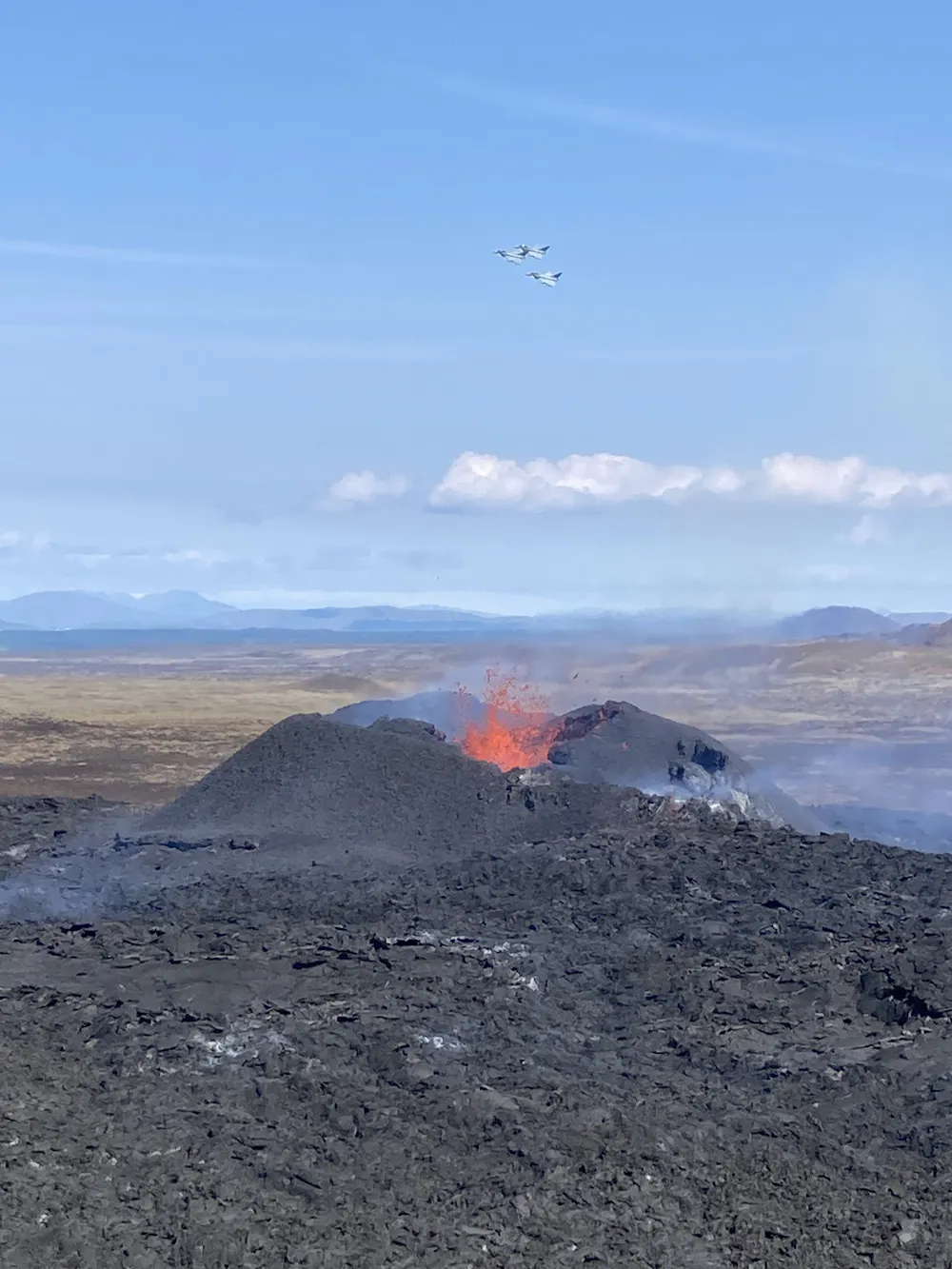
German Typhoon jets fly in formation over the 2023 Litli-Hrútur eruption. James Day/SIO
With all these eruptions, Icelanders will have to adapt. Lava flows can disrupt infrastructure such as the Svartsengi geothermal plant, and volcanic gases can cause health problems.
The Fagradalsfjall and Sundhnúkur eruptions have already provided scientists with a treasure trove of data and insight into how volcanoes work. Continued study of volcanism on the Reykjanes Peninsula will help scientists understand how, when and why eruptions take place, and to better manage the hazards associated with living with volcanoes.![]()
James Day, Professor of Geosciences, University of California, San Diego
This article is republished from The Conversation under a Creative Commons license. Read the original article.
NASA smacked a spacecraft into an asteroid – details on its 12-million-year history
NASA’s DART mission – Double Asteroid Redirection Test – was humanity’s first real-world planetary defence mission.
In September 2022, the DART spacecraft smashed into the companion “moon” of a small asteroid 11 million kilometres from Earth. One goal was to find out if we can give such things a shove if one were headed our way.
By gathering lots of data on approach and after the impact, we would also get a better idea of what we’d be in for if such an asteroid were to hit Earth.
Five new studies published in Nature Communications today have used the images sent back from DART and its travel buddy LICIACube to unravel the origins of the Didymos-Dimorphos dual asteroid system. They’ve also put that data in context for other asteroids out there.
DART’s last complete image of Dimorphos, about 12km from the asteroid and 2 seconds before impact. NASA/Johns Hopkins APL
Asteroids are natural hazards
Our Solar System is full of small asteroids – debris that never made it into planets. Those that come close to Earth’s orbit around the Sun are called Near Earth Objects (NEOs). These pose the biggest risk to us, but are also the most accessible.
Planetary defence from these natural hazards really depends on knowing their composition – not just what they’re made of, but how they’re put together. Are they solid objects that will punch through our atmosphere if given the chance, or are they more like rubble piles, barely held together?
The Didymos asteroid, and its tiny moon Dimorphos, are what’s known as a binary asteroid system. They were the perfect target for the DART mission, because the effects of the impact could be easily measured in changes to Dimorphos’ orbit.
They are also close(ish) to Earth, or are at least NEOs. And they’re a very common type of asteroid we haven’t had a good look at before. The chance to also learn how binary asteroids form was the icing on the cake.
Quite a few binary asteroid systems have been discovered, but planetary scientists don’t exactly know how they form. In one of the new studies, a team led by Olivier Barnouin from Johns Hopkins University in the United States used images from DART and LICIACube to estimate the age of the system by looking at surface roughness and crater records.
They found Didymos is roughly 12.5 million years old, while its moon Dimorphos formed less than 300,000 years ago. That may still sound like a lot, but it’s much younger than was expected.
A pile of boulders
Dimorphos is also not a solid rock as we’d typically imagine. It is a rubble pile of boulders that are barely held together. Along with its young age, it shows there can be multiple “generations” of these rubble pile asteroids in the wake of larger asteroid collisions.
Sunlight actually causes small bodies like asteroids to spin. As Didymos started to spin like a top, its shape became squashed and bulged in the middle. This was enough to cause large pieces to just roll off the main body, with some even leaving tracks.
These pieces slowly created a ring of debris around Didymos. Over time, as the debris started sticking together, it formed the smaller moon Dimorphos.
How the spin of Didymos could have produced its tiny moon Dimorphos. Video by Yun Zhang.
Another study, led by Maurizio Pajola from Auburn University in the US used boulder distributions to confirm this. The team also discovered there were significantly more (up to five times) large boulders than have been observed on other non-binary asteroids humans have visited.
Another of the new studies shows us that boulders on all asteroids space missions have visited so far (Itokawa, Ryugu and Bennu) were likely shaped the same way. But this excess of larger boulders on the Didymos system could be a unique feature of binaries.
The locations of 15 suspected boulder tracks on the surface of Didymos. Bigot, Lombardo et al., (2024)/Image taken by DRACO/DART (NASA)
Lastly, another paper shows this type of asteroid appears to be more susceptible to cracking. This happens due to the heating–cooling cycles between day and night: like a freeze–thaw cycle but without the water.
This means if something (such as a spacecraft) were to impact it, there would be much more debris thrown up into space. It would even increase the amount of “shove” it could have. But there is a good chance that what lies underneath is much stronger than what we’re seeing on the surface.
This is where the European Space Agency’s Hera mission will step in. It will not only be able to provide higher-resolution images of the DART impact sites, but will also be able to probe the asteroids’ interiors using low-frequency radar.
The DART mission not only tested our ability to protect ourselves from future asteroid impacts, but also enlightened us on the formation and evolution of rubble pile and binary asteroids near Earth.![]()
Eleanor K. Sansom, Research Associate, Curtin University
This article is republished from The Conversation under a Creative Commons license. Read the original article.
Many dementia cases could be prevented, but far from all: study
Millions of cases of dementia could be prevented or delayed by reducing a range of risk factors such as smoking or air pollution, according to a major new study, though outside experts warn that such measures can only go so far.
The debilitating condition, which progressively robs people of their memories, cognitive abilities, language and independence, currently affects more than 55 million people across the world.
Dementia is caused by a range of diseases, the most common of which is Alzheimer's.
A huge review of the available evidence published in The Lancet journal on Wednesday said that the "potential for prevention is high" in the fight against dementia.
The study follows a previous report in 2020 that also emphasised the importance of prevention.
At the time, the international team of researchers estimated that 40 percent of dementia cases were linked to 12 risk factors.
The factors included people having a lower level of education, hearing problems, high blood pressure, smoking, obesity, depression, physical inactivity, diabetes, excessive drinking, traumatic brain injury, air pollution and social isolation.
The latest update adds two more risk factors: vision loss and high cholesterol.
"Nearly half of dementias could theoretically be prevented by eliminating these 14 risk factors," the study said.
- EU turns down new drug -
Decades of research and billions of dollars have failed to produce a cure or truly effective drug for dementia.
But since the start of last year, two Alzheimer's treatments have been approved in the United States: Biogen's lecanemab and Eli Lilly's donanemab.
They work by targeting the build-up of two proteins -- tau and amyloid beta -- considered to be one of the main ways the disease progresses.
However, the benefits of the drugs remain modest, they have severe side effects, and they are often very expensive.
In contrast to the US, the European Union's medicine watchdog last week refused to approve lecanemab, and it is still considering donanemab.
Some researchers hope the fact that the new drugs work at all means they will pave the way for more effective treatments in the future.
Others prefer to focus on ways to prevent dementia in the first place.
Masud Husain, a neurologist at the UK's University of Oxford, said that focusing on risk factors "would be far more cost effective than developing high-tech treatments which so far have been disappointing in their impacts on people with established dementia".
- 'How much more could we do?' -
The Lancet study was welcomed by experts in the field, among whom the importance of prevention is hardly debatable.
However, some said the idea that nearly half of all dementia cases could be prevented should be put in perspective.
It has not been proven that the risk factors directly cause dementia, as the authors of the study acknowledged.
For example, could it be dementia that is causing depression, rather than the other way around?
It is also difficult to separate the risk factors from each other, though the researchers tried.
Some could be intrinsically linked, such as depression and isolation, or smoking and high blood pressure.
Above all, many of the risk factors are societal scourges that have long proven near impossible to fully address.
The study lays out different recommendations ranging from the personal -- such as wearing a helmet while cycling -- to governmental, such as improving access to education.
"It is not clear whether we could ever completely eliminate any of these risk factors," Charles Marshall, a neurologist at Queen Mary University of London, told AFP.
"We already have public health programmes to reduce smoking and hypertension (high blood pressure), so how much more could we do?"
Tara Spires-Jones, a neuroscientist at the University of Edinburgh, said it was important that "we do not blame people living with dementia for their brain disease".
That is because "it is clear that a large portion of dementias could not be prevented due to genes and things beyond people's control, like opportunities for education as children", she added.
In world first, EU's sweeping AI law enters into force
The European Union's landmark law on artificial intelligence came into force on Thursday, which Brussels vows will drive innovation while protecting citizens' rights.
The EU earlier this year adopted the world's first sweeping rules to govern AI, especially powerful systems like OpenAI's ChatGPT after difficult and tense negotiations.
Although the rules were first proposed in 2021, they took on greater urgency when ChatGPT burst onto the scene in 2022, showing generative AI's human-like ability to churn out eloquent text within seconds.
Other examples of generative AI include Dall-E and Midjourney, which can generate images in nearly any style with a simple input in everyday language.
"With our artificial intelligence act, we create new guardrails not only to protect people and their interests, but also to give business and innovators clear rules and certainty," European Commission President Ursula von der Leyen said.
Companies will have to comply by 2026 but rules covering AI models like ChatGPT will apply 12 months after the law enters into force.
Strict bans on using AI for predictive policing based on profiling and systems that use biometric information to infer an individual's race, religion or sexual orientation will apply six months after the law enters into force.
The law known as the "AI Act" takes a risk-based approach: if a system is high-risk, a company has a stricter set of obligations to fulfil to protect citizens' rights.
The higher the risk to Europeans' health or rights, for example, the greater the companies' requirements to protect individuals from harms.
"The geographic scope of the AI Act is very broad, so organisations with any connections to the EU in their business or customer base will need an AI governance programme in place to identify and comply with their obligations," said Marcus Evans, partner at law firm Norton Rose Fulbright.
Companies in violation of the rules on banned practices or data obligations face fines of up to seven percent of worldwide annual revenue.
The EU in May established an "AI Office" of tech experts, lawyers and economists under the new law to ensure compliance.
Mediterranean heatwave 'virtually impossible' without climate change: scientists
The punishing heat experienced around the Mediterranean in July would have been "virtually impossible" in a world without global warming, a group of climate scientists said Wednesday.
A deadly heatwave brought temperatures well above 40 degrees Celsius (104 Fahrenheit) to southern Europe and North Africa, where such extreme summer spells are becoming more frequent.
Scorching heat claimed more than 20 lives in a single day in Morocco, fanned wildfires in Greece and the Balkans, and strained athletes competing across France in the Summer Olympic Games.
World Weather Attribution, a network of scientists who have pioneered peer-reviewed methods for assessing the possible role of climate change in specific extreme events, said this case was clear.
"The extreme temperatures reached in July would have been virtually impossible if humans had not warmed the planet by burning fossil fuels," according to the WWA report by five researchers.
The analysis looked at the average July temperature and focused on a region that included Morocco, Portugal, Spain, France, Italy and Greece.
Scientists used this and other climate data to assess how the heat in July compared to similar periods in a world before humanity began rapidly burning oil, coal and gas.
They concluded the heat recorded in Europe was up to 3.3C hotter because of climate change.
Beyond the Mediterranean, intense heat reached Paris this week where athletes competing in the Olympic Games withered as temperatures hit the mid-30s this week.
"Extremely hot July months are no longer rare events," said Friederike Otto, a climate scientist at Imperial College London, a co-author of the study.
"In today's climate... Julys with extreme heat can be expected about once a decade," she said.
Scientists have long established that climate change is driving extreme weather and making heatwaves longer, hotter and more frequent.
This latest episode came in a month when global temperatures soared to their highest levels on record, with the four hottest days ever observed by scientists etched into the history books in July.
The past 13 months have been the warmest such period on record, exceeding a 1.5C limit that scientists say must be kept intact over the long term to avoid catastrophic climate change.
How a futuristic material is able to change its properties from soft to rigid, and back
In our everyday life, we are surrounded by objects that have properties enabling them to perform certain functions. Rigidity and softness enable an object to perform a specific function. These propoerties are seemingly opposing in nature, and one property cannot be traded for another.
For example, pillows are soft to provide the necessary cushioning and comfort. A rolling pin is rigid and round to be able to roll over dough. Once these objects are fabricated, those properties cannot be changed. A pillow cannot flatten dough, and a rolling pin cannot provide support for a head and neck.
But imagine if an object as soft as a pillow could transform into an object as stiff as a rolling pin. With a simple switch, that object could acquire the properties and functions of a stiff material and, with another click, those of a soft material.
A material that could do this would allow an object to have multiple functions. This multifunctionality would inherently bring a substantial drop in the use of our resources. It would represent a paradigm shift for the sustainable future of everyday technologies.
Future materials
Along with other material scientists, physicists and engineers, my research investigates what we describe as reconfigurable mechanical metamaterials. These are a class of re-programmable multipurpose metamaterials with a transformable internal architecture.
These materials have three antagonist — seemingly counteractive — properties: floppiness, rigidity and multistability. This means that a user can re-program, on demand, their properties to be either stiff or soft or, if needed, even multistable.
An object made by this all-in-one class of metamaterials can become rigid to resist the application of external forces as a stiff structure, shape morph as a floppy mechanism, or trap and absorb energy as a multistable material.
After fabrication
A material that can acquire — post-fabrication — the traits of either a structure, a mechanism or a multistable matter does so because of the arrangements of its building block, in this case, a meta-hinge.
Reconfigurable building block, namely a metahinge. Applying a pair of forces to the rigid structure on the left can form a flexible hinge, generating a flopping mechanism (right) that can rotate around the central pivot. (D. Pasini and L. Wu), CC BY
This rearrangement can be triggered through the application of forces at particular pressure points. During the reconfiguration process, their edges come into contact, eventually merge, and close the central void, forming a flexible hinge. In one configuration, the building block is rigid because the metal hinge is not formed, whereas, in the other, the activation of the meta-hinge generates local rotation around the central pivot, making it floppy.
The metahinge activation can turn a structure into a floppy mechanism: on the left, a rigid curved beam withstands the applied load with negligible deformation, while on the right, the same beam becomes extremely floppy and sag in the opposite direction under the application of the identical load. (D. Pasini and L. Wu), CC BY
The reconfigurable building block can be used to create multifunctional structures with re-programmable properties. For example, a one-dimensional beam can be made to behave as either a stiff or floppy structure under a load applied at its midspan.
On the other hand, tessellating the building block in two dimensions allows the creation of three types of reconfigurations, each corresponding to a given class of macroscopic solids, either rigid, floppy or multistable at the verge between the two. Extensions to three dimensions are also possible.
The selective activation of metahinges enables a single metamaterial to acquire seemingly conflicting mechanical properties: rigidity (left), floppiness (right) and multistability when between the two states (middle). (D. Pasini and L. Wu), CC BY
Applications of metamaterials
Multifunctional products that can benefit from property reprogrammability span multiple sectors. In addition to physical properties, other geometric properties can be re-programmed. For example, the reconfigurability of the unit cells can bring overall changes in the size and shape of a product.
Fostering sustainability through multifunctional products, such as this reconfigurable coat hanger in different states: fully deployed with a width of 52 cm, and condensed, with a width of 16 cm. (D. Pasini, L. Wu and A. Sitbon), CC BY
A multifunctional coat hanger is just one example. By selectively activating certain hinges, the coat hanger can collapse for space-saving and ease of transportation, as well as be deployed when needed in different sizes and forms to accommodate clothing of different sizes. This provides an unprecedented level of multifunctionality, leading to sustainable resource use.
This all-in-one class of metamaterials helps create multipurpose products. This multifunctionality promises to reduce the use of resources, open a sustainable pathway to our future technology and contribute to attaining the sustainability targets our world has set, thereby paving the way for a greener and more resilient future.![]()
Damiano Pasini, Professor of Mechanics and Materials, McGill University
This article is republished from The Conversation under a Creative Commons license. Read the original article.
One year on 'Mars': Inside NASA's ultra-realistic isolation study
Sealed inside a habitat in Texas and cut off from the outside world for over a year, Kelly Haston was the commander of a first-of-its-kind simulation for NASA to prepare for a future mission to Mars.
From conducting mock "Marswalks" to tending to a vertical garden, and occasionally grappling with boredom -- Haston expressed pride in advancing the cause of space exploration while admitting the experience made her reconsider the reality of life on the Red Planet.
"Going to space would be an amazing opportunity," the 53-year-old biologist told AFP. "But I would say that it would be harder having experienced this, to know how it feels to leave your people."
The overarching goal of the experiment, called CHAPEA (Crew Health and Performance Exploration Analog) Mission 1, is to better understand the impacts of isolation on a crew's performance and health.
The project lasted 378 days and concluded in early July.
After all, a round-trip to Mars could easily take more than two years, factoring in the transit time of six-to-nine months and the time NASA hopes to spend on the planet.
For Haston, the hardest part was clear: "I could have been in that habitat for another year and survived with all of the other restrictions, but your people -- you miss your people so much."
Communications with the outside world were delayed by twenty minutes each way, simulating how long it takes a radio signal to travel between Earth and Mars.
They were also some limits on sending and receiving videos, to account for bandwidth restrictions.
The worst feeling was when relatives or friends were experiencing rough times, said Haston. "You couldn't be there for them in real time."
Her only direct human contacts were her three teammates and fellow Mars colonists -- but she insists they never went stir-crazy.
"Of course, there were times where you had crabby days, or something was bothering us, either as a crew or as an individual," she explained.
"But the communication was extremely good in this group," she said and besides, such problems were few and far between. "Up until the very end, we ate meals together."
Their 1,700-square-foot (160-square-meter) home included crew quarters, common areas and even an area for crops like tomatoes and peppers.
Called "Mars Dune Alpha" the 3D-printed habitat was installed inside a hangar at the NASA Johnson Space Center in Houston.
Simulated "Marswalks" took place in an exterior area that recreated the Martian environment with red soil and cliffs painted along the walls.
Crew members donned spacesuits and passed through an airlock to reach the "sandbox," as it was nicknamed, with tasks coordinated by their colleagues inside.
- Boredom -
"There were days where you did really wish you were outside, I can't lie," says the Canadian who now lives in California. But, to her surprise, these pangs only intensified towards the end.
Periods of boredom are an inevitable part of long space expeditions, and it was precisely this extended isolation that set CHAPEA apart from most prior "analog" missions.
Halston staved off ennui by embroidering mission symbols and images of Mars.
Of course, "analogs can't address all problems or all issues of an eventual mission to Mars," she said, though the lessons learned will aid in planning.
Each team member's food intake was meticulously documented, their blood, saliva and urine samples were collected, and their sleep habits, physical and cognitive performance analyzed.
"The food system is one of the greatest mass drivers on a human mission for human logistics, and we are going to be resource-constrained on these missions," NASA scientist Grace Douglas said on a podcast.
This makes it critical to determine the minimum necessary provisions to maintain astronauts' health and ensure the mission's success.
For now, NASA is keeping the details of the crew's tasks under wraps to preserve the element of surprise for the next two iterations of the mission. CHAPEA 2 is set for 2025.


