Did plague really decimate Neolithic farmers 5,200 years ago, as a new study suggests?
Around 5,200 years ago, plague was not just present but common in six generations of one Swedish family, according to a
new study.
The researchers analysed both the ancient DNA of these people’s skeletal remains and the pathogens that left traces in them.
Three different strains of plague were present, of which the latest was possibly significantly more virulent than the earlier two. However, none had the gene that enabled the flea-based transmission behind the spread of the bubonic plague, the
Black Death disease that resulted in the loss of half the population in some parts of medieval Europe between 1347 and 1351.
The authors of the new study analysed ancient DNA from 108 Scandinavian Neolithic people found in eight “megalithic” large stone tombs in Sweden and one stone cist (a coffin-like box in the ground) in Denmark. The plague bacterium Yersinia pestis was found in about 17% of those whose DNA was sequenced, but this probably underestimates its frequency.
The three distinct waves of plague spread through the population over a period of around 120 years. The first two waves were small and contained, but the third was more widespread.
Population crashes
The researchers suggest the wide prevalence of plague around 5,200 years ago could have contributed to the striking declines seen in the Neolithic population in Europe. These declines, of the order of those seen during the Black Death, have been revealed by archaeological research in southern Scandinavia and many other parts of Europe over the last 15 years.
We know this in part because the number of radiocarbon-dated archaeological sites drops very considerably in this period. Analysis of fossil pollen from plants and trees preserved in bogs and lakes also suggests areas that had previously been cleared for farming saw the regrowth of forests, so these two lines of evidence support one another.
But while the population declines are not in doubt, the idea that plague was responsible is much more open to question. To understand why, we need to go a bit further back.
Farming was brought to southern Scandinavia about 6,000 years ago by immigrant descendants of people originally from present-day Turkey. These farmers had intermixed to varying degrees with the local hunter-gatherers – the people already present in Europe – as they dispersed across the continent over the preceding 2,500 years.
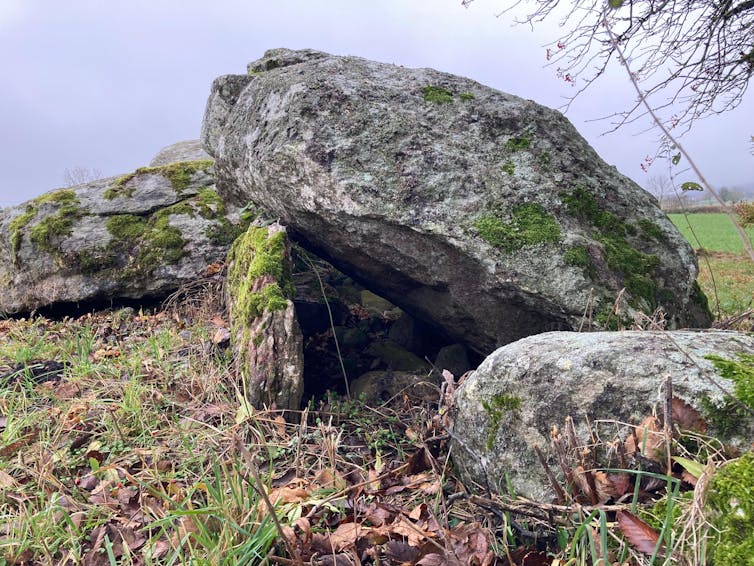
Neolithic passage grave at Falbygden, southern Sweden.
Frederik Seersholm, Author provided
The population of farmers in southern Scandinavia expanded very rapidly, reaching a peak around 5,600 years ago, 400 years after their arrival. At this point, it started to decrease, dropping by perhaps as much as 60-70% over the following 300 years.
The decline was not a sudden event like the Black Death, but a gradual process. In fact, by the time of the occurrences of plague revealed by the new research, the population level had already reached its floor. But the population continued to remain low, so plague might have been instrumental in this.
Britain makes an interesting comparison. Here too, farming was introduced by immigrants around 6,000 years ago, and we see exactly the same pattern: the population rises to a peak 400 years later, then gradually declines until it reaches a low point 500-600 years later.
After the first couple of hundred years of farming immigration, there is very little evidence of continental connections that could have introduced plague until the arrival of new immigrants from the east after 4,500 years ago.
These immigrants carried a type of genetic ancestry, known as Eurasian steppe ancestry, that had first appeared in the western half of Europe around 5,000 years ago. It seems significant that, so far, the earliest evidence of plague in Britain is after this, from two Bronze Age sites dating to around 4,000 years ago.
It’s also worth noting that farming was very late arriving at the northwest extremities of Europe. Immigrant farmers had arrived in southeast and central Europe 8,500 and 7,500 years ago respectively. Here too, wherever people have looked, they have found similar boom-bust population patterns.
In other words, there seems to be some general process going on here that we still don’t really understand. Possible explanations include outbreaks of violence as the population peaks, and climate cooling events affecting crop yields. For the moment, disease outbreaks look a less likely explanation.

Stephen Shennan, Professor of Theoretical Archaeology, UCL
This article is republished from The Conversation under a Creative Commons license. Read the original article.


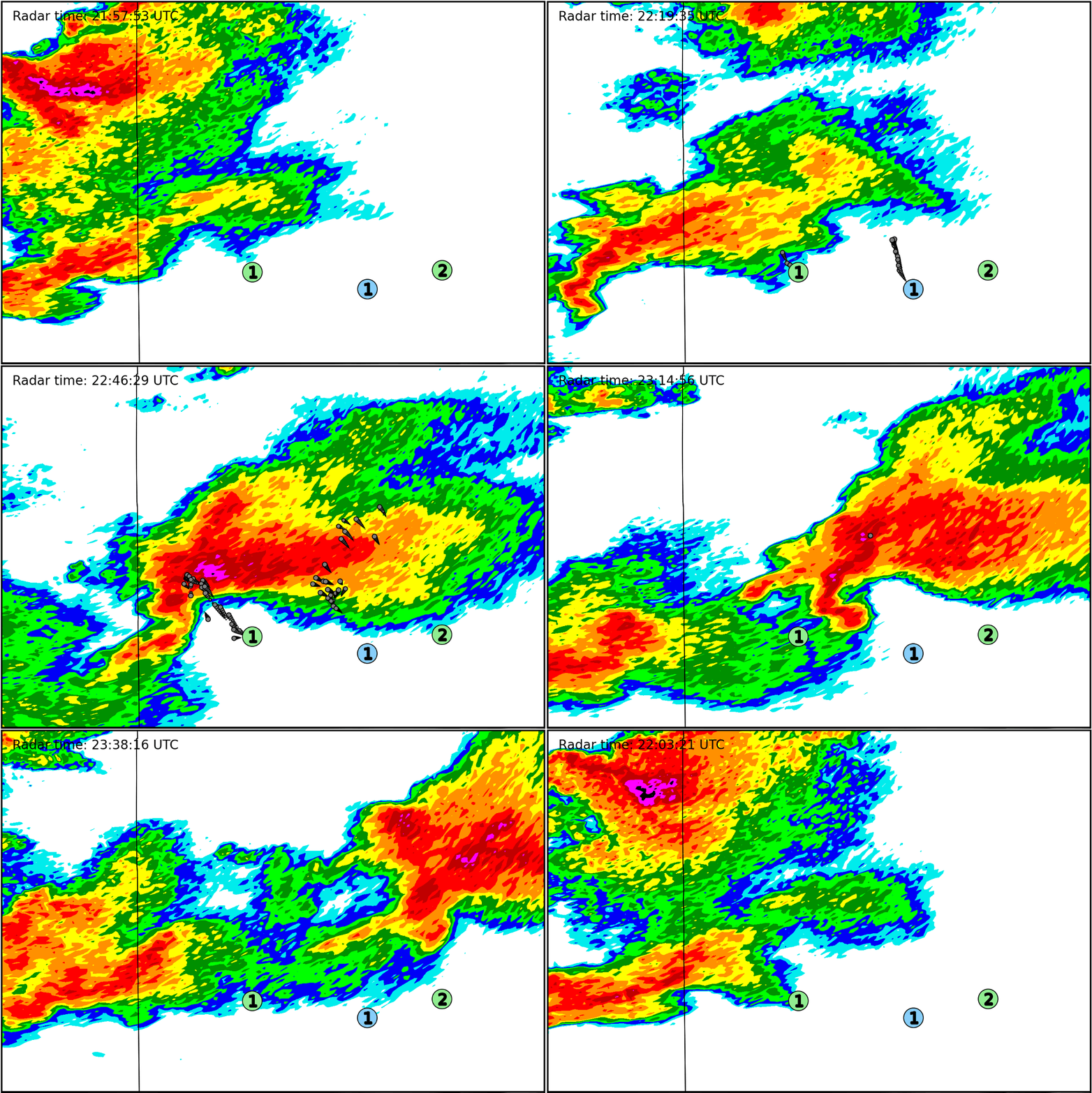 Symbols show the paths of over 70 balloon-borne probes that the authors’ team launched into a supercell thunderstorm. The probes, carried by the wind, mapped the temperature in the storm’s downdraft region, which can be a critical source of rotation for tornadoes. Luke LeBel/Penn State


 A bee hummingbird (Mellisuga helenae) feeds at the House of Hummingbirds sanctuary in Palpite, Cuba © YAMIL LAGE / AFP
 A tourist takes photos of a zunzuncito, or bee hummingbird, which is endemic to Cuba and measures between 5 and 6 centimeters © YAMIL LAGE / AFP
 Male bee hummingbirds have an iridescent red head © YAMIL LAGE / AFP