Elon Musk's Tesla Inc and SpaceX on Monday joined a legal brief filed by businesses opposed to President Donald Trump's order restricting immigration from seven Muslim-majority countries, according to a court filing.
Musk agreed to become part of Trump's business advisory council in December, and has advocated discussing issues directly with the president. Uber chief executive Travis Kalanick quit the council last week amid mounting pressure over Trump's immigration policies.
(This story corrects to Muslim-majority 'countries' instead of 'companies' in first paragraph.)
Even if NOAA fabricated data, the evidence still supports climate change Donald LeRoi, NOAA Southwest Fisheries Science Center Climate scientists have worked hard for decades to prove climate change. Why is the US House Committee on Science, Space and Technology working so hard not to believe them? On Sunday February 5th, the U.S. House of Representatives…
"The Dr. Oz Show," which has come under fire from physicians and politicians for promoting "miracle" cures with no evidence, will launch a new weekly segment on the connections between spirituality and health that veers, once again, into the territory of miracles. Christian author and motivational speaker Priscilla Shirer and several pastors will join Oz for…
The Earth is blanketed by a magnetic field. It’s what makes compasses point north, and protects our atmosphere from continual bombardment from space by charged particles such as protons. Without a magnetic field, our atmosphere would slowly be stripped away by harmful radiation, and life would almost certainly not exist as it does today.
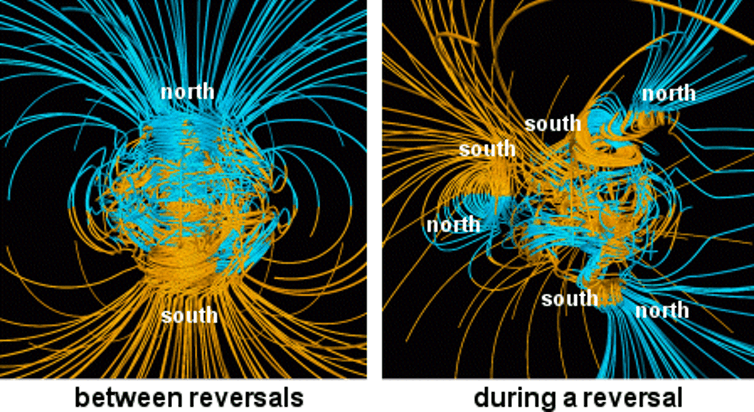
You might imagine the magnetic field is a timeless, constant aspect of life on Earth, and to some extent you would be right. But Earth’s magnetic field actually does change. Every so often – on the order of several hundred thousand years or so – the magnetic field has flipped. North has pointed south, and vice versa. And when the field flips it also tends to become very weak.
On the left, the Earth’s magnetic field we’re used to. On the right, a model of what the magnetic field might be like during a reversal.
What currently has geophysicists like us abuzz is the realization that the strength of Earth’s magnetic field has been decreasing for the last 160 years at an alarming rate. This collapse is centered in a huge expanse of the Southern Hemisphere, extending from Zimbabwe to Chile, known as the South Atlantic Anomaly. The magnetic field strength is so weak there that it’s a hazard for satellites that orbit above the region – the field no longer protects them from radiation which interferes with satellite electronics.
And the field is continuing to grow weaker, potentially portending even more dramatic events, including a global reversal of the magnetic poles. Such a major change would affect our navigation systems, as well as the transmission of electricity. The spectacle of the northern lights might appear at different latitudes. And because more radiation would reach Earth’s surface under very low field strengths during a global reversal, it also might affect rates of cancer.
We still don’t fully understand what the extent of these effects would be, adding urgency to our investigation. We’re turning to some perhaps unexpected data sources, including 700-year-old African archaeological records, to puzzle it out.
These analyses reveal an astounding feature: There’s a patch of reversed polarity beneath southern Africa at the core-mantle boundary where the liquid iron outer core meets the slightly stiffer part of the Earth’s interior. In this area, the polarity of the field is opposite to the average global magnetic field. If we were able to use a compass deep under southern Africa, we would see that in this unusual patch north actually points south.
This patch is the main culprit creating the South Atlantic Anomaly. In numerical simulations, unusual patches similar to the one beneath southern Africa appear immediately prior to geomagnetic reversals.
The poles have reversed frequently over the history of the planet, but the last reversal is in the distant past, some 780,000 years ago. The rapid decay of the recent magnetic field, and its pattern of decay, naturally raises the question of what was happening prior to the last 160 years.
Archaeomagnetism takes us further back in time
In archaeomagnetic studies, geophysicists team with archaeologists to learn about the past magnetic field. For example, clay used to make pottery contains small amounts of magnetic minerals, such as magnetite. When the clay is heated to make a pot, its magnetic minerals lose any magnetism they may have held. Upon cooling, the magnetic minerals record the direction and intensity of the magnetic field at that time. If one can determine the age of the pot, or the archaeological site from which it came (using radiocarbon dating, for instance), then an archaeomagnetic history can be recovered.
Using this kind of data, we have a partial history of archaeomagnetism for the Northern Hemisphere. In contrast, the Southern Hemisphere archaeomagnetic record is scant. In particular, there have been virtually no data from southern Africa – and that’s the region, along with South America, that might provide the most insight into the history of the reversed core patch creating today’s South Atlantic Anomaly.
But the ancestors of today’s southern Africans, Bantu-speaking metallurgists and farmers who began to migrate into the region between 2,000 and 1,500 years ago, unintentionally left us some clues. These Iron Age people lived in huts built of clay, and stored their grain in hardened clay bins. As the first agriculturists of the Iron Age of southern Africa, they relied heavily on rainfall.
The communities often responded to times of drought with rituals of cleansing that involved burning mud granaries. This somewhat tragic series of events for these people was ultimately a boon many hundreds of years later for archaeomagnetism. Just as in the case of the firing and cooling of a pot, the clay in these structures recorded Earth’s magnetic field as they cooled. Because the floors of these ancient huts and grain bins can sometimes be found intact, we can sample them to obtain a record of both the direction and strength of their contemporary magnetic field. Each floor is a small magnetic observatory, with its compass frozen in time immediately after burning.
With our colleagues, we’ve focused our sampling on Iron Age village sites that dot the Limpopo River Valley, bordered today by Zimbabwe to the north, Botswana to the west and South Africa to the south.
What’s happening deep within the Earth, beneath the Limpopo River Valley?
Sampling at Limpopo River Valley locations has yielded the first archaeomagnetic history for southern Africa between A.D. 1000 and 1600. What we found reveals a period in the past, near A.D. 1300, when the field in that area was decreasing as rapidly as it is today. Then the intensity increased, albeit at a much slower rate.
The occurrence of two intervals of rapid field decay – one 700 years ago and one today – suggests a recurrent phenomenon. Could the reversed flux patch presently under South Africa have happened regularly, further back in time than our records have shown? If so, why would it occur again in this location?
Over the last decade, researchers have accumulated images from the analyses of earthquakes’ seismic waves. As seismic shear waves move through the Earth’s layers, the speed with which they travel is an indication of the density of the layer. Now we know that a large area of slow seismic shear waves characterizes the core mantle boundary beneath southern Africa.
This particular region underneath southern Africa has the somewhat wordy title of the African Large Low Shear Velocity Province. While many wince at the descriptive but jargon-rich name, it is a profound feature that must be tens of millions of years old. While thousands of kilometers across, its boundaries are sharp. Interestingly, the reversed core flux patch is nearly coincident with its eastern edge.
The fact that the present-day reversed core patch and the edge of the African Large Low Shear Velocity Province are physically so close got us thinking. We’ve come up with a model linking the two phenomena. We suggest that the unusual African mantle changes the flow of iron in the core underneath, which in turn changes the way the magnetic field behaves at the edge of the seismic province, and leads to the reversed flux patches.
We speculate that these reversed core patches grow rapidly and then wane more slowly. Occasionally one patch may grow large enough to dominate the magnetic field of the Southern Hemisphere – and the poles reverse.
The conventional idea of reversals is that they can start anywhere in the core. Our conceptual model suggests there may be special places at the core-mantle boundary that promote reversals. We do not yet know if the current field is going to reverse in the next few thousand years, or simply continue to weaken over the next couple of centuries.
But the clues provided by the ancestors of modern-day southern Africans will undoubtedly help us to further develop our proposed mechanism for reversals. If correct, pole reversals may be “Out of Africa.”
No, it’s not a silly Atlantis myth Pixabay We can only guess at what Mauritia might have looked like, because it probably lies between three and six miles under the sea. The lost continent of Mauritia likely spanned a great swathe of the Indian Ocean before it was torn apart by indomitable geologic forces and plunged…
Lori Keesey, NASA Goddard Space Flight Center A long-standing mystery among marine biologists is why otherwise healthy whales, dolphins, and porpoises - collectively known as cetaceans - end up getting stranded along coastal areas worldwide. Could severe solar storms, which affect Earth's magnetic fields, be confusing their internal compasses and causing them to lose their way?…
Given time, solid objects can actually flow NASA A view of Ceres' cyrovolcano Ahuna Mons, with its height exaggerated by a factor of two. At 2.5 miles tall, Ahuna Mons sticks out like a sore thumb on Ceres. The ice volcano is by far the biggest thing on the dwarf planet, and there are no runners-up.…
SpaceX's final version of the Falcon 9 rocket, which Elon Musk aims to launch before the end of the year, will fix a potential problem with cracks in its turbopumps, the company said on Thursday. Its statement followed a report that the U.S. Government Accountability Office will flag turbine wheel cracks in the rocket's turbopumps as a safety issue. NASA, the U.S. space agency, and the Air Force are among SpaceX's customers.
The GAO’s preliminary findings were reported by the Wall Street Journal on Thursday.
In an email to Reuters, SpaceX said it has "qualified our engines to be robust to turbine wheel cracks. However, we are modifying the design to avoid them altogether,” said spokesman John Taylor.
In addition to flying cargo to the International Space Station, SpaceX has NASA contracts to begin flying astronauts to the orbiting research laboratory as early as 2018.
"SpaceX has established a plan in partnership with NASA to qualify engines for manned spaceflight," Taylor said.
GAO investigators found that the Falcon 9 turbopumps, which are part of the system that delivers propellants to the engine, have blades that are prone to cracking, the newspaper said.
SpaceX last month resumed flights following a 4-1/2-month investigation into why a rocket blew up as it was being fueled for a routine pre-launch test in Florida.
The cause of the accident was traced to a burst canister of helium in the rocket’s second stage liquid oxygen tank. It was unrelated to the issue with the rocket’s turbopumps.
The accident was SpaceX's second since the Falcon 9 debuted in June 2010. The company's next launch is targeted for Feb. 14.
(Reporting by Irene Klotz; Editing by Dan Grebler)
A standing ovation Jean-Bernard Caron—Royal Ontario Museum Ovatiovermis cribratus Fossil specimen of newly identified worm with legs. The rocky imprint looks like the shadow of a flattened shrimp. But this tiny creature—no bigger than a thumb—lurked in the shallow seas of North America long before shrimp existed. The 500-million-year-old worm with leg-like appendages is a distant…
The maker of the Epipen, used for the emergency treatment of anaphylactic shock, is facing a federal anti-trust investigation after lawmakers were alerted to a massive price increase last year.
According to the Washington Post, Mylan, the maker of the injectable drug, admitted that the Federal Trade Commission requested information from them months ago "as part of a preliminary investigation."
Mylan has been under scrutiny after raising the price of the EpiPen more than 500 percent in recent years, to over $600 per two-pack.
Adding fuel to the fire was the fact that Mylan's CEO, Heather Bresch, is the daughter of Democratic West Virginia Sen. Joe Manchin. Bresch helped engineer the bump in prices after taking over as head of the company.
At issue now are accusation that Mylan may have tried to halt competition while reaping huge profits.
Mylan is already under scrutiny by New York Attorney General Eric Schneiderman, who opened an investigation into their business practices last September, accusing the company of inserting "potentially anticompetitive terms" into its sales contracts for Epipen "with numerous local school systems."
By law, those schools must keep EpiPens on hand for the protection of children.
A spokesperson for Mylan dismissed the accusations of illegal actions, calling them "without merit."
"Any suggestion that Mylan took any inappropriate or unlawful actions to prevent generic competition is without merit," spokesperson Nina Devlin said in a statement. ""We note that the epinephrine auto-injector market is and always has been competitive, with multiple products competing on the market since we acquired EpiPen Auto-Injector."
Devlin added, "Further, Teva has had patent licenses to launch their proposed generic alternative to EpiPen Auto-Injector since June 2015, pending FDA approval, years prior to patent expiry."
In October, Mylan agreed to pay a $465 million settlement, without an admission of wrongdoing, with the Justice Department over claims the company over-billed Medicaid by misclassifying the EpiPen in order to take advantage of a federal drug rebate program.
Lola Gayle, STEAM Register It's long been known that the Milky Way galaxy and its companion galaxy Andromeda are moving with respect to the expanding universe. This movement means that both galaxies will collide in the very distant future. But what exactly is propelling the Milky Way through space? According to new research published in Nature…
Lola Gayle, STEAM Register Ancient Mayans went through two periods of collapse. The first - called the Preclassic collapse - occurred in the second century A.D., and the second - called the Classic Maya collapse - occurred in the ninth century A.D., when many of the ancient civilization's cities were abandoned. While both events are still…
In the long view, modern history is the story of increasing rights of control over your body – for instance, in matters of reproduction, sex, where you live and whom you marry. Medical experimentation is supposed to be following the same historical trend – increasing rights of autonomy for those whose bodies are used for research.
Indeed, the Nuremberg Code, the founding document of modern medical research ethics developed after the Second World War in response to Nazi medical experiments, stated unequivocally that the voluntary, informed consent of the human subject is essential. Every research ethics code since then has incorporated this most fundamental principle. Exceptions to this rule are supposed to be truly exceptional.
Yet today, more and more medical experimenters in the United States appear to circumvent getting the voluntary, informed consent of those whose bodies are being used for research. What’s more, rather than fighting this retrograde trend, some of the most powerful actors in medical research are defending it as necessary to medical progress.
A few years ago, I fell in with a growing group of professionals in medicine and allied fields such as bioethics who have mobilised to defend the right to informed consent in medical experimentation. As a historian of medicine, I had worked since 1996 with intersex rights activists on improving care for children born with bodies in between the male and female types. In 2009, colleagues alerted me that a group of parents judged ‘at risk’ of having a child born with a particular genetic intersex condition appeared to be unwitting subjects in a medical experiment.
A major researcher and physician was promoting the prenatal use of a drug (dexamethasone) aimed at preventing intersex development. Targeting would-be parents who knew they had this condition running in their families, the researcher told them that the ‘treatment’ had been ‘found safe for mother and child’.
In fact, the US Food and Drug Administration (FDA) has not approved dexamethasone for preventing intersex development, much less found it ‘safe’ for this use. Indeed, the FDA has noted dexamethasone causes harm in foetal animals exposed to it. No one seems to have told the parents that this ‘treatment’ had not gone through anything like the normal route of drug approval: there has been no animal modelling of this use, no blinded control trial for effectiveness, and no long-term prospective safety trials in the US, where thousands of foetuses appear to have been exposed.
Shockingly, at the same time that this researcher was pushing the ‘treatment’ as ‘safe’, she was obtaining grants from the US National Institutes of Health (NIH) to use the same families in retrospective studies to see if it had been safe. A Swedish research group has recently confirmed – through fully consented, prospective studies – that this drug use can cause brain damage in the children exposed prenatally.
As I sought allies in defending the rights of these families, I discovered that, while this was an especially egregious case of failure to obtain informed consent to what amounted to a medical experiment, the lapse was not unique. Public Citizen’s Health Research Group, a Washington-based NGO, has been leading the work in tracking cases where medical researchers fail in their obligations to obtain informed consent.
Recently, Public Citizen, together with the American Medical Student Association, sounded an alarm about two clinical trials, one called iCOMPARE, the other FIRST. In these studies, researchers extended the working hours of newly trained physicians to see if these physicians and their patients were better or worse off with the most inexperienced doctors working longer, more tiring shifts.
The young doctors used in these studies were not given the option of not participating. If their residency programmes participated, they were in. More concerning, their patients were never informed that they were experimental subjects, even though a primary research goal was to see if patients treated by residents working longer shifts would experience higher rates of harm.
Some studies tracked by Public Citizen reveal downright bizarre ethical mistakes. A recent study funded by the US Department of Health and Human Services, led by a US Department of Veterans Affairs researcher, sought to determine whether, if brain-dead kidney donors’ bodies were cooled after brain death, living recipients of the transplanted kidneys did better. The researchers decided they didn’t need to get voluntary consent to the experiment from the living kidney recipients. They simply maintained the dead donors were the experimental subjects.
The largest contemporary fight over failure to obtain informed consent has been over the Surfactant Positive Airway Pressure and Pulse Oximetry Trial (or SUPPORT). This was a large NIH-funded study meant to determine, in part, whether higher or lower levels of oxygen after birth provided very premature babies with benefit or harm. The consent forms for this study did not inform the parents that the experiment’s purpose was to see if, by being randomly assigned to one of two experimental oxygen ranges, babies end up more likely to be blind, neurologically damaged or die.
Most parents also weren’t informed that the researchers would use experimental measuring devices meant to ‘blind’ professional caregivers to the babies’ real oxygen levels to try to make the study more rigorous. Researchers told many parents that the study involved no special risks because all the procedures in the research were supposedly standard of care. This was a demonstrably untrue claim.
In this case, the US Office for Human Research Protections (OHRP) – an agency meant to protect the rights of people in federally funded research – agreed with Public Citizen and an allied group of more than 40 of us in medicine and bioethics that the informed consent for this trial was seriously inadequate. But in a series of emails meant to stay private, top NIH officials pressured the OHRP to back off its criticisms. OHRP is supposed to oversee NIH’s work, not the other way around!
NIH leaders also partnered with the editor of TheNew England Journal of Medicine to publicly defend this study. The journal’s editor-in-chief tried actively to limit the ability of us critics to respond. Meanwhile, the parents were never officially informed of what happened to their babies.
Those defending these troubling studies often argue that elaborate consent procedures can get in the way of obtaining important scientific results. They say that subjects might encounter the risks of the experiment even in ‘normal’ patient care, so we might as well engage them in studies without scaring them off through frightening research consent forms.
It is true that the current research ethics system in the US is cumbersome, inefficient and dysfunctional. Researchers often find themselves confused and frustrated by the bureaucracies of research ethics systems.
But that is no excuse not to vigorously maintain the first principle of the Nuremberg Code: the voluntary consent of the subject is essential. We can’t afford the risk to medical research that sloppy ethics entail; when the public finds out about the circumvention of informed consent – as in the case of the infamous US Public Health Service syphilis study at Tuskegee – the damage to the integrity and authority of the medical research community is inevitably significant and long-lasting.
The tenets of the Nuremberg Code were not meant only for Nazis. If Nazis presented the only danger to people being used for medical experiments, eliminating the Nazis would have solved our problems. The Nuremberg Code was written to guide all of us, because good intentions are not enough.
By Alice Dreger
This article was originally published at Aeon and has been republished under Creative Commons.