What is known presents many reasons for concern. Scientists know, for example, that at least 3,200 plastic chemicals pose risks to human health or the environment. They know that most of these compounds can leach into food and beverages, and that they cost the U.S. more than $900 billion in health expenses annually. Yet only 6 percent of plastic chemicals — which can account for up to 70 percent of a product’s weight — are subject to international regulations.
Over the past few months, a flurry of studies and reports have highlighted one group of substances as particularly problematic: “endocrine-disrupting chemicals,” or EDCs. These chemicals, released at every stage of the plastic life cycle, mimic hormones and interfere with the metabolic and reproductive systems. They were recently found in samples of plastic food packaging from around the world, and a study published last month linked them to 20 percent of the United States’ preterm births.
The unchecked production, distribution, and disposal of plastics and other petrochemical-based products has led to “a perpetual cycle of human exposure to EDCs from contaminated air, food, drinking water, and soil,” Tracey Woodruff, a professor of reproductive sciences at the University of California, San Francisco, wrote in the New England Journal of Medicine earlier this month. Philip Landrigan, a public health physician and professor of epidemiology at Boston College, told Grist that the crisis has “quietly and insidiously gotten worse while all attention has been focused on the climate.”
Although some policymakers have taken steps to protect people from EDCs — the European Commission, for example, in 2022 proposed stricter labeling regulations that would require companies to alert consumers of their hazards — many in the field believe the overarching response has been incommensurate with the scale of the crisis. Because so many plastics and petrochemical products are traded internationally, some endocrinologists and public health authorities believe a global approach is needed.
“This is an international problem that is affecting our world and its future,” said Andrea Gore, a professor of pharmacology and toxicology at the University of Texas, Austin.
Gore and others are appealing to the negotiators of the U.N. global plastics treaty, who meet for their next round of talks next month in Ottawa, Canada. There is increasing interest among delegates for a treaty that not only protects the environment, but public health — a step that the international nature of the EDC problem makes clear must be taken.
The endocrine system is complex, involving a series of glands throughout the body that secrete chemical messengers called hormones. These molecules lock onto a cell’s receptors to induce some kind of response: perhaps the production of another hormone, or the correction of a nutrient imbalance. Endocrine hormones control a long list of necessary human functions like growth, metabolism, reproduction, lactation, and managing blood sugar — any malfunction, let alone absence, of these processes can lead to health problems like infertility, diabetes, hypertension, and death.
EDCs tamper with the endocrine system, often by mimicking hormones to trigger the corresponding response, or by blocking them to prevent it from happening at all. Research has identified at least 1,000 of these substances in pesticides, inks, building materials, cosmetics, and plastic products, but the nonprofit Endocrine Society, whose members include physicians and scientists, calls this “only the tip of the iceberg” due to the enormous number of chemicals yet to be tested.
Some of the most common or familiar EDCs found in plastics include phthalates, used to make the material more flexible; bisphenol A, or BPA, used to make strong, clear products; and PFAS, a class of more than 14,000 chemicals used to make food containers, outdoor clothing, and other products oil- or water-repellent. Other EDCs of concern include organophosphate ethers, benzotriazoles, and PBDEs, all of which are used to make plastic products fire- and light-resistant.
What makes this particularly worrisome is that humans can be exposed to endocrine-disrupting chemicals simply by touching plastic, inhaling microplastics within dust, and eating food or drinking water that has been in contact with plastic. According to one 2022 study, more than 1,000 chemicals — including many EDCs — commonly used in packaging like takeout containers can migrate into food. A separate study from 2021 found that more than 2,000 chemicals can leach from a single plastic product into water.
As noted in a report published last month by the Endocrine Society and the nonprofit International Pollutants Elimination Network, or IPEN, exposure to endocrine-disrupting substances can occur throughout the plastic life cycle. Fracking for oil and gas — the material’s main ingredients — uses more than 750 chemicals, many of which are known or suspected endocrine disruptors, and people living near these operations may have an elevated risk of developmental or reproductive problems. More EDCs are released during plastics manufacturing, sometimes in air and water emissions, other times on the backs of nurdles, tiny plastic pellets that can be shaped into larger products. These pebble-sized pieces often spill directly from factories or during transportation, and can release their chemicals once in the environment.
At the end of the plastic life cycle, incinerators and landfills can release PFAS, dioxins, PCBs, and other endocrine disruptors as air or soil pollution — some of which may contaminate nearby food supplies. Littered plastics tend to make their way into the ocean, where they break down into microplastics and leach some of those same EDCs, along with others like dibutyltin and mercury.
Those facing the greatest risk tend to be residents of low-income communities and people of color. “They’re more likely to be living in areas where there’s more pollution,” Gore said — like from nearby plastics manufacturing facilities or waste disposal sites. Plus, she added, low-income families often live without easy access to fresh produce and are more dependent on foods packaged in plastic. “We know people of lower socioeconomic status have disproportionate exposures.”
Reducing exposure to endocrine disruptors presents a challenge for several reasons. The biggest is the U.S. and other countries’ lax approach to chemical regulation, which doesn’t usually require that new compounds be tested for endocrine-disrupting properties or other safety concerns before they can enter production and get incorporated into products. “Right now we operate on the basis that all chemicals are innocent until proven guilty,” Landrigan told Grist.
Even when scientists agree that something is harmful, bureaucratic delays and industry lobbying often impede regulation. The Toxics Substances Control Act, or TSCA — the United States’ main chemical law — has for example only banned a handful of substances in the nearly 50 years since it was passed, a period in which at least 100,000 new chemicals have entered the market, according to Landrigan. This is partly due to the unrealistic expectation that scientists draw a direct, causal link between a substance and specific health effects, which would require unethically exposing people to toxicants and observing the outcomes.
Another unfortunate side effect of that expectation is a phenomenon called “regrettable substitution,” where companies swap chemicals known to be harmful for lookalikes that haven’t been studied as extensively. Later research often reveals the substitute is just as toxic as the original, if not more so. This has occurred on a wide scale with EDCs such as PFAS, as well as bisphenols — although now that several countries have restricted BPA from plastic products like baby bottles, products labeled (often inaccurately) as free from that substance are now being manufactured with bisphenol S, despite research suggesting it also disrupts the endocrine system.
Some scientists accuse the chemical industry of “weaponizing uncertainty” to delay or kill regulation, a strategy they liken to Big Oil’s campaign to raise doubt about the reality of climate change. But for many EDCs in particular, they agree there is strong enough associative evidence of their harms — from cell and animal studies, as well as observations in people who have been exposed to the chemicals at work or as a result of an accident — to warrant bans and restrictions.
Scientists and public health advocates have been trying to reform chemical regulations for years now, but the U.N.’s global plastics treaty presents an opportunity to do so on an international level. “A global treaty can’t reform TSCA,” Landrigan said, “but it can set benchmarks telling countries that if they want to ship their products internationally, they have to conform to certain standards.”
One leading proposal for the treaty is that negotiators create a comprehensive inventory of the many chemicals used in plastic production, along with a list of “chemicals of concern” identifying which should be prioritized for phasing out. According to Sara Brosché, a science adviser for IPEN, this list should include classes of chemicals rather than individual ones. “EDCs would be one very clear category” to be phased out, she told Grist, along with carcinogens and so-called “persistent organic pollutants” that don’t break down naturally in the environment.
Scientists also support listing and phasing out “polymers of concern,” the types most likely to contain EDCs and other hazardous substances. Polyvinyl chloride, for example — frequently used in plastic water pipes — can expose people to endocrine disruptors including benzene, phthalates, and bisphenols.
So far, these ideas have only been suggested for inclusion in the treaty; negotiators don’t even have a first draft yet, and are still debating whether the primary goal should be to “end plastic pollution” or to “protect human health and the environment … by ending plastic pollution.” The existing text, a laundry list of nearly every suggestion made thus far, leaves plenty of room for countries to simply “minimize,” “manage,” or vaguely “regulate” hazardous plastic chemicals, rather than eliminate them altogether. The final draft is due by year’s end, though many expect an extension, with further negotiations continuing into 2025.
To Landrigan and many others, the most important thing is that the treaty include a global cap on plastic production, which could triple by 2060 to more than 1.2 billion metric tons annually if current trends continue. That’s the weight of more than 118,000 Eiffel Towers. “We see the current exponential increase in plastic production as simply not sustainable,” he said. “It will overwhelm the planet.” Less plastic will mean fewer opportunities for EDC exposure, he added. And that will surely save lives.
This article originally appeared in Grist at https://grist.org/science/plastic-chemicals-are-inescapable-and-theyre-messing-with-our-hormones/.
Grist is a nonprofit, independent media organization dedicated to telling stories of climate solutions and a just future. Learn more at Grist.org













 Tropical environments like the Congo Basin boast high carbon storage and low changes in albedo © Guerchom Ndebo / AFP
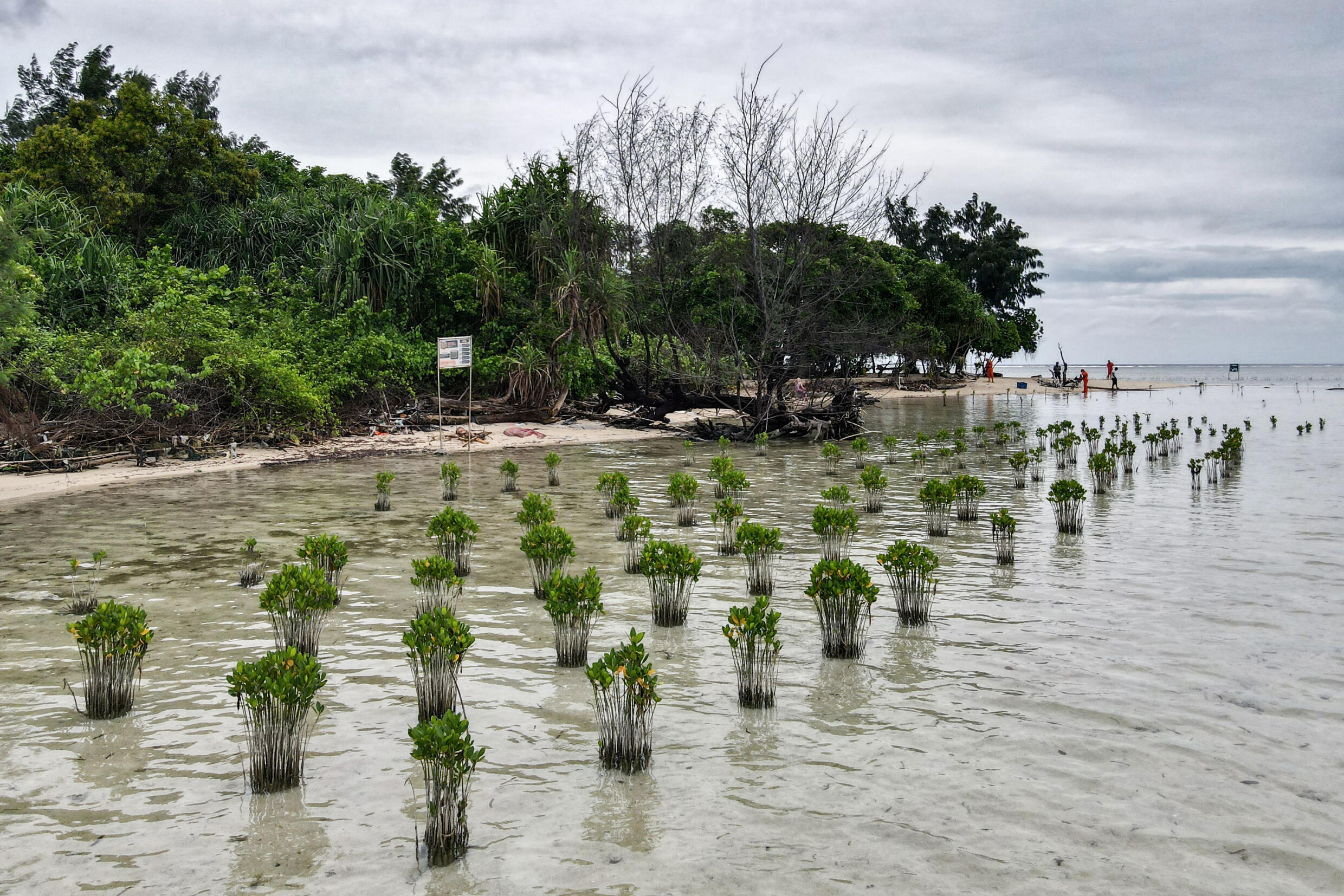 Mangrove trees planted in Pari island to slow erosion caused by rising sea levels © Bay ISMOYO / AFP