

How is snow made? An atmospheric scientist describes the journey

Curious Kids is a series for children of all ages. If you have a question you’d like an expert to answer, send it to curiouskidsus@theconversation.com.


Curious Kids is a series for children of all ages. If you have a question you’d like an expert to answer, send it to curiouskidsus@theconversation.com.
Just over five years ago, on 22 February 2019, an unmanned space probe was placed in orbit around the Moon. Named Beresheet and built by SpaceIL and Israel Aerospace Industries, it was intended to be the first private spacecraft to perform a soft landing. Among the probe’s payload were tardigrades, renowned for their ability to survive in even the harshest climates.
The mission ran into trouble from the start, with the failure of “star tracker” cameras intended to determine the spacecraft’s orientation and thus properly control its motors. Budgetary limitations had imposed a pared-down design, and while the command center was able to work around some problems, things got even trickier on 11 April, the day of the landing.
On the way to the Moon the spacecraft had been traveling at high speed, and it needed to be slowed way down to make a soft landing. Unfortunately during the braking maneuver a gyroscope failed, blocking the primary engine. At an altitude of 150 m, Beresheet was still moving at 500 km/h, far too fast to be stopped in time. The impact was violent – the probe shattered and its remains were scattered over a distance of around a hundred metres. We know this because the site was photographed by NASA’s LRO (Lunar Reconnaissance Orbiter) satellite on 22 April.

So what happened to the tardigrades that were traveling on the probe? Given their remarkable abilities to survive situations that would kill pretty much any other animal, could they have contaminated the Moon? Worse, might they be able to reproduce and colonize it?
Tardigrades are microscopic animals that measure less than a millimeter in length. All have neurons, a mouth opening at the end of a retractable proboscis, an intestine containing a microbiota and four pairs of non-articulated legs ending in claws, and most have two eyes. As small as they are, they share a common ancestor with arthropods such as insects and arachnids.
Most tardigrades live in aquatic environments, but they can be found in any environment, even urban ones. Emmanuelle Delagoutte, a researcher at the CNRS, collects them in the mosses and lichens of the Jardin des Plantes in Paris. To be active, feed on microalgae such as chlorella, and move, grow and reproduce, tardigrades need to be surrounded by a film of water. They reproduce sexually or asexually via parthenogenesis (from an unfertilized egg) or even hermaphroditism, when an individual (which possesses both male and female gametes) self-fertilizes. Once the egg has hatched, the active life of a tardigrade lasts from 3 to 30 months. A total of 1,265 species have been described, including two fossils.
Tardigrades are famous for their resistance to conditions that exist neither on Earth nor on the Moon. They can shut down their metabolism by losing up to 95% of their body water. Some species synthesize a sugar, trehalose, that acts as an antifreeze, while others synthesize proteins that are thought to incorporate cellular constituents into an amorphous “glassy” network that offers resistance and protection to each cell.
During dehydration, the tardigrade’s body can shrink to half its normal size. The legs disappear, with only the claws still visible. This state, known as cryptobiosis, persists until conditions for active life become favorable again.
Depending on the species of tardigrade, individuals need more or less time to dehydrate and not all specimens of the same species manage to return to active life. Dehydrated adults survive for a few minutes at temperatures as low as -272°C or as high as 150°C, and over the long term at high doses of gamma rays of 1,000 or 4,400 Gray (Gy). By way of comparison, a dose of 10 Gy is fatal for humans, and 40-50,000 Gy sterilizes all types of material. However, whatever the dose, radiation kills tardigrade eggs. What’s more, the protection afforded by cryptobiosis is not always clear-cut, as in the case of Milnesium tardigradum, where radiation affects both active and dehydrated animals in the same way.
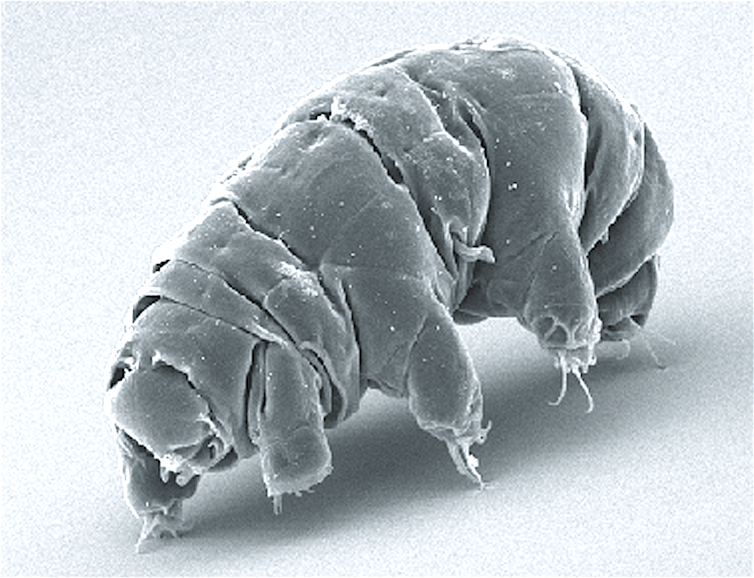
Image of the species Milnesium tardigradum in its active state. Schokraie E, Warnken U, Hotz-Wagenblatt A, Grohme MA, Hengherr S, et al. (2012), CC BY
So what happened to the tardigrades after they crashed on the Moon? Are any of them still viable, buried under the moon’s regolith, the dust that varies in depth from a few meters to several dozen meters?
First of all, they have to have survived the impact. Laboratory tests have shown that frozen specimens of the Hypsibius dujardini species travelling at 3,000 km/h in a vacuum were fatally damaged when they smashed into sand. However, they survived impacts of 2,600 km/h or less – and their “hard landing” on the Moon, though unwanted, was far slower.
The Moon’s surface is not protected from solar particles and cosmic rays, particularly gamma rays, but here too, the tardigrades would be able to resist. In fact, Robert Wimmer-Schweingruber, professor at the University of Kiel in Germany, and his team have shown that the doses of gamma rays hitting the lunar surface were permanent but low compared with the doses mentioned above – 10 years’ exposure to gamma rays would correspond to a total dose of around 1 Gy.
Finally, the tardigrades would have to withstand a lack of water as well as temperatures ranging from -170 to -190°C during the lunar night and 100 to 120°C during the day. A lunar day or night lasts a long time, just under 15 Earth days. The probe itself wasn’t designed to withstand such extremes and even if it hadn’t crashed, it would have ceased all activity after just a few Earth days.
Unfortunately for the tardigrades, they can’t overcome the lack of liquid water, oxygen and microalgae – they would never be able to reactivate, much less reproduce. Their colonising the Moon is thus impossible. Still, inactive specimens are on lunar soil and their presence raises ethical questions, as Matthew Silk, an ecologist at the University of Edinburgh, points out. Moreover, at a time when space exploration is taking off in all directions, contaminating other planets could mean that we would lose the opportunity to detect extraterrestrial life.
The author thanks Emmanuelle Delagoutte and Cédric Hubas of the Muséum de Paris, and Robert Wimmer-Schweingruber of the University of Kiel, for their critical reading of the text and their advice.
Laurent Palka, Maître de conférences, Muséum national d’histoire naturelle (MNHN)
This article is republished from The Conversation under a Creative Commons license. Read the original article.
Researchers believe two omega-3 fatty acids, docosahexaenoic and eicosapentaenoic acids, or DHA and EPA, are the most beneficial to overall health. When the body breaks them down, their byproducts have anti-inflammatory effects.

EPA and DHA are two omega-3 fatty acids particularly linked to health benefits. Minutemen/Wikimedia Commons via LibreTexts
I am a pulmonologist at the University of Virginia School of Medicine, and my research team and I are working to identify risk factors that may contribute to the development of pulmonary fibrosis. In this disease, scarred lung tissue can lead to respiratory failure and death.
We examined whether higher levels of DHA and EPA in the blood of patients with pulmonary fibrosis in different groups of research participants in the U.S. were linked to disease progression. We found that patients with higher levels of omega-3 fatty acids in their blood had a slower decline in lung function and longer survival. Notably, these findings persisted even after we accounted for other factors such as age and co-occurring diseases.
Currently, there are very few treatments available for pulmonary fibrosis. Those that do exist have significant side effects. Our findings suggest that increasing omega-3 fatty acids in a patient’s diet may slow the progression of this devastating disease.
Researchers have investigated the role of nutrition in many other diseases, but it remains understudied in chronic lung diseases, including pulmonary fibrosis. Our study, along with other published research, suggests dietary modifications may influence the trajectory of this disease and improve a patient’s ability to tolerate treatment.
Scarring in lung tissue makes it more difficult to breathe.
Furthermore, other studies using mice have shed light on how omega-3 fatty acids may protect against pulmonary fibrosis by regulating the activity of inflammatory cells and slowing buildup of scar tissue in the lungs.
Since we were able to measure omega-3 fatty acid levels in the blood at only one point in time, we could not determine whether changing levels over time correlates with changes in pulmonary fibrosis.
Crucially, it remains unknown whether increasing omega-3 fatty acid levels in the blood will have a meaningful effect on the lives of patients with pulmonary fibrosis. Omega-3 fatty acids in the blood might not directly affect pulmonary fibrosis and may simply reflect healthier lifestyles and diets.
Clinical trials are necessary to actually determine whether omega-3 fatty acids are beneficial for patients with respiratory diseases.
We plan to continue researching whether omega-3 fatty acids have a protective effect against pulmonary fibrosis.
Specifically, we hope to determine the mechanism by which omega-3-enriched interventions affect the lungs of patients with pulmonary fibrosis.
These will be important steps to identify patients who may be particularly responsive to omega-3 therapies and move these treatments toward clinical testing.
John Kim, Assistant Professor of Medicine, University of Virginia
This article is republished from The Conversation under a Creative Commons license. Read the original article.
This can perpetuate intimate image abuse (including things like “revenge porn”) and disrupt democratic processes. Currently, many jurisdictions are grappling with how to regulate AI deepfakes.
But if you’ve been a victim of a deepfake scam, can you obtain compensation or redress for your losses? The legislation hasn’t caught up yet.
In most cases of deepfake fraud, scammers will avoid trying to fool banks and security systems, instead opting for so-called “push payment” frauds where victims are tricked into directing their bank to pay the fraudster.
So, if you’re seeking a remedy, there are at least four possible targets:
The quick answer is that once the fraudster vanishes, it is currently unclear whether you have a right to a remedy from any of these other parties (though that may change in the future).
Let’s see why.
In principle, you could seek damages from a social media platform if it hosted a deepfake used to defraud you. But there are hurdles to overcome.
Platforms typically frame themselves as mere conduits of content – which means they are not legally responsible for the content. In the United States, platforms are explicitly shielded from this kind of liability. However, no such protection exists in most other common law countries, including Australia.
The Australian Competition and Consumer Commission (ACCC) is taking Meta (Facebook’s parent company) to court. They are testing the possibility of making digital platforms directly liable for deepfake crypto scams if they actively target the ads to possible victims.
The ACCC is also arguing Meta should be liable as an accessory to the scam – for failing to remove the misleading ads promptly once notified of the problem.
At the very least, platforms should be responsible for promptly removing deepfake content used for fraudulent purposes. They may already claim to be doing this, but it might soon become a legal obligation.
In Australia, the legal obligations of whether a bank has to reimburse you in the case of a deepfake scam aren’t settled.
This was recently considered by the United Kingdom’s Supreme Court, in a case likely to be influential in Australia. It suggests banks don’t have a duty to refuse a customer’s payment instructions where the recipient is suspected to be a (deepfake) fraudster, even if they have a general duty to act promptly once the scam is discovered.
That said, the UK is introducing a mandatory scheme that requires banks to reimburse victims of push payment fraud, at least in certain circumstances.
In Australia, the ACCC and others have presented proposals for a similar scheme, though none exists at this stage.

Australian banks are unlikely to be liable for customer losses due to scams, but new schemes could force them to reimburse victims. TK Kurikawa/Shutterstock
The providers of generative AI tools are currently not legally obliged to make their tools unusable for fraud or deception. In law, there is no duty of care to the world at large to prevent someone else’s fraud.
However, providers of generative AI do have an opportunity to use technology to reduce the likelihood of deepfakes. Like banks and social media platforms, they may soon be required to do this, at least in some jurisdictions.
The recently proposed EU AI Act obligates the providers of generative AI tools to design these tools in a way that allows the synthetic/fake content to be detected.
Currently, it’s proposed this could work through digital watermarking, although its effectiveness is still being debated. Other measures include prompt limits, digital ID to verify a person’s identity, and further education about the signs of deepfakes.
None of these legal or technical guardrails are likely to be entirely effective in stemming the tide of deepfake fraud, scams or deception – especially as generative AI technology keeps advancing.
However, the response doesn’t need to be perfect: slowing down AI generated fakes and frauds can still reduce harm. We also need to pressure platforms, banks and tech providers to stay on top of the risks.
So while you might never be able to completely prevent yourself from being the victim of a deepfake scam, with all these new legal and technical developments, you might soon be able to seek compensation if things go wrong. 
With audio, video and image deepfakes only growing more realistic, we need multi-layered strategies of prevention, education and compensation.
Jeannie Marie Paterson, Professor of Law, The University of Melbourne
This article is republished from The Conversation under a Creative Commons license. Read the original article.
‘World’s first’ flying car
US firm Alef Aeronautics displayed to the public for the first time the working model of what it says is the world’s first real flying car.
“It drives like a car, looks like a car and has a vertical take-off,” said the company’s president and CEO, Jim Dukhovny.
The electric-powered car has received special airworthiness certification from the US Federal Aviation Administration (FAA).
The current prototype can transport two people a distance of up to around 110 miles (170 kilometres) and the company expects to start production of a final version at the end of 2025.
The company has already received nearly 3,000 pre-orders for the car, which sells for $300,000.
Robotic dog
Chinese firm Tecno Mobile showed off a robotic dog inspired by the German Shepherd which uses AI and powerful sensors to understand voice commands and perform lifelike actions such as bowing, shaking hands and climbing stairs.
 Chinese firm Tecno Mobile showed off a robotic dog inspired by the German Shepherd which uses AI and powerful sensors to understand voice commands and perform lifelike actions such as bowing and shaking hands © Josep LAGO / AFP
The robot –- dubbed the "Dynamic 1" -- can be controlled by a smartphone apps as well, and it aims to provide the "joy of pet ownership" without the hassles.
Transparent laptop
Chinese manufacturer Lenovo presented a prototype of a laptop with a 17.3-inch transparent glass screen which offers "a completely borderless and see-through display experience".
 A visitor tests the transparent display of new Lenovo ThinkBook laptop on the first day of the Mobile World Congress (MWC) in Barcelona © PAU BARRENA / AFP
Instead of a traditional keyboard, it has a touch surface where keys can be projected or you can use a special pen to draw on the screen. The company has not announced a release date for the product.
The screen's transparency can be adjusted so that not everyone who passes by can always see what you are doing.
"The transparent display existed only in futuristic movies, maybe in AR glasses. That's only in the past as we can see," said Lenovo executive director Aiguo Zheng.
AI-powered companion doll
With its cloth body, floral blouse and brown hair, Hyodol has all the look of a children's doll. But Hyodol -- made by a South Korean company of the same name -- is aimed at seniors.
Packed with sensors and AI-power microprocessors, it can play songs, remind seniors with a voice message to take their medicine and can notify the guardian of its user when no movement is detected for a certain period of time.
 An employee of South Korean company Hyodol holds AI-powered dolls meant to provide companionship to elderly people © Josep LAGO / AFP
Standing 35 centimeters (14 inches) tall, the doll is designed to talk when touched by the user and in accordance with customisable time settings such as meal times.
"We are committed to empowering seniors to live independently while staying connected with their community and loved ones," the company said.
Impaired speech voice converter
Dutch startup Whispp demonstrated a calling app which uses AI technology to covert impaired speech due to conditions such as throat cancer, stroke or even stuttering into the user’s natural voice in real time.
Unlike other solutions for people with voice disorders which convert speech to text, the app allows the user to talk to anyone they want on their phone or laptop and maintain a natural conversation flow, while sounding like their own healthy voice.
"We are really helping people who lost their voice get their voice back," said Whispp co-founder and CEO Joris Castermans, adding he hopes the app will one day be on all smartphones "to make this a more inclusive world".
© 2024 AFP
Up to 40% of FTD cases have some family history, which means a genetic cause may run in the family. Since researchers identified the first genetic mutations that cause FTD in 1998, more than a dozen genes have been linked to the disease. These discoveries provide an entry point to determine the mechanisms that underlie the dysfunction of neurons and neural circuits in the brain and to use that knowledge to explore potential approaches to treatment.
I am a researcher who studies the development of FTD and related disorders, including the motor neuron disease amyotrophic lateral sclerosis, or ALS. ALS, also known as Lou Gehrig’s disease, results in progressive muscle weakness and death. Uncovering the similarities in pathology and genetics between FTD and ALS could lead to new ways to treat both diseases.
Wendy Williams’ care team announced her diagnosis of frontotemporal dementia on Feb. 22, 2024.
Genes contain the instructions cells use to make the proteins that carry out functions essential to life. Mutated genes can result in mutated proteins that lose their normal function or become toxic.
How mutated proteins contribute to FTD has been under intense investigation for decades. For instance, one of the key proteins in FTD, called tau, helps stabilize certain structures in neurons and can form clumps in diseased brains. Another key protein, progranulin, regulates cell growth and a part of the cell called the lysosome that breaks down cellular waste products.
Remarkably, the most common genetic mutation in FTD – in a gene called C9orf72 – also causes ALS. In fact, apart from the mutations in genes that encode for tau and progranulin, most genetic mutations that cause FTD also cause ALS. Another protein, TDP-43, forms clumps in the brains of over 95% of ALS cases and almost half of FTD cases. Thus, these disorders share close links in genetics and pathology.
Frontotemporal dementia typically affects people under 60.
The same genetic mutation can cause FTD in one patient, ALS in another or symptoms of both FTD and ALS at the same time. Remarkably, some people who carry these genetic mutations may have no obvious symptoms for decades.
One reason the same mutation can cause both FTD and ALS is that, in addition to lifestyle and environmental factors, other genes may also influence whether mutated genes lead to disease. Identifying these modifier genes in FTD, ALS and other neurodegenerative diseases could lead to new treatment approaches by boosting the activity of those that protect against disease or suppressing the activity of those that promote disease.
Modifier genes have long been a focus of research in my laboratory at the University of Massachusetts Chan Medical School. When my laboratory was still in San Francisco, we collaborated with neurologist Bruce Miller and generated the first stem cell lines from FTD patients with mutations in progranulin and C9orf72. These stem cells can be turned into neurons for researchers to study in a petri dish. My team also uses fruit flies to identify modifier genes and then test how they influence disease in neurons from patients with FTD or ALS.
For instance, in close collaboration with cell biologist J. Paul Taylor, my laboratory was among the first to discover a small subset of modifier genes that help transport molecules into or out of the nucleus of a neuron. We also discovered modifier genes that encode for some proteins that help repair damaged DNA. Targeting these modifier genes using gene-silencing techniques developed by Nobel laureate Craig Mello and other researchers at UMass Chan could offer potential treatments.
Because the brain is an extremely complex organ, it can be very difficult to understand what causes personality and behavioral changes in FTD patients.
Over the years, my team has used mice to study the causes of these changes. For instance, we found that the reduced social interaction we observed in mice engineered to have FTD is linked to two different disease proteins in the same part of the brain, suggesting that this symptom may be caused by defects in the same neural circuit. These deficits could be reversed by injecting a molecule called microRNA-124 into the prefrontal cortex, the part of the brain that controls social behaviors.
Moreover, with my longtime collaborator neuroscientist Wei-Dong Yao, our labs found that mice with FTD have defects at the synapses in this part of the brain. Synapses are areas where neurons are in contact with each other and play an important role in transporting information in the nervous system. Recently, he found that lack of empathy in another mouse model of FTD could be reversed by increasing activity in the prefrontal cortex.
Further research to understand the molecular mechanisms and brain circuitry behind FTD offer hope that its devastating symptoms, including behavioral and personality changes, will be treatable in the future.
This is an updated version of an article originally published on Feb. 22, 2023.
Fen-Biao Gao, Professor of RNA Therapeutics, Governor Paul Cellucci Chair in Neuroscience Research, Founding Director of Frontotempral Dementia Research Center, UMass Chan Medical School
This article is republished from The Conversation under a Creative Commons license. Read the original article.
For more than a decade, I have studied just that: how to design media to support children’s learning, particularly in moral development. My research, along with the work of many others, shows that children can learn important developmental and social skills through media.
Research on how to design children’s media to support learning is not new.
When “Sesame Street” debuted in November 1969, it began a decadeslong practice of testing its content before airing it to ensure children learned the intended messages of each episode and enjoyed watching it. Some episodes included messages notoriously difficult to teach to young children, including lessons about death, divorce and racism.
Researchers at the Sesame Workshop hold focus groups at local preschools where participating children watch or interact with Sesame content. They test the children on whether they are engaged with, pay attention to and learn the intended message of the content. If the episode passes the test, then it moves on to the next stage of production.
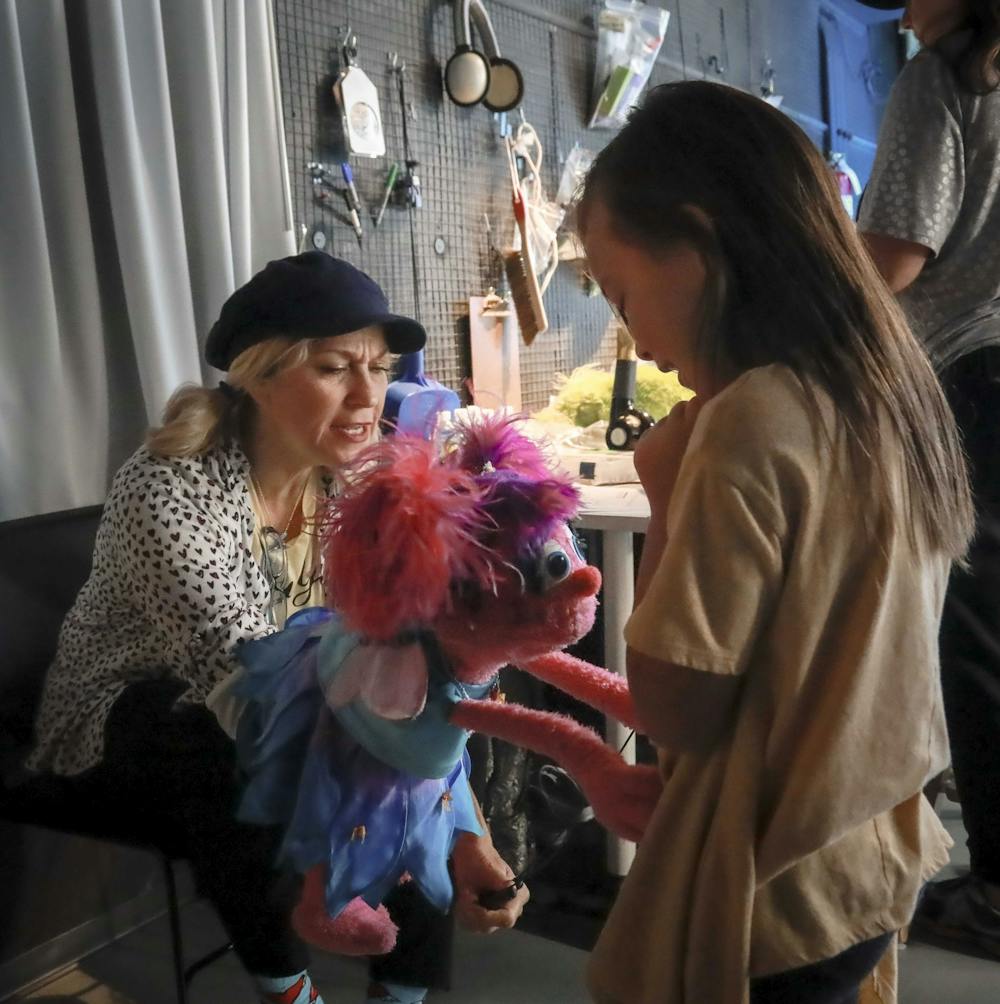
The Sesame Workshop uses muppets to teach children about difficult topics. AP Photo/Bebeto Matthews
If children do not learn the intended message, or are not engaged and attentive, then the episode goes back for editing. In some cases, such as a 1992 program designed to teach children about divorce, the entire episode is scrapped. In this case, children misunderstood some key information about divorce. “Sesame Street” did not include divorce in its content until 2012.
With help from the pioneering research of “Sesame Street,” along with research from other children’s television shows both in the industry and in academia, the past few decades have seen many new insights on how best to design media to promote children’s learning. These strategies are still shaping children’s shows today.
For example, you may have noticed that some children’s television characters speak directly to the camera and pause for the child viewer at home to yell out an answer to their question. This design strategy, known as participatory cues, is famously used by the shows “Blue’s Clues” and “Dora the Explorer.” Researchers found that participatory cues in TV are linked to increased vocabulary learning and content comprehension among young children. They also increase children’s engagement with the educational content of the show over time, particularly as they learn the intended lesson and can give the character the correct answer.
Participatory cues are a prominent feature of children’s shows like ‘Blues Clues.’
You may have also noticed that children’s media often features jokes that seem to be aimed more at adults. These are often commentary about popular culture that require context children might not be aware of or involve more complex language that children might not understand. This is because children are more likely to learn when a supportive adult or older sibling is watching the show alongside them and helping explain or connect it to the child’s life. Known as active mediation, research has shown that talking about the goals, emotions and behaviors of media characters can help children learn from them and even improve aspects of their own emotional and social development.
Programs have also incorporated concrete examples of desired behaviors, such as treating a neurodiverse character fairly, rather than discussing the behaviors more abstractly. This is because children younger than about age 7 struggle with abstract thinking and may have difficulty generalizing content they learned from media and applying it to their own lives.
Research on an episode of “Arthur” found that a concrete example of a main character experiencing life through the eyes of another character with Asperger’s syndrome improved the ability of child viewers to take another person’s perspective. It also increased the nuance of their moral judgments and moral reasoning. Just a single viewing of that one episode can positively influence several aspects of a child’s cognitive and moral development.
One skill that has proven difficult to teach children through media is inclusivity. Multiple studies have shown that children are more likely to exclude others from their social group after viewing an episode explicitly designed to promote inclusion.
For example, an episode of “Clifford the Big Red Dog” involved Clifford and his family moving to a new town. The townspeople initially did not want to include Clifford because he was too big, but they eventually learned the importance of getting to know others before making judgments about them. However, watching this episode did not make children more likely to play with or view disabled or overweight children favorably.
Based on my own work, I argue that one reason inclusivity can be difficult to teach in children’s TV may be due to how narratives are structured. For example, many shows actually model antisocial behaviors during the first three-quarters of the episode before finally modeling prosocial behaviors at the end. This may inadvertently teach the wrong message, because children tend to focus on the behaviors modeled for the majority of the program.
My team and I conducted a recent study showing that including a 30-second clip prior to the episode that explains the inclusive message to children before they view the content can help increase prosocial behaviors and decrease stigmatization. Although this practice might not be common in children’s TV at the moment, adult viewers can also fill this role by explaining the intended message of inclusivity to children before watching the episode.

Adult viewers watching TV alongside children can help kids apply the lessons the shows teach to their own lives. miniseries/E+ via Getty Images
Children’s media is more complex than many people think. Although there is certainly a lot of media out there that may not use study-informed design practices, many shows do use research to ensure children have the best chance to learn from what they watch.
It can be difficult to be a parent or a child in a media-saturated world, particularly in deciding when children should begin to watch media and which media they should watch. But there are relatively simple strategies parents and supportive adults can use to leverage media to support their child’s healthy development and future.
Parents and other adults can help children learn from media by watching alongside them and answering their questions. They can also read reviews of media to determine its quality and age appropriateness. Doing so can help children consume media in a healthy way.
We live in a media-saturated world, and restricting young children’s media use is difficult for most families. With just a little effort, parents can model healthy ways to use media for their children and select research-informed media that promotes healthy development and well-being among the next generation.
Drew Cingel, Associate Professor of Communication, University of California, Davis; Allyson Snyder, Ph.D. Candidate in Communication, University of California, Davis; Jane Shawcroft, Ph.D. Candidate in Communication, University of California, Davis, and Samantha Vigil, Ph.D. Candidate in Communication, University of California, Davis
This article is republished from The Conversation under a Creative Commons license. Read the original article.
