Biometric identifiers record fingermarks only as 2D pictures, and although these carry a lot of information, there’s a lot missing. A 2D fingerprint neglects the depth of the fingermark, including pores and scars buried in the ridges of fingers that are difficult to see.
I’m an educator and scientist who studies holography, a field of research that focuses on how to display 3D information. My lab has created a way to map and visualize fingermarks in three dimensions from any perspective on a computer – using digital holography.
Fingermark types
Scientists categorize fingermarks as either patent, plastic or latent, depending on how visible they are when left on a surface.
Patent fingermarks are the most visible type – bloody fingerprints at crime scenes are one example. Plastic fingermarks are found on soft surfaces, such as clay, Play-Doh or chocolate bars. The human eye can see both patent and plastic fingermarks quite easily.
The least visible are latent fingermarks. These are usually found on hard surfaces such as glass, metals, woods and plastics. To make them out, a fingerprint examiner has to use physical or chemical methods such as dusting with powder, creating chemical reactions with appropriate reagents or cyanoacrylate fuming.
Cyanoacrylate makes super glue in its liquid form, but as a gas it can make latent fingermarks visible. Researchers develop the prints by letting cyanoacrylate vapor molecules react with components in the latent fingerprint residue.
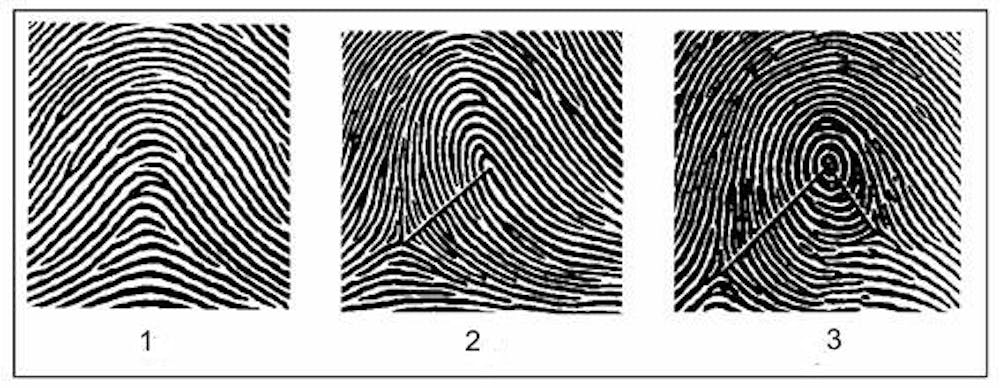
The geometric details on fingermarks are categorized into three levels. Level 1 encompasses visible ridge patterns, so loops, whorls and arches. Level 2 refers to minutiae or small details, such as bifurcations, endings, eyes and hooks.
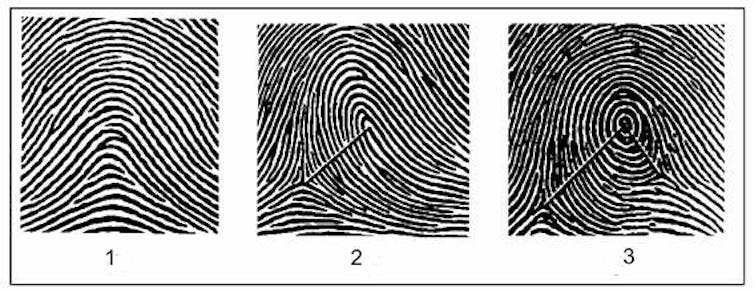
Fingerprints have visible ridge structures, such as arches (left), whorls (middle) and loops (right), but at the microscopic level they have much finer patterns and structures. ValeriyPolunovskiy/Wikimedia Commons, CC BY-SA
Finally, Level 3 features, such as pores, scars and creases, are too small for the human eye to resolve. This is where optical techniques like holography come in handy, since optical wavelengths are in the order of microns, small enough to make out small details on an object.
Developing fingermark holograms
Since fingermarks are usually collected as 2D pictures, and holograms display 3D information, my team wanted to develop a technique that can show all the 3D topological characteristics of a fingermark.
To do this, we’ve been collaborating with Akhlesh Lakhtakia’s group at Penn State. They developed a specialized technique that deposits a nanoscale columnar thin film layer, called a CTF, on top of the fingermark to develop and preserve it.
Columnar thin films are dense pillars of glassy material that uniformly cover the fingermark, like a dense growth of identical trees in a forest. Just as the tops of these trees would reflect the topology of the ground, the tops of these columnar thin films replicate the 3D structure of the fingermarks on which they are deposited.
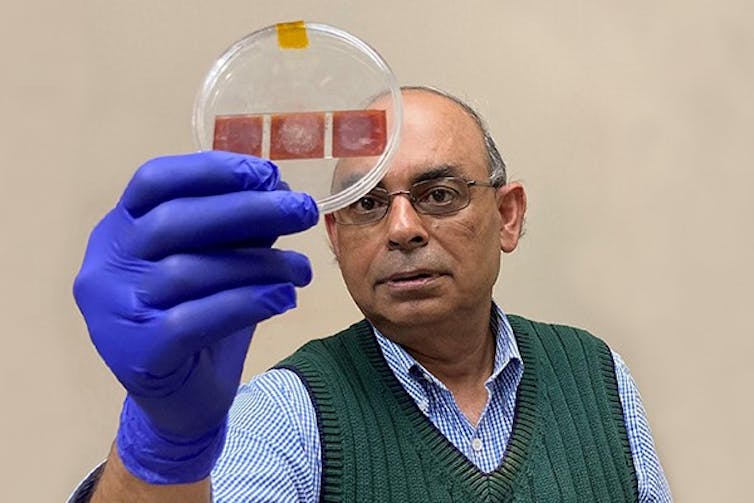
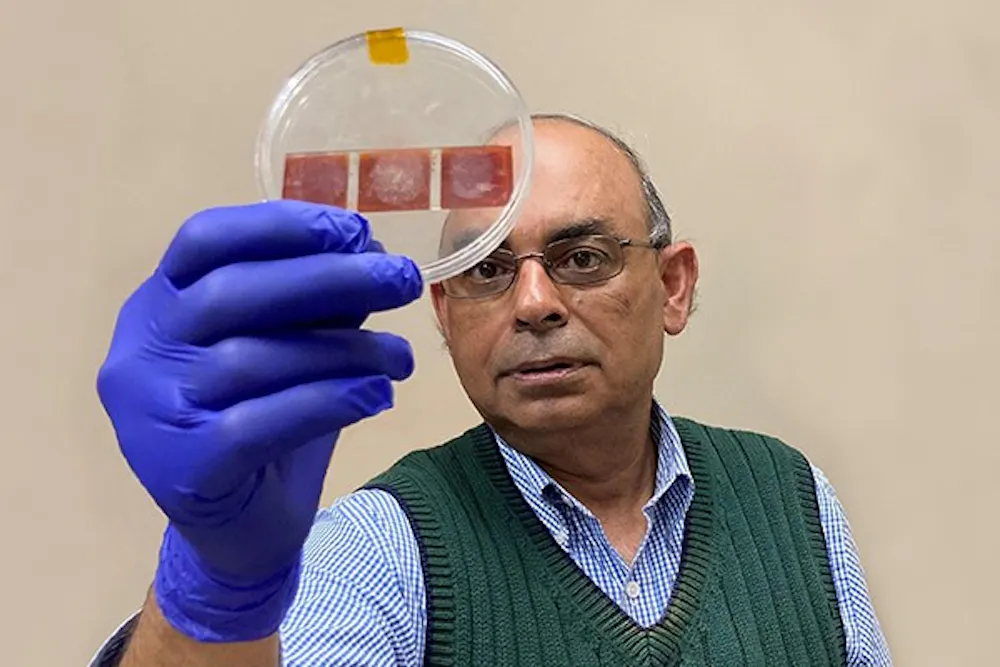
Samples collected using CTF film. Banerjee Lab
To make a hologram of something like a 3D fingermark, researchers split light from a laser into two parts. One part, called the reference wave, shines directly on a digital camera. The other wave shines on the object, in this case the fingermark.
If the object is reflective, the reflected light is also directed to the digital camera and superimposed on the reference wave.
The superposition of waves – both from the reference and the object – creates an interference pattern, which is called a hologram. In digital holography, this hologram, which is a 2D picture, is recorded in the digital camera. Researchers then import the hologram to a computer, where they can use the physical laws of wave propagation to figure out where the light waves from the laser bounced off different parts of the object.
This process allows them to reconstruct the object as a 3D picture.
So, the reconstructed hologram has all the 3D details of the object, and you can now visualize the 3D object on a laptop from any perspective.
Picking up fingermarks
In 2017, our collaboration reported our first results, where we made 3D pictures of latent fingermarks using the CTF technique. We recorded holograms of the CTF-developed fingermarks with two different wavelengths of light – green and blue – generated from a laser. Using two different wavelengths allowed us to make out tiny details such as pores in the 3D reconstructions.
Lakhtakia’s research group has deposited hundreds of fingermarks on glass, wood and plastic. They’ve then let them age in different environments, at various temperatures and humidity levels, before coating them with CTF film to pick up the fingerprint. My group records the digital holograms of these fingermarks and visualizes them in 3D on a computer.
We have also started working on a better 3D fingermark analysis plan to help identify crime suspects.
The Miami Valley Regional Crime Lab in Dayton, Ohio, has graded the quality of the fingermarks captured by Lakhtakia’s research group. It will also help us develop a new method for grading the 3D holographic reconstructions, something that does not currently exist. This may involve creating categories to classify how clear the 3D renderings of the fingermarks are.
The use of fingerprints as unique identifiers has a long history, going back to ancient Babylonian and Chinese civilizations. They’ve been used for forensic purposes since the late 1890s, starting in Calcutta, India. Our work aims to build on this rich history and use cutting-edge technologies to improve fingermark analysis.
Partha Banerjee, Professor of Electrical and Computer Engineering, University of Dayton
This article is republished from The Conversation under a Creative Commons license. Read the original article.