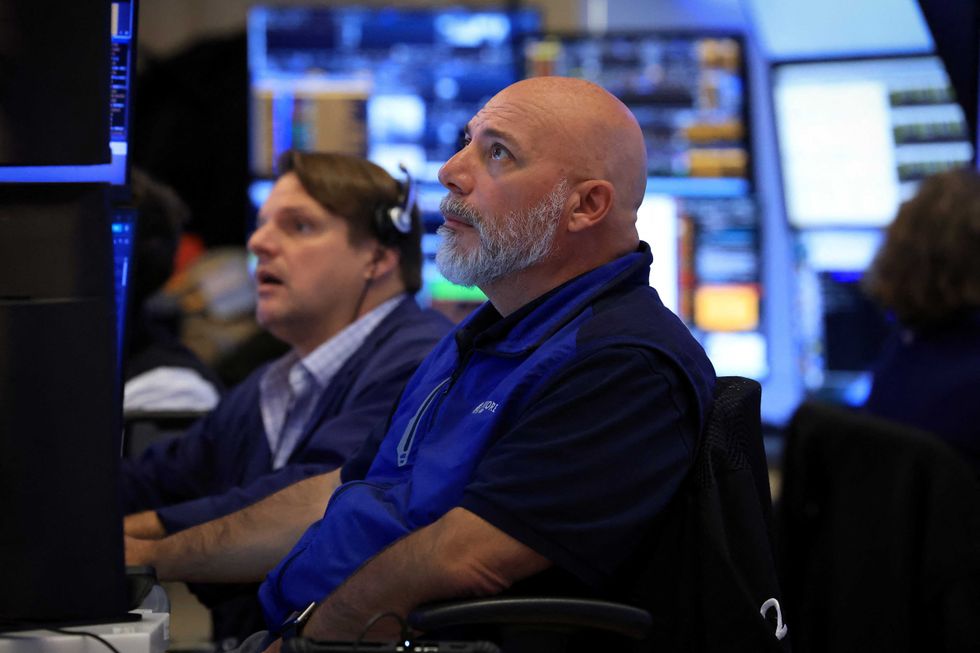
Traders work on the floor at the New York Stock Exchange (NYSE) in New York City, U.S., August 24, 2026. REUTERS/Brendan McDermid

A U.S. market crash could be just around the corner “directly as a result” of a recent Middle East development and a confluence of other factors, political analysts Krystal Ball and Saagar Enjeti warned on Monday.
Last week, the Yemeni militant organization the Houthis gained significant control over the Bab al-Mandeb Strait — a critical global shipping chokepoint in the Red Sea — after seizing control of Yemen’s west coast and Mayyun island, which divides the strait into two channels. The Saudi Arabian East-West oil pipeline was also damaged in an attack originating from Iraq, threatening 4% of global oil supply.
The developments come as oil prices continue to surge to what Ball called “extraordinarily dire” levels amid the months-long disruption of traffic through the Strait of Hormuz.
Experts have already warned that the disruption to trade through the Bab al-Mandeb Strait could inflict a global “inflationary shock,” but Enjeti warned that a confluence of other factors specific to the United States could soon send the U.S. economy into freefall.
“This could be it,” Enjeti warned in an episode of the political program “Breaking Points” that aired on Monday.
Specifically, Enjeti pointed to the extent to which the artificial intelligence (AI) industry is propping up the U.S. economy, with Deloitte finding that “AI-fueled tech investments” accounted for “about half” of real U.S. gross domestic product (GDP) growth since 2025. With AI tech leaders unanimously calling for a “slowdown” in recent days amid fears that the rapidly developing tech could "destroy humanity,” the combination of Iran-war-caused inflation and slowdowns in AI investments could be catastrophic, Enjeti warned.
“Let's say you have a unilateral tech slowdown, which is propping up the entire U.S. economy, [and] people wake up to diesel going $6.23 a gallon — it was $6 last week, and that was the all-time high — that's where we're at!” Enjeti said.
“You've got crushing consumer sentiment, you've got $4.31 a gallon in gasoline, $6.23 diesel... that, combined with the genuine downturn in the U.S. stock market, [and] we are living in a whole [different] universe at that point. That would actually lead to... I can't even imagine. You would have Federal Reserve behavior, unemployment could skyrocket.”
The tools and circumstances that have kept the U.S. market somewhat stable throughout President Donald Trump’s deeply unpopular war against Iran, Ball warned, were also close to expiring.
“There were all sorts of cushions that were in place: China, which dramatically reduced their [oil] buying, our Strategic Petroleum Reserve that we were drawing [from], [the Saudis] were able to use this East-West pipeline to get more barrels out of the region,” Ball noted.
“Now, it feels like all of those previous pieces which cushioned the blow are falling away, and Trump's ability to market manipulate has also seemingly fallen away.”
Report typos and corrections to corrections@rawstory.com.
For customer support contact support@rawstory.com.