
Extending Trump’s 2017 tax law
Let’s start with taxes.

Boasts by Donald Trump and his allies that he was swept back into office in a "landslide" does not hold up under scrutiny based upon an analysis by CNN's Zachary Wolf who also noted that the numbers suggest there are warning signs on the horizon in the 2026 midterms.
In his column, Wolf wrote that the former president may claim he was the recipient of a stunning wave of voters last Tuesday, but recent history reveals he didn't even come close.
As the analyst notes, there are two different metrics: actual voter totals and the number of Electoral College votes awarded. Neither prop up Trump's claims.
ALSO READ:Ecstatic J6 offenders look forward to pardons from 'Daddy Trump' — and retribution
With Tuesday's votes still being tabulated, the Electoral College tally is unlikely to change, with the president-elect landing 312 EC votes which, according to the CNN analyst: "It’s a solid win, but in the lower half of US presidential elections."
"It would be a better showing than either his or Joe Biden’s 306 electoral votes in 2016 and 2020, respectively. It would also outperform both of George W. Bush’s electoral victories in 2000 and 2004," he wrote before adding, " But it would be far short of Barack Obama’s 365 electoral votes in 2008 and 332 in 2012. Bill Clinton never reached 50% in the popular vote because both of his presidential elections featured a strong third-party candidate in Ross Perot. But Clinton did run away with the Electoral College vote, winning 370 electoral votes in 1992 and 379 in 1996."
Those numbers pale next to fellow Republican Ronald Reagan's 1984 total of 525 electoral votes as well as 58% of the popular vote.
As for those popular votes, "Both Richard Nixon in 1972 and Lyndon B. Johnson in 1964 exceeded 60% in the popular vote for their reelection campaigns, something that seems impossible in today’s political climate. It’s also incredible to think that two such massive landslides would occur within eight years."
With that in mind, Wolf suggested Trump's purported landslide may look worse in 2026.
Trump will never be on a presidential ballot again, because the 22nd Amendment limits presidents to two terms. But voters will get an opportunity to weigh in on how he and Republicans use their power in two years, during the 2026 midterm elections, he wrote. "The past three presidents, including Trump in his first term, all lost control of the House after their first two years in office. If Trump does end up with a friendly Republican majority this year, he’ll have to work hard to keep voters on his side two years from now."
You can read more here.
Appearing on MSNBC just days after Donald Trump won re-election over Vice President Kamala Harris, conservative lawyer George Conway suggested Donald Trump's biggest campaign promise will fall apart just like a similar one did after he was first elected in 2016.
Speaking with the co-hosts of "The Weekend," the Trump critic maintained that, if the former president's history with Congress is any guide, the president-elect will botch his mass deportation plans which he made central to his bid for a third shot at the presidency.
Speaking with former RNC chair Michael Steele, Conway first conceded, "Removing these people should be part of enforcing the law for the sake of enforcing the law and not to make a spectacle for political gain."
ALSO READ: 'Bloodbath': Inside the MAGA playbook for mayhem after Election Day
"I think this whole effort will be kind of like the wall was. The wall, people love to talk about the wall, but when he actually had a Republican Congress he asked for teensy weensy bits, a few million here and there for the wall which you cannot build a wall around this building," he joked. "Then, he went and did that for two years he got a budget his his own budget negotiators supported. And Republicans and everybody went home and he said 'I will veto it.'"
"Somebody on Fox News, one of these propagandists on Fox News started pushing saying why is there so little money for the wall?" he elaborated. " And he shut down the government for two or three months."
"This is the kind of chaos –– he cannot get this right," he added. "There are going to be not enough resources to do all the crazy things he wants to do. We are just going to see a mess. I think one of the things we can do, I'm sorry this is a long answer, is point out the mess, point out the incompetence."
As an aside he noted, "And I think we still need to talk about how he is crazy. That did not change at two o'clock Wednesday morning."
Watch below or at the link
- YouTube youtu.be
As part of the ongoing, and seemingly endless, postmortem on Vice President Kamala Harris' loss to Donald Trump, the co-hosts on MSNBC's "The Weekend" attempted to tackle the finger-point at voting groups for not showing up and questions over running women and people of color for office.
According to co-Host Symone Sanders Townsend, she has spent years working in Democratic politics, "when there were usually, the people at the top were men and they were all white men and then over the course of years it has changed."
ALSO READ:'I don't know how that happened': Senior Dems saw writing on wall in Pennsylvania
"The men became people of color, Black people, brown people came into the room and women came into the room," she continued. "I worked for the vice president and to watch her concede the election to someone who is not nearly as qualified as her but someone whom millions of people voted for, it was like I felt like the sentiment in that Erica L. Green and Maya King New York Times piece [ For Black Women, ‘America Has Revealed to Us Her True Self’] that you put up on the screen, I felt that."
"It is like America, it kind of feels like a rejection in some sense, but also I think the positivity that I brought a couple blocks over, several other people did vote for her," she added. "Millions of people voted for her, she got like 70 million of votes, people voted for her. But it still wasn't enough to watch not just on our network but others, if I am going to be honest, people the days after the election say it is time to stop putting up women and black people. I am like, I need a minute, but I am happy to be here today."
Former RNC chair and current "The Weekend" co-host Michael Steele chimed in, "That last part is just stupid. Anyone out there saying that needs to check themselves because women and Black and brown people are the ones who have ascended in terms of our economy, politics, culture et cetera."
Watch below or at the link
- YouTube youtu.be
One major element of the far-right Heritage Foundation's authoritarian Project 2025 document has been helping the next Republican administration dramatically expand executive power. But one expert isn't so sure it will be easy for President-elect Donald Trump despite his decisive win and a Republican-controlled Congress.
The Guardian recently reported that Trump is set up to be the most powerful president in U.S. history since Franklin Delano Roosevelt's four-term administration in the early 20th century. In January, when he assumes the presidency, he'll do so with a Republican-controlled Senate and possibly a Republican-run House of Representatives. He'll also have a six-member Supreme Court supermajority that includes three of his own appointees. Trump repeatedly promised to be a "dictator" on "day one" on the campaign trail, and the electorate rewarded him with both a convincing Electoral College victory and even the national popular vote.
Former Rep. Joe Walsh (R-Illinois) was one of Trump's loudest Republican critics. He told the Guardian that a second Trump term would be “a revenge tour on steroids."
READ MORE: Trump has vowed to be a 'dictator' on day one. What exactly will he do?
"I don’t think people realize what’s coming. He is emboldened," Walsh said. "If I were the rest of the world and the country, I’d be scared to death because we just put an absolutely out-of-control authoritarian in the White House. That’s scary s—."
However, Elaine Kamarck, who served in former President Bill Clinton's administration, isn't convinced that Trump's quest for absolute power will come about so easily. She opined that much of Trump's hopes for new additional authority would depend on Congress willingly ceding some of its own power, which she flatly said is "not going to happen." She pointed out that despite the 6-3 Supreme Court, only 11% of lower court judges were Trump appointees, and that the rest of the federal judiciary would not so easily grant him the vast executive power he's seeking.
"For him to expand presidential power, Congress has to give up power and they’re not in the mood to do that," Kamarck said. "They’ve never done that. There are plenty of institutionalists in Congress.”
“Now, there might be things that the president wants to do that people don’t like that the Republican Congress goes along with him on but that’s politics. That’s not a dictatorship," she added.
The mechanics of Congress are designed to make it extremely difficult for the dominant party to ram through its agenda. Even though Republicans will have at least 52 seats in the 100-member U.S. Senate (votes are still being counted in Arizona's Senate race), Democrats can still gum up the works in numerous ways. This will likely include members invoking cloture for any GOP-sponsored bill, which requires a 60-vote majority to overcome. Outgoing Senate Minority Leader Mitch McConnell (R-Kentucky) made cloture a signature element of his obstructionist approach to stalling former President Barack Obama's legislative agenda, invoking it a record number of times since becoming the top Senate Republican in 2007.
Additionally, as the Congressional Research Service has noted, the Senate requires a process called "unanimous consent" in order to conduct most business. If unanimous consent is granted, senators are limited in how much they can debate on the floor and what amendments they can bring to legislation under consideration. If a sole member denies unanimous consent, debate and amendments are virtually unlimited, making it virtually impossible for the majority party to enact its agenda.
The ability of one senator to hold up the legislative process was on display for most of 2023, when Sen. Tommy Tuberville (R-Alabama) routinely denied unanimous consent to move forward with hundreds of promotions of high-ranking military officers. Tuberville objected largely out of protest of President Joe Biden's Department of Defense allowing for the travel costs of service members obtaining abortion care out of state (for those who live in states where abortion is banned) to be reimbursed.
The Alabama senator's months-long blockade frustrated even his fellow Republicans, who sharply criticized him on the Senate floor for endangering national security and weakening the U.S. military. Even though he ultimately relented, Tuberville's blockade lasted for 10 months.
READ MORE: 'Fascist to the core': Trump's top general slams ex-president as 'most dangerous person'
Click here to read the Guardian's report in full.
The entire panel of MSNBC's "The Weekend" was left speechless before dissolving into nervous laughter after a noted expert on authoritarianism detailed how Donald Trump managed to get himself re-elected and what to expect now that voters have handed him another four years in office.
Co-host Michael Steele prompted historian Ruth Ben-Ghiat with, "I want to get your thoughts of what we can now say is the emerged, the realized form of American fascism that the American people, by some 50-plus percent decided, 'Yes, let's do that.'"
"I mean there is much to say," she began. "We are here now, you know, Donald Trump was very skilled at conditioning Americans to think that democracy and American democracy in particular was failing."
"He called America a garbage can. He spread with his allies disinformation about the economy, said that America was failing and praised foreign dictators so he could bolster his own idea of leadership, which is 'I alone can fix it,'" she elaborated.
ALSO READ:Ecstatic J6 offenders look forward to pardons from 'Daddy Trump' — and retribution
"And all the slogans we have seen for years from him add up to this kind of strong men model of leadership which depends on having an enemy and an internal enemy, the enemy within," she continued.
"So you can justify these kind of crackdowns on the vulnerable, these repressions," she predicted. " And so this is all very unfortunate but he did a good job of conditioning over and over. We've have had eight years of this, Americans to see democracy is inferior to something else. That something else would be strong men ruled by him."
After she concluded, there was a long pause before Steele and co-host Symone Sanders Townsend simultaneously uttered, "Hmmm," which then led to a smattering of nervous laughter before turning to guest George Conway.
You can watch below or at the link
- YouTube youtu.be
The owners of a Washington, D.C. pizzeria are having to deal with an avalanche of blowback after posting on social media what they thought was an innocuous message directed at President-elect Donald Trump.
The day after Trump's election win over Vice President Kamala Harris, Menomale Pizza co-founder Mariya Rusciano posted on X and Facebook, "The people have spoken. @realDonaldTrump won the popular vote and the electoral college Congratulations! Can we gift @WhiteHouse a nice Italian wood burning pizza oven?"
That set off an online firestorm with one commenter bluntly stating: "Do the owners realize that Team Trump has declared war on Washington DC and the federal workforce?”
ALSO READ: 'Bloodbath': Inside the MAGA playbook for mayhem after Election Day
According to a report from the Washington Post, Rusciano and her husband Ettore are doing damage control and attempting to explain that they had a similar message prepared for Harris if she won, responding to a commenter with, "...we’re trying to put a wood burning pizza oven in The White House. This post is a statement of fact and a shot at an awesome opportunity, because America is the land of opportunity. The same post would’ve gone out if @VP Harris won last night."
Despite that, the damage is already done with the Post reporting, "Instead of a reply from the White House, Rusciano’s message has drawn scores of irate social media posts and private messages from neighbors and customers who clearly were in no mood to welcome the president-elect."
According to the owner, she felt she was making a shrewd marketing move and attempted to explain on social media by writing, "No matter who wins, America is still the land of opportunity and what a great opportunity it would be to install an Italian pizza oven at the White House? Our pizza is apolitical, we are an example of what can be achieved in America through hard work and an entrepreneurial spirit.”
The report adds that she said the business hasn't been impacted much, with one employee admitting they noticed slower business afterward.
You can read more here.
Donald Trump's presidential transition team has already hit its first bump in the road after he won re-election Tuesday, reports the New York Times.
At issue is a failure to turn in paperwork –– now over a month overdue — that would clear the path to the turnover of sensitive documents which would allow the incoming administration to hit the ground running after the former president returns to the Oval Office.
That paperwork includes a "legally required ethics pledge stating that he will avoid conflicts of interest and other ethical concerns while in office" the absence of which has caused progress to come to halt.
ALSO READ:Ecstatic J6 offenders look forward to pardons from 'Daddy Trump' — and retribution
According to the report from the Times' Ken Bensinger, the failure to address the impasse has the potential to put America's security at risk.
Reporting, "While the transition team’s leadership has privately drafted an ethics code and a conflict-of-interest statement governing its staff, those documents do not include language, required under the law, that explains how Mr. Trump himself will address conflicts of interest during his presidency," Bensinger added, "The Trump transition’s ethics documents are silent on the question of Mr. Trump’s ethical conduct."
As it stands now, the administration of President Joe Biden is legally prohibited from providing the former president's transition team with classified intelligence and national defense briefings.
The report adds that the missing paperwork also blocks Trump's people from the "physical access to the 438 different federal agencies that they will soon control, and it cannot allow them to review their files."
You can read more here.
After ending his 2024 presidential campaign, anti-vaxxer Robert F. Kennedy Jr. endorsed Donald Trump. RFK Jr.'s supporters have been hoping that if Trump won the election, he would offer Kennedy a major position — perhaps at the U.S. Department of Health and Human Services (HHS).
But Trump's team, according to the Telegraph in the U.K., seems to be "quietly distancing itself" from Kennedy following some anti-vaccine remarks he made during an interview with NBC News after President-elect Trump's decisive victory over Vice President Kamala Harris.
"Mr. Kennedy had previously said that Mr. Trump had 'promised' him control of the Department of Health and Human Services and public health agencies like the Food and Drug Administration (FDA)," the Telegraph's Benedict Smith reports. "However, there is disquiet in the Trump team about media attention on the former independent candidate after he was pressed in a post-election interview with NBC about his vaccine skepticism."
READ MORE: Path forward' to Democrats winning may come sooner than you think: analysis
RFK Jr., during the interview, insisted, "We're not going to take vaccines away from anybody" but claimed there were "huge deficits" in vaccine safety.
"If handed control of the public health agencies by Mr. Trump," Smith notes. "Mr. Kennedy said on Wednesday he planned to clear out 'entire department'…. He added that he could not eliminate public health agencies altogether without congressional approval, but would seek to root out 'corruption' in those bodies."
READ MORE: 'Listen here, sweetheart': Possible Trump AG pick threatens NY’s Letitia James with 'prison'
Read the Telegraph's full report at this link.
President-elect Donald Trump is so far not abiding by a federal law on presidential transitions, and his noncompliance is kneecapping his own incoming administration.
That's according to a recent report by the New York Times' Ken Bensinger. The former and now-incoming president has yet to submit a legally required pledge to avoid ethical conflicts of interest. And because he has yet to do so, this means no one on his transition team can physically access the 438 different federal agencies between now and January 20. Additionally, neither Trump nor his team can get security clearances from President Joe Biden's administration needed to have national security briefings and access classified national intelligence.
This requirement was included in a 2019 amendment to the bipartisan Presidential Transition Act, which lays out the complex process in which an outgoing administration assists the incoming president with the transition of power. The Times noted that the law was "born in part out of concerns about ethical issues during the first Trump administration."
READ MORE: Watchdogs vow accountability for Trump crimes despite presidential win
Max Stier, who is the head of the nonpartisan Partnership for Public Service (which assists the presidential transition process), told Bensinger that this "could leave the country vulnerable at a critical moment."
“The consequences are severe,” Stier told the Times. “It would not be possible to be ready to govern on Day 1.”
Trump's own conflicts of interest are staggering, with the anti-corruption watchdog group Center for Responsibility and Ethics in Washington (CREW) identifying approximately 3,400 such conflicts from Trump's first administration. This includes him hosting members of foreign governments at his privately owned properties, like the Trump International Hotel in Washington, DC prior to its sale in 2022.
Another example of the depth of Trump's ethical conflicts came to light In a January 2024 report issued by the House Oversight Committee, which found that his businesses received approximately $8 million from foreign governments while he occupied the White House. The report's authors argued that this was a blatant violation of the Constitution's Emoluments Clause, which prohibits federal officials from receiving gifts from foreign government without prior permission from Congress.
READ MORE: 'Gives the game away': Dem says Eric Trump admitted to taking money from foreign countries
Rep. Jamie Raskin (D-Maryland) pointed out that Trump's transition team failed to meet a September 1 deadline to sign an agreement with the General Services Administration that makes $7.2 million available for the presidential transition process. Both Biden and Vice President Kamala Harris each submitted their paperwork ahead of that deadline, which requires public disclosure of all donors to a transition effort and caps donations at $5,000 apiece.
"He’s completely thumbing his nose at the idea that all Americans are participating in the same basic public enterprise," Raskin told the Times.
As of Thursday, White House Press Secretary Karine Jean-Pierre confirmed that the Biden administration had reached out to the Trump transition team, who said "they have an intent" to submit the legally required paperwork. However, they did not indicate when they would be doing so. Trump transition team co-chairs Howard Lutnick and Linda McMahon issued a statement saying that "all transition staff have signed a robust ethics pledge as a requirement of their participation" but gave no further details.
Click here to read Bensinger's full article in the Times (subscription required).
READ MORE: 'Inexperienced, loyalist clowns': National security expert slams possible Trump CIA picks
Leaders of nations that have been on a friendly footing with the United States for decades already have in place plans for how they will deal with President-elect Donald Trump primarily based upon their experience with him before he was booted from office in 2020.
According to a report from the New York Times, foreign diplomats and government officials know that the returning Trump is easy to manipulate with flattery and will use a combination of those close to him and think tanks to sway him indirectly.
The report notes that those same leaders have already been making new efforts to "ingratiate" themselves which should open the door to smoother relations.
ALSO READ: 'Bloodbath': Inside the MAGA playbook for mayhem after Election Day
According to Malcolm Turnbull, a former prime minister of Australia, "There were two misapprehensions about Trump. The first was he would be different in office than he was on the campaign trail. The second was the best way to deal with him was to suck up to him.”
"European diplomats are realistic about the task that confronts them. But they cling to the idea that with the proper approach, Mr. Trump can be swayed," the Times is reporting with Karen Pierce, Britain’s ambassador to the United States, confessing, "With President Trump, it’s the art of the possible. If you can explain what we can do together and how we can improve things in a significant way, then you can make progress.”
Kim Darroch, Pierce's predecessor, is doubtful about the early Trump outreach.
"It’s essential to do it; it’s remiss not to do it,” he explained before cautioning. “But I’m skeptical that we will shift him on issues where he’s made public commitments, whether tariffs or ending U.S. arms supplies to Ukraine.”
You can read more here.
The economy was one of their top issues as voters went to the polls this year. So what does Donald Trump’s return to the White House – as well as Republican gains in Congress – mean for the U.S. economy?
Let’s start with taxes.
Nearly all of the provisions of the Tax Cuts and Jobs Act of 2017, which Congress passed and Trump signed into law in his first year in office, expire at the end of 2025. If those parts of the law aren’t extended, it would result in a tax hike of about US$4 trillion through 2034. This would impose an additional burden on households coming out of a period of high inflation that resulted in significant hardship for many families – and contributed to Trump’s victory.
Extending the individual income tax cuts would keep marginal tax rates from jumping and lead – relative to letting them expire – to an increase in economic output in the long run. This occurs because lower taxes increase demand for goods and services in the short run. Lower tax rates increase the incentive to work, save and invest, which leads to more hours worked, more capital, increased labor productivity and new business formations in the long run.
The law also improved tax simplicity by doubling the standard deduction. And it promoted fairness by increasing the child tax credit, reducing how many taxpayers are subject to the alternative minimum tax and capping the deduction on state and local income taxes. The expiration of these provisions would result in a significant increase in the tax burden on many lower- and middle-income households.
Given that Trump signed the act into law in 2017, I believe it’s a good bet that, at a minimum, he’ll extend the law, which will be much easier with a Republican Congress. And many economists would argue that will be good news for American households and the economy as a whole.
More importantly, in my view, are what I expect will be his more business-related policies that should promote innovation, investment and productivity, many of which also relate to the 2017 tax law.
A few of these policies also relate to the same tax law – and so are very likely to be extended or reformed early in Trump’s second term. Two provisions that are set to expire soon are the 20% small-business deduction and a measure that allows for the expensing of equipment such as computers and manufacturing machinery.
The small-business deduction, which allows owners to deduct up to 20% of their share of the company’s income from their individual tax bills, was found to increase employment by 1.2 million jobs a year. It’s also important to ensure that small businesses remain competitive with larger rivals. Allowing businesses to fully expense the cost of equipment has been found to increase economic output by about 5% over the long term.
It’s important to extend these provisions to avoid a large tax increase on small businesses that would reduce job creation and innovation and lead to slower growth and lower living standards.
A related issue is accounting for research and development expenditures. The 2017 tax law actually raised taxes for companies by requiring these expenses be spread over five years, which raises the cost of capital and disincentives investment. Trump has said he would change this so all expenses, including R&D, can be immediately expensed. This should promote economic growth.
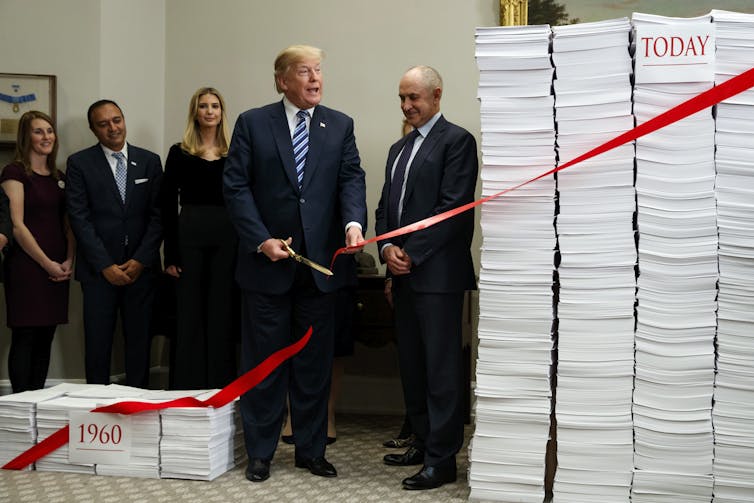
Trump loved cutting red tape – and red ribbons. Here, he illustrates how much federal regulations have increased since 1960.
AP Photo/Evan Vucci
More broadly, Trump’s first term in office was characterized by a reduction in red tape as regulatory reform was a major focus of his administration. Research on the economic cost of new regulations suggests the extra burden of regulations during the Trump administration was significantly lower than during the administrations of George W. Bush, Barack Obama and Joe Biden.
Research suggests the U.S. economy remains stifled by heavy-handed and poorly targeted regulations that slow growth and innovation. Trump has promised to further reduce regulations during a second term, so it could lead to solid gains in economic output.
Given the promise of artificial intelligence to increase productivity and growth in the near future, I believe it is more important than ever to ensure that government agency’s set the rules of the game in a fair and efficient manner, without choking off the economic benefits of increased innovation.
But there’s one big caveat to this. Extending those tax cuts will put serious strain on the national debt, which is currently at unsustainable levels.
Since the turn of the century, U.S. debt has increased from $10 trillion to over $35 trillion, and the Congressional Budget Office projects that the debt will increase as a share of GDP from 99% in 2024 to 166% in 2054.
Reforming the tax code to avoid a significant increase in taxes is important, but offsetting the revenue loss with spending cuts will be vital to avoid adding to the debt. Failing to do so would significantly increase the deficit and national debt, and put the nation’s finances on an even more precarious path.
But Trump could go further than simply finding offsets. The start of the new administration is a perfect time, in my view, to create a new fiscal commission to jump-start a bipartisan conversation on sustainable fiscal policy solutions.
John W. Diamond, Director of the Center for Public Finance at the Baker Institute, Rice University
This article is republished from The Conversation under a Creative Commons license. Read the original article.
A growing movement believes President-elect Donald Trump is fighting a spiritual war against demonic forces within the United States. Trump himself stated in his acceptance speech on Nov. 6, 2024, that the reason that “God spared my life” was to “restore America to greatness.”
NAR advocates claim they receive divine guidance in reconstructing modern society based on Christian spiritual beliefs. In 2015, an estimated 3 million adult Americans attended churches that were openly part of NAR. Some scholars estimate that the number of active NAR adherents may be larger, as the movement may include members of Protestant Christian churches that are not directly aligned with the NAR movement.
NAR emerged in the late 1990s when theologian C. Peter Wagner popularized the term “New Apostolic Reformation.” Wagner argued that God was creating modern-day apostles and prophets who would lead Christianity in remaking American society.
The roots of the New Apostolic Reformation can be traced to the broader charismatic movement that sees spiritual forces as an active part of everyday life.
This view does not separate sacred experience from regular everyday life. For the much larger network of charismatic Christians and Pentecostal movements that emphasize a personal relationship with God, the world is full of the active presence of the Holy Spirit, spiritual gifts and direct divine experiences.
Central to NAR is the belief that Christian religious leaders should be the main source of cultural and political authority in America.
NAR proponents argue that select leaders receive direct revelation from God, guiding the direction of churches and fighting spiritual warfare against demonic influences, which they believe corrupt the behavior of individuals and nations.
NAR advocates for a hierarchical structure in which religious leaders and their political allies hold authority in society.
They believe in “The Seven Mountains Mandate,” a way to represent Christian control of society through a strategy that Christians should infiltrate, influence and eventually control seven key areas in society – business, government, media, arts and entertainment, education, family, and religion – to bring about cultural transformation.
By doing so, NAR proponents believe they can establish a pure and true form of what they believe is a society ruled by divine guidance and strict adherence to biblical ideas.
Lance Wallnau, a prominent Christian author, speaker, social media influencer and consultant associated with NAR, has promoted the idea that such engagement where NAR Christian leaders hold authority through a government tied to divine will is essential for advancing societal transformation.
Wallnau has been a vocal supporter of Trump, viewing him as a significant figure in NAR’s vision.
Followers of the NAR believe that they must engage in spiritual warfare, which includes prayers and actions aimed at combating perceived demonic influences in society.
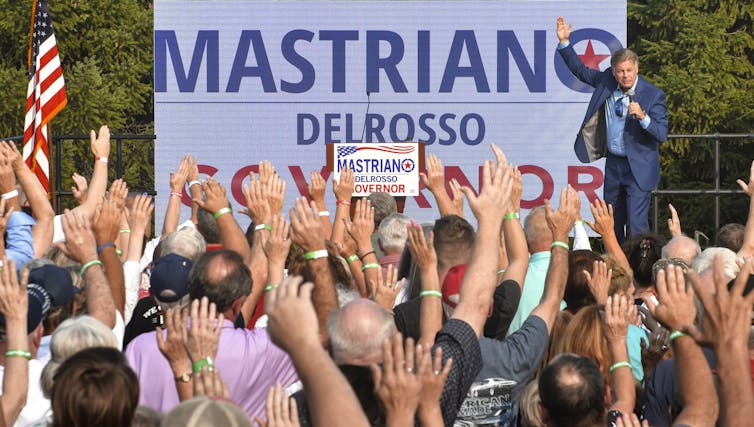
Evangelist Lance Wallnau speaks during a September 2022 rally for Republican gubernatorial candidate Doug Mastriano in Chambersburg, Pa.
Doug Kapustin/For The Washington Post via Getty Images
This practice often involves identifying “strongholds” of evil, around cultural issues, such as gay marriage, transgender rights and LGBTQ+ activism, and working to dismantle them. An example of this is a recent series of religious-based political rallies led by NAR leaders known as “The Courage Tour” that advocated directly for Trump’s second election.
The NAR emphasizes that Christians should expect to see miraculous signs, where extraordinary events, such as Trump’s survival of an assassination attempt, are interpreted to be explained only by divine or spiritual intervention.
The movement’s adherents also believe in faith-based healing and supernatural experiences, such as prophetic utterances and speech.
Many NAR leaders and followers support Trump, viewing him as a divinely appointed figure who would facilitate NAR’s goals for societal reconstruction, believing he was chosen by God to fulfill a prophetic destiny.
They position Trump as a warrior against a so-called demonically controlled – and therefore corrupted – “deep state,” aligning with NAR’s emphasis on spiritual warfare and cultural dominion as outlined in the “Seven Mountains” mandate. NAR leaders followed Trump’s understanding of a corrupt government.
The NAR led a “Million Women” worship rally on Oct. 12, 2024, to Washington, D.C., in which the organizers sought to encourage 1 million women NAR adherents to come to pray, protest and support Trump’s campaign. The event was promoted as a “last stand moment” to save the nation by helping Trump win the election as a champion against dark, satanic forces.
Several prominent politicians, legislators and members of the judiciary, such as House Speaker Mike Johnson and Supreme Court Justice Samuel Alito, have flown the NAR-based “Appeal to Heaven” flag.
For NAR evangelicals, the presidential election is interpreted through a Christian apocalyptic rhetoric. In this rhetoric one candidate is a force for good, a warrior for God – Trump – and the other is led by demonic forces such as Harris. Trump’s 2024 win is seen as a critical moment of spiritual warfare where the forces of God defeat the forces of evil.
Despite its growing popularity, NAR faces substantial criticism. Many mainstream Christian churches argue that the movement’s teachings deviate from traditional Christian orthodoxy.
Critics highlight abuse of authority by people who claim God is directing their actions and the potential for abuse of authority by those claiming apostolic roles. The embrace of Trump raises concerns about blending evangelical faith and political ambition.
Critics argue that the NAR’s support for Trump compromised the integrity of the gospel, prioritizing political power over spiritual integrity. The events surrounding the Jan. 6, 2021, attack on the U.S. Capitol further complicated this relationship, exposing the potential dangers of conflating religious beliefs with partisan politics.
Moreover, the NAR’s emphasis on spiritual warfare and the idea of taking control over society has raised other Christian groups’ concerns about its potential to foster an “us versus them” mentality, leading to increased polarization within society.
The New Apostolic Reformation represents a significant development, blending charismatic practices with a strong emphasis on politics and cultural transformation.
However, a large majority of Americans disagree that society should be remade based on religious theology. Thus, for now, the NAR movement’s fundamental views about religion and government are starkly at odds with most Americans.
Art Jipson, Associate Professor of Sociology, University of Dayton
This article is republished from The Conversation under a Creative Commons license. Read the original article.
In the days since the Supreme Court overturned Roe v. Wade, which had established the constitutional right to an abortion, some Christians have cited the Bible to argue why this decision should either be celebrated or lamented. But here’s the problem: This 2,000-year-old text says nothing about abortion.
As a university professor of biblical studies, I am familiar with faith-based arguments Christians use to back up views of abortion, whether for or against. Many people seem to assume the Bible discusses the topic head-on, which is not the case.
Abortions were known and practiced in biblical times, although the methods differed significantly from modern ones. The second-century Greek physician Soranus, for example, recommended fasting, bloodletting, vigorous jumping and carrying heavy loads as ways to end a pregnancy.
Soranus’ treatise on gynecology acknowledged different schools of thought on the topic. Some medical practitioners forbade the use of any abortive methods. Others permitted them, but not in cases in which they were intended to cover up an adulterous liaison or simply to preserve the mother’s good looks.
In other words, the Bible was written in a world in which abortion was practiced and viewed with nuance. Yet the Hebrew and Greek equivalents of the word “abortion” do not appear in either the Old or New Testament of the Bible. That is, the topic simply is not directly mentioned.
The absence of an explicit reference to abortion, however, has not stopped its opponents or proponents from looking to the Bible for support of their positions.
Abortion opponents turn to several biblical texts that, taken together, seem to suggest that human life has value before birth. For example, the Bible opens by describing the creation of humans “in the image of God”: a way to explain the value of human life, presumably even before people are born. Likewise, the Bible describes several important figures, including the prophets Jeremiah and Isaiah and the Christian Apostle Paul, as having been called to their sacred tasks since their time in the womb. Psalm 139 asserts that God “knit me together in my mother’s womb.”

‘The Creation of Adam’ from the Sistine Chapel ceiling in the Vatican, painted by Michelangelo.
GraphicaArtis/Getty Images
However, abortion opponents are not the only ones who can appeal to the Bible for support. Supporters can point to other biblical texts that would seem to count as evidence in their favor.
Exodus 21, for example, suggests that a pregnant woman’s life is more valuable than the fetus’s. This text describes a scenario in which men who are fighting strike a pregnant woman and cause her to miscarry. A monetary fine is imposed if the woman suffers no other harm beyond the miscarriage. However, if the woman suffers additional harm, the perpetrator’s punishment is to suffer reciprocal harm, up to life for life.
There are other biblical texts that seem to celebrate the choices that women make for their bodies, even in contexts in which such choices would have been socially shunned. The fifth chapter of the Gospel of Mark, for example, describes a woman with a gynecological ailment that has made her bleed continuously taking a great risk: She reaches out to touch Jesus’ cloak in hopes that it will heal her, even though the touch of a menstruating woman was believed to cause ritual contamination. However, Jesus commends her choice and praises her faith.
Similarly, in the Gospel of John, Jesus’ follower Mary seemingly wastes resources by pouring an entire container of costly ointment on his feet and using her own hair to wipe them – but he defends her decision to break the social taboo around touching an unrelated man so intimately.
In the response to the Supreme Court’s decision, Christians on both sides of the partisan divide have appealed to any number of texts to assert that their particular brand of politics is biblically backed. However, if they claim the Bible specifically condemns or approves of abortion, they are skewing the textual evidence to fit their position.
Of course, Christians can develop their own faith-based arguments about modern political issues, whether or not the Bible speaks directly to them. But it is important to recognize that although the Bible was written at a time when abortion was practiced, it never directly addresses the issue.
Melanie A. Howard, Associate Professor of Biblical & Theological Studies, Fresno Pacific University
This article is republished from The Conversation under a Creative Commons license. Read the original article.
Copyright © 2026 Raw Story Media, Inc. PO Box 21050, Washington, D.C. 20009 |
Masthead
|
Privacy Policy
|
Manage Preferences
|
Debug Logs
For corrections contact
corrections@rawstory.com
, for support contact
support@rawstory.com
.
