Republicans plan to fund Immigration and Customs Enforcement and Customs and Border Protection through a strictly partisan budget process this week, prompting Democrats to warn that the strategy will establish a dangerous precedent that both parties may exploit in future administrations.
The GOP aims to adopt a budget resolution as soon as Thursday that would allow them to bypass the Senate filibuster and pass immigration enforcement funding through reconciliation — a fast-track process traditionally reserved for tax measures, reported MS NOW. The plan sets a June 1 deadline for final passage, coinciding with President Donald Trump's directive.
“They’re setting a precedent for the future, and it is going to be extremely difficult in the future for whoever ends up in the minority,” Sen. Patty Murray (D-WA), the top Democrat on the Appropriations Committee, told reporters Wednesday.
Republicans have proposed $140 billion in spending over 10 years, allocating $70 billion each to the Senate Homeland Security and Judiciary Committees. This would enable Republicans to pass a $70 billion ICE and CBP funding bill with a simple majority, circumventing the 60-vote threshold typically required for government funding measures.
"Republicans are inviting us to just do multi-year appropriations through reconciliation," said Sen. Chris Murphy (D-CT), while Sen. Chris Van Hollen (D-MD) added: "Democrats should not play by a different set of rules from Republicans when it comes to reconciliation."
For decades, lawmakers considered agency budgets off-limits for reconciliation. Democrats initially breached this norm under President Joe Biden by funding part of the IRS budget through reconciliation, and Republicans subsequently pushed hundreds of billions for Department of Homeland Security and military spending through the same process.
Republicans acknowledge the risk. "It's hard to say that we're going to do this just once and then it's done, because we never do," said Sen. Shelley Moore Capito (R-WV), the No. 4 Senate Republican. "It's one, and then it's precedent — and then it's off to the races."
Democrats remain divided on the issue. Some, including Rep. Rosa DeLauro (D-CT), oppose using reconciliation for agency funding under any circumstances, while others acknowledged uncertainty about future positions.
Republicans are setting a “dangerous precedent all around," said Rep. Ed Case (D-HI).
Rep. Robert Adertholt (R-AL), on the other hand, blamed the Senate for the funding dysfunction, saying House Republicans feel they have no choice but to bypass the filibuster.
“I understand about the filibuster – I understand it, but that is not actually in the Constitution, as I understand it,” Aderholt told MS NOW. “So I really have been very disappointed in the Senate the way they handle this. I don’t really blame the speaker. I think he’s been put in a difficult position, but the Senate should have found a way to work through this.”
"Wah, wah, wah," Ocasio-Cortez told Raw Story on Wednesday, mimicking a whining baby and laughing in response to a question from reporter Matt Laslo. "Democrats have attempted and asked Republicans for 10 years to ban partisan gerrymandering, and for 10 years, Republicans have said, 'no.'"
Laslo was asking Ocasio-Cortez to respond to complaints from the GOP that it would be unconstitutional for Democrats to have a 10-1 congressional majority in Virginia, which the gerrymandering ballot measure would make possible. A Virginia circuit court judge blocked the vote-approved redistricting on Wednesday, however.
Still, Ocasio-Cortez saw no problem with Democrats supporting gerrymandering after years of opposing it when done on the Republican side. For AOC, the GOP "wanted to start this," and the Democrats are just fighting back.
"What they're mad at is they're accustomed to a Democrat Party that rolls over, doesn't fight and takes everything sitting down," Ocasio-Cortez said. "What they're mad at right now is that we are here in a new day."
She mentioned Republican gerrymandering in North Carolina and Texas, where Democrats lost seats. Trump's call for Texas Republicans to gerrymander arguably kicked off what's now seen as a redistricting arms race.
"We have been asking the Democratic Party to stand up and fight, and now they did," AOC continued. "Now the Republican Party doesn't like the fact that they are fighting against someone who actually will stand up for the American people."
Ocasio-Cortez said she would "welcome" working with the Republicans to pass a ban on partisan gerrymandering.
"We have the bill right here to end this all today," she said, smiling. "But they don't want to because they like pursuing and continuing to enact an unfair electoral landscape."
FBI Director Kash Patel's own agency members raised alarms after an investigation was launched into a New York Times journalist who wrote a story that was critical of his girlfriend, country music singer Alexis Wilkins.
The New York Times reported on Wednesday that Trump's FBI began investigating Times reporter Elizabeth Williamson after she published a story detailing how Wilkins was regularly escorted by FBI security, and raised questions about Patel's use of FBI jets for personal travel. Wilkins criticized the reporting and called Williamson a "stalker" on X.
The Times said Williamson had one off-the-record phone call with Wilkins herself during her reporting process. Williamson noted in her story that Wilkins "declined to be interviewed" for the story.
Williamson also spoke with several people in Wilkins' orbit for the story and exchanged emails with Wilkins before it ran, according to the NYT.
That apparently wasn't enough for Wilkins or Patel.
"Agents interviewed the girlfriend, queried databases for information on the reporter, Elizabeth Williamson, and recommended moving forward to determine whether Ms. Williamson broke federal stalking laws, the person said," according to the NYT report.
"Those actions prompted concerns among some Justice Department officials who saw the inquiry as retaliation for an article that Mr. Patel and his girlfriend, Alexis Wilkins, did not like, and who determined there was no legal basis to proceed with the investigation, according to the person briefed on the matter," it added. The investigation went no further.
After weathering years of challenges, from online competition to the COVID pandemic, President Donald Trump’s tariffs became “the last reason” why Jennifer Bergman decided to close down the New York City toy store her mother opened in 1981.
As small businesses currently navigate a complex tariff refund process and still face rising costs, Bergman, 59, is one of five business owners speaking out in a new $200,000 YouTube ad campaign launched Wednesday by Small Businesses Against Tariffs, a project from the Defending Democracy Together Institute, an advocacy group formed by anti-Trump conservatives.
“I'm not afraid of [Trump]. I'm not afraid of his goons, and if they want to throw us all into jail because we're saying things against them, that's fine by me,” Bergman told Raw Story.
“My parents would be really proud of me, and they'd bail me out if they were still around. Actually, they'd be right there with me in jail.”
Bergman closed her store, West Side Kids, in July after she realized she wasn’t going to be able to pay her rent or make payroll.
”I’d never had that before, ever, ever,” she said.
Over the years, Bergman’s staff shrunk from 12 employees to four. Those four people lost their jobs when the store closed and struggled to find new ones, with one even becoming unhoused, Bergman said.
When Trump added a 145 percent tariff on China last year, Bergman said a $10 toy she’d typically sell for $20 would need to be marked up to $45 to cover the extra costs since she couldn't “afford to eat any of it.”
The price of a scooter she’d typically sell for $150 shot up to $180 when her supplier called to say they needed to reroute shipping containers to Canada and raise prices after Trump announced tariffs last May.
“Prices were going up, and you only have a finite amount of money to spend,” Bergman said.
“The product was getting so much more expensive that I was spending more money for less.”
Bergman also blamed Trump’s tariffs for preventing her from closing on a deal to sell her store as she was in conversation with two potential buyers in early 2025.
“When the tariffs hit, they were both like, ‘We can't do this right now … we just need to deal with this,’ and so I lost the opportunity to sell my store, too.” Bergman said.
‘Never in my wildest dreams’
After deciding to expand to a second location in 2024, Gabe Hagen, co-founder and owner of Brick Road Coffee in Arizona, said starting construction in early 2025 was “rough” timing due to tariffs.
“Once we learned the results of the election and what the new administration was planning on doing with tariffs, we had to really think on our feet,” Hagen told Raw Story.
“We had to kind of re-pivot what we were doing, so we cut back a lot up front.”
Hagen, who is also featured in the Small Businesses Against Tariffs campaign, said the business decided to change equipment purchases and pre-purchased a year’s worth of cups and disposables to “weather the impacts of tariffs.”
Hagen’s projections for stocking the second location, which is both a roastery and a coffee shop, ended up being about a third of what he actually spent.
“The strain of that on a new small business — especially one that's just expanded — we're already so tight on our cash, it's just rough,” Hagen said.
At the end of 2024, raw coffee beans cost Hagen about $4 a pound. At one point, prices spiked to just under $7 a pound, Hagen said. Now prices for speciality coffee are still $5 to $6 per pound, he said.
When Hagen started, roasted coffee cost around $10 per pound. Now prices range between $12 to $14 on the wholesale side, he said.
“Never in my wildest dreams did I think we'd be paying 50 percent tariffs on a Brazil coffee, which is our number one coffee that we use,” Hagen said.
The Trump administration backed down its tariffs on coffee at the end of last year, but small businesses like Hagen's are still feeling the effects.
“Every new business, we expect some bleed, but this bleed is taking a lot longer than we expected,” he said.
Hagen took out another working capital loan and put his house up for collateral, he said.
Gabe Hagen at Brick Road Coffee's second location and roaster, Prism Coffee Lab (Photo provided by Brick Road Coffee)
“We don't really have many more levers left on a small business side, so that's why tariffs were so important for me to speak out against because I can't just grow my coffee,” Hagen said.
The unpredictability of Trump’s tariffs make it hard to know “when we'll feel relief," Hagen said.
“I don’t know if it'll change back, so I think the hardest part for me is I don't know how to do a 12 month forecast," he said.
From a trucking company to a DIY flower shop and an eco-friendly dinnerware company, small businesses have struggled to stay afloat due to tariffs, Raw Story reported.
"We felt it was important to run this campaign in light of spiking prices and confusion around the tariff refund policy,” a Small Businesses Against Tariffs spokesperson said.
“Our hope is that it will help to educate Americans about who truly pays the costs of tariffs and trade wars: American small businesses and consumers. The goal here is to keep engaging those people who show an active interest in the tariff issue, to emphasize who ends up paying the costs of tariffs and to de-bunk widespread lies.”
MORRISVILLE, N.C. — When the Department of Homeland Security surged federal agents into North Carolina last November, they pledged to “target criminal aliens” and go after “the worst of the worst — including murderers, rapists, and pedophiles.”
But in one case reviewed by Raw Story, federal immigration authorities received a tip about a 24-year-old Guatemalan national suspected of involvement in the kidnapping and rape of a 16-year-old girl — and they repeatedly missed the opportunity to detain him, despite him being in police custody.
Federal immigration authorities appear to have learned about Maynor Godinez-Mendez when a detective with the Fuquay-Varina Police Department contacted the FBI’s Human Trafficking Division. When Godinez-Mendez was interviewed following his arrest on suspicion of contributing to the delinquency of a minor, a federal Homeland Security Investigations agent was present and translated.
Even after Immigration and Customs Enforcement, or ICE, received a notification from a detention officer that he was in a local jail, they still failed to take Godinez-Mendez into custody, and he was released on his own recognizance four hours later.
The day after Godinez-Mendez’s release from jail, the Department of Homeland Security announced “Operation Charlotte’s Web.” Border Patrol “stormed” North Carolina’s largest city “in unmarked SUVs and masks, sweeping up hundreds of people,” as described in the Charlotte Observer. In the midst of the five-day blitz, the operation briefly expanded into the booming area about 150 miles to the northeast surrounding the state capitol of Raleigh, which includes Fuquay-Varina.
Chafed by the agency’s fumbled response involving Godinez-Mendez, an ICE Enforcement and Removal Operations supervisor tasked a team with apprehending the suspect. But based on faulty intelligence, ICE staked out the wrong house.
During an arrest operation on Dec. 2, 2025, agents in unmarked SUVs converged on a different man and blocked him at the entrance of a shopping center in Morrisville. When the man tried to back up and drive away, an agent rammed his car through a hedgerow, spun the vehicle around, and pushed it into a parked car.
The driver was not Godinez-Mendez, but rather another Guatemalan. His name was Milton Roblero.
When the agents took Roblero into custody, they determined that he had an outstanding order for deportation. Federal prosecutors charged him with forcibly assaulting a federal officer with a deadly weapon and willfully damaging government property.
Roblero’s lawyer filed a motion to dismiss, while questioning whether the agent who rammed his vehicle “violated ICE’s own policy and regulations restricting offensive driving techniques.” The shopping center includes a daycare, and the motion contends that ICE policy prohibits using offensive driving techniques “in school zones where children are present or going to or from school or where the danger to the public outweighs the enforcement benefit.”
Surveillance video shows ICE ramming Milton Roblero's vehicle during his arrest in Morrisville, N.C. on Dec. 2, 2025. (federal courts) roar-assets-auto.rbl.ms
The government did not directly address the question of whether ICE violated its policies, only saying in a court filing that the agents’ use of a vehicle for an administrative arrest was “appropriate.” But a filing in federal court on Monday indicates the government agreed to plead down the charges to a misdemeanor for impeding federal immigration officers’ traffic interdiction efforts. The agreement notes that Roblero will be removed to Guatemala following resolution of federal charges.
Andreina Malki, the defense manager for the immigrant advocacy group Siembra NC, told Raw Story Roblero’s arrest fits a pattern of unsafe activity by ICE.
“They used unmarked vehicles that don’t have any indication that they might be ICE,” she said. “If you’re a person driving, and unmarked cars try to block you in, you would probably try to leave. The fact that he got rammed and then got a charge for using his vehicle as a weapon — the story doesn’t add up. It’s not clear to the people being stopped who’s stopping them.”
Lindsay Williams, an ICE spokesperson, told Raw Story he couldn’t speak to the specifics of Roblero’s arrest.
A missing person case leads to a call to the FBI’s Human Trafficking Division
The circumstances that led to Roblero’s arrest began three weeks earlier with a missing person case that developed into a kidnapping and rape investigation.
Police in Fuquay-Varina, a town on the southwestern fringe of Raleigh, received a frantic phone call from a woman who reported that her 16-year-old daughter was missing (Raw Story is withholding the girl’s name because she is a juvenile). According to the police investigative report obtained through federal court filings, the daughter had texted: “Mommy and Daddy, I’m sorry for doing this to you, and well, I’m not coming home. I love you all very much.” The mother’s calls went straight to voicemail.
After interviewing the girl’s younger cousins, the police were able to get the name of a former boyfriend, then a residential address, and ultimately a description of a vehicle registered to the address. Using a law enforcement database, the police determined that the vehicle, a 2012 Hyundai Accent, had been repeatedly observed at an apartment complex in Cary, a nearby city.
Two Fuquay-Varina police officers went to the apartment complex the day after the 16-year-old girl had disappeared. As the officers were speaking with two females, the 16-year-old girl walked out of the apartment. She told the officers that the owner of the Hyundai was “Maynor,” and that he was in the car with another man named “William” when they picked her up.
Initially, the 16-year-old girl told the police that she had run away because of problems at home, and that nothing happened to her at the apartment. She said she had only watched TV and slept.
But on Nov. 13, two days after the 16-year-old girl was returned to her family, she told Cpl. Cassaundra Sullivan that William Godinez-Ramirez had called her and told her to go to an Indian grocery store. When she got into the car, according to Sullivan’s notes, Godinez-Ramirez told the 16-year-old girl to throw her phone out the window. She refused, and Godinez-Ramirez reportedly got out of the car, opened her door, grabbed the phone and threw it away. The girl told the officer that another man, Maynor Godinez-Mendez, and his wife were also in the car. They drove to a car wash, switched cars, and drove on to the apartment in Cary.
Summarizing what Sullivan learned from her interview, Detective Salvatore Fundaro wrote that the 16-year-old girl “reported that Godinez-Ramirez raped her” and “also reported that Godinez-Ramirez told her that he was going to kill her family if she didn’t leave with him.”
Fundaro consulted with the Wake County District Attorney’s Office, and he said he was advised to keep investigating before charging with rape and kidnapping, but he swore out warrants for contributing to the delinquency of a minor for both Godinez-Ramirez and Godinez-Mendez.
The federal authorities appear to have learned about the investigation of the two men on Nov. 12. That day, Fundaro wrote, he contacted the FBI’s Human Trafficking Division for assistance with the case. What raised his suspicions was that the 16-year-old girl had told her parents that she was going to a job, but her employer told the detective she hadn’t shown up for work for the past three months.
On the same day, a federal immigration officer signed a Department of Homeland Security administrative arrest warrant for Godinez-Mendez.
Accompanied by the Homeland Security Investigations agent, Fundaro interviewed Godinez-Mendez at the Morrisville Police Department. Godinez-Mendez “could not offer a logical reason as to why they switched vehicles,” Fundaro wrote. The detective asked if the reason was “because they knew they had committed a crime and wanted to avoid apprehension,” but Godinez-Mendez denied that.
Susan Weis, a spokesperson for the town of Fuquay-Varina said she was unable to comment because the case remains under investigation. The town also cannot “comment on another agency’s procedures,” she said.
Godinez-Mendez wound up spending six hours in the Wake County Detention Center, but ICE did not respond to a detainer inquiry from the jail or take the opportunity to place him in custody.
“Immigration warrants take a back seat to criminal charges,” Williams, the ICE spokesman, told Raw Story. “If he was arrested for something serious, we would let that process play out.”
Williams’ statement appears to be at odds with the bellicose language in the DHS press release, issued the day after Godinez-Mendez’s release, that takes aim at “criminal aliens” and “sanctuary politicians.”
“Americans should be able to live without fear of violent criminal illegal aliens hurting them, their families, or their neighbors,” then-Assistant Secretary Tricia McLaughlin said. “We are surging law enforcement to Charlotte to ensure Americans are safe and public safety threats are removed. There have been too many victims of criminal illegal aliens. President Trump and [former] Secretary [Kristi] Noem will step up to protect Americans when sanctuary politicians won’t.”
Only slightly more than half the people detained by federal immigration agents during “Operation Charlotte’s Web” had a criminal record, according to data recently released by the Deportation Data Project.
Asked to reconcile the seeming contradiction between the administration’s rhetoric about targeting the most serious criminals and the imperative to let charges play out in state courts, Williams said: “We’re going to deport him, whether it’s now or seven years from now. We ideally want folks to be held accountable for their crimes. The deportation order doesn’t expire. The system will take effect.”
‘I want to get hands on him’
The morning of Godinez-Mendez’s release from the Wake County Detention Center, an immigration agent identified in emails obtained by Raw Story by the initials “CD” forwarded the detainer inquiry to an ICE supervisor.
“Here is the lead you forwarded to us but not in custody,” the agent wrote.
The supervisor, identified only by the initials “SC,” forwarded the message to another agent.
“Biometrics did not hit as expected,” the supervisor wrote. “I wish we had a heads up. Magistrate bonded him out last night. He was there for 6 hours. They only charged him with contributing to the delinquency of a minor.
“I want to get hands on him,” the message continued. “What can you provide to assist? His booking record has an address in Morrisville. Work location? Vehicle info?”
On Nov 29, an ICE agent conducted surveillance on the house in Morrisville, observing through binoculars from a distance of 200 yards away. The agent watched an individual identified as “Target 1” leave the house and drive away in a red Honda Civic, and also leave the house and get into a white truck. It’s unclear who the agent actually saw.
After the ICE agent witnessed a man leave the house and drive away in a red Honda Civic on Dec. 2, he radioed the arrest team — eight agents, including three on loan from Homeland Security Investigations. Given Godinez-Mendez’s “pattern of life,” the agents anticipated that he would drive to the nearby shopping center.
But the man they arrested was not Godinez-Mendez.
None of the federal court documents or local police investigative reports reviewed by Raw Story implicate Milton Roblero, the man arrested by ICE on Dec. 2, in the kidnapping and rape investigation
About three weeks later, the real suspect was arrested on state criminal charges of felony conspiracy and felonious restraint. On the same day he was booked, for the second time, in the Wake County Detention Center, a magistrate issued a 48-hour hold to allow ICE to take him into custody.
ICE did not respond. On Dec. 28, he was released on a $25,000 bond.
Following his indictment in February, Godinez-Mendez was finally deported by Homeland Security Investigations, Melanie Shekita, a Wake County prosecutor, told Raw Story.
House Democrats are demanding an honest accounting of FBI Director Kash Patel's alleged drinking problem.
Democrats on the House Judiciary Committee have called on the 46-year-old Patel to take an alcohol-abuse test or testify under oath after The Atlantic published a deeply sourced report on his alleged excessive drinking, and Rep. Jamie Raskin (D-MD) sent him a letter seeking a sworn statement statement authenticating the accuracy of his answers by 5 p.m. Tuesday, reported The Hill.
“These glimpses of your relationship to alcohol would be alarming to see in an FBI agent; for us to see them in the FBI Director himself is shocking and indicative of a public emergency,” the committee's Democrats wrote in a letter sent to Patel.
The lawmakers also asked President Donald Trump's nominee to lead the bureau to share his security clearance questionnaire responses, the results of his World Health Organization’s alcohol disorders test and a sworn written statement attesting to the accuracy of all materials he submits to the committee by next week's deadline.
“A damning and explosive report recently revealed that the men and women of the Federal Bureau of Investigation (FBI) are privately — and at times publicly — alarmed by your ‘episodes of excessive drinking and unexplained absences,’” the lawmakers wrote, quoting the Atlantic report.
“There are numerous accounts that you consume alcohol to the point of illness, direct profanity-laced outbursts at support staff, and pass out drunk behind locked doors in episodes making you so unreachable that agents have had to fetch SWAT-level breaching equipment to waken you,” the lawmakers added.
Patel filed a $250 million defamation lawsuit against the Atlantic on Monday, and a spokesperson for the House Judiciary Committee's Republican majority defended Patel's tenure as FBI director.
“Crime is down to record-low levels. Criminals are behind bars, and America is safer thanks to the leadership of President Trump and Director Patel," the spokesperson told The Hill. "This is just another unserious effort from anonymous sources and partisan actors to attack the President and his Administration."
Republicans are pointing fingers after a narrow redistricting loss in Virginia undermined President Donald Trump's national gerrymandering crusade, effectively erasing months of GOP gains and creating a stalemate in the high-stakes redistricting battle.
Republican insiders acknowledged their party should have invested more heavily and earlier in Virginia, where Democrats narrowly won a referendum on a new congressional map that could provide the party as many as four additional House seats that, combined with Democratic gains in California and a court-drawn seat in Utah, has eliminated the advantage the GOP built from new maps in Texas, North Carolina, Ohio and Missouri, reported Politico.
"You'd be hard pressed to find a single Republican tonight who doesn't think the GOP should've done more in Virginia," one GOP operative said. "It actually hurts more that it was so close."
The spending disparity proved significant. Democrats' campaign, led by Virginians for Fair Elections, raised $64 million — nearly three times what Republicans spent. House Majority Forward, a Democratic nonprofit aligned with House leadership, contributed nearly $38 million. Despite Republicans having $297 million available through the Trump-aligned MAGA Inc. since last year, they never deployed comparable resources to Virginia.
“If they had spent some money, they could have won tonight and someone’s got to own that and explain why that decision was made,” said a second Virginia-based GOP strategist.
The defeat has prompted recriminations extending beyond Virginia. Republicans targeted Indiana's GOP legislature for rejecting the White House's push to redraw maps for partisan advantage. Trump allies have spent significant resources trying to defeat the Indiana Republicans who resisted the effort.
Some Republicans questioned the entire redistricting arms race. Rep. Kevin Kiley, a Republican-turned-independent targeted by California Democrats' gerrymander, argued the conflict had spiraled uncontrollably. "Now that this whole thing has just gotten completely out of hand, there have been no winners, and it's created such instability, maybe this is the time that we can come together and say, 'Alright, enough is enough,'" he said.
National Republican Congressional Committee Chair Richard Hudson expressed hope Virginia's Supreme Court, which reserved authority to review the new map, might void Democrats' effort. "This close margin reinforces that Virginia is a purple state that shouldn't be represented by a severe partisan gerrymander," he said.
Republicans now look to Florida Gov. Ron DeSantis to help fix the problem they created.
He has delayed a special redistricting session until after Virginia voted and has yet to release a map proposal, but now the pressure's on the rumored 2028 GOP presidential candidate.
“To my friends in Tallahassee: in a state that is ruby red, it’s time to respond to what we saw tonight in Virginia with a redistricting plan that reflects Florida’s true partisan lean — and adds 3–4 GOP seats to our supermajority,” said former Trump White House spokesperson Harrison Fields in a social media post. “Virginia is a purple state being drawn as deep blue. Florida should draw a map that’s even redder — and get it passed ASAP.”
President Donald Trump's Justice Department has charged a prominent watchdog of extremist groups with fraud, alleging that their use of paid informants to obtain intelligence on extremist activity actually funded the very hate groups they fight.
According to CNBC, the indictment against the Southern Poverty Law Center "was returned Tuesday by a grand jury in U.S. District Court in the Middle District of Alabama ... The SPLC, which is a non-profit civil rights group, is charged with six counts of wire fraud, four counts of bank fraud, and one count of money laundering."
Acting Attorney General Todd Blanche proclaimed at a press conference, “The SPLC was not dismantling the groups. It was instead manufacturing the extremism it purports to oppose by paying sources to stoke racial hatred.”
Organization head Bryan Fair already confirmed the existence of a criminal probe against them before the indictment came down, saying, “Although we don’t know all the details, the focus appears to be on the SPLC’s prior use of paid confidential informants to gather credible intelligence on extremely violent groups.”
The SPLC has been a vital source of information for years on hate groups and the figures leading them. However, it has increasingly been a target of fury by Republicans, who dispute its extremist designations of certain groups with closer ties to mainstream Republican politics, like the virulently antigay Family Research Council and Moms For Liberty.
Some Republican officials even accused the Biden administration of working behind the scenes to encourage the SPLC to issue hate group status to certain conservative organizations.
A Florida Democratic congresswoman facing a mountain of federal charges and ethics violations resigned from Congress Monday just hours before the House Ethics Committee was set to announce sanctions against her.
Rep. Sheila Cherfilus-McCormick's chief of staff confirmed the resignation to NOTUS, which came after months of mounting pressure from both parties to step down.
In March, a House Ethics panel found her guilty of more than two dozen violations related to accusations that she funneled Federal Emergency Management Agency, or FEMA, funds into her 2021 congressional campaign. She was also indicted in November on 15 felony counts.
Rep. Greg Steube (R-FL) had already drafted an expulsion resolution and was waiting for the Ethics Committee to finish its work before filing it.
“She stole $5 million, she’s been indicted with 15 felonies. If she was found guilty of 25 different ethics violations, I think it’s incumbent on the House to expel her from the body,” Steube said. “I’m shocked that she hasn’t retired.”
Cherfilus-McCormick had previously refused to resign, arguing that due process required a formal finding before any punishment.
President Donald Trump and White House chief of staff Susie Wiles are "running scared" as multiple Cabinet members face scandals that have derailed the administration's messaging priorities, according to a foreign policy expert.
The Daily Beast's David Rothkopf said Trump's recent nomination of Dr. Erica Schwartz as CDC director signals desperation to contain the damage from his controversial appointments, many of whom have been embroiled in controversy in recent weeks.
"They appointed a head of the CDC who is a woman, who actually is a public health professional" and "the least Trumpy nomination they've made anywhere," Rothkopf said on The Daily Beast Podcast.
Schwartz, a Brown University-educated vaccine supporter and former deputy surgeon general, contrasts with Health Secretary Robert F. Kennedy Jr., whose biography revealed he once sliced up a roadkill raccoon in front of his children. Kennedy has promoted conspiracy theories and lacks formal medical training.
Multiple Cabinet controversies have consumed the news cycle in recent weeks. Vice President JD Vance drew criticism for telling Pope Leo XIV to "be careful when he talks about matters of theology." Defense Secretary Pete Hegseth faced ridicule for citing a prayer largely invented by Quentin Tarantino for the movie "Pulp Fiction" to praise a rescue mission during the Iran war.
FBI Director Kash Patel faced bombshell allegations in The Atlantic of binge-drinking and erratic behavior, which he has denied. Labor Secretary Lori Chavez-DeRemer resigned Monday after her department's internal watchdog investigated complaints of potential misconduct, including an alleged affair with her bodyguard. She became the third Cabinet secretary forced out in seven weeks.
Rothkopf characterized the administration as operating in a "golden age of chaos," suggesting Trump and Wiles now recognize they made poor appointments. "They're just saying, 'God, we just don't need the headaches, let's get a professional in here,'" he said.
Wiles had sought to redirect attention toward the administration's "affordability" agenda ahead of November midterms, but the cascade of Cabinet controversies has dominated coverage instead. Rothkopf noted that Wiles had initially received credit for limiting turnover compared to Trump's first term, but has now "gotten to the point of no return."
Labor Secretary Lori Chavez-DeRemer will be the next Trump administration official to depart, the White House announced on Monday.
Steven Cheung, the White House communications director, announced DeRemer's departure in a post on X.
"Labor Secretary Lori Chavez-DeRemer will be leaving the Administration to take a position in the private sector," Cheung wrote. "She has done a phenomenal job in her role by protecting American workers, enacting fair labor practices, and helping Americans gain additional skills to improve their lives. Keith Sonderling will take on the role of Acting Secretary of Labor."
DeRemer is the third cabinet secretary to depart the Trump administration this year. Attorney General Pam Bondi was let go after she failed to prosecute the president's enemies, and Homeland Security Secretary Kristi Noem resigned after a series of leadership missteps.
Donald Trump opened Monday by publicly contradicting his own Energy Secretary, dismissing Chris Wright's assessment that gas prices will remain elevated through next year as "totally wrong."
According to reporting from The Hill's Julia Manchester, Energy Secretary Chris Wright told CNN's Jake Tapper on Sunday that "prices have likely peaked" but cautioned that "that could happen later this year, that might not happen until next year."
Wright attempted to soften his pessimistic forecast by invoking Trump's first-term record. "Under $3 a gallon is pretty tremendous in inflation-adjusted terms. We had that in the Trump administration, but we hadn't seen that in inflation-adjusted terms for quite a long time. We'll get back there for sure."
Trump rejected the assessment entirely. Speaking directly to Julia Manchester on Monday morning, the president flatly stated: "No, I think he's wrong on that. Totally wrong."
When pressed on how the ongoing blockade of the Strait of Hormuz impacts energy markets, Trump offered a vague timeline that depends entirely on resolving the Iran conflict: "As soon as this ends," pointing to the war.
The current reality undermines both men's optimism, Manchester reported. According to AAA data, the average price of gas in the U.S. sat at $4.00 per gallon on Monday morning — well above the $3 threshold Wright referenced as a near-term goal, and far from the "tremendous" sub-$3 pricing either official promised.
The Catholic Church is not done with Donald Trump.
Just as the president appeared to dial back his attacks on Pope Leo XIV, the Bishop of Palm Beach — whose diocese includes Trump's Mar-a-Lago estate — issued a scathing public scolding of Trump's "disrespectful and violent attacks" on the pontiff.
According to The Daily Beast, Bishop Manuel de Jesús Rodríguez, installed in his post by Pope Leo in December, issued an unusually blunt statement on Sunday that frames Trump's conduct as a constitutional violation.
"The Diocese of Palm Beach stands firm with our Holy Father, Pope Leo XIV, and strongly rejects the disrespectful and violent attacks that Donald J. Trump has directed against the Holy Father," the bishop wrote.
The bishop went further, asserting that Trump's attacks on the Pope violate constitutional protections. "These attacks also constitute a grave violation of the religious freedom enshrined in the Constitution of the United States and, as such, harm the rights of the American Catholic faithful."
"Please pray for the safety of the Holy Father," the statement concluded — a warning that carries particular weight coming from a bishop overseeing the area where Trump maintains his primary residence.
The feud began with Trump's original attack on the Pope for criticizing his unprovoked Iran war. Vice President JD Vance then escalated things by admonishing the pontiff to stick to matters of "morality" — effectively telling the Pope to stay out of geopolitical affairs.
The bishop's intervention carries added symbolic weight given his personal history. Rodríguez previously served in the Catholic church diocese in Queens, New York — roughly seven miles from where Trump was raised — making this a rebuke from a spiritual leader with geographic ties to the president's own background.




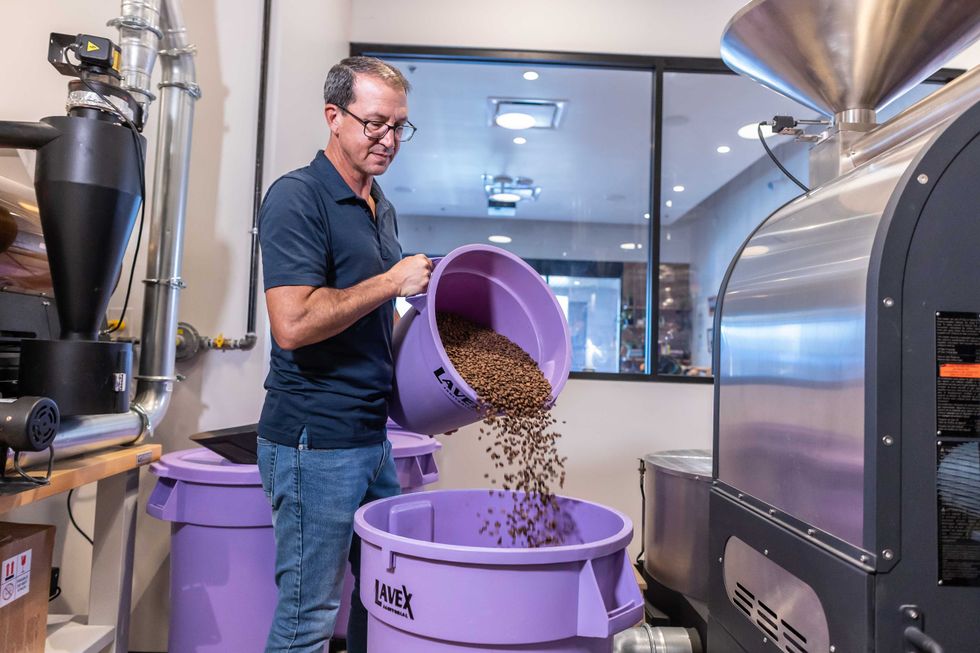 Gabe Hagen at Brick Road Coffee's second location and roaster, Prism Coffee Lab (Photo provided by Brick Road Coffee)