U.S. Senate Majority Leader Mitch McConnell on Monday blocked a second attempt by Democrats to pass a measure aimed at prodding the Justice Department to release to the public Special Counsel Robert Mueller’s report on Russian meddling in the 2016 U.S. presidential election.
Earlier this month, the House of Representatives voted 420-0 in favor of making the report public. On Sunday, Attorney General William Barr informed Congress that Mueller had concluded that President Donald Trump did not collude with Russia to influence the outcome of the 2016 election.
Reporting by Richard Cowan; Editing by Peter Cooney
Archeologists believe they have found a rare Viking ship burial site in a region of Norway known for its Viking-era treasures, Norwegian officials said Monday.
Using ground-penetrating radar (GPR), experts found a ship-shaped anomaly near other Viking burial mounds in the Borre Park in Vestfold county, southeast of Oslo.
"The GPR data clearly show the shape of a ship, and we can see weak traces of a circular depression around the vessel. This could point to the existence of a mound that was later removed," Terje Gansum, leader of the department for cultural heritage management in Vestfold county, said in a statement.
He said researchers would carry out further investigations to try and assess the size of the preserved find.
There are only seven ship burials dating from the Viking Age (800-1050) in Europe, including three located in Vestfold county.
NTB scanpix/AFP / Vestfold Fylkeskommune This handout picture released March 25, 2019 by Vestfold Fylkeskommune shows Norwegian Minister of Climate and Environment Ola Elvestuen posing at the place where a ship's grave probably originated from the Viking Age has been discovered
Another Viking ship burial was believed to have been found in Jellestad in southeastern Norway last year.
During the Viking era, when Norse seafarers raided and traded from their Northern European homelands across wide areas of Europe, high-ranking officials were sometimes buried in a ship on land, along with decorative goods and even oxen or horse remains, then covered with a mound of dirt.
"The discovery of a new Viking ship in Vestfold is a historic event that will attract international attention," Norwegian Climate and Environment Minister Ola Elvestuen said.
The Speaker has made clear she wants the full Mueller report released, and does not want the DOJ to give Congress a separate classified briefing. On Sunday she also demanded "the full report & documentation be made public without any further delay."
Monday afternoon Speaker Pelosi doubled down on her demands, while taking the opportunity to remind the "broken clock" President it was just a few days ago he too wanted the Mueller report released:
"Even a broken clock is right twice a day," Speaker Pelosi quipped:
A trove of Aztec sacrifices including a richly adorned jaguar dressed as a warrior and recently discovered in downtown Mexico City could lead archaeologists to the most tantalizing find yet: an Aztec emperor’s tomb.
Discovered off the steps of the Aztec’s holiest temple during the reign of the empire’s most powerful ruler, the sacrificial offerings also include a young boy, dressed to resemble the Aztec war god and solar deity, and a set of flint knives elaborately decorated with mother of pearl and precious stones.
The offerings were deposited by Aztec priests over five centuries ago in a circular, ritual platform once located in front of the temple where the earliest historical accounts describe the final resting place of Aztec kings.
None of these details have been reported before and such a discovery would mark a first since no Aztec royal burial has yet been found despite decades of digging.
“We have enormous expectations right now,” lead archeologist Leonardo Lopez Lujan told Reuters. “As we go deeper we think we’ll continue finding very rich objects.”
The jaguar offering, found in a large rectangular stone box in what would have been the center of the circular platform, has stirred particular excitement.
Only about one-tenth of the box’s contents has been excavated, but already a wide array of artifacts has been found near the top, including a spear thrower and a carved wooden disk placed on the feline’s back that was the emblem of the Aztec patron deity Huitzilopochtli, the war and sun god.
A layer of aquatic offerings placed on top of the west-facing jaguar have also been identified, including a large amount of shells, bright red starfish and coral that likely represented the watery underworld the Aztecs believed the sun traveled through at night before emerging in the east to begin a new day.
A roseate spoonbill, a pink bird from the flamingo family, has also been found in the offering. It was associated with warriors and rulers, and thought to represent their spirits in their descent into the underworld.
“There’s an enormous amount of coral that’s blocking what we can see below,” said archeologist Miguel Baez, part of the team excavating the offerings at the base of the temple, known today as the Templo Mayor, located just off Mexico City’s bustling Zocalo plaza.
The Templo Mayor would have been as high as a 15-story pyramid before it was razed along with the rest of the Aztec capital Tenochtitlan after the 1521 Spanish conquest of Mexico.
Expanded by each Aztec king, the shrine was believed to be at the center of the universe and was crowned with two smaller temples, one on the north side dedicated to the rain god Tlaloc and one on the south to Huitzilopochtil.
The latest offerings all align with the southern temple.
WARRIOR SOCIETY
Several decades after the conquest, chroniclers detailed the burial rites of three Aztec kings, all brothers who ruled from 1469 to 1502.
According to these accounts, the rulers’ cremated remains were deposited with luxurious offerings and the hearts of sacrificed slaves in or near the circular platform.
In 2006, a massive monolith of the Aztec earth goddess was discovered nearby with an inscription corresponding to the year 1502, which is when the empire’s greatest ruler and the last of the brothers, Ahuitzotl, died.
Elizabeth Boone, an ancient Mexico specialist at Tulane University, notes that Ahuitzotl’s death would have been marked with lavish memorizing and that the jaguar may represent the king as a fearless warrior.
“You could have Ahuitzotl in that box,” she said.
A smaller stone box next to the jaguar offering containing a top layer of copal bars, used by Aztec priests for incense, has also been identified, though it too has only been partially excavated as both were only opened earlier this year.
Next to it another stone box has been found containing 21 flint knives decorated to resemble warriors, including the same war god disk but made of mother of pearl, as well as a miniature wooden spear thrower and shield.
Finally, an adjacent circular offering holds an approximately 9-year-old sacrificed boy found with a wooden war god disk, a jade bead necklace and wings made from hawk bones and attached to his shoulders.
Like the jaguar, the boy likely had his heart torn out as part of a ritual sacrifice, though further tests will need to be conducted to confirm the theory.
The offerings also speak to the geographic reach of the Aztecs, a warrior society like ancient Sparta that conquered neighboring kingdoms to acquire tribute.
The starfish came from the Pacific Ocean, for example, while the jade was brought from Central America near present-day Honduras.
“The offerings provide a window not only into the (Aztecs) sacred world, but also their economic lives,” said Frances Berdan, an Aztec scholar at California State University, San Bernardino.
Meticulous sifting through the latest offerings is expected to continue for at least several more months, though practical hardships weigh on the archaeologists.
Mexico’s new government has cut the project’s budget by 20 percent this year, according to several archeologists who work on the excavation, and nearly all members of the 25-person team have not been paid since December.
Reporting by David Alire Garcia; Editing by Sandra Maler
U.S. President Donald Trump on Monday recognized the Golan Heights as Israeli territory in an election boost for Israeli Prime Minister Benjamin Netanyahu, as his chief political rival sought to appear as a better alternative to lead Israel.
During a White House visit by Netanyahu, Trump signed a proclamation officially granting U.S. recognition of the Golan Heights as Israeli territory, in a dramatic shift from decades of U.S. policy. Israel seized the strategic land from Syria in the 1967 Middle East war.
The recognition, which Trump had announced in a tweet last Thursday, appeared to be the most overt gesture by the Republican president to help Netanyahu, who had been pressing Trump for the move.
The Israeli prime minister, who faces an election on April 9, earlier on Monday cut short his U.S. visit after a rocket fired from Gaza injured seven people near Tel Aviv. He arrived in Washington on Sunday, originally for a four-day trip.
Signing the document as Netanyahu looked over his shoulder, Trump said: “This was a long time in the making.”
He handed the pen that he used for his signature to Netanyahu, and said: “Give this to the people of Israel.”
Netanyahu welcomed Trump’s move and said Israel has never had a better friend. He harked back to two previous Middle Eastern wars as the reason why Israel needs to hang on to the Golan.
“Just as Israel stood tall in 1967, just as it stood tall in 1973, Israel stands tall today. We hold the high ground and we should never give it up,” he said.
The rocket attack near Tel Aviv in central Israel, blamed on Hamas, came as the American Israel Public Affairs Committee (AIPAC), a pro-Israel group, held its annual meeting in Washington with speaker after speaker expressing U.S. support for strong ties with the country.
“We stand with Israel because her cause is our cause, her values are our values, and her fight is our fight,” Vice President Mike Pence said.
Pence also talked tough against Iran, saying that under Trump, “America will never allow Iran to obtain a nuclear weapon.”
Netanyahu’s strongest election challenger, Benny Gantz, appeared before the gathering on Monday, and vowed to protect his country against threats from Iran and Syria. He called for unity in Israel.
“We must remember if that we want hope, we must have unity,” he said.
With election day approaching, opinion polls put Netanyahu’s right-wing Likud and Gantz’s centrist Blue and White party neck and neck.
Trump’s event came as he celebrated the end of U.S. Special Counsel Robert Mueller’s investigation into whether Trump’s 2016 presidential campaign colluded with Russia. Attorney General William Barr on Sunday said Mueller found no evidence that the campaign conspired or coordinated with Russia.
Reporting by Steve Holland and Jeff Mason; editing by Jonathan Oatis
U.S. Secretary of State Mike Pompeo called on Russia to “cease its unconstructive behavior” by supporting Venezuelan President Nicolas Maduro during a phone call with his Russian counterpart, the State Department said on Monday.
Spokesman Robert Palladino said Pompeo had spoken to Russian Foreign Minister Sergei Lavrov about Venezuela on Monday.
“The secretary told Russian Foreign Minister Lavrov that the United States and regional countries will not stand idly by as Russia exacerbates tensions in Venezuela,” Palladino said in a statement.
The call appears to have been prompted by reports of the arrival on Sunday in the Venezuelan capital, Caracas, of two Russian air force planes carrying a Russian defense official and nearly 100 troops, amid strengthening ties between Caracas and Moscow.
The State Department statement did not refer to the arrival of the Russian passenger jet and a military cargo plane, although it condemned Russian military support for the “illegitimate regime of Nicolas Maduro.”
Russia has warned the United States and neighbors against a military intervention in Venezuela.
During the call with Lavrov, Pompeo urged Moscow to join the United States and regional countries in backing opposition leader Juan Guaido.
The Trump administration has imposed crippling sanctions on the OPEC nation’s oil industry. On Friday it sanctioned its development bank, Bandes, in efforts to choke off financial flows to Maduro’s government and called on Venezuelan military leaders to abandon him.
Maduro has denounced the sanctions as U.S. intervention and has won diplomatic backing from Russia, China and Cuba.
Reporting by Lesley Wroughton; Editing by Chizu Nomiyama and Susan Thomas
A law is supposed to protect property owners from lowball offers by the government when it takes land through eminent domain. But a letter shows how simple it is for officials to eviscerate what is already a pretty toothless law.
On March 15, President Donald Trump vetoed Congress’ attempt to stop him from declaring a national emergency to build a wall along the United States’ border with Mexico.
His construction plans still face court challenges. But if the effort survives, you can expect this to happen in the near future: The federal government will begin seizing private land to build the wall, a process known as eminent domain.
It’s a fundamental power, laid out in the Fifth Amendment. The government can take your land to build public works, but it has to pay you “just compensation” — the amount that a willing buyer would pay a willing seller to purchase the property.
But the federal power to seize land contains none of the landholder protections commonly found in state and local jurisdictions. The federal government rarely loses its bid to take land. Under a special procedure, federal officials can file a Declaration of Taking that results in a court granting immediate title to the land. Bulldozers can roll the next day. The only fight, essentially, is over how much money the property owner will receive.
Fifteen months ago, ProPublica examined the Department of Homeland Security’s use of eminent domain to construct the first border barrier, then called a fence. The Secure Fence Act, passed in 2006 with bipartisan support, resulted in 654 miles of fencing along the 2,000-mile border.
What we found was troubling. Wealthier property owners who could afford lawyers saw their compensation offers triple on average, while poorer landholders took what the government offered or bargained on their own for slightly more.
We were puzzled, however, to find that Homeland Security appeared to have ignored the one federal law designed to protect the rights of property owners from lowball offers by the government.
The obscure Uniform Act requires the government to conduct formal appraisals to establish the worth of any property valued at more than $10,000. Those appraisals are supposed to be done in concordance with the exacting guidelines spelled out in a 262-page federal manual. And the government is supposed to negotiate fairly and without coercion.
We knew Homeland Security had the ability to waive those protections, but we never found concrete proof that the agency had done so.
Until now.
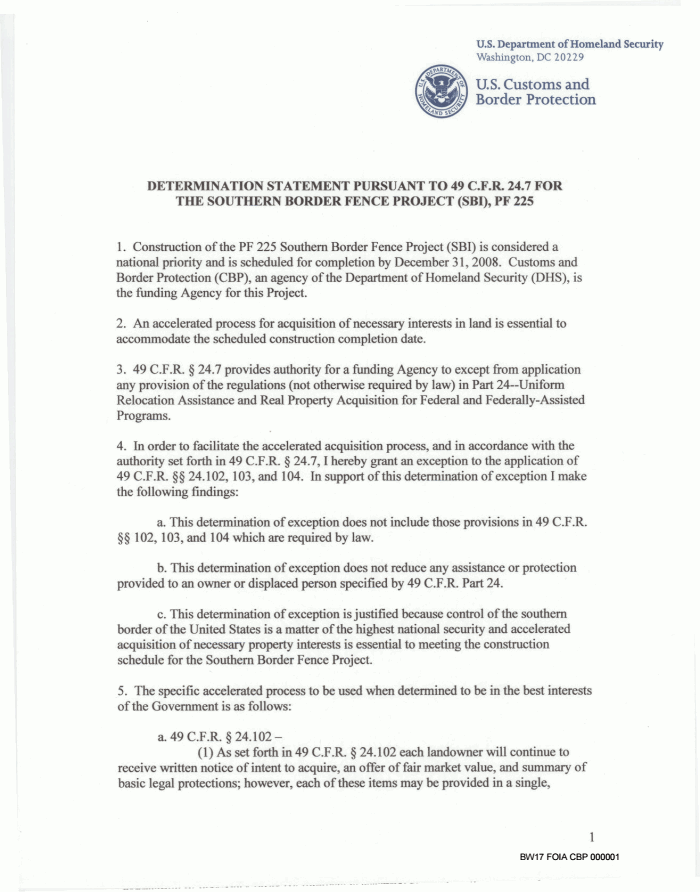
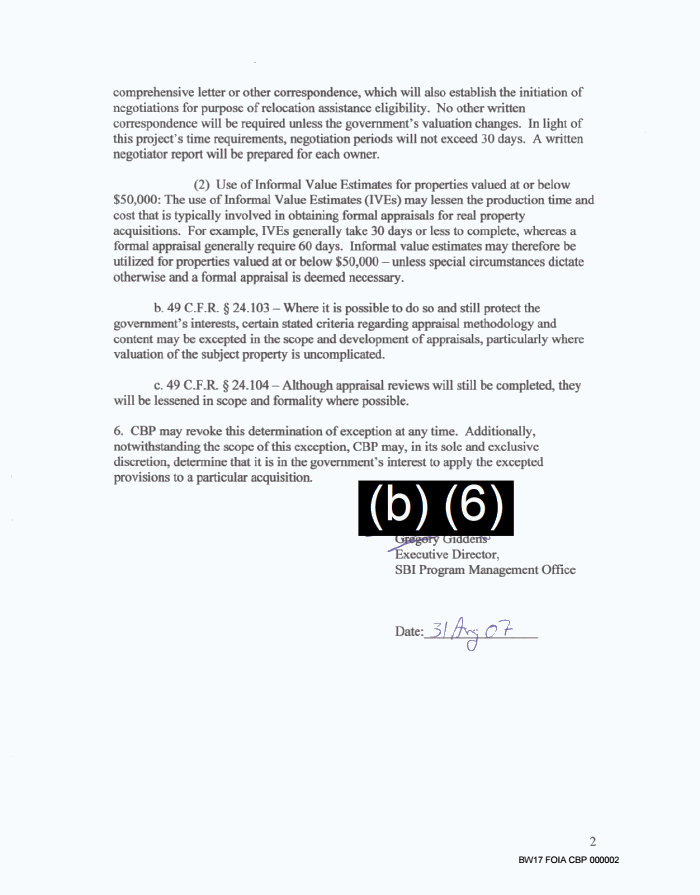
Almost two years after filing a Freedom of Information Act request, Homeland Security released a copy of the formal document that allows the government to ignore many safeguards built into the act.
The document underscores just how easy it is for the federal government to eviscerate what is already a pretty toothless law. As it turned out, all it took was a two-page letter signed by a midlevel bureaucrat in U.S. Customs and Border Protection, an agency of Homeland Security.
Here’s a look at the letter and at the protections that it stripped away. Nothing would stop the Trump administration from doing the exact same thing today. Congress has taken no action to reform the Uniform Act or the Declaration of Taking, despite the laws’ controversial past.
Congress passed a law setting Dec. 31, 2008, as the deadline to complete construction of the $2.4 billion fence. CBP used that artificial date as the reason to rush land negotiations.
Congress passed a law setting Dec. 31, 2008, as the deadline to complete construction of the $2.4 billion fence. CBP used that artificial date as the reason to rush land negotiations.
In order to ignore provisions of the Uniform Act, an agency official has to declare that a waiver “does not reduce any assistance or protection provided to an owner or displaced person.” You might think that gutting the law would do just that. But as a property owner, or as an American citizen, you have no right to contest the determination.
Some see Trump’s declaration of a national emergency as extreme. Back in 2006, CBP called construction of the fence “a matter of the highest national security,” which justified running roughshod over the Uniform Act.
Here’s the meat of the waiver. No need for a lot of documentation regarding your land’s value. And negotiations are capped at 30 days. After that, CBP cuts a check and takes possession of the property.
CBP arbitrarily raised the threshold for conducting a full appraisal to $50,000. That may seem like a small amount to homebuyers on the coasts. But most of the land seized was in Texas’ poverty-stricken Rio Grande Valley. By raising the cap to $50,000, the government did not have to conduct a formal appraisal for more than 90 percent of properties, often ranch or agricultural land.
To ensure fairness, the Uniform Act requires a second government official to review the proposed purchase price. The waiver allowed that second evaluation to skimp on rigor.
In this case, the agency official who signed the waiver was Greg Giddens, who had a distinguished 35-year public service career. Giddens managed construction of the fence. Afterward, he became the top contracting official at the Department of Veterans Affairs. Now retired, he works as a partner at Potomac Ridge Consulting, which helps companies win government contracts.
What it really does is set the stage for a battle royale with Trump and Barr doing everything in their power to keep secret the full report and, equally important, the materials underlying the report. They’re likely to fight Democrats in Congress, if not both parties, over the materials’ release. And while they’ll probably cite a range of reasons for their objections to revealing the report, they also share an expansive view of a president’s right to keep his discussions secret.
The public and Congress are unable to judge whether Barr’s conclusions are justified because Barr’s letter is mostly silent about the underlying Mueller report conclusions and evidence. This would be remedied in time if Barr were required to provide the full report and its supporting witness and documentary evidence.
But Trump and Barr each have tools to minimize the access of House investigations to the report and evidence. Despite the end of Mueller’s probe, those investigations continue: Democrat Jerrold Nadler, chairman of the House Judiciary Committee, made it clear on Sunday that he plans to “move forward” with his committee’s investigations, “into obstruction of justice, abuses of power, corruption, to defend the rule of law, which is our job.”
To be sure, these grounds for withholding, properly and narrowly applied, have support in precedent.
But I believe that Trump and Barr can be counted on to use every means available to overstate and exaggerate the degree to which these doctrines justify withholding this information from justifiable, duly-authorized House investigations.
In its precise form, this covers “proceedings” of the grand jury. These “proceedings” are occasions when the jurors themselves meet and hear evidence in an investigation. Typically, in investigations of a president or those around him, “proceedings” encompass only a small fraction of the overall body of witnesses and documents.
Voluntary witnesses can be interviewed by the FBI and prosecutors, without the unnecessary trappings of the grand jury. Such witnesses need only attend “proceedings” to the very limited extent that the jurors themselves need to hear them in person to vote an indictment.
Similarly, the documents accumulated in an investigation are only to a very limited extent brought to the grand jurors themselves, as needed for indictment. Over 90 percent of the time, interview memos by the FBI and prosecutors, not grand jury transcripts and specific grand jury exhibits, record the witness and documentary information.
Like King Midas’ touch that turned everything into gold, the “Midas touch” doctrine turns everything indirectly and remotely having some attenuated whiff of a grand jury into walled-up “proceedings” of the grand jury.
Mueller surely has full FBI and prosecutors’ materials and interviews regarding what Flynn said about Trump’s opposition to sanctions for Russia. Yet Barr’s letter says nothing of this, even though the actual Mueller report may include a full accounting of it.
Here’s what could then happen if Flynn even once spoke to a grand jury: Using the “Midas touch” doctrine, Barr – if he provides a version of the Mueller report to the public – could keep all of the evidence secret that Flynn provided to law enforcement.
And the public would not even know if this material was expunged.
Executive privilege cannot be used to shield evidence of crime. Since Barr wrote in his letter that Mueller would not exonerate Trump for obstruction of justice, which is a crime, I believe executive privilege should not be used to shield Trump’s communications that relate to obstruction.
So even if Trump has left an evidentiary trail a mile wide showing his intent to snuff out the Mueller inquiry, I expect Trump will claim that is all behind a wall of executive privilege.
And, in the broadest interpretation, executive privilege could supposedly stretch far beyond the president’s own communications, down to lowly assistants and factotums who know about “pre-decisional deliberations” at any level, high or low.
In this interpretation, if there are intelligence agency deputies who contributed to the conclusion, contrary to the president, of the Russian threat, those deputies and their reports are all “pre-decisional deliberations” shielded by executive privilege.
Will the House of Representatives fight against Trump and Barr’s claims of privilege?
The Vatican generally waits roughly 70 years after the end of a papacy before making archival materials available. In this case, the Vatican has decided to allow access earlier, possibly due to the controversy surrounding Pius XII’s wartime papacy.
Many have criticized Pius XII for failing to condemn the Holocaust. Instead, he spoke out against the general loss of life in wartime.
Others believe he worked behind the scenes to combat the Nazis and save Jewish lives. The Vatican archives might soon shed some light on these questions.
In the meantime, what do we know about his papacy and the environment in which he was working?
Fear of communism
As a scholar who has been teaching Holocaust history primarily to students who grew up in the Christian faith, the question of the attitudes of Christians, and especially of the Church, comes up frequently in my classes.
There is strong evidence that Pius XII knew of the Nazis’ “Final Solution” – their intention to annihilate the Jews. Information came to him from various sources. For example, the Polish ambassador to the Vatican brought the pope updates and entreaties for action.
Additionally, the World Jewish Congress begged the pope openly to proclaim his revulsion for Nazism. Even the U.S. informed the Vatican in September 1942 that residents of the Warsaw Ghetto were being slaughtered.
This was prior to the Nazi deportation of some 265,000 Jews from the ghetto to Treblinka death camp and months before the final Nazi liquidation of the ghetto, in which the Jews themselves fought for their own lives in the Warsaw Ghetto Uprising beginning in April 1943.
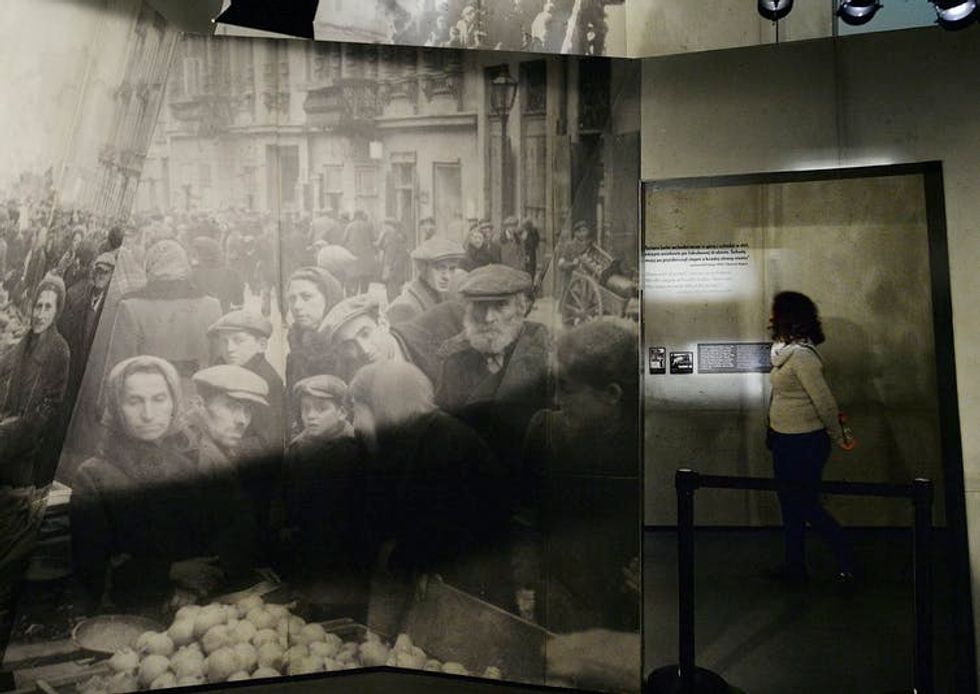
Exhibits from the Warsaw Ghetto at POLIN Museum of the History of Polish Jews in Warsaw, Poland.
The Church had a long history of antipathy to the Jews. The Jews, beginning from Jesus’ day, were understood by the Church to deserve condemnation for Christ’s suffering and death. Church theology and social policy through the centuries reflected that negative attitude.
While the Church spoke openly against a Nazi euthanasia program that during World War II murdered more than 300,000 mentally and physically disabled Christians, acting on behalf of Jews was a much lesser concern.
Additionally, in the Vatican’s view, however reprehensible Nazism was, it did not pose as great or immediate a threat as communism.
Even prior to this period, communism had been of considerable concern to the Catholic Church. Pope Pius IX’s 1846 encyclical, “Qui Pluribus,” a response to the nationalistic philosophies that sought to unify Italy in that day, deemed communism contrary to natural law. He described it as a doctrine that stood to destroy all existing laws, governments, property and human society itself.
During World War II, Russia, allied with the Western democracies, and not Germany, was the Church’s greatest enemy.
Role of Pope Pius XII
In this context, and fearing that the Nazis might win the war, the Vatican was reluctant to cause a crisis of conscience for Catholics fighting for Germany’s Nazi regime against communist Russia.
Indeed, in 1933, in his role as the Vatican ambassador to Germany, Eugenio Pacelli negotiated a treaty – called a concordat – between the Vatican and the Nazi regime. Five years later, Pacelli would become Pope Pius XII.
The concordat promised that, in exchange for the Nazis’ guarantee of the preservation of the Church’s and Catholics’ rights in Germany, the Vatican would remain neutral and not denounce Nazism.
The Vatican saw this as its best path towards safeguarding the Church’s interests and those of some 20 million German Catholics. It assured the Vatican that German churches would remain open and that priests, bishops, and even the pope himself would remain safe from Nazi harassment and possible arrest.
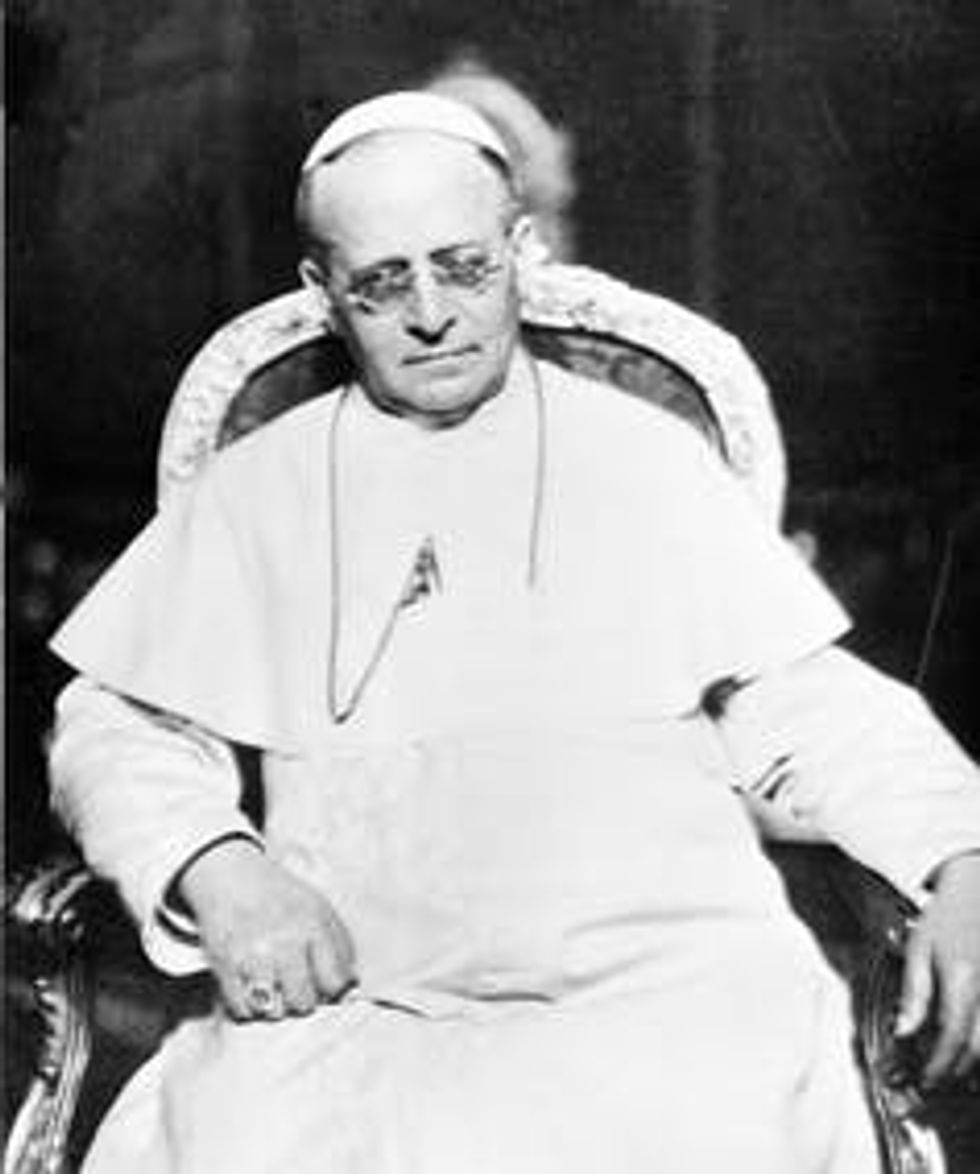
It bears noting that Pius XII’s predecessor, Pius XI, had spoken out against the Nazis more openly than his successor would do. He had commissioned an encyclical specifically directed against racism and anti-Semitism.
However, this encyclical was never signed. It is believed that his aides kept it from Pius XI while he was on his death bed in 1938.
Scholarship on the unsigned encyclical suggests that it was viewed by many in the Church hierarchy as too dangerous. The Vatican was afraid that, in response to what the Nazis would have seen as a serious provocation, they might have gone so far as to arrest every bishop in Germany.
Reluctance to confront Nazism
Pius XII was much less willing than his predecessor to confront Nazism.
When he did speak out, he made only brief and veiled references. In his 1942 Christmas radio broadcast, for example, which lasted three and a half hours, he mentioned only an unnamed group that might be understood to be the Jews.
The pope referred to “humanity’s obligation to the hundreds of thousands of persons who without any fault on their own part, sometimes only because of their nationality or race, have been consigned to death or to a slow decline.”
In the same broadcast, he said that “the Church would be untrue to herself, ceasing to be a mother, if she turned a deaf ear to her children’s anguished cries, which reach her from every class of the human family.”
Pius XII did not specifically identify the Jews as victims or the Nazis as the victimizers. Nonetheless, reporting on the pope’s message, the Times of London said that he clearly, “condemns the worship of force and its concrete manifestation in the suppression of national liberties and in the persecution of the Jewish race.”
A top Nazi official, Heinrich Himmler, stated that the pope had clearly repudiated their movement – even though he had not refer to it by name. He noted that the pope was “virtually accusing the German people of injustice toward the Jews, and making himself the mouthpiece of the Jewish war criminals.”
The questions that will remain
Those who support Pius XII argue that negative assessments of his wartime actions ignore statements such as these and devalue all the pope may have done in secret to help the Jews.
These supporters, including Pope Francis, look forward to the opening of the archives, which they hope will prove that the wartime pope did everything that they believe he could.
Proof of actions Pius XII took in support of Jews might also allow the Church to move forward towards his canonization, which has been stalled since 2009. Three of the four popes since Pius XII have already been declared saints.
Findings of heretofore unknown actions of Pius XII may redeem his tarnished papacy and, with it, the Church more generally. But, for many, it might not resolve deeper questions about what Pope Pius XII did, or did not do, publicly.
President Donald Trump’s lawyer Rudy Giuliani said Special Counsel Robert Mueller’s report into Russian interference in the 2016 election, whether the Trump campaign colluded, and whether Trump obstructed justice was more positive than he had anticipated, based on the summary of the report released on Sunday.
“It’s better than I expected,” said Giuliani, who, echoing Trump, relentlessly attacked Mueller and his work when he began to represent the president last year.
Mueller’s report, according to the summary by U.S. Attorney General William Barr, found no evidence President Donald Trump’s campaign conspired with Russia in the 2016 election. It also did not find that the president obstructed justice, though it did not exonerate him.
Barr said he and Deputy Attorney General Rod Rosenstein then concluded there was insufficient evidence of obstruction.
“This is a complete and total vindication of the President,” Giuliani and others on Trump’s outside legal team later said in a statement.
“They got it right,” said Washington lawyer John Dowd, who served as Trump’s personal lawyer on the probe until March 2018. “I’m just very, very happy for the president.”
“It’s been an awful two years, in my opinion wholly unjustified,” Dowd told Reuters.
Mueller spent nearly two years investigating allegations that Russia meddled in the 2016 election.
The report also outlines the Russian effort to influence the election and documents crimes by people associated with Russia in connection with that, Barr said.
Reporting by Karen Freifeld; Editing by Leslie Adler and Chris Reese
A maths and physics teacher from a secondary school in a remote village in Kenya's Rift Valley has won the $1 million Global Teacher Prize for 2019, organisers have said.
Peter Tabichi, who organisers say gives away 80 percent of his monthly income to the poor, received the prize at a ceremony Saturday in Dubai hosted by Hollywood star Hugh Jackman.
"Every day in Africa we turn a new page and a new chapter... This prize does not recognise me but recognises this great continent's young people. I am only here because of what my students have achieved," Tabichi said.
"This prize gives them a chance. It tells the world that they can do anything," he added after beating nine finalists from around the world to claim the award.
The Dubai-based Varkey Foundation, which organises the event and handed out the prize for the fifth time, praised Tabichi's "dedication, hard work and passionate belief in his students' talent".
All this combined, it said in a statement, "has led his poorly-resource school in remote rural Kenya to emerge victorious after taking on the country's best schools in national science competitions".
Tabichi, 36, teaches at the Keriko Mixed Day Secondary School in Pwani village, in a remote, semi-arid part of Kenya's Rift Valley, where drought and famine are frequent.
Around 95 percent of the school's pupils "hail from poor families, almost a third are orphans or have only one parent, and many go without food at home," the statement added.
"Drug abuse, teenage pregnancies, dropping out early from school, young marriages and suicide are common."
To get to school, some students have to walk seven kilometres (four miles) along roads that become impassable during the rainy season.
The school, with a student-teacher ration of 58 to 1, has only one desktop computer for the pupils and poor internet, but despite that Tabichi "uses ICT in 80 percent of his lessons to engage students", the foundation said.
Kenyan President Uhuru Kenyatta congratulated Tabichi in a video message, saying "your story is the story of Africa, a young continent bursting with talent".
Two Russian air force planes landed at Venezuela’s main airport on Saturday carrying a Russian defense official and nearly 100 troops, according to media reports, amid strengthening ties between Caracas and Moscow.
A flight-tracking website showed that two planes left from a Russian military airport bound for Caracas on Friday, and another flight-tracking site showed that one plane left Caracas on Sunday.
That comes three months after the two nations held military exercises on Venezuelan soil that President Nicolas Maduro called a sign of strengthening relations, but which Washington criticized as Russian encroachment in the region.
Reporter Javier Mayorca wrote on Twitter on Saturday that the first plane carried Vasily Tonkoshkurov, chief of staff of the ground forces, adding the second was a cargo plane carrying 35 tonnes of material.
An Ilyushin IL-62 passenger jet and an Antonov AN-124 military cargo plane left for Caracas on Friday from Russian military airport Chkalovsky, stopping along the way in Syria, according to flight-tracking website Flightradar24.
The cargo plane left Caracas on Sunday afternoon, according to Adsbexchange, another flight-tracking site.
The flights carried officials who arrived to “exchange consultations,” wrote Russian government-owned news agency Sputnik, which quoted an unnamed source at the Russian embassy.
“Russia has various contracts that are in the process of being fulfilled, contracts of a technical military character,” Sputnik quoted the source as saying.
A Reuters witness saw what appeared to be the passenger jet at the Maiquetia airport on Sunday.
Venezuela’s Information Ministry did not immediately reply to a request for comment.
Russia’s Defense Ministry and Foreign Ministry did not reply to messages seeking comment. The Kremlin spokesman also did not reply to a request for comment.
The Trump administration has levied crippling sanctions on the OPEC nation’s oil industry in efforts to push Maduro from power and has called on Venezuelan military leaders to abandon him. Maduro has denounced the sanctions as U.S. interventionism and has won diplomatic backing from Russia and China.
In December, two Russian strategic bomber aircraft capable of carrying nuclear weapons landed in Venezuela in a show of support for Maduro’s socialist government that infuriated Washington.
Maduro on Wednesday said Russia would send medicine “next week” to Venezuela, without describing how it would arrive, adding that Moscow in February had sent some 300 tonnes of humanitarian aid.
Venezuela in February had blocked a convoy carrying humanitarian aid for the crisis-stricken country that was coordinated with the team of opposition leader Juan Guaido, including supplies provided by the United States, from entering via the border with Colombia.
Reporting by Carlos Garcia, Carlos Jasso, Diego Ore and Brian Ellsworth in Caracas, and Maria Tsvetkova and Gabrielle Tetrault-Farber in Moscow; Editing by Leslie Adler and Chris Reese




 NTB scanpix/AFP / Vestfold Fylkeskommune