The White House barred reporters from Reuters, the Associated Press and Bloomberg from covering a dinner between President Donald Trump and North Korean leader Kim Jong Un on Wednesday after two of them asked Trump questions during his initial interactions with Kim.
The three wire services are part of the White House press pool that covers U.S. presidents wherever they go.
Reporters in the pool regularly shout out questions to leaders and on Wednesday they asked Trump about the summit and the testimony in Congress of his former attorney and fixer Michael Cohen, in two separate opportunities known as “pool sprays.”
The reporters were later excluded from covering the dinner because of what White House spokeswoman Sarah Sanders said were “sensitivities over shouted questions in the previous sprays,” the Washington Post reported.
The pool was present when Trump and Kim first met and shook hands. During that short initial meeting, while cameras were rolling, Reuters correspondent Jeff Mason asked Trump what he wanted to achieve at the summit and whether he had backed away from his demand for North Korea’s denuclearization.
Trump replied “No” to the second question and gave a longer answer to the first.
AP reporter Jonathan Lemire then asked Trump if he expected to end the Korean War. Trump said: “We’ll see.”
Reporters were then escorted out of the room. Shortly thereafter they were brought back in to listen while Trump and Kim, seated this time, visited.
At the conclusion of that “pool spray,” the AP’s Lemire asked Trump if he had a reaction to Cohen’s testimony due to take place later on Wednesday. With excerpts from Cohen’s prepared remarks having already been made public, Trump scowled and shook his head.
Cohen accused Trump of being a racist, a conman and a cheat.
After the second interaction, pool reporters returned to their work space, followed by Sanders, who expressed concern about the questions asked and announced that the third “pool spray” would be limited to photographers. Pool reporters argued against the move and persuaded Sanders to include a print reporter and a radio reporter along with the television journalists.
Wire reporters - the two who had asked questions, plus one more and an additional print reporter - remained excluded.
“Due to the sensitive nature of the meetings we have limited the pool for the dinner to a smaller group, but ensured that representation of photographers, tv, radio and print Poolers are all in the room,” Sanders said in a written statement.
“We are continuing to negotiate aspects of this historic summit and will always work to make sure the U.S. media has as much access as possible.”
Reuters said it was “deeply troubled” by the exclusion of Mason and other reporters from covering the dinner.
“We believe it is essential that government provide access to – and the ability to ask questions of – officials and hold them to account,” Reuters said in a statement.
The Associated Press said it opposed White House efforts to restrict access to the president.
“It is critically important that any president uphold American press freedom standards, not only at home but especially while abroad,” said AP spokeswoman Lauren Easton.
The amount of debt held by America’s farmers has risen rapidly to 1980s-levels at $409 billion from $385 billion last year, with loan demand remaining “historically high,” U.S. Agriculture Secretary Sonny Perdue said on Wednesday.
The figures reflect a level of strain on the U.S. farm belt that is comparable to the agricultural crisis of three decades ago, this time driven by lingering weakness in commodity prices, storms damaging crops and loss of key export markets such as China due to President Donald Trump’s trade disputes.
“Farm debt has been rising more rapidly over the last five years, increasing by 30 percent since 2013 – up from $315 billion to $409 billion, according to USDA data, and up from $385 billion in just the last year – to levels seen in the 1980s,” Perdue said in his testimony to the House Agriculture Committee.
But he added: “Relatively firm land values have kept farmer debt-to-asset levels low by historical standards at 13.5 percent, and continued low interest rates have kept the cost of borrowing relatively affordable.”
“But those average values mask areas of greater vulnerability,” he said.
In the 1980s, thousands of farm operations financially collapsed after producers dealing with low crop prices fell behind on high-interest land and equipment loans.
USDA chief economist Robert Johansson said late last week that the U.S. Department of Agriculture is concerned about a potential future decline in farmland real estate prices, a key pillar of equity for the U.S. agricultural heartland, but has seen no sign of that happening so far.
Farm incomes and agrarian credit conditions continued to erode in the second half of 2018 and for bankers one key concern has been the amount of farmland that could come up for sale in the coming months and whether that could trigger an across-the-board drop in land prices.
“I get more phone calls from bankers these days than farmers,” Austin Scott, Congressman from Georgia, said at the hearing.
The Trump administration has pledged up to $12 billion in aid for farmers to offset their losses from the trade fights. Perdue said more than $8 billion has been paid as part of those programs to date. USDA has said there will not be an aid package for 2019.
Reporting by Humeyra Pamuk; writing by Richard Valdmanis; editing by Jonathan Oatis and Phil Berlowitz
Pakistan and India said Wednesday they had shot down each other's warplanes, in a dramatically escalating confrontation that has fuelled concerns of an all-out conflict between the nuclear-armed rivals.
Calling for talks with India to defuse the situation, Pakistan Prime Minister Imran Khan warned of the potentially catastrophic consequences should "better sense" not prevail.
"Can we afford any miscalculation with the kind of weapons that we have and you have?" he said in a televised statement.
While both sides have sought to play down the threat of war, the rare aerial engagement over the divided and disputed territory of Kashmir significantly raises the stakes in a standoff sparked by a suicide attack on the Indian-controlled side earlier this month.
Pakistan initially said it downed two Indian jets in its airspace and captured two pilots, but later its military spokesman tweeted that there was "only one pilot" in Pakistani custody.
India's foreign ministry demanded the "immediate and safe return" of the pilot, calling on Pakistan to ensure no harm comes to him.
The pilot "gives Islamabad a key bargaining chip that may affect just how muscular Delhi's next move could be," tweeted US analyst Michael Kugelman.
New Delhi also confirmed the loss of one of its planes and said it had shot down a Pakistani fighter jet.
In a sign of the deepening crisis, Pakistan closed its airspace "until further notice". At least six airports were shuttered in India, and a vast area north of New Delhi was closed to civilian flights.
"We do not want to go towards war," Pakistan's military spokesman Major General Asif Ghafoor told a press conference.
Ghafoor said the jets had been shot down after Pakistani planes earlier flew across the Line of Control, the de facto border in Kashmir, to the Indian side in a show of strength, hitting non-military targets including supply depots.
Afterwards, he said, the two Indian planes crossed the LoC into Pakistani airspace. One fell into Pakistani-held Kashmir, while the second crashed on the other side, he said.
He denied initial reports that a Pakistan plane had been shot down, saying accounts an F-16 had been lost were incorrect.
- 'Unfortunate loss' -
Later, Indian foreign ministry spokesman Rajeesh Kumar said a Pakistani jet was hit as it took part in an operation "to target military installations on the Indian side".
He said the Indian plane flown by the captured pilot -- a Mig-21 -- was lost in that operation.
Pakistan state media published a video purportedly showing the captured pilot being interrogated.
It shows a blindfolded man in an Indian Air Force uniform, his face bloodied, with his hands tied behind him, giving his name, rank and serial number as a soldier interrogates him.
The military later released a second video showing the man without a blindfold and drinking a cup of tea.
The incidents are the latest in a dangerous sequence of events between the two countries, whose ties have been under intense strain since the February 14 suicide bombing in Indian Kashmir that killed 40 troops.
New Delhi had promised to act, and on Tuesday its warplanes flew into Pakistani airspace and struck what it said was a camp of Jaish-e-Mohammed (JeM), the militant group that claimed the Kashmir bombing.
It was India's first air strike on Pakistani soil since the neighbours fought a war in 1971 -- when neither had nuclear weapons.
Islamabad, while denying the Indian strike caused any major damage or casualties, quickly vowed to retaliate, fuelling fears of a disastrous confrontation in South Asia.
- Appeal against 'escalation' -
Earlier Wednesday, India's foreign minister sought to ease the situation by downplaying Tuesday's strike, repeating Indian claims that it had been a pre-emptive attack on JeM.
"India does not wish to see further escalation of this situation," Sushma Swaraj said during a visit to China.
The US, along with China, Britain, Germany and the European Union, have called for cooler heads to prevail.
"We encourage India and Pakistan to ... avoid escalation at any cost," US Secretary of State Mike Pompeo said.
China Wednesday again urged the two sides to "exercise restraint". Britain said it was "deeply concerned" and working with partners including the UN Security Council to defuse tensions.
- Crisis for Khan -
The confrontation represents the first major foreign policy crisis for Pakistan's leader, who is believed to be close to the powerful military and who came to power last year vowing to seek dialogue with New Delhi.
Pakistan has denied involvement in the Kashmir bombing on February 14.
While India has consistently accused its neighbour of supporting extremist groups, Pakistan has equally vehemently denied any role in attacks in India and its only Muslim-majority state, Kashmir.
The Himalayan region has been divided between India and Pakistan since independence in 1947. They have fought two of their three wars over the territory.
Previously, the US and other members of the international community have acted to defuse tensions.
"If I were Washington, I'd be in overdrive making phone calls and signalling that it wants tensions to be de-escalated now," said Moeed Yusuf, an expert at the US Institute of Peace in Washington.
"The risks of letting this play out are too great."
White House adviser Jared Kushner made a whirlwind visit this week to rally U.S.-allied Gulf Arab allies to support his still- unannounced Middle East peace plan, the leaked contours of which suggest little has been done to address Arab demands.
Kushner’s approach to ending the Israeli-Palestinian conflict does not appear to have progressed since his last regional tour in June, focusing largely on economic initiatives at the expense of a land-for-peace deal long central to the official Arab position, two sources in the Gulf told Reuters on Wednesday.
Palestinians have refused to discuss any peace blueprint with the United States in the wake of President Donald Trump’s recognition of Jerusalem as Israel’s capital in 2017, while some Arab leaders have publicly rejected any deal that fails to address Jerusalem’s status or refugees’ right of return.
Kushner, who is President Donald Trump’s son-in-law, met with leaders in the United Arab Emirates, Bahrain and Oman this week. He arrived in Turkey on Wednesday.
Three sources said Kushner had gone to Saudi Arabia on Tuesday although there was no official statement on the visit or his meetings with King Salman and Crown Prince Mohammed bin Salman. The Saudi media office did not respond to a request for comment.
One of the sources, who spoke on condition of anonymity, said the plan presented this week did not appear to take into consideration previously stated Arab demands on the status of Jerusalem, the right of Palestinian refugees to return and Israeli settlements in occupied territory.
Under the Arab Peace Initiative drawn up by Saudi Arabia in 2002, Arab nations offered Israel normal ties in return for a statehood deal with the Palestinians and full Israeli withdrawal from territory captured in 1967.
The source said Kushner, a real estate developer with little experience of international diplomacy or political negotiation, wanted to make a deal first and then agree on details.
The source added that the plan envisages a “substantial” financial contribution from Gulf states, but did not provide details.
ARAB CONCERNS
King Salman has dismissed Arab concerns that Saudi Arabia might back a U.S. deal that aligns with Israel on key issues, after the crown prince, who is close to Kushner, reportedly pressed Palestinian President Mahmoud Abbas to support the administration’s efforts.
Kushner’s meeting with Prince Mohammed on Tuesday was the first since the murder of prominent journalist Jamal Khashoggi by Saudi agents in the Saudi consulate in Istanbul last October sparked an outcry and tarnished the prince’s image.
Jordan, a U.S. ally where a majority of the population are descendants of Palestinians who fled during or after the creation of Israel in 1948, insists that no peace can be achieved without dealing with Jerusalem, where it serves as custodian of Muslim holy sites.
“The Americans are still in the process of presenting various ideas and scenarios but don’t appear to have arrived at final parameters of a plan,” said a second source in the Gulf region.
“They know that there are final-status issues that are non-starters for regional allies and the Palestinians alike,” the source added, referring to Saudi Arabia, Egypt and Jordan.
Kushner was given responsibility for Israel-Palestinian policy two years ago, but has still not provided concrete details of U.S. efforts, which Trump has dubbed “the deal of the century”.
Kushner said in an interview on Monday that Washington would present the peace plan only after Israel’s election on April 9, though previous targets have passed without any announcement.
He said it would build on past efforts — including the 1990s Oslo accords that provided a foundation for Palestinian statehood — and resolve borders and final-status issues. But he made no specific mention of a Palestinian state.
Israel has long rejected any return to what it has described as indefensible boundaries that existed before it captured the West Bank, East Jerusalem and the Gaza Strip in the 1967 Middle East war.
(Writing by Stephen Kalin; Editing by Kevin Liffey)
George Conway, a noted conservative attorney and spouse to White House Counselor to the President Kellyanne Conway took yet another of his famous swings at President Donald Trump Wednesday morning.
Barely an hour before former Trump personal attorney Michael Cohen is to testify in open session before Congress, and barly an hour after President Trump officially meet North Korean dictator Kim Jong-un, Conway responded to a tweet from The Washington Post.
The Post tweeted out an opinion piece titled, "Why does Trump fall in love with bad men?" The "bad man" is, of course, Kim Jong-un.
Conway's response was simple and to the point: "Sociopaths attract."
Former Trump "fixer" and personal attorney Michael Cohen released his prepared testimony late Tuesday night, ahead of his open-door testimony before Congress today. It is being called "earth-shattering," and a "bombshell," and it is.
Cohen's written remarks, published by The New York Times, span 20 pages. Here are eight of the most stunning "bombshell" revelations.
"He was a presidential candidate who knew that Roger Stone was talking with Julian Assange about a WikiLeaks drop of Democratic National Committee emails."
"Mr. Stone told Mr. Trump that he had just gotten off the phone with Julian Assange and that Mr. Assange told Mr. Stone that, within a couple of days, there would be a massive dump of emails that would damage Hillary Clinton’s campaign."
"Mr. Trump responded by stating to the effect of 'wouldn’t that be great.'"
•Cohen says Trump did not expect to win and his entire campaign was a money-making venture.
"Donald Trump is a man who ran for office to make his brand great, not to make our country great. He had no desire or intention to lead this nation – only to market himself and to build his wealth and power. Mr. Trump would often say, this campaign was going to be the 'greatest infomercial in political history.'"
"He never expected to win the primary. He never expected to win the general election. The campaign – for him – was always a marketing opportunity."
•Trump knew about the Trump Tower Moscow project and indirectly told Cohen to lie about it.
"In conversations we had during the campaign, at the same time I was actively negotiating in Russia for him, he would look me in the eye and tell me there’s no business in Russia and then go out and lie to the American people by saying the same thing. In his way, he was telling me to lie."
"There were at least a half-dozen times between the Iowa Caucus in January 2016 and the end of June when he would ask me “How’s it going in Russia?” – referring to the Moscow Tower project."
•Cohen says he doesn't have proof of collusion but has "suspicions" it happened.
"Questions have been raised about whether I know of direct evidence that Mr. Trump or his campaign colluded with Russia. I do not. I want to be clear. But, I have my suspicions."
•He says Donald Trump Jr. told Trump about the now-infamous Trump Tower meeting with the now imprisoned Russian lawyer that Trump lied about and said was about Russian adoptions.
"I remember being in the room with Mr. Trump, probably in early June 2016, when something peculiar happened. Don Jr. came into the room and walked behind his father’s desk – which in itself was unusual. People didn’t just walk behind Mr. Trump’s desk to talk to him. I recalled Don Jr. leaning over to his father and speaking in a low voice, which I could clearly hear, and saying: 'The meeting is all set.' I remember Mr. Trump saying, 'Ok good...let me know.'"
•Trump is privately even more racist than he is publicly.
"Mr. Trump is a racist. The country has seen Mr. Trump court white supremacists and bigots. You have heard him call poorer countries 'shitholes.'"
"In private, he is even worse."
"He once asked me if I could name a country run by a black person that wasn’t a 'shithole.' This was when Barack Obama was President of the United States."
"While we were once driving through a struggling neighborhood in Chicago, he commented that only black people could live that way. And, he told me that black people would never vote for him because they were too stupid."
•Trump bragged about cheating the IRS.
"When telling me in 2008 that he was cutting employees’ salaries in half – including mine – he showed me what he claimed was a $10 million IRS tax refund, and he said that he could not believe how stupid the government was for giving “someone like him” that much money back."
•Cohen says he will give the Committee a copy of a check Trump signed reimbursing Cohen for the hush money payments. He allegedly signed it while in office as President, which means he likely has committed a crime while being President – an impeachable offense.
"I am providing the Committee today with several documents. These include:"
"A copy of a check Mr. Trump wrote from his personal bank account – after he became president - to reimburse me for the hush money payments I made to cover up his affair with an adult film star and prevent damage to his campaign;"
In 1513, a free and literate African named Juan Garrido explored Florida with a Spanish conquistador, Juan Ponce de León. In the following decades, Africans, free and enslaved, were part of all the Spanish expeditions exploring the southern region of the United States. In 1565, Africans helped establish the first permanent European settlement in what is St. Augustine, Florida today.
These records date back to the 1590s and document some of the earliest black history of the U.S.
Catholicism and runaway slaves
These Catholic Church records show that everyone was treated in theory as “brothers in Christ” and that the Church helped incorporate Africans into Spanish communities. It also helped free some slaves.
St. Augustine’s Catholic records show that after English Protestants established a settlement in what became South Carolina in 1670, their African slaves began to flee southward seeking admission into the “True Faith” – which to the Spaniards meant Catholicism.
Florida’s Spanish governors sheltered them and saw to their religious conversion, seeking royal approval of their actions. After some deliberation, in 1693, Spain’s monarch ruled that all slaves fleeing Protestant lands to seek conversion in Catholic colonies should be freed. Word of the fugitives’ reception in St. Augustine spread quickly through South Carolina, generating bitter complaints among planters and encouraging additional southward escapes by their slaves.
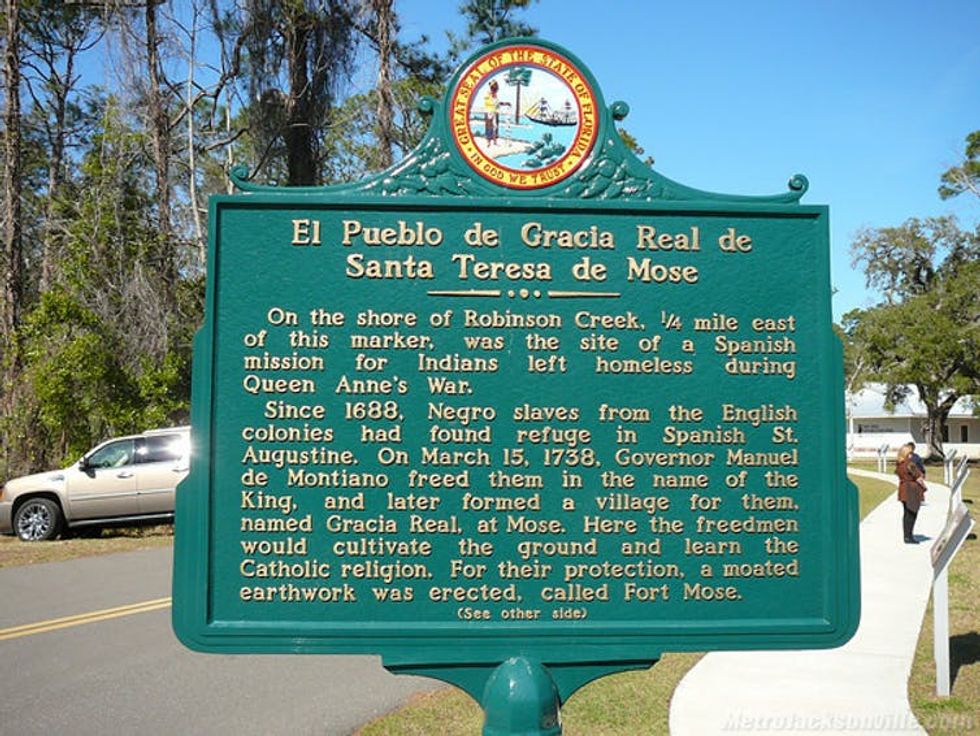
By 1738, the number of slave runaways reaching Florida had grown to approximately 100. Based on Spain’s religious sanctuary policy, Florida’s Spanish governor freed the runaways and established them in a town of their own called Gracia Real de Santa Teresa de Mose, two miles north of the Spanish city of St. Augustine. Mose was modeled after the nearby Indian towns where Catholic priests were also assigned to teach the “new Christians” the principles of the Catholic faith.
Its leader and captain of the town’s militia, Francisco Menéndez, was of Mandinga ethnicity and came from the Senegambian region of West Africa in modern-day Senegal. He probably spoke a variety of languages but learned Spanish as well and wrote petitions to the Spanish King. Others at Mose came from the Congo nation, that is today in West Central Africa.
Pedro Graxales, the Congo man who was sergeant of the Mose militia was married to a slave woman of the Carabalí nation, from what is today southeastern Nigeria. The couple chose godparents from Congo for their children.
Florida’s priests noted that some people from Congo had undergone previous Catholic baptisms in Africa and that even as they learned Spanish, some of them still prayed and blessed themselves in their native language of Kikongo, a Bantu language spoken throughout large areas of West Central Africa.
Creating a black Catholic family
Baptism into the Catholic faith was important because it cleansed black converts of the “stigma of original sin.” It also brought them into the “Christian brotherhood” of the church. Baptism also served an important social function. Families were linked in a system of reciprocal obligations between the baptized and his or her godparents, as also between the parents and godparents.
For example, Francisco Felipe Edimboro and his wife, Filis, were African-born slaves of Florida’s wealthiest planter, Don Francisco Sánchez. The couple had their three-year-old son baptized on the same day that their master and his mulatto consort baptized their natural son. Edimboro and Filis eventually had 10 more children baptized in St. Augustine’s church. On July 15, 1794, they were themselves baptized and married.
Their Catholic baptism and marriage coincided with their suit to buy their freedom and likely contributed to the successful outcome of that litigation.
As a free man, Felipe Edimboro became a landowner and sergeant of St. Augustine’s free black militia. He also served as godfather to 21 black children born in St. Augustine whose baptisms were recorded in its Catholic Church.
What these records say about families
These and other records allow scholars to track the history of several generations of the large Edimboro family to the present day.
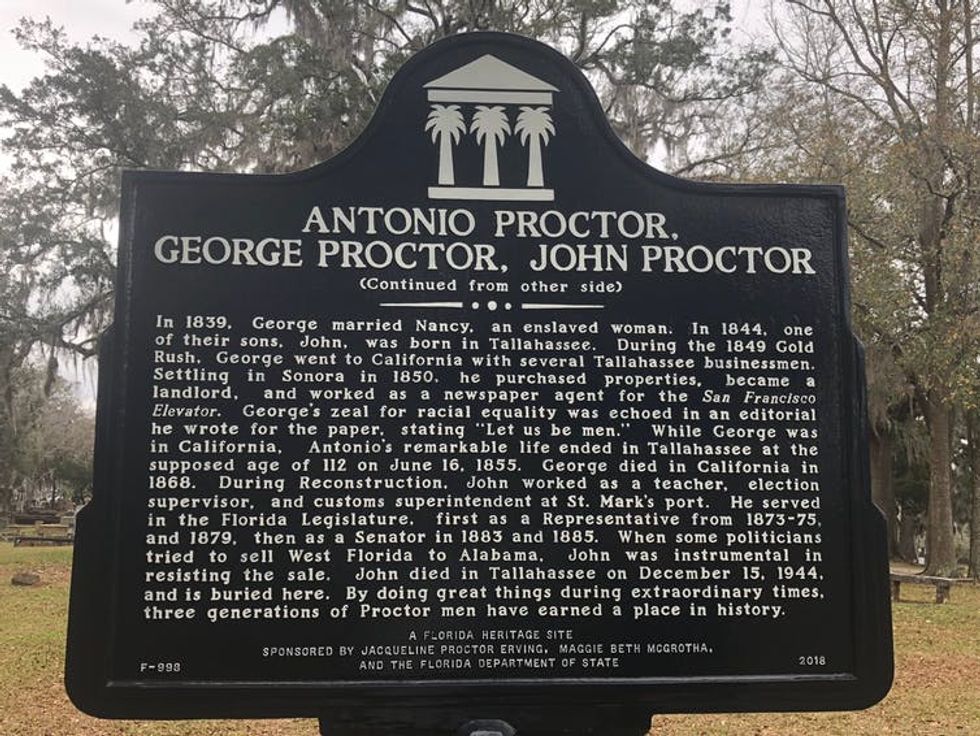
One of Edimboro and Filis’s free daughters, Eusebia, had a child with an enslaved man named Antonio Proctor, described in the records as “the best translator of the Indian languages in the province.”
Edimboro and Proctor served on the Spanish frontier together and Proctor’s valuable military service earned him his freedom.
Eusebia and Antonio’s freeborn son, George Proctor, became a master carpenter and builder in territorial Florida and George’s son, John Proctor, served in the Florida House of Representatives in the 1870s and in the Florida Senate from 1883 to 1886.
More than 100 descendants recently commemorated their family’s rich heritage in a public ceremony in Tallahassee, Florida where they mounted a memorial plaque in the Old City Cemetery.
These records show that black history in United States begins much earlier than previously thought. They also show that men, women, and children once thought forgotten left rich histories in these little explored sources.
British actress Emma Thompson has quit an anticipated film produced by California's Skydance studios because it hired former Disney creative director John Lasseter, who is accused of sexual harassment, her publicist told AFP Tuesday.
The two-time Oscar winner was to voice one of the characters in the much touted animated film "Luck," and had already begun recordings, according to the entertainment news site Variety.
But she dropped the project when Skydance announced in early January that it recruited Lasseter, 62, who was forced to leave his position at Disney as animation chief after acknowledging he made staff feel uncomfortable with unwanted hugs.
AFP/File / Robyn BECK John Lasseter was forced to leave his position at Disney as animation chief after acknowledging he made staff feel uncomfortable with unwanted hugs
Thompson wrote to management at the studio to protest the decision to bring on Lasseter, who is famous for transforming Pixar from a small graphics department into the most successful animation studio in the world.
The 59-year-old performer then forwarded her letter to the Los Angeles Times, which published it in full.
"It feels very odd to me that you and your company would consider hiring someone with Mr Lasseter's pattern of misconduct given the present climate in which people with the kind of power that you have can reasonably be expected to step up to the plate," Thompson wrote in the note, whose authenticity her publicist confirmed to AFP.
"If a man has been touching women inappropriately for decades, why would a woman want to work for him if the only reason he's not touching them inappropriately now is that it says in his contract that he must behave 'professionally'?"
"I am well aware that centuries of entitlement to women's bodies whether they like it or not is not going to change overnight," she continued. "Or in a year."
"But I am also aware that if people who have spoken out -- like me -- do not take this sort of a stand then things are very unlikely to change at anything like the pace required to protect my daughter's generation."
Cuba has rejected a proposal to legalize same-sex marriage in its new and revised constitution, a move that disappointed some gay rights activists.
An article that would have redefined marriage as a “union between two people” – rather than a “union between a man and a woman” – was eliminated from a proposed new constitution, which was written last year by the National Assembly, analyzed and debated in thousands of public meetings across the island and, on Feb. 24, approved by the Cuban people at referendum.
Marriage is now defined in the constitution as “a social and legal institution” and “one form of family organization.” In other words, same-sex marriage is not explicitly permitted – but it’s no longer strictly prohibited, either.
This is how social change works these days in Cuba, my home country and the subject of my academic research. Progress is no longer revolutionary. It comes slowly, and cloaked in moderation.
Thanks to a thaw in U.S.-Cuba relations under President Barack Obama, American tourists began visiting the communist country for the first time since the Kennedy administration placed a trade embargo on Cuba after Fidel Castro’s 1959 communist revolution.
The new constitution – the fourth such update to Cuba’s founding document – creates official legal standing for Castro’s economic reforms, which had remained in legal limbo under a Cold War-era constitution that did not recognize private property or the business sector.
Cuban President Miguel Diaz-Canel with former President Raúl Castro, brother of Fidel Castro.
Many Cubans hoped the reform process would also expand civil liberties, bringing Cuban law more into line with its changing society.
LGBTQ rights groups, in particular, launched public awareness campaigns about sexual diversity. By late 2018, the path seemed to have been paved for gay marriage.
Still, the newly approved constitution does substantially expand social, political and economic rights in Cuba.
It limits Cuban presidents to two five-year terms. Previously, Cuba had no term limits. It also creates a prime minister position and strengthens local government, shifting power out of the executive. The criminal justice system in Cuba now operates on the presumption of innocence, not guilt.
Freedom of assembly, long restricted on the island, has also been expanded.
Previously, Cubans had the “right to meet, demonstrate and associate, for licit and peaceful purposes,” but only as part of a so-called “organización de masa” – the Cuban term for state-run groups. The new constitution removes the words “organizaciones de masa,” depoliticizing the freedom of assembly.
It remains to be seen whether the government will actually respect Cubans’ new right to form independent organizations – especially if those groups are political in nature.
“Spontaneous gatherings [in Cuba] are not seen positively and are always perceived to be the product of a foreign power,” wrote José Gabriel Barrenechea of La Trinchera, a blog for and by “young Marxists,” in a recent post.
But the recent economic reforms that increased prosperity for some have left certain minority groups – namely Afro-Cubans and the elderly – behind. Anti-discrimination statutes do nothing to close the widening wage gap.
The verdict is also mixed on how women fare under new laws.
Abortion, which unlike in the majority of Latin America and Caribbean has long been easily accessible in Cuba, is now officially protected in a provision guaranteeing women’s access to reproductive health services. And all forms of gender-based violence, not just domestic abuse and sexual assault, but also street harassment and workplace intimidation, are criminalized.
However, a popular constitutional guarantee that the government will provide free, universal child care and elder care to all working families women was eliminated.
This shifts the burden of care away from the government and onto the family. In a patriarchal society like Cuba’s, I believe women will inevitably assume these domestic duties.
Cubans evidently feared that other heralded rights would be lost, too.
In last year’s island-wide public meetings, people frequently requested assurances that universal health care and free public education through the post-graduate level would be maintained.
They were.
Rights deferred
But some long-hoped-for rights remain elusive.
Independent media is still prohibited, a blow to the blogs and alternative news sites that have cropped up to fill the information vacuum of a country where all news sources are government-owned.
Some analysts have noted that – as in the case of gay marriage – language defining the role of the media in Cuba was loosened somewhat. And in December the government announced it would allow Cubans to access the internet on their smartphones.
This may leave the door open for greater press freedom in the future.
However, in my analysis, regional politics make that unlikely to occur any time soon.
For six decades, the U.S. government has tried to destabilize Cuban society by broadcasting anti-Communist messages on radio and TV broadcasts.
Now, the U.S. Office of Cuba Broadcasting has turned its attention to social media. The Trump administration in 2018 admitted that it tried to create fake Facebook accounts to foment dissent on the island, though it says the project “never got off the ground.”
This revelation will likely only strengthen the Cuban government’s resolve to limit Cubans’ access to information.
The constitutional reform process has confirmed that radical progress in Cuba will have to wait. But Cuba is changing, in zigs and in zags – just perhaps not as fast as some might hope.
Special Counsel Robert Mueller and other U.S. prosecutors have been investigating whether President Donald Trump’s 2016 campaign conspired with Russia. Trump and Moscow have denied any collusion.
U.S. intelligence agencies have concluded Russia interfered in the presidential election with a campaign of hacking and propaganda to sow discord in the United States and damage the Republican Trump’s Democratic opponent Hillary Clinton. Russia denies it.
Here are some key interactions between Trump advisors and Russian figures that have been unearthed by Mueller’s probe and investigations in Congress.
TRUMP TOWER MEETING
Several top Trump aides, including campaign chairman Paul Manafort, son-in-law Jared Kushner and son Donald Trump Jr., met in June 2016 at Trump Tower in New York with a Russian lawyer who had offered damaging information about Democratic presidential candidate Hillary Clinton. U.S. prosecutors said the lawyer, Natalia Veselnitskaya, was an agent for the Kremlin. The meeting was arranged by Rob Goldstone, a British music publicist. Participants in the meeting said nothing improper occurred and that Veselnitskaya discussed U.S. sanctions on Russia and adoption policy, not election issues. The president said he did not know about the meeting beforehand.
EFFORTS TO BUILD A SKYSCRAPER IN MOSCOW
Trump’s former personal lawyer, Michael Cohen, said he pursued a deal to build a Trump-branded skyscraper in Moscow until June 2016, after Trump had clinched the Republican presidential nomination. Cohen said in a guilty plea that he spoke with an assistant to Russian President Vladimir Putin’s press secretary in January of that year and briefed Trump on the project more than three times.
Trump’s lawyer Rudy Giuliani said the Moscow skyscraper talks continued until Trump won the November 2016 election, but later said he misspoke.
Trump, who repeatedly said during the campaign that he had no contacts with Russia, said after Cohen’s guilty plea in November 2018 there was nothing wrong with pursuing the deal.
EFFORTS TO SET UP A MEETING WITH RUSSIAN LEADERS
Trump campaign adviser George Papadopoulos worked between March 2016 and August 2016 to set up a meeting with Russian leadership, according to prosecutors. They said a London-based professor with ties to the Russian government told him in April 2016 that Moscow had compromising information on Clinton.
Papadopoulos served 14 days in prison after pleading guilty to lying to the FBI about those efforts.
MANAFORT OFFERS CAMPAIGN INSIGHTS
Manafort shared election campaign polling data in August 2016 with Konstantin Kilimnik, a former business partner who Mueller has described as having ties to Russian intelligence, according to a court filing inadvertently made public by Manafort’s lawyers. The two also discussed a plan to resolve the conflict in Ukraine, a major Kremlin foreign policy goal as it seeks relief from U.S. economic sanctions, according to court filings.
Manafort, a veteran Republican political consultant who earned million of dollars working for pro-Russian politicians in Ukraine, also offered private briefings about the campaign to Russian billionaire Oleg Deripaska, who is close to Putin, in an effort to collect past debts, according to the Washington Post.
ROGER STONE AND WIKILEAKS
Roger Stone, a veteran Republican political consultant who has worked on and off with Trump for decades, shared with Trump campaign officials advance knowledge he had of a plan by the WikiLeaks website to release emails stolen from the Clinton campaign by Russians, prosecutors said. The charging document mentions that a senior Trump campaign official “was directed to contact Stone about any additional releases and what other damaging information” WikiLeaks had about the Clinton campaign, raising the possibility Trump himself made the request. Stone pleaded not guilty to lying to Congress and witness tampering.
MEETINGS WITH RUSSIAN AMBASSADOR SERGEI KISLYAK
Several Trump advisers met with Russia’s ambassador to the United States, Sergei Kislyak, before Trump became president.
They included: Michael Flynn, who served as Trump’s first White House national security advisor. Flynn has pleaded guilty to lying to the FBI about his communications with Kislyak in December 2017, after Trump won the election but before he took office. During those calls, according to the indictment, Flynn discussed U.S. sanctions against Russia and asked Kislyak to help delay a U.N. vote seen as damaging to Israel, a move that ran counter to the policies of then-President Barack Obama.
Jeff Sessions, a U.S. senator serving as a campaign adviser who Trump later named attorney general, said he met with Kislyak at least twice in 2016 after initially telling Congress he was unaware of any communications between the campaign and Russia. As attorney general, Sessions recused himself from oversight of the Russia investigation, drawing the ire of Trump. The recusal by Sessions left Rod Rosenstein, the No. 2 Justice Department official, with oversight over the probe, which at the time was headed by the FBI. After Trump fired FBI Director James Comey in May 2017, Rosenstein appointed Mueller as special counsel to take over the probe.
Kushner said he asked Kislyak if he could set up a secure communications channel at the Russian Embassy after Trump won the election. Kushner also said he met with Sergei Gorkov, the head of Russian state-owned bank, Vnesheconombank, during that period at Kislyak’s insistence. Vnesheconombank has been subjected to U.S. economic sanctions since mid-2014.
Pakistan confirmed on Wednesday that it had carried out airstrikes in Indian-controlled Kashmir and shot down two Indian jets in its own airspace, capturing one of the pilots as the conflict with its nuclear-armed neighbor continued to escalate.
“Today, Pakistan Air Force undertook strikes across Line of Control from within Pakistani airspace,” the foreign ministry said in a statement.
The Pakistan military said Indian jets had entered Pakistan in response and two had been shot down, with one pilot captured.
Reporting by James Mackenzie; Editing by Simon Cameron-Moore
A storied French colonial-era hotel once used by the North Vietnamese government to house foreign guests during the Vietnam War is set to host U.S. President Donald Trump and North Korean leader Kim Jong Un as they meet for a second nuclear summit on Wednesday.
The Sofitel Legend Metropole Hanoi has hosted dignitaries and celebrities from Charlie Chaplin on his honeymoon in 1936 to “Hanoi Jane” Fonda during her 1970s anti-war campaign and even Trump himself on a recent visit to the Vietnamese capital.
The Metropole could begin a new chapter as a symbol of peace if Trump and Kim, as some officials in Seoul and Washington expect, formally declare an end to the last remaining Cold War conflict after their two-day summit.
The United States and North Korea are technically still at war, because the 1950-53 Korean War ended in a truce, not a peace treaty.
“We hope Trump and Kim make some progress with their denuclearization and hopefully open North Korea to the outside world,” said Stephen Fries, a doctor from Colorado whose long-planned family trip was disrupted by preparations for the summit.
He was among two dozen Metropole guests touring an underground air raid bunker at the hotel used during the Vietnam War that was rediscovered by chance in 2011 while the hotel was renovating its poolside Bamboo bar.
Trump and Kim will meet at the Metropole at 6:30 pm (1130 GMT) on Wednesday, where the two will have a 20-minute one-on-one chat followed by a dinner with aides, the White House said.
“It’s about time there is a deal. Vietnam had been our enemy, now they are kind of a friend. I hope North Korea would become exactly like Vietnam, and maybe use it an example to follow for its own economic development,” Fries said.
SECRETS AND SECURITY
The elegant interior of the 118-year-old Metropole thronged with security personnel and hotel staff on the summit eve as final preparations were made. Nearby street corners were guarded by armed police, while security staff searched pot plants around the pool.
In a letter distributed ahead of the leaders’ arrival, the hotel’s general manager notified guests of the “very strict security measures” expected in the coming days.
All but one entrance to hotel will be blocked during the summit and a temporary checkpoint has been installed to screen guests, who need to show copies of their passports to gain access to the hotel.
The hotel, decorated with U.S. and North Korean flags was locked down on Wednesday morning, with roads around it blocked and TV crews filming at barricades.
Trump and Kim likely chose Metropole for its ability to keep secrets, Nguyen Dinh Thanh, former head of marketing at Metropole, told Reuters.
“When superstars come here, some journalists offered $2,000-$5,000 or more to staff to take a photo of that superstar, but that has never happened,” said Thanh.
“That shows Metropole has a tradition of keeping secrets as well as knowing how to treat VIP guests.”
CELEBRITIES AND CONTROVERSIES
Heads of state from European kings and British royals to U.S. and South American presidents have all chosen the Metropole as their Hanoi abode.
It has attracted celebrities such as Angelina Jolie and Brad Pitt in 2007, but perhaps its most iconic guest is American actress Jane Fonda, who stayed for two weeks in 1972 when visiting then-enemy territory.
A controversial photo of her sitting with North Vietnamese troops atop an anti-aircraft gun used to shoot at American planes earned her the nickname “Hanoi Jane”.
The Metropole also hosted Graham Greene, who wrote part of his seminal 1955 work, “The Quiet American” there, and numerous war correspondents during the 20-year-long Vietnam War that ended in 1975.
Trump, who stayed in the hotel on his last visit to Vietnam in 2017, has chosen the easier-to-secure JW Marriott hotel this time. Kim is staying at the Melia Hanoi hotel.
Despite its long history of hosting VIPs, the Metropole is not an ideal summit venue from a security point of view, said Le Van Cuong, who used to head the strategy institute of the Ministry of Public Security.
“Metropole is definitely more tricky to protect the leaders, especially because of the lack of space. In the protection job, space gives us advantages. Metropole sits right in the center of crowded streets, so it’s difficult to ensure security,” Cuong told Reuters.
“Singapore chose an isolated island and protection on such island is much easier, definitely easier than Metropole.”
Trump and Kim held their first summit at Singapore’s Capella hotel, a refurbished British Royal Artillery mess on the resort island of Sentosa.
For live coverage of the summit, click: here; Eikon SUMMIT LIVE [nL3N20L1GT]Reporting by Soyoung Kim, James Pearson, Mai Nguyen and Ju-min Park in HANOI.; Editing by Lincoln Feast.
U.S. President Donald Trump and North Korean leader Kim Jong Un meet on Wednesday for their second summit, betting their personal relationship can break a stalemate over the North’s nuclear weapons and end more than 70 years of hostility.
Despite little progress toward his stated goal of ridding North Korea of its nuclear weapons since first meeting Kim in Singapore last year, Trump has said he is fully committed to his personal diplomacy with Kim.
Trump said late last year he and Kim “fell in love”, and on the eve of his departure for the second summit said they had developed “a very, very good relationship”.
Whether the bonhomie can move them beyond summit pageantry to substantive progress on eliminating Pyongyang’s nuclear arsenal that threatens the United States is the question that will dominate their talks in the Vietnamese capital of Hanoi.
“Vietnam is thriving like few places on earth. North Korea would be the same, and very quickly, if it would denuclearize,” Trump said on Twitter.
“The potential is AWESOME, a great opportunity, like almost none other in history, for my friend Kim Jong Un. We will know fairly soon - Very Interesting!”
Trump and Kim will meet at the Metropole hotel at 6:30 p.m. (1130 GMT) on Wednesday for a 20-minute, one-on-one chat followed by a dinner with aides, the White House said.
The elegant interior of the 118-year-old Metropole thronged with security personnel and hotel staff as final preparations were made.
On Thursday, the two leaders will hold “a series of back and forth” meetings, the White House said. The venue for those meetings has not been announced.
In Singapore, they pledged to work toward denuclearization and permanent peace on the Korean peninsula. North and South Korea have been technically still at war since their 1950-53 conflict, with the Americans backing the South, ended in a truce, not a treaty.
The Singapore meeting - the first between a sitting U.S. president and a North Korean leader - ended with great fanfare but little substance over how to dismantle North Korea’s nuclear weapons and ballistic missiles.
Both sides are likely to feel pressure to agree on specific measures this time - what concrete steps North Korea will take to give up weapons that threaten the U.S. mainland, and what the United States will offer in return.
Many analysts believe North Korea won’t commit to significant disarmament unless punishing U.S.-led economic sanctions are eased.
Trump has held out the prospect of easing them if North Korea does something “meaningful”.
HUMAN RIGHTS
Any deal will face scrutiny from American lawmakers and others skeptical that North Korea is really willing to give up the cherished weapons it has long seen as its guarantee of national security, amid worry a compromise could undermine U.S. regional interests.
U.S. intelligence officials have said there is no sign Kim will ever give up his entire arsenal, and U.N. investigators say human rights have not improved in North Korea.
Trump scoffs at the doubters, citing a freeze in North Korea’s nuclear and missile tests since late 2017, and saying the United States would have gone to war with North Korea if he had not been president.
Whatever the outcome, the summit should boost Kim’s bid to end his country’s pariah status and cement his place, both on the world stage and at home.
As the young, third-generation leader of one of the world’s most impoverished and isolated nations, living under punishing sanctions, Kim will again stand as an equal to the president of the world’s most powerful country.
For Trump, a deal that eases the North Korean threat could hand him a big foreign-policy achievement in the midst of domestic troubles.
While Trump is in Hanoi, his former personal lawyer Michael Cohen is testifying before U.S. congressional committees, with the president’s business practices the main focus.Anticipation has also been rising about the impending release of Special Counsel Robert Mueller’s report on Russian interference in the 2016 U.S. election, though a senior U.S. Justice Department official said on Friday it would not come this week.
CONCESSIONS?
In the run-up to the summit, Trump has indicated a more flexible stance, saying he is in no rush to secure North Korea’s denuclearization.
The two sides have discussed specific and verifiable denuclearization measures, such as allowing inspectors to observe the dismantlement of North Korea’s Yongbyon nuclear reactor, U.S. and South Korean officials say.
U.S. concessions could include opening liaison offices or declaring an end to the technical state of war, they say.
Vietnam, relishing its role as mediator, could serve as a model for North Korea as it seeks a path out of isolation.
Vietnam normalized ties with old battlefield foe the United States in 1995 after decades of Cold War mistrust, and its “doi moi” reforms transformed its economy.
Trump is due to meet Vietnam’s president, Nguyen Phu Trong, at the grand, colonial-era presidential palace, before he meets Kim.
For live coverage of the summit, click: here; Eikon SUMMIT LIVE [nL3N20M1H6]; Reporting by Soyoung Kim in HANOI; Editing by Robert Birsel, Nick Macfie and Lincoln Feast





 AFP/File / Robyn BECK
