Saudi Arabia’s public prosecutor held talks overnight with Turkish intelligence officials over the investigation into the killing of journalist Jamal Khashoggi at the Saudi consulate in Istanbul, Demiroren news agency said.
It said Saud Al Mojeb left his hotel shortly after midnight and went to the Istanbul regional offices of Turkey’s National Intelligence Agency (MIT). It did not say how long he stayed there before returning to his hotel.
Khashoggi’s death has escalated into a crisis for the world’s top oil exporter, which at first denied any knowledge of, or role in, his disappearance four weeks ago.
Last week Mojeb contradicted previous Saudi statements, saying Khashoggi’s killing was premeditated. Riyadh says it has arrested 18 suspects, including a team sent to Istanbul hours before Khashoggi’s death, but has rejected Turkey’s call for their extradition.
President Tayyip Erdogan, who has demanded more information from Saudi Arabia, said on Tuesday Istanbul’s chief prosecutor had asked Mojeb to disclose who sent the team from Riyadh which is suspected of involvement in the killing.
The killing of Khashoggi, a critic of de facto ruler Crown Prince Mohammed bin Salman, has put into focus the West’s close relationship with Saudi Arabia - a major arms buyer and linchpin of Washington’s regional plans to contain Iran.
Reporting by Daren Butler; Editing by Dominic Evans
President Donald Trump said on Wednesday the U.S. Constitution does not guarantee the right to citizenship to everyone born in the country and he would continue his push to end it, bringing his tough line on immigration to the fore as the country heads into next week’s congressional elections.
“So-called Birthright Citizenship, which costs our Country billions of dollars and is very unfair to our citizens, will be ended one way or the other. It is not covered by the 14th Amendment because of the words ‘subject to the jurisdiction thereof.’ Many legal scholars agree.....” Trump wrote in a Twitter post.
The 14th Amendment, added after the U.S. Civil War, grants citizenship to anyone born on U.S. soil and was intended to give constitutional protections to former slaves. But Republicans such as Trump say it creates an incentive for people to come to the country illegally to have children.
The lawyer husband of one of Trump’s top advisers, Kellyanne Conway, wrote in an opinion piece on Wednesday that such a move to end birthright citizenship would be unconstitutional.
“Sometimes the Constitution’s text is plain as day and bars what politicians seek to do. That’s the case with President Trump’s proposal to end “birthright citizenship” through an executive order,” George Conway wrote.
White House Press Secretary Sarah Sanders said in an interview with Fox News on Wednesday there was “more than just one piece of the puzzle” on immigration.
“The president wants to see a total reform take place. We have massive loopholes in our immigration system that we have to close or we’re just going to continue kicking the can down the road,” she added.
Reporting by Lisa Lambert and Doina Chiacu; Editing by Bernadette Baum
Iran has no fear about new U.S. sanctions due to take effect in coming days, Iranian President Hassan Rouhani was quoted as saying on Wednesday.
The United States plans to impose sanctions targeting Iran’s oil sector on Nov. 4.
“(Nov. 4) of this year signifies a new injustice from the Americans,” the Islamic Republic of Iran Broadcasting news agency quoted Rouhani as saying.
“But the people should know with certainty that the government has no fear of American threats.”
He added: “In the past few months our people have faced difficult times and it’s possible that the next few months will be difficult. But the government will use all its power to reduce these problems.”
Washington reimposed a number of sanctions on Iran in May after pulling out of a multilateral 2015 deal intended to curb the Islamic Republic’s nuclear program.
The Iranian rial has hit record lows against the U.S. dollar in recent months under the threat of revived U.S. sanctions, with heavy demand for dollars among ordinary Iranians trying to protect their savings.
The cost of living has also soared, sparking sporadic demonstrations against profiteering and corruption, with many protesters chanting anti-government slogans.
Separately, Oil Minister Bijan Zanganeh said on Wednesday that 280,000 barrels of oil had been sold on the country’s energy bourse and that an additional 720,000 barrels would be offered for sale again on the exchange, according to SHANA, the news website of the Iranian Oil Ministry.
Iran began selling crude oil to private companies for export on Sunday, part of a strategy to counter the planned sanctions.
Reporting by Babak Dehghanpisheh; Editing by Dale Hudson
Human remains have been discovered at a Rome property owned by the Vatican, the Holy See said Tuesday, in a potential breakthrough for police investigating one of Italy's darkest mysteries.
"During restoration works in a space annexed to the Apostolic Nunciature of Italy... fragments of human bone were found," the Vatican said in a statement, in reference to the diplomatic office of the Holy See in Rome.
A police investigation is underway to establish the age and gender of the body and date of death.
Media reports said the remains were discovered on Monday.
Detectives will be looking in particular at whether they are a DNA match for Emanuela Orlandi or Mirella Gregori, both of whom were underage when they went missing separately in Rome in 1983.
Orlandi was the daughter of a member of the Vatican's police, and was last seen on June 22, 1983 when leaving a music class.
Theories have circulated that the then 15-year-old was kidnapped by an organised crime gang to put pressure on Vatican officials to recover a loan.
Another claim was that she was taken to force the release from prison of Mehmet Ali Agca, the Turk who attempted to assassinate Pope Jean Paul II in 1981.
Her brother Pietro has been leading a decades-long campaign to find out what happened to her and has accused the Vatican of silence and even complicity in the case.
The Vatican has said on several occasions that it has cooperated with Italian police over the case.
Gregori disappeared exactly 40 days before Orlandi.
Her mother says Gregori answered the intercom at the family apartment before telling her parents it was a school friend and she was going out to speak to him. She never returned.
Investigators have not ruled out that the cases could be connected.
The man accused of detonating a bomb in a New York City subway passageway on behalf of Islamic State last December was a troubled individual who committed a serious crime but not a terrorist, his lawyer told jurors in a Manhattan federal courtroom on Tuesday.
In her opening statement on the first day of Akayed Ullah’s trial, Julia Gatto readily told jurors that they should find her client guilty of setting off the bomb, which did not kill anyone. However, she said they should acquit him of the charge that he supported Islamic State, which is designated a terrorist organization by U.S. authorities.
“This case is not about a foreign terrorist organization planting an operative in our midst,” Gatto said. “What this case is about is a deeply troubled, isolated young man who wanted to take his own life.”
Ullah, a 28-year-old immigrant from Bangladesh, was arrested last December after detonating a homemade bomb in a pedestrian tunnel connecting two subway lines and a bus terminal in midtown Manhattan. He has been charged with six criminal counts, which include using a weapon of mass destruction and providing material support to Islamic State.
Gatto’s statement came after Assistant U.S. Attorney Rebekah Donaleski laid out the prosecutors’ case, telling the jury that Ullah’s act was inspired by Islamic State propaganda he found online.
Donaleski said Ullah built a bomb out of a pipe taken from a construction site where he worked as an electrician, using match heads and sugar as explosives and screws as shrapnel.
“The defendant was inspired by ISIS,” Donaleski said, using the Islamic State acronym. She said a search of Ullah’s computer revealed that he had viewed propaganda urging supporters unable to travel to join Islamic State to carry out “lone wolf” attacks wherever they live.
Donaleski told the jury that, while on his way to carry out the attack, Ullah posted on Facebook: “Trump you failed to protect your nation,” followed by an Arabic message that she said expressed support of Islamic State.
Gatto countered that the prosecutors “give far too much credit to an organization that deserves none.”
“Tooling around on the internet does not make you an ISIS member,” she said. “He does not know a single ISIS member and not a single ISIS member knows him.”
Ullah, Gatto said, was not thinking rationally and wanted only to kill himself in a way that would “send a message.”
Reporting by Brendan Pierson in New York; Editing by Tom Brown
- Britain’s Prince Harry led a song at a Maori meeting ground in New Zealand’s indigenous Te Reo language on Wednesday, the final day of his tour of the Pacific with his wife Meghan.
The pair were welcomed onto the Te Papaiouru Marae on where his grandmother Queen Elizabeth visited in 1953 in the north-eastern town of Rotorua, famed for its geothermal activity and described by its mayor as the ‘heartland of Maori culture’.
Meghan wore a navy Stella McCartney dress and Harry a grey suit. Both were adorned by feathered cloaks gifted to them by the marae and Meghan also wore a carved greenstone necklace given to her by the country’s governor general.
Prince Harry opened his address in the Te Reo language and ended his speech with a Maori proverb. His strong pronunciation drew applause from the crowd. He then led a traditional song entitled ‘Te Aroha’, which means ‘love’ in Te Reo.
Harry’s enthusiasm toward the Maori language was welcomed by Rotorua Mayor Steve Chadwick.
“As our confidence as bilingual district grows, so does our confidence in our people and our future,” he said in a speech.
The use of Te Reo Maori language is experiencing a revival in New Zealand, after years of decline due to historical policies that cracked down on the use of the language, particularly in schools.
Free Maori language courses often report being booked out and Prime Minister Jacinda Ardern has said her infant daughter Neve Te Aroha will learn the language alongside English.
The royal couple were set to depart New Zealand for London on Thursday after an two-week tour that has included visits to Australia, Tonga and Fiji.
Reporting by Charlotte Greenfield; Editing by Michael Perry
Oil prices climbed for the first time in three days on Wednesday, but rising supply and fears over the outlook for demand amid the U.S.-China trade war kept pressure on the market.
Brent crude futures had gained 52 cents, or 0.7 percent, to $76.43 a barrel by 0310 GMT. They fell 1.8 percent on Tuesday, at one point touching their lowest since Aug. 24 at$75.09 a barrel.
U.S. West Texas Intermediate (WTI) crude futures advanced 29 cents, or 0.4 percent, to $66.47 a barrel on Wednesday. They dropped 1.3 percent the day before, after hitting their weakest since Aug. 17 at $65.33 a barrel.
Both crude benchmarks have fallen about $10 a barrel from four-year highs reached in the first week of October, and are on track to post their worst monthly performance since July 2016.
Oil has been caught in the global financial market slump this month, with equities under pressure from the trade scrap between the world’s two largest economies.
U.S. President Donald Trump said on Monday that he thinks there will be “a great deal” with China on trade but warned that he has billions of dollars worth of new tariffs ready to go if a deal is not possible.
Trump said he would like to make a deal now but that China was not ready. He did not elaborate.
The United States has already imposed tariffs on $250 billion worth of Chinese goods, and China has responded with retaliatory duties on $110 billion worth of U.S. goods.
In a bearish signal, the American Petroleum Institute reported U.S. crude inventories rose 5.7 million barrels last week, more than analyst forecasts for a 4.1 million-barrel build.
Investors will look to official government data on U.S. inventories due on Wednesday.
Meanwhile, the International Energy Agency (IEA) said high oil prices were hurting consumers and could dent fuel demand at a time of slowing global economic activity.
“There are two downward pressures on global oil demand growth. One is high oil prices, and in many countries they’re directly related to consumer prices. The second one is global economic growth momentum slowing down,” IEA chief Fatih Birol said on Tuesday at an energy conference in Singapore.
Oil production from Russia, the United States and Saudi Arabia reached 33 million barrels per day (bpd) for the first time in September, Refinitiv Eikon data showed.
That is an increase of 10 million bpd since the start of the decade and means the three producers alone now meet a third of global crude demand.
The United States is set to impose new sanctions on Iranian crude from next week, and exports from the Islamic Republic have already begun to fall.
Saudi Arabia and Russia have said they will pump enough crude to meet demand once the sanctions kick in.
Reporting by Aaron Sheldrick; Editing by Joseph Radford
Chinese intelligence officers conspired with hackers and company insiders to break into private companies’ computer systems and steal information on a turbo fan engine used in commercial jetliners, according to a U.S. indictment unsealed on Tuesday.
The indictment said at the time of the hacks, a Chinese-state owned aerospace company was working to develop a comparable engine for use in aircraft manufactured in China and in other countries.
Chinese-made jets, including the C919 and ARJ21, currently use foreign engines but the country has been trying to develop a competitive homegrown alternative.
The 10 people charged conspired to steal sensitive data “that could be used by Chinese entities to build the same or similar engine without incurring substantial research and development expenses,” the indictment released by the U.S. Department of Justice said.
It said more than a dozen companies were targeted, but only Capstone Turbine Corp was identified by name.
The Justice Department said those hacked included a French firm co-developing a turbofan jet engine with a U.S. company.
France’s only civil turbofan engine maker, Safran SA, co-develops engines with U.S.-based General Electric Co (GE) through their longstanding CFM International partnership, the world’s biggest jet engine manufacturer by number of units sold.
The venture’s latest engine, known as LEAP, powers the largest category of Airbus SE and Boeing Co jets and includes a version for China’s new passenger plane, the Commercial Aircraft Corporation of China (COMAC) C919.
A Safran spokesman in China declined to comment and the company’s French head office could not be contacted outside normal business hours.
GE declined to comment.
The indictment charges Zha Rong and Chai Meng along with other co-conspirators who worked for the Jiangsu Province Ministry of State Security, a unit of the foreign intelligence arm of the Ministry of State Security.
It says their efforts to steal sensitive commercial aviation and other data took place from January 2010 through May 2015.
This marks the third major corporate espionage-related case involving Chinese intelligence officers brought by the Justice Department since last month.
In late September, a Chinese national who had also enlisted in the U.S. Army Reserve was arrested in Chicago for working for Chinese intelligence to recruit engineers and scientists, including some who worked for U.S. defense contractors.
Then earlier in October, the Justice Department also announced it had arrested a spy for China’s Ministry of State Security on charges of economic espionage and attempting to steal trade secrets from several U.S. aviation and aerospace companies.
In that matter, the FBI said the extradition of Chinese operative Xu Yanjun from Belgium was unprecedented, and the case highlighted the Chinese government’s direct control over economic espionage in the United States.
John Demers, the head of the Justice Department’s National Security Division, highlighted the pattern of the three cases in a public statement Tuesday.
“This is just the beginning,” he said. “Together with our federal partners, we will redouble our efforts to safeguard America’s ingenuity and investment.”
Reporting by Sarah N. Lynch and David Shepardson in Washington; additional reporting by Brenda Goh in Shanghai and Allison Lampert in Montreal; Editing by Grant McCool, Chris Reese and Darren Schuettler
A yellow excavator, forklift and other heavy equipment made by U.S. firm Caterpillar gleam outside Cuba’s annual trade fair, reflecting once-bright hopes for increased U.S.-Cuban commerce fanned by the 2014 detente between the old Cold War foes.
But inside the pavilion where U.S. firms present their wares, only eight have stands this year, according to a Reuters count. That is down from 13 last year and several dozens in 2015-16, underscoring the decline in U.S. business interest since Donald Trump became president.
Last year, the Trump administration tightened the decades-old trade embargo on the Communist-run island once more and sharply reduced staffing at the U.S. embassy in Havana due to a series of health incidents among U.S. diplomats.
“Trump has scared everyone off,” said Eduardo Aparicio, general manager of U.S. logistics company Apacargoexpress, operating under an exemption to the embargo allowing U.S. companies to sell food and medical supplies here.
Aparicio says he is struggling to find U.S. firms keen on doing business with Cuba given fears of reprisals from the Trump administration.
“Not that many things have changed with the Trump administration but the outlook has. It no longer feels like we are advancing,” said Jay Brickman, vice president of Florida-based shipping company Crowley Maritime Corporation, which has been shipping to Cuba for 17 years.
“If you are a corporate executive who feels like nothing is happening, then eventually you look elsewhere.”
Brickman, Aparicio and others at Cuba’s premier business event said the country’s dire financial situation was another factor in declining U.S. business interest. Cuba is battling a cash crunch amid lower aid from ally Venezuela and weaker exports.
Brickman said Cuban orders via his firm were down 10 percent this year.
U.S. companies had embraced Cuba in the wake of the detente reached by former U.S. and Cuban Presidents Barack Obama and Raul Castro, jostling for a foothold in an opening market of 11 million consumers.
Lawyers working with U.S. firms interested in doing business with Cuba say the larger ones are taking a long-term view and remain keen.
Heavy equipment maker Caterpillar, for example, had lobbied to sell in Cuba for years before one of its dealers, privately held Puerto Rican company Rimco, said last year it was opening a distribution center here.
“This is the beginning of a lot of things to come,” Rimco Vice President Caroline McConnie said of the machinery displayed outside the pavilion.
McConnie said Rimco would look to rent as well as sell machines in Cuba given its cash crunch, and expected to announce its first two deals soon: one to rent equipment for quarries and another to sell marine motors for tugboats.
“We will benefit from the first movers’ advantage,” she said.
A Christian missionary from Indiana was killed in Cameroon on Tuesday when he was shot while traveling in a region where the military and separatists have been fighting, a family member said.
The U.S. State Department confirmed on Tuesday that an American citizen had been killed in Cameroon and said it was offering all appropriate consular assistance to the family, but provided no further details about the person.
Charles Wesco, a 44-year-old Baptist missionary, had been in Cameroon for less than two weeks when he was killed, his sister-in-law, Joy Williams, said.
He was shot in a region of northwest Cameroon where the military has been fighting English-speaking separatists who want to break away from the predominantly Francophone central government and create an independent state called Ambazonia.
The conflict has killed hundreds of people since last year and has emerged as Cameroon President Paul Biya’s greatest security problem in nearly four decades in power.
Biya won election to a seventh term earlier this month.
The American missionary was traveling in a vehicle with his wife, one of his children and another missionary, heading toward the town of Bamenda, when a soldier shot him several times in the head, Williams said by phone from the United States.
Aside from Wesco, no one else in the vehicle was struck by gunfire during the ambush, Williams said, and the family was unsure if the soldier was with the country’s military or the separatists.
Wesco, who lived in Warsaw, Indiana, and belonged to a local Baptist church there, had been a piano tuner before becoming a missionary, Williams said. He is survived by eight children, she said.
The Wesco family had originally planned to move to Cameroon in August but had delayed their mission because of the unrest, she said. “They were aware of the danger,” she said.
Reporting by Lesley Wroughton in Washington, Additional reporting by Alex Dobuzinskis in Los Angeles; Writing by David Alexander; Editing by Lisa Lambert and Bill Berkrot
The executive order that President Donald Trump is considering to curb birthright citizenship may not conflict with the U.S. Constitution, Vice President Mike Pence said on Tuesday.
“... The Supreme Court of the United States has never ruled on whether or not the language of the 14th amendment, subject to the jurisdiction thereof, applies specifically to people who are in the country illegally,” he said in an interview with Politico.
Democrats will try to harden U.S. policy toward Saudi Arabia, Russia and North Korea if they win a majority in the U.S. House of Representatives, while maintaining the status quo on hot-button areas like China and Iran, congressional sources say.
If Democrats win at least 23 more seats on Nov. 6, they will regain control of the 435-member House of Representatives from Republicans for the first time since 2011. That means they can determine what legislation can be considered in the chamber and have a bigger role in setting spending policy and writing legislation, in their challenge to U.S. President Donald Trump’s foreign policy agenda.
But since they must still work with a likely Republican-controlled Senate to pass any bills, the Democratic majority’s greatest influence will be oversight, the ability to call hearings and, if necessary, subpoena witnesses, as they chair committees like Foreign Affairs, Armed Services and Intelligence.
If Republicans defy opinion polls and maintain control of the House after weeks of campaigning by Trump, they are expected to embrace his policies. Several influential moderates are retiring, paving the way for a more conservative Republican House that could heed Trump’s calls to cut aid for Central America and slash the foreign affairs budget by some 30 percent.
SAUDI ARABIA
The furor over the death of journalist Jamal Khashoggi at the Saudi consulate in Istanbul has added to lawmakers’ frustration with Saudi Arabia over civilian deaths in the war in Yemen and human rights.
A Democratic-led House would vote on legislation to block arms deals with Riyadh, make it difficult to win congressional approval of a nuclear energy deal with the kingdom and take up a measure to stop U.S. aircraft refueling and other support for the campaign in Yemen.
RUSSIA
Democrats plan Russia-related investigations, such as a probe of business ties and conflicts of interest between Trump and Russia.
But from a policy perspective, a Democratic-led House would push to punish Russia for interference in U.S. elections and activities including its aggression in Ukraine and involvement in the Syrian civil war.
The House would push for more sanctions, including measures targeting new Russian sovereign debt. They would also try to pressure Trump to enact all of the sanctions in a sweeping bill he reluctantly signed into law in August 2017.
“Trump would have to accept policies that he is not so enthusiastic to accept,” said Ilan Goldenberg, a former congressional aide and State Department official now at the Center for a New American Security.
Members of Congress have also vowed to push harder, using subpoena power if necessary, to obtain information about Trump’s summit last summer with Russian President Vladimir Putin. The White House has released few details about the meeting.
NORTH KOREA
Democrats say they are determined to obtain more information about meetings by Trump and Secretary of State Mike Pompeo with North Korean Leader Kim Jong Un, worried that Trump is so eager to make a “great deal” that he will give Kim too much.
They plan to call administration officials to testify in public, and behind closed doors, about the status of talks. But they also will walk a fine line, because they do not want to be seen as interfering with diplomacy and efforts to prevent a nuclear war.
CHINA
Aides and outside experts do not expect that Democratic House control will mean significant changes in China policy. Democrats will hold more hearings, and demand more briefings, but criticism of Beijing has so far crossed party lines and that is not expected to change.
Prominent Democrats, such as Representative Adam Schiff, who is in line to chair the House Intelligence Committee, have joined Republicans backing measures to clamp down on China, like legislation treating ZTE Corp and Huawei Technologies Co Ltd technology and phones as major cyber security threats.
Like Republicans, Democrats are divided on Trump’s trade war with China. Some party members see free trade as a generator of jobs, while others back tariffs to protect workers in industries such as steel and manufacturing.
IRAN
Democrats were infuriated by Trump’s withdrawal from the international nuclear deal with Iran that Democratic President Barack Obama’s administration reached in 2015. But there is little they can do to change the policy as long as Republicans occupy the White House.
Lawmakers also are wary of seeming too friendly to Iran, especially given hostility to Tehran by the government of Israel. While Israeli Prime Minister Benjamin Netanyahu has worked increasingly closely with U.S. Republicans, strong ties to Israel remain a top priority for both parties.
Reporting by Patricia Zengerle; Editing by Mary Milliken and Peter Cooney
In the wake of recent violent events in the U.S., many people are expressing concern about the tone and content of online communications, including talk of the “dark web.” Despite the sinister-sounding phrase, there is not just one “dark web.” The term is actually fairly technical in origin, and is often used to describe some of the lesser-known corners of the internet. As I discuss in my new book, “Weaving the Dark Web: Legitimacy on Freenet, Tor, and I2P,” the online services that make up what has become called the “dark web” have been evolving since the early days of the commercial internet – but because of their technological differences, are not well understood by the public, policymakers or the media.
As a result, people often think of the dark web as a place where people sell drugs or exchange stolen information – or as some rare section of the internet Google can’t crawl. It’s both, and neither, and much more.
Seeking anonymity and privacy
In brief, dark websites are just like any other website, containing whatever information its owners want to provide, and built with standard web technologies, like hosting software, HTML and JavaScript. Dark websites can be viewed by a standard web browser like Firefox or Chrome. The difference is that they can only be accessed through special network-routing software, which is designed to provide anonymity for both visitors to websites and publishers of these sites.
Websites on the dark web don’t end in “.com” or “.org” or other more common web address endings; they more often include long strings of letters and numbers, ending in “.onion” or “.i2p.” Those are signals that tell software like Freenet, I2P or Tor how to find dark websites while keeping users’ and hosts’ identities private.
Those programs got their start a couple of decades ago. In 1999, Irish computer scientist Ian Clarke started Freenet as a peer-to-peer system for computers to distribute various types of data in a decentralized manner rather than through the more centralized structure of the mainstream internet. The structure of Freenet separates the identity of the creator of a file from its content, which made it attractive for people who wanted to host anonymous websites.
Today, the more commonly used internet has billions of websites – but the dark web is tiny, with tens of thousands of sites at the most, at least according to the various indexes and search engines that crawl these three networks.
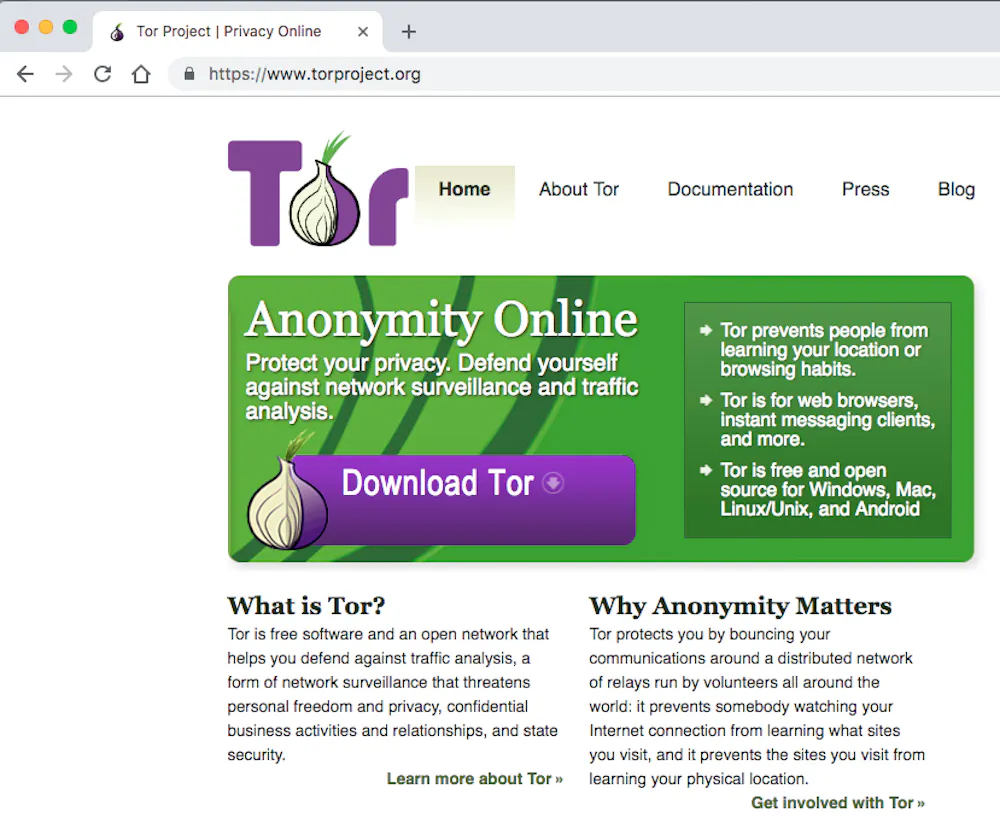
The Tor Project promotes and encourages online anonymity.
The most commonly used of the three anonymous systems is Tor – which is so prominent that mainstream websites like Facebook, The New York Times and The Washington Post operate versions of their websites accessible on Tor’s network. Obviously, those sites don’t seek to keep their identities secret, but they have piggybacked on Tor’s anonymizing web technology in order to allow users to connect privately and securely without governments knowing.
In addition, Tor’s system is set up to allow users to anonymously browse not only dark websites, but also regular websites. Using Tor to access the regular internet privately is much more common than using it to browse the dark web.
Moral aspects of ‘dark’ browsing
Given the often sensationalized media coverage of the dark web, it’s understandable that people think the term “dark” is a moral judgment. Hitmen for hire, terrorist propaganda, child trafficking and exploitation, guns, drugs and stolen information markets do sound pretty dark.
Even complaining that dark web information isn’t indexed by search engines misses the crucial reality that search engines never see huge swaths of the regular internet either – such as email traffic, online gaming activity, streaming video services, documents shared within corporations or on data-sharing services like Dropbox, academic and news articles behind paywalls, interactive databases and even posts on social media sites. Ultimately, though, the dark web is indeed searchable as I explain in a chapter of my book.
Thus, as I suggest, a more accurate connotation of “dark” in “dark web” is found in the phrase “going dark” – moving communications out of clear and public channels and into encrypted or more private ones.
Managing anxieties
Focusing all this fear and moral judgment on the dark web risks both needlessly scaring people about online safety and erroneously reassuring them about online safety.
For instance, the financial services company Experian sells services that purport to “monitor the dark web” to alert customers when their personal data has been compromised by hackers and offered for sale online. Yet to sign up for that service, customers have to give the company all sorts of personal information – including their Social Security number and email address – the very data they’re seeking to protect. And they have to hope that Experian doesn’t get hacked, as its competitor Equifax was, compromising the personal data of nearly every adult in the U.S.
It’s inaccurate to assume that online crime is based on the dark web – or that the only activity on the dark web is dangerous and illegal. It’s also inaccurate to see the dark web as content beyond the reach of search engines. Acting on these incorrect assumptions would encourage governments and corporations who want to monitor and police online activity – and risk giving public support to privacy-invading efforts.