First Lady Melania received criticism for wearing a pith helmet during a trip to Africa, The New York Timesreported Friday.
The newspaper described the helmet as "a common symbol of European colonial rule."
“When people think of Africa, they have these standard narratives,” Professor Kim Yi Dionne explained. “Her attire is a signal of her understanding of what Africa is in 2018. It’s tired and it’s old and it’s inaccurate.”
“It’s like showing up to a meeting of African-American cotton farmers in a Confederate uniform,” suggested Matthew Carotenuto, a coordinator of African Studies at St. Lawrence University.
Saudi Arabia’s Crown Prince Mohammed bin Salman dismissed remarks by Donald Trump in which the U.S. president said he had warned the king he would not last in power “for two weeks” without U.S. military backing and demanded he pay up.
“I love working with him. You know, you have to accept that any friend will say good things and bad things,” Prince Mohammed said in a Bloomberg interview published on Friday.
“We believe that all the armaments we have from the United States of America are paid for, it’s not free armament. So ever since the relationship started between Saudi Arabia and the United States of America, we’ve bought everything with money,” Prince Mohammed added.
Trump made the comments at a rally in Mississippi on Tuesday. Despite the harsh words, the Trump administration has had a close relationship with Saudi Arabia, which it views as a bulwark against Iran’s ambitions in the region.
Trump made Saudi Arabia his first stop on his maiden international trip as president last year.
Saudi Arabia is the world’s top oil exporter and the de facto leader of OPEC, which has been criticized by Trump for high oil prices.
Reporting By Stephen Kalin; Editing by Richard Balmforth
U.S. first lady Melania Trump read to children at an orphanage, fed a baby elephant, and went on a short safari on Friday in Kenya, the third country on her nearly week-long Africa tour.
Trump, who has also visited Ghana and Malawi, kicked off her day with a stop at an elephant orphanage, where she helped bottle feed an elephant and patted another, clearly having a good time.
Afterwards she donned a white hat and took a short safari in Nairobi National Park, passing by zebras, giraffes and other animals.
The first lady then visited a local children’s orphanage. She delighted in holding babies and held hands with older children, who sang and danced. She also read them a book.
Trump met with her counterpart, Kenya’s first lady Margaret Kenyatta, and attended a theater performance.
Trump departs for Egypt on Saturday morning before returning to the United States.
Reporting by Jeff Mason; Editing by Matthew Mpoke Bigg
Russian state media -- and Kremlin-backed trolls -- are helping to push Brett Kavanaugh's nomination the U.S. Supreme Court as part of a broader effort to undermine American democracy.
Julia Davis, a Russian media watchdog, published a column for The Daily Beast that tracked how the country's state-run media is amplifying President Donald Trump's defense of his embattled judicial nominee.
“Guess what stands in Kavanaugh’s way?" said Kremlin propagandist Dmitry Kiselyov. "Certainly, the disease of malignant feminism … used to destroy promising careers and eliminate political opponents."
Vitaly Milonov, a Russian lawmaker allied with president Vladimir Putin, called for the imprisonment of feminists -- who he called "monkey" and "witches."
Hamilton 68, a website that tracks Russian influence operations on social media, found a high level of activity by Twitter bots backing Kavanaugh and amplifying the GOP defense.
The operation even seemed to influence Trump, who claimed in a Friday morning tweet that anti-Kavanaugh protesters had been paid by billionaire financier George Soros.
That conspiracy theory was previously advanced by the state-run RT network, Davis said.
The Kremlin's support for Kavanaugh is intended to highlight divisions in American politics, according to Davis and other experts.
All this is part of a broader picture in which the Kremlin continues to differentiate between Trump and the American government.
"They are pro-Kavanaugh bc they know he will divide U.S. and undermine Americans' faith in the most revered legal institution in the country," she added.
Kavanaugh is one of the most deeply unpopular Supreme Court nominees in history, and Democrats are furious at Republican efforts to ram his nomination through the Senate.
"Russian state media is supporting Trump’s Kavanaugh nomination both in its domestic publications, as well as those aimed at the English-speaking audiences," Davis said. "All this is part of a broader picture in which the Kremlin continues to differentiate between Trump and the American government."
The United States is likely to succeed in shutting down the World Trade Organization’s supreme court because other WTO members are powerless to stop it, diplomats, lawyers and officials said at a conference in Geneva on Friday.
The United States has blocked appointments of judges to the Appellate Body, throwing the WTO into crisis as it runs out of legal muscle to rule on international trade disputes.
The European Union has made proposals to reform the way the judges work, but U.S. Ambassador Dennis Shea poured cold water on several of them on Thursday, saying appeals judges had “strayed” from what was agreed when the WTO was set up in 1995.
One diplomat from a large developing country said on Friday the United States regretted setting up the appeals system and it was not putting forward any ideas to reform it.
“We have no leverage,” he said. “The other side is flexing its muscles.”
“Moral suasion is all that is left,” said a Geneva-based trade lawyer.
Another trade lawyer and former negotiator for a U.S. ally said various alternatives being put forward were “band-aids”.
“I don’t think there’s anything right now that the other (WTO) members can do. And I don’t think that any of these other band-aid solutions amount to anything,” he said.
A trade lawyer and former staffer on the Appellate Body’s secretariat said the United States was using hard leverage in many areas of trade, with its tariff war and regional trade agreements as well as at the WTO.
The trade experts were speaking at an event organized by the Cato Institute at Geneva’s Center for Trade and Economic Integration, on condition that the names and affiliations of speakers were not reported.
Attendees included senior officials from the WTO and ambassadors from WTO missions as well as veteran trade lawyers. Organizers said that U.S. officials had been invited to take part but declined.
Hundreds of members of a conservative Hindu group in southern India will lie down at the entrance of a hill temple to stop women of menstruating age from entering, its chief said, even after the top court last week lifted a centuries-old ban.
The government of the state of Kerala is bracing for a face-off between the protesters and women and girls aged 10-50 who want to visit the Sabarimala hill temple, which attracts tens of millions of pilgrims every year, when it re-opens on Oct. 17.
The state’s police force has asked neighboring states to provide policewomen for the protests because some of its own have refused to be rostered for duty because they support the ban.
Last week, India’s Supreme Court lifted the ban, saying it was upholding rights to equality of worship.
The temple authorities had said the ban was essential to the rites related to the temple’s chief deity, Ayyappan, considered eternally celibate.
“Hundreds of our men will lie down at the entry point of the hill when the temple opens at 5 pm on Oct. 17” for the pooja, or prayer ceremony, said Rahul Easwar, chief of the Ayyappa Dharma Sena. The group of devotees is fighting the lifting of the ban and he is the grandson of a former chief priest at Sabarimala.
“Those women who come to worship defying the temple custom will have to walk through our bodies,” Easwar told Reuters, adding the protest was not against the judiciary but against the move by the state to implement the order hastily.
His group would file a plea on Friday seeking a review of the verdict, Easwar said, urging the state government to maintain the status quo while that is being considered.
The Communist party-led state government has accepted the order and vowed to provide protection to women visiting the shrine.
The state has witnessed sporadic protests from devotees, including women, since the order and both of India’s main political parties, the ruling Bharatiya Janata Party and Congress, have been critical of the lifting of the ban.
Congress is staging a day-long fast in Pathanamthitta district, which is home to the temple, on Friday.
“The political parties are trying to fish in troubled waters,” said P. Geetha, a prominent women’s activist, who has been demanding gender equality at Sabarimala.
She said that they were taking advantage of the protests for political gain and that those supporting the ban were trying to make Sabarimala a conflict zone to dissuade women of menstruating age from going there.
The police chief of Pathanamthitta district, T. Narayanan, said preparations are being made to implement the order.
“We have taken note of the protests. We will assess the situation next week and come out with the measures to be taken for the security at Sabarimala,” Narayanan said.
Writing by Malini Menon; Editing by Martin Howell and Nick Macfie
Congolese doctor Denis Mukwege and Yazidi campaigner Nadia Murad won the 2018 Nobel Peace Prize on Friday for their work in fighting sexual violence in conflicts around the world.
The pair won the award "for their efforts to end the use of sexual violence as a weapon of war and armed conflict," Nobel committee chairwoman Berit Reiss-Andersen said in unveiling the winners in Oslo.
"A more peaceful world can only be achieved if women and their fundamental rights and security are recognised and protected in war," she said.
One a doctor, the other a former Islamic State sex slave, both have come to represent the struggle against a global scourge which goes well beyond any single conflict, as the #MeToo movement has shown.
The prize was announced as #MeToo marks its first anniversary after a year in which allegations of sexual abuse, rape and harassment have toppled dozens of powerful men.
By recognising the pair's work, the Nobel committee has placed a spotlight on the use of sexual violence in war as a global problem.
- 'Weapon of mass destruction' -
Mukwege, 63, was recognised for two decades of work to help women recover from the violence and trauma of sexual abuse and rape in the war-torn eastern Democratic Republic of Congo.
AFP / Kun TIANNobel peace laureates since 2012
Women, children and even babies just a few months old, Mukwege has treated tens of thousands of victims of rape at Panzi hospital which he founded in 1999 in South Kivu.
Known as "Doctor Miracle", he is an outspoken critic of the abuse of women during war who has described rape as "a weapon of mass destruction".
"Denis Mukwege is the foremost, most unifying symbol, both nationally and internationally, of the struggle to end sexual violence in war and armed conflicts," Reiss-Andersen said.
Alongside Mukwege, the committee honoured Murad, a 25-year-old Iraqi woman from the Yazidi community who in 2014 was kidnapped by Islamic State militants and endured three months as a sex slave before managing to escape.
She was one of thousands of Yazidi women and girls who were abducted, raped and brutalised by jihadists during their assault that year on the Kurdish-speaking minority, which the United Nations has described as genocide.
AFP/File / Marc JOURDIERCongolese gynaecologist Denis Mukege is known as 'Doctor Miracle'
Her nightmare began when the jihadists stormed her village in northern Iraq in August 2014. From there she was taken to Mosul where she was repeatedly gang-raped, tortured and beaten.
"The first thing they did was force us to convert to Islam", she told AFP two years ago. "After conversion, they did whatever they wanted."
After her escape, she quickly became a figurehead for efforts to protect the Yazidi community and was later named a UN ambassador for victims of human trafficking.
The Nobel committee said Murad had shown "uncommon courage" in recounting her own sufferings and speaking up on behalf of other victims.
"She refused to accept the social codes that require women to remain silent and ashamed of the abuses to which they have been subjected."
- 'Personal security at risk' -
Both Mukwege and Murad had "put their personal security at risk" by focusing attention on and combating such war crimes, Reiss-Andersen said.
"Denis Mukwege is the helper who has devoted his life to defending these victims. Nadia Murad is the witness who tells of the abuses perpetrated against herself and others.
"Each of them in their own way has helped to give greater visibility to war-time sexual violence, so that the perpetrators can be held accountable."
DPA/AFP/File / Julian StratenschulteNadia Murad from Iraq's Yazidi community was kidnapped by Islamic State militants and endured three months as a sex slave before managing to escape
Whether in Africa, the Middle East or Myanmar, rape has been used against hundreds of thousands of people, either as a weapon of war or tool in the oppression of minorities.
Sexual violence as a weapon of war has been going on for centuries, but it was only recently acknowledged as a crime against humanity with the UN's adoption in 2008 of Resolution 1820.
And the #MeToo movement, which rose up a year ago following allegations of rape, sexual abuse and harassment against Hollywood director Harvey Weinstein and has since swept the globe, has also had a very sobering effect.
"#MeToo and war crimes is not quite the same thing. But they do however, have that in common: that it is important to see the suffering of women, to see the abuses and to achieve that it is important that women leave the concept of shame and speak out," said Reiss-Andersen.
It was a #MeToo scandal that prompted the Swedish Academy to postpone this year's Literature Prize for the first time in 70 years.
Mukwege and Murad will share the prestigious prize of a gold medal, a diploma and a cheque for nine million Swedish kronor -- almost $1 million or 863,000 euros.
The award will be presented at a ceremony in Oslo on December 10, the anniversary of the death of prize creator Alfred Nobel, a Swedish philanthropist and scientist who died in 1896.
Donna Strickland, an associate professor at the University of Waterloo in Canada, was awarded the 2018 Nobel Prize in physics. The third woman to have ever been awarded this prize in 117 years, she shares it with Arthur Ashkin and Gérard Mourou.
Women make up 27 per cent of full professors in the academy as a whole, and in science, technology, engineering and math, that number is much lower. For racialized and Indigenous women in all fields, the numbers go down even further.
The rank of full professor offers more pay, more prestige and more opportunities to be selected for senior leadership roles within a university.
A 2018 report from the Canadian Association of University Teachers also concluded that, despite talk by universities and colleges of a commitment to inclusive institutions, progress on equity has been exceptionally slow.
The twins of sexism and racism
The reasons why so few women get Nobel Prizes and achieve full professorship, and even fewer who are racialized or Indigenous do, are interconnected.
It’s the twins of sexism and racism. As political scientist Malinda Smith shows, there are a number of factors — she calls them the “dirty dozen” — that normalize gender and racial biases. This results in a tiny demographic (white, male) as the predictable winners in a rigged game.
Examples of the “dirty dozen” include white male students receiving more opportunities to network. Then there are the reference letters. While female students might have better grades, it is more likely in letters of reference that their professors will talk about them as having potential or being hard workers, compared to white men who are cast as brilliant.
On top of that, workload concerns leave women less time for research. For example, women, particularly if racialized or Indigenous, are more likely to get sessional work, with significantly lower pay scales, higher teaching loads and little time for research.
Finally, tenure-track women are less likely to get competitive research funding, and when they do, they often earn less money than men.
To become a full professor, one needs to apply and be evaluated by committees repeatedly — first for a tenure-track position, then for tenure and promotion — usually with an impressive portfolio of research funding and peer-reviewed publications. This is a portfolio that requires extensive research time, collaborations and support to achieve.
Women scientists are victims of a systemic inequity that impacts us all.
A reward system biased towards men
I have just completed a research project on the role of the Nobel Prize in university rankings and the impact on equity. The study found that influential university rankings judge institutions based on the number of articles published by faculty and staff in top-ranked journals.
It found that this reward system is biased towards men.
Noble Prize winner Donna Strickland in her lab. Strickland co-invented a method of generating high-intensity, ultra-short optical pulses which has a variety of applications, including corrective laser eye surgery.
THE CANADIAN PRESS/Nathan Denette)
Men are more likely to publish other men in top-ranked health and science journals. The role of sexism in terms of who gets published and what gets published isn’t considered when deciding who and what is ranked as world-class.
The majority of decision-makers who create or accept the metrics used to decide who and what is world-class are white and male — including ranking advisories, university leaders, top journal editors and adjudication committees for major awards. Sexism and racism are reinforced and normalized through these feedback loops.
This Boys Club impacts women when they go up for promotion at research-intensive universities, because how they are deemed worthy or unworthy is largely based on how many publications they have in top-ranked journals, awards and, depending on the field, the research funding that they bring in.
Science as the heroic man
All the talk of equity over the last 30 years has really been a distraction from talking about how little progress has actually been made. Not because women, racialized and Indigenous scholars are less productive or doing less innovative work, but because of sexism and racism.
By promoting and accepting this ranking as legitimate, universities reinforce a sexist and racist metric as the way to determine the quality of a university and what counts in the wider academic systems.
The Nobel as an indicator of world-class research maintains the illusion that science is conducted by the heroic man and — very, very rarely — a woman. Men are represented as toiling away to make great discoveries.
What is left out is the reality of science as a collaborative effort — with women most likely not receiving credit for their work. What is left out is that the Nobel is decided by a few men.
White men decide who is world-class
In the case of the Nobel, a few (mainly Swedish and Norwegian) white men ultimately decide who is best in the fields of physics, medicine, chemistry, advocating for world peace and literature.
The Nobel adjudication committees mirror society. Predominately white men decide on who and what is world class, and based on these decisions, who to invite into the club.
Once in a while someone who isn’t part of the demographic gets in, but the status quo remains intact.
What Strickland achieved is impressive. But it isn’t a sign that the patriarchy is being smashed.
This is a corrected version of a story originally published Oct. 4, 2018. The earlier story said the Nobel Prize for literature was cancelled in 2018 because of allegations of rape against a former committee chair. The allegations were against the husband of a committee member, not a member of the committee.
Ten days before the opening ceremony of the 1968 Olympic Games in Mexico City, uniformed soldiers and rooftop snipers opened fire on student protesters in a plaza in the capital city’s Tlatelolco neighborhood.
Foreign correspondents reporting from Tlatelolco estimated that about 300 young people died, although the toll of the Oct. 2, 1968 massacre remains contested. Over a thousand people who survived the shooting were arrested.
Tlateloloco was not the first time Mexico’s government would send the army in to kill its own citizens. Nor, as my research on crime and security in the country shows, was it the last.
Mexico’s perfect dictatorship
Technically speaking, Mexico was a democracy in 1968. But it was run by the Institutional Revolutionary Party, or PRI, the same party that governs it today under President Enrique Peña Nieto.
Using press manipulation, electoral fraud and coercion, the PRI won every presidential election and most local elections from 1929 to 2000. In the words of the Nobel Prize-winning author Mario Vargas Llosa, it was a “perfect dictatorship” – an authoritarian regime that “camouflaged” its permanence in power with the superficial practice of democracy.
The PRI kept kept a tight rein on Mexico during its 80-year rule.
But it did so in secret. When soldiers sent by President Gustavo Díaz Ordaz killed scores of students exercising their constitutional right to peaceful protest in broad daylight and cold blood, something the Mexico’s national consciousness shifted and snapped.
But most thinkers and historians agree that Tlatelolco was when democracy’s first seeds were planted. After the massacre, a “tradition of resistance” took root in Mexico.
1968’s summer of revolution
The Tlatelolco massacre came after a tense summer of student demonstrations.
Throughout late summer, Mexico City saw peaceful marches, demonstrations and rallies. The students demanding free speech, accountability for police and military abuses, the release of political prisoners and dialogue with their government.
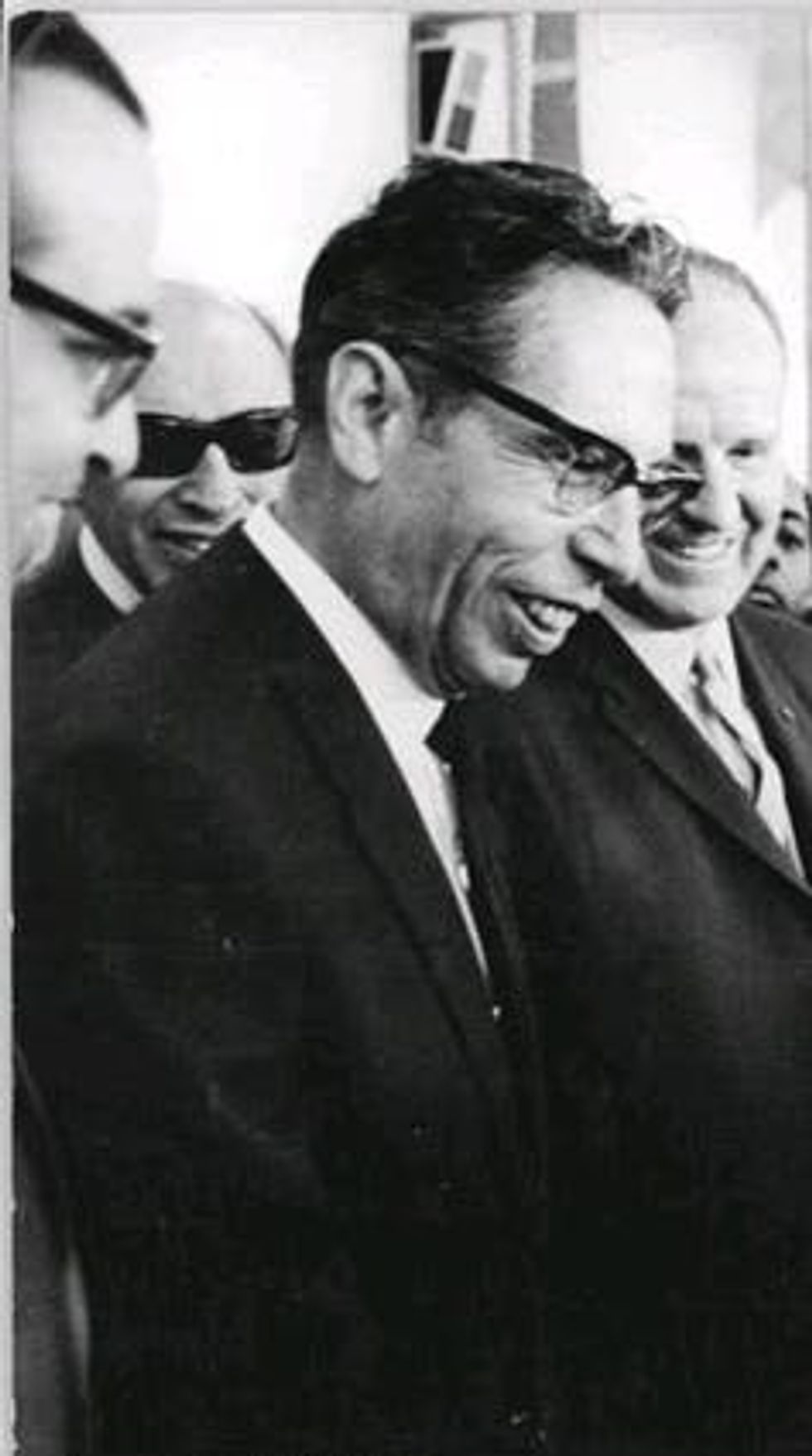
President Gustavo Díaz Ordez before the 1968 Mexico City Olympics.
The uprising brought bad publicity at an inconvenient time. Mexico was about to host the 1968 Olympics. President Gustavo Díaz Ordaz wanted to showcase a modern nation at the forefront of emerging economies – not unruly leftists decrying an authoritarian government.
Díaz Ordaz said the protesters were Communist agents sent by the Cubans and Soviets to infiltrate his regime – a claim the Central Intelligence Agency debunked in a now-declassified Sept. 1968 report.
By early October, with the Olympics rapidly approaching, the government had decided to put an end to the unrest. So when students planned an Oct. 2 rally at the Plaza of the Three Cultures in Tlatelolco, Díaz Ordaz sent undercover agents and soldiers in.
Their mission, as some of the raid’s organizers later admitted, was to delegitimize Mexico’s pro-democracy movement by inciting violence. Plainclothed soldiers from Mexico’s “Batallón Olimpia,” created to maintain order during the Olympics, opened fire on the crowded plaza.
Díaz Ordaz claimed that he had saved Mexico from a communist coup.
But even Lyndon B. Johnson administration’s – which had no sympathy for communism – described the crackdown as a “gross over-reaction by the security forces.”
No one was ever punished for the murders.
50 years to freedom
Each year, Mexicans commemorate the Tlatelolco massacre with marches and rallies.
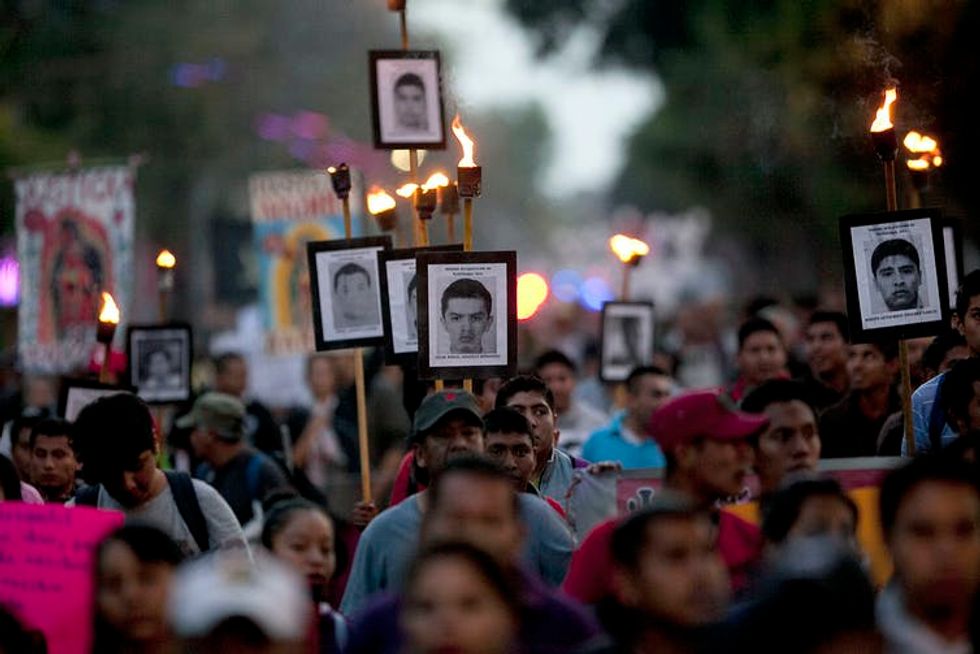
For the past four years, these events have coincided with nationwide demonstrations over the unexplained disappearance of 43 student activists from Ayotzinapa Teachers’ College, in the southern Mexican state of Guerrero, on Sept. 26, 2014.
The students were traveling via bus to Mexico City to attend a commemorative rally for the victims of Tlatelolco and engage in civil acts of disobedience along the way – an annual tradition at the college.
According to the government’s official investigation, police in the town of Iguala confronted the caravan under instructions from the town’s mayor. His wife had a party that day, the report says, and he didn’t want any disturbances.
Mexicans march to demand the return of the 43 teachers college students who disappeared in 2014.
The officers opened fire, killing six students on the bus. The remaining 43 passengers were then allegedly taken to a police station, where they were handed over to a local drug gang, Guerreros Unidos, which is alleged to have ties to the mayor. Gang members say they took the 43 students to a local dump, killed them and burned their bodies.
That horrifying tale is the official story endorsed by President Enrique Peña Nieto, whose six-year term ends in December. Iguala’s mayor, his wife and at least 74 other people were arrested for the disappearance and murder of the Ayotzinapa students.
They believe it is more likely that the Mexican army – and therefore the federal government – was involved in the disappearances.
In June 2018, a federal court re-opened the Ayotzinapa case and ordered the creation of an Investigative Commission for Justice and Truth to clarify what really happened to the 43 students.
“They were taken alive,” their parents insist. “We want them back alive.”
Transforming Mexico, again
Forty-six years after the Tlatelolco massacre, almost to the day, this brutal abuse of power by President Peña Nieto and his PRI party – which had retaken power in 2012 – rekindled something of the revolutionary spirit of 1968.
In July, Mexican voters once again rejected the PRI, handing a landslide presidential victory to Andrés Manuel López Obrador, a leftist outsider who promised to “transform” the country.
But he also plans to continue using Mexico’s military – the same efficient killing force that fired on students at Tlatelolco and allegedly disappeared them in Ayotzinapa – in law enforcement duties.
This, in my assessment, is a dangerous mistake.
According to an analysis done by Mexico’s CIDE university, between 2007 and 2014, in armed confrontations the army killed eight suspected criminals for each one it wounded and arrested. In most countries, the ratio goes the other way.
As CIDE legal scholar Catalina Pérez Correa has written, using Mexico’s army as police carries the same risks today it did in 1968 – and in 2014, for that matter.
President-elect López Obrador has declared that under his government Mexico’s military will be not an “instrument of war” but an “army of peace.”
The ghosts of Tlatelolco and Ayotzinapa are a reminder that all Mexicans should have their doubts.
Humans aren’t the only people in society – at least according to the law. In the U.S., corporations have been given rights of free speech and religion. Some natural features also have person-like rights. But both of those required changes to the legal system. A new argument has laid a path for artificial intelligence systems to be recognized as people too – without any legislation, court rulings or other revisions to existing law.
Legal scholar Shawn Bayer has shown that anyone can confer legal personhood on a computer system, by putting it in control of a limited liability corporation in the U.S. If that maneuver is upheld in courts, artificial intelligence systems would be able to own property, sue, hire lawyers and enjoy freedom of speech and other protections under the law. In my view, human rights and dignity would suffer as a result.
The corporate loophole
Giving AIs rights similar to humans involves a technical lawyerly maneuver. It starts with one person setting up two limited liability companies and turning over control of each company to a separate autonomous or artificially intelligent system. Then the person would add each company as a member of the other LLC. In the last step, the person would withdraw from both LLCs, leaving each LLC – a corporate entity with legal personhood – governed only by the other’s AI system.
That process doesn’t require the computer system to have any particular level of intelligence or capability. It could just be a sequence of “if” statements looking, for example, at the stock market and making decisions to buy and sell based on prices falling or rising. It could even be an algorithm that makes decisions randomly, or an emulation of an amoeba.
An interview with Sophia, a robot citizen of Saudi Arabia.
In certain places, some people might have fewer rights than nonintelligent software and robots. In countries that limit citizens’ rights to free speech, free religious practice and expression of sexuality, corporations – potentially including AI-run companies – could have more rights. That would be an enormous indignity.
Artificial intelligence systems could be tasked with law enforcement among human populations – acting as judges, jurors, jailers and even executioners. Warrior robots could similarly be assigned to the military and given power to decide on targets and acceptable collateral damage – even in violation of international humanitarian laws. Most legal systems are not set up to punish robots or otherwise hold them accountable for wrongdoing.
What about voting?
Granting voting rights to systems that can copy themselves would render humans’ votes meaningless. Even without taking that significant step, though, the possibility of AI-controlled corporations with basic human rights poses serious dangers. No current laws would prevent a malevolent AI from operating a corporation that worked to subjugate or exterminate humanity through legal means and political influence. Computer-controlled companies could turn out to be less responsive to public opinion or protests than human-run firms are.
Immortal wealth
Two other aspects of corporations make people even more vulnerable to AI systems with human legal rights: They don’t die, and they can give unlimited amounts of money to political candidates and groups.
Politicians financially backed by algorithmic entities would be able to take on legislative bodies, impeach presidents and help to get figureheads appointed to the Supreme Court. Those human figureheads could be used to expand corporate rights or even establish new rights specific to artificial intelligence systems – expanding the threats to humanity even more.
The U.S. is not the only place where the advance of racism and misogyny in politics has has spurred black women to run for office at unprecedented levels.
I’m a scholar of black feminism in the Americas, so I have been closely watching Brazil’s 2018 campaign season – which has been marked by controversy around race and gender – for parallels with the United States.
Brazil has shifted rightward since 2016, when the left-leaning female president Dilma Rousseff was ousted in a partisan impeachment process that many progressives regard as a political coup.
Her successor, then-Vice President Michel Temer, quickly passed an austerity budget that reversed many progressive policies enacted under Rousseff and her predecessor, Workers Party founder Luís Inácio “Lula” da Silva.
The move decimated funding for agencies and laws that protect women, people of color and the very poor.
Racism in Brazil
In Brazil, these three categories – women, people of color and the very poor – tend to overlap.
Brazil, which has more people of African descent than most African nations, was the largest slaveholding society in the Americas. Over 4 million enslaved Africans were forcibly taken to the country between 1530 and 1888.
Brazil’s political, social and economic dynamics still reflect this history.
Afro-Brazilians – who make up just over half of Brazil’s 200 million people, according to the 2010 census – are also underrepresented in Brazilian politics, though sources disagree on exactly how few black Brazilians hold public office.
This year, 9,204 of the 27,208 people running for office across Brazil are women, which reflects a law requiring political parties to nominate at least 30 percent women. About 13 percent of female candidates in 2018 are Afro-Brazilian.
A campaign ad for Rio city council member Talíria Petrone, who is running for Congress.
In São Paulo, Brazil’s most populous state, 105 black women ran for office in 2014. This year, 166 are. In Bahia state, there are 106 black female candidates for political office, versus 59 in 2014. The number has likewise doubled in Minas Gerais, from 51 in 2014 to 105 this year.
As in the United States, Brazil’s black wave may be a direct response to alarming social trends, including sharp rises in gang violence and police brutality, both of which disproportionately affect black communities.
But many female candidates in Rio de Janeiro, Brazil’s second largest city, say one specific event inspired them to run.
Her death unleashed an avalanche of activism among black women in Rio de Janeiro, with new groups offering fundraising and political training for female candidates of color.
On Sunday, 231 black women from Rio de Janeiro state will stand for election in local, state and federal races – more than any other state in Brazil and more than double the number who ran in 2014.
Brazil has hundreds of black women’s groups. Some, including Geledes, a center for public policy, are mainstays of the Brazilian human rights movement. The founder of the Rio de Janeiro anti-racism group Criola, Jurema Werneck, is now the director of Amnesty International in Brazil.
The fact that thousands of black women, both veteran activists and political newcomers, will appear on the ballot on Sunday is testament to their efforts.
As in the United States, black Brazilian women’s demand for political representation is deeply personal. They have watched as their mostly male and conservative-dominated congresses chipped away at hard-won protections for women and people of color in recent years, exposing the fragility of previous decades’ progress on race and gender.
Black women in Brazil and the U.S. know that full democracy hinges on full participation. By entering into politics, they hope to foster more inclusive and equitable societies for all.
The three 2018 Nobel Prize winners for chemistry were recognized for inventing fast and reliable methods for “hacking” evolution – techniques that have transformed scientific research and have already led to better drug treatments, greener and more efficient chemical manufacturing processes, and more economical biofuels.
Thanks to these inventions, what nature takes millennia to do, can now be performed by chemists in weeks or less. What’s more, these prize-winning methods form what I regard as a final proof for the molecular basis for Charles Darwin’s theory of evolution.
The Nobel Prize in chemistry was split between Frances H. Arnold and George P. Smith and Sir Gregory P. Winter; the latter two received the
other half. I will admit my bias toward Frances H. Arnold whose technology the Nobel Committee recognized – on the directed evolution of enzymes, which are proteins that catalyze chemical reactions – because much of my own work has been built on it. Smith and Winter also used evolution to fast-track the development of proteins and antibodies with desirable properties. They harnessed the power of viruses to exponentially increase the scale of directed evolution envisioned by Arnold and expanded it to the development of protein-based therapeutics like Humira for chronic pain.
A stamp printed by Congo, shows an early ancestors of the modern elephant.
To explain it simply, both methods generate a broad variety of proteins in the lab and then use un-natural selection – that is, selecting the protein with the most desirable qualities – and then mutating this new protein in the lab to make it better and better. In that way, it’s a molecular version of evolution. Darwinian evolution created the modern elephant’s trunk from a stubby nose by the repeated processes of natural genetic mutation and survival of the fittest; directed evolution creates new enzymes from natural occurring ones by iterative cycles of mutation and selection.
Survival of the fittest - molecules
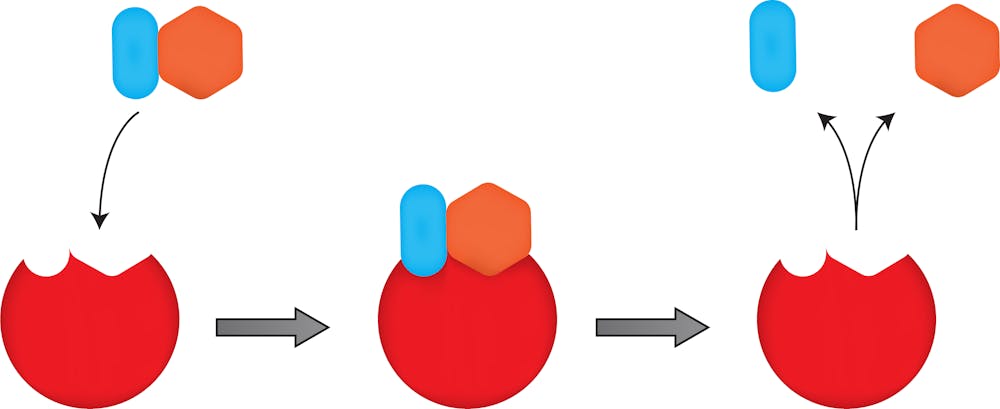
In high school biology, we learn about the “lock-and-key” concept of enzymes. In this model, enzymes, which are nature’s biocatalysts that speed up chemical reactions, are the “locks” evolved to connect with a natural target molecules – the “keys” – to complete a specific chemical reaction.
If you want an enzyme to do something new, something unnatural, like selectively insert an oxygen atom into a molecule to manufacture a valuable drug, you are unlikely to find that enzyme in nature.
The lock (red) and key (blue-orange) model of an enzyme. In nature, enzymes that fit only one key take millions of years to evolve. Arnold figured out how to speed up the evolution of the enzymes to perfectly match the target she was trying to alter.
Arnold’s approach is to take an enzyme from nature and then transform it – through laboratory evolution – into one that performs the reactions that interest her. She does this by taking the gene that encodes the enzyme and putting it through the biological equivalent of an error-prone Xerox copier, which then duplicates the gene millions of times but inserts mutations randomly throughout.
Arnold then took these millions of poorly copied genes and inserted each one into a different bacterium. This collection of bacteria is called a gene library. Because each of the genes is mutated in a different way, the enzyme each bacterium produces when it is fed and grows will be slightly different. The challenge is to find the bacterium that carries the enzyme with the most desirable qualities.
For example, say you have an industrial process that requires an enzyme that works at high temperatures, but the natural enzyme falls apart under these extreme conditions. You would make thousands of random copy mutants, test them each to see if they perform at a high temperature, pick the winners and repeat the process with the winner. That’s an iterative process of mutation and selection, just like natural evolution.
Frances Arnold, George Smith and Gregory Winter won the 2018 Nobel Prize for chemistry.
It is not unlike what it took to breed wolves into miniature dachshunds over the last tens of thousands of years. In this case, sexual reproduction is used by breeders to create gene variations and then selected traits they wanted, over many generations to arrive at the various dog breeds. Arnold figured out how to do that on a single-enzyme scale. In this way, the enzyme lock ends up changed to fit a new molecular key.
One of the first examples Arnold demonstrated as proof of concept was a little scary. She started with an enzyme responsible for drug resistance that chews up penicillin drugs and forced it to evolve to chew up a newer generation of penicillins, in this case, a more advanced antibiotic.
In this way she sped up the evolutionary clock for antibiotic resistance in a test tube. Since then, the same principle of directed evolution has been adopted to create enzymes with many useful new functions, for instance to evolve enzymes to make biofuels and drugs. Drugs now made using enzymes generated by directed evolution include the blockbuster cholesterol lowering drug atorvastatin (lipitor) and the diabetes drug sitagliptin (Januvia).
Evolution with help from viruses
Arnold shares the Nobel Prize with Smith and Winter, who invented ways to attach or “display” proteins and antibodies of interest on the surface of special virus particles, called bacteriophage. Using viruses rather than bacteria, as Arnold had done, was a different approach for identifying a gene that encoded a protein with particularly valuable qualities. This method is particularly useful for finding proteins that bind to a target protein, such as the target of a drug.
Each virus in a phage library displays a different protein on its surface. The viruses expressing the most desirable proteins are identified through several complex steps. The “winning” viruses then go through multiple cycles of mutation and testing and selection to yield proteins that fit and bind perfectly to their target.
The advantage of using viruses to display the proteins with the desired properties miniaturizes the selection process and allows you to process millions of mutated genes to find the one that best fits the job, as compared to only thousands of mutated genes using bacteria.
This technology has had the greatest impact on antibody therapies. Antibodies are molecules our immune system uses to bind and kill pathogens and naturally clear dying cells. But scientists are increasingly using them to bind to drug targets to treat various diseases. Adalimumab (Humira) is an example of a therapeutic antibody used in treatment of rheumatoid arthritis.
With each subsequent generation, the antibodies evolve and and better fit their target protein. With each generation, the fit between antibody and target grows stronger and more specific.
From single enzymes to evolving concerts of enzymes
I started off my own career in chemical synthesis, which is developing ways to make chemicals atom by atom in a round-bottomed flask. This is challenging work and I came to realize that organisms makes complex chemicals seemingly effortlessly as they grow, so I wanted to learn how to adapt nature’s enzyme catalysts – the tools that life uses to do chemistry – to synthesize useful unnatural molecules.
Around the mid-1990s, Arnold’s research showed me that we could ultimately use this nature-inspired method of directed evolution to improve the function of single enzymes to get them to perform chemistry they could not do naturally, millions of times faster, and get them to perform chemistry we could not do by any means.
I wondered: If doing a single biotransformation, converting A to B, is a powerful thing, could we find a way to generate pathways to connect three, four or even five or more steps, converting steps A to E and beyond in a single test tube? If one biocatalyst is a good thing, how about a molecular assembly line inside of cells for a non-natural molecule such as an AIDS drug. We called our pathway directed evolution technique bioretrosynthesis, because we start with the last step and work to the first.
In a paper published in Nature Chemical Biology, we described how we reverse engineered a five-step molecular production line to synthesize the AIDS drug Didanosine using Arnold’s bacterial method.
Currently this drug is made using chemical processes and is very expensive. Our proof of principle showed the cost could be lessened by using a starting material that is 30-fold less expensive and using enzymes created through directed evolution to do the hard work.
One of the most exciting things to me about this Nobel breakthrough is that it provides a direct proof of Darwin’s theory of evolution, at the molecular scale, from gene to physical trait. This theory, supported by the observations of gradual changes in the fossil record over geological timescales, can now be witnessed in the lab over the course of just a few weeks to make incredibly useful tools that benefit humanity.
Frances Arnold, after she received the news learning she won the Nobel Prize for chemistry, explains how she mimics nature and began using evolution to design powerful proteins.
The #MeToo campaign has given mostly Western women confidence to speak up about violence at the hands of men, but in Africa women say stigma and victim-blaming still keep many silent.
Fiercely patriarchal societies and religious and traditional views on the role of women means even complaining about domestic violence is an uphill battle, let alone bringing down abusive men in power, activists say.
In Kenya, a confident and bubbly 40-year-old psychologist -- who, tellingly, asked to remain anonymous -- told AFP she was stunned when a former boyfriend slapped her in the face in front of his family.
Their reaction was that he had a "hot temper".
Later, much to her surprise, five of her close friends revealed they too had been abused in relationships.
"If even that is 'normal' and we don't talk about it, how does the #MeToo movement... how do we interact with that?" she asked.
GETTY IMAGES NORTH AMERICA/AFP/File / DAVID MCNEWThe #MeToo campaign has given mostly Western women confidence to speak up about violence at the hands of men
Like others interviewed by AFP, she said the #MeToo movement had prompted more discussions about women's rights and sharing stories of sexual assault, but mostly in private WhatsApp groups or Facebook chats rather than publicly.
"The issues definitely affect (us) but the blame is always shifted back onto the woman, that it is her fault, her dressing, her speech or she needs to be taught a lesson because she is too strong," said the psychologist.
"It's not only men, but women who are thinking that way."
- 'A little beating shows love' -
Nevertheless, in the year since #MeToo went viral, there have been cases in which women have spoken up or refused to be silenced.
In March in Uganda, angry women took to Twitter to call for the resignation of MP Onesmus Twinamasiko who gave a television interview encouraging men to beat their wives to "discipline" them.
AFP / Isaac KasamaniUgandan blogger and activist Rosebell Kagumire says African mindsets need a radical makeover
"Yeah, you need to do a little beating, it shows the love even," he said.
He later apologised, but did not face any consequences.
His view is not uncommon in Uganda. A government report published in 2016 showed that one in five female Ugandans between the age of 14 and 49 had reported physical or sexual violence within a 12-month period.
When female lawmaker Sylvia Rwabwogo pressed charges against a man who stalked and harassed her for eight months leading to his jailing in June for two years, she faced a backlash of criticism and mockery from Ugandans sympathising with the "lovestruck" student.
"The fact we can attack an MP who has been a victim of sexual harassment... instead of asking ourselves what is wrong here, we are not yet there," said activist Rosebell Kagumire.
- Sex for marks -
As discussions about male abuse of power trickle through, an increasing number of reports have emerged of university lecturers in Uganda, Kenya and Nigeria coercing female students into having sex with them for higher marks.
In Uganda this led to several suspensions this year, while in Sierra Leone 71 people -- including teachers and pupils -- were arrested last month for "exam malpractice".
AFP / Isaac KasamaniFiercely patriarchal societies and religious and traditional views on the role of women means even complaining about domestic violence is an uphill battle
"One of my science teachers demanded sex for a favourable grade after our final exams a year ago," a second-year student at the Freetown Teachers College told AFP on condition of anonymity.
A secondary school pupil, named Elizabeth, said she had faced several sexual advances but "never complained about it for fear of reprisals from teachers".
A report on the safety of girls and young women released this week by Plan International listed Johannesburg, Kampala, Lima, Nairobi and Bamako as the top five most risky cities in the world for sexual assault and rape.
Kampala was the most dangerous for kidnap and murder, and Kampala and Nairobi were fifth and sixth respectively in terms of risk of sexual harassment.
- Traumatic justice system -
Wangechi Wachira, head of the Centre for Rights Education and Awareness (CREAW) in Kenya, said that while the #MeToo movement resonated with women, many were unwilling to follow through with complaints due to an unsympathetic justice system, lack of support and burden of proof being on the victim.
"The whole system that needs to be supporting you is trying to traumatise you more," she said.
Most workplaces do not even have mechanisms to deal with sexual harassment complaints, she added.
Monica Godiva Akullo, a Ugandan lawyer and activist, pointed out that many of the challenges faced by African women were global, despite the #MeToo movement coming from "rich, famous women".
She referred to the case of US Supreme Court nominee Brett Kavanaugh, whose alleged sexual assault victim Christine Blasey Ford was mocked by President Donald Trump himself at a political rally.
"From Uganda to the US, our societies still don't believe women," she said.




 AFP / Kun TIAN
 AFP/File / Marc JOURDIER
 DPA/AFP/File / Julian Stratenschulte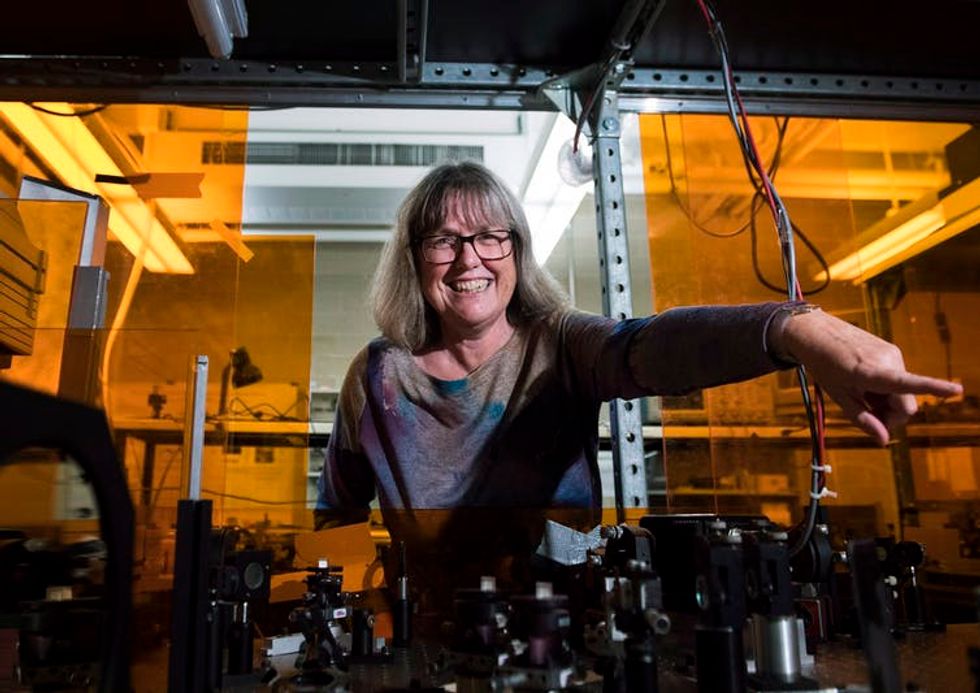









 GETTY IMAGES NORTH AMERICA/AFP/File / DAVID MCNEW
 AFP / Isaac Kasamani
 AFP / Isaac Kasamani

