Canada and the United States showed scant sign of being close to striking a deal on revamping the trilateral NAFTA that underpins $1.2 trillion in annual trade, as Canadian sources played down talk of a U.S. quota on autos.
Canada says it does not feel bound by a U.S.-imposed deadline for the end of September to conclude a deal.
While multiple deadlines have been and gone during the more than year-long negotiations to renew NAFTA, pressure on Canada to agree to a deal is growing, partly to push it through Congress before Mexico’s new government takes office on Dec. 1.
Trump, who struck a side-deal with third NAFTA member Mexico last month, has threatened to exclude Canada if necessary. He also warned of tariffs on Canadian autos exports.
Canadian Foreign Minister Chrystia Freeland has held talks with U.S. Trade Representative Robert Lighthizer in each of the last four weeks and on Thursday opened another round.
A senior Canadian labor leader briefed on the negotiations told Reuters that an immediate breakthrough was unlikely.
“We’ve made progress according to the briefing I got but of course there is no agreement and there are some predictable issues that need to be resolved,” said Hassan Yussuff, president of the Canadian Labour Congress.
Yussuff said a standoff over how to settle disputes was “a critical issue”. The two sides are also at odds over U.S. demands for more access to Canada’s dairy market.
The uncompromising tone by Trump, who came to power last year threatening to tear up NAFTA unless major changes were made to a pact he blames for the loss of manufacturing jobs, has stoked market fears about the potential damage to three nations’ highly integrated economies.
The Globe and Mail newspaper on Thursday reported that U.S. negotiators want Ottawa to agree to capping its auto exports to the United States at 1.7 million vehicles a year, something that Canadian industry sources dismissed as unacceptable.
“Canada absolutely ... would not agree to a self-imposed quota,” said a source familiar with the talks.
Separately, a Canadian source directly familiar with the negotiations said “we have not discussed a cap”.
As part of the bilateral deal between Mexico and the United States, the Mexican side agreed to limit its exports of autos and SUVs.
Freeland plans to return to Canada on Thursday ahead of a two-day meeting of female foreign ministers she is co-hosting in Montreal on Friday and Saturday. Next week she will be in New York for a United Nations session.
Additional reporting by Dave Graham in Mexico City and Allison Lampert in Montreal; Editing by Susan Thomas
A French court ordered Marine Le Pen to submit to a psychiatric evaluation as part of its investigation into her decision to post images of Islamic State executions on Twitter, the far right leader said on Thursday and denounced the order.
The investigation is one of a series that have distracted Le Pen’s National Rally, formerly known as the National Front, as it seeks to rebuild after her loss to President Emmanuel Macron in the second round of an election last year.
The investigation relates to three graphic images of Islamic State executions Le Pen posted on Twitter in 2015, including the beheading of American journalist James Foley.
The tribunal declined to confirm it had ordered the evaluation but said the assessments were a normal part of such probes.
“I thought I had seen it all: but no! For having denounced the horrors of #Daesh in tweets, the ‘justice’ is submitting me to a psychiatric evaluation! How far will they go?” Le Pen wrote on Twitter. “It’s UNBELIEVABLE.”
She later told reporters she would skip the test. “I’d like to see how the judge would try and force me do it,” she said.
Le Pen’s criticism fits the party’s narrative that it is persecuted by judges as part of an attempt by the establishment to undermine it politically.
Le Pen was placed under formal investigation in March on suspicion of disseminating violent images. The law states that medical evaluations must be carried out in such probes.
Le Pen and her party have been targeted by a series of other judicial probes, including over the alleged misuse of EU funds.
According to a copy of the court document dated September 11, which Le Pen published on Twitter, the judge wants the evaluation to assess if she suffers from any mental illness and, if so, if that could have affected her understanding of what she was doing when she posted the tweets.
The expert is also tasked with determining whether her mental health could be a risk to the public.
Le Pen’s hard-left rival Jean-Luc Melenchon said the evaluation was unnecessary because Le Pen was “politically responsible for her political acts.”
“This is not how we will weaken the far-right,” he said.
Italy’s Interior Minister Matteo Salvini said in a statement: “A court orders a psychiatric assessment for Marine Le Pen. Words fail me! Solidarity with her and with the French who love freedom!”
Reporting by Ingrid Melander and Simon Carraud; Additional reporting by Crispian Balmer in Rome; Editing by Richard Lough and Matthew Mpoke Bigg
Seismologists, too, are still studying the Sept. 19 earthquake, trying to better understand what’s happening underneath Mexico City. Our recent paper, published in Geophysical Research Letters in March, brings critical findings to light.
After the damaging quake, we analyzed data from the national network of seismological sensors, as well as high-quality GPS stations around the country. Together, these instruments measure shaking across Mexico. We wanted to know what caused this magnitude 7.1 earthquake and whether a future shock could strike even closer to this city of 20 million.
That catastrophe marked an entire generation of Mexicans, including ourselves, back when we were just kids.
Now, as working seismologists, we have discovered that the 2017 earthquake, called Puebla-Morelos, was fundamentally unlike its 1985 predecessor. In fact, it was different than most big Mexican earthquakes, which typically happen along the country’s Pacific coast, where two tectonic plates collide.
The Puebla-Morelos quake occurred well inland – just 70 miles south of Mexico City, in Puebla state. Since the 1920s, only five other large earthquakes have originated in central Mexico.
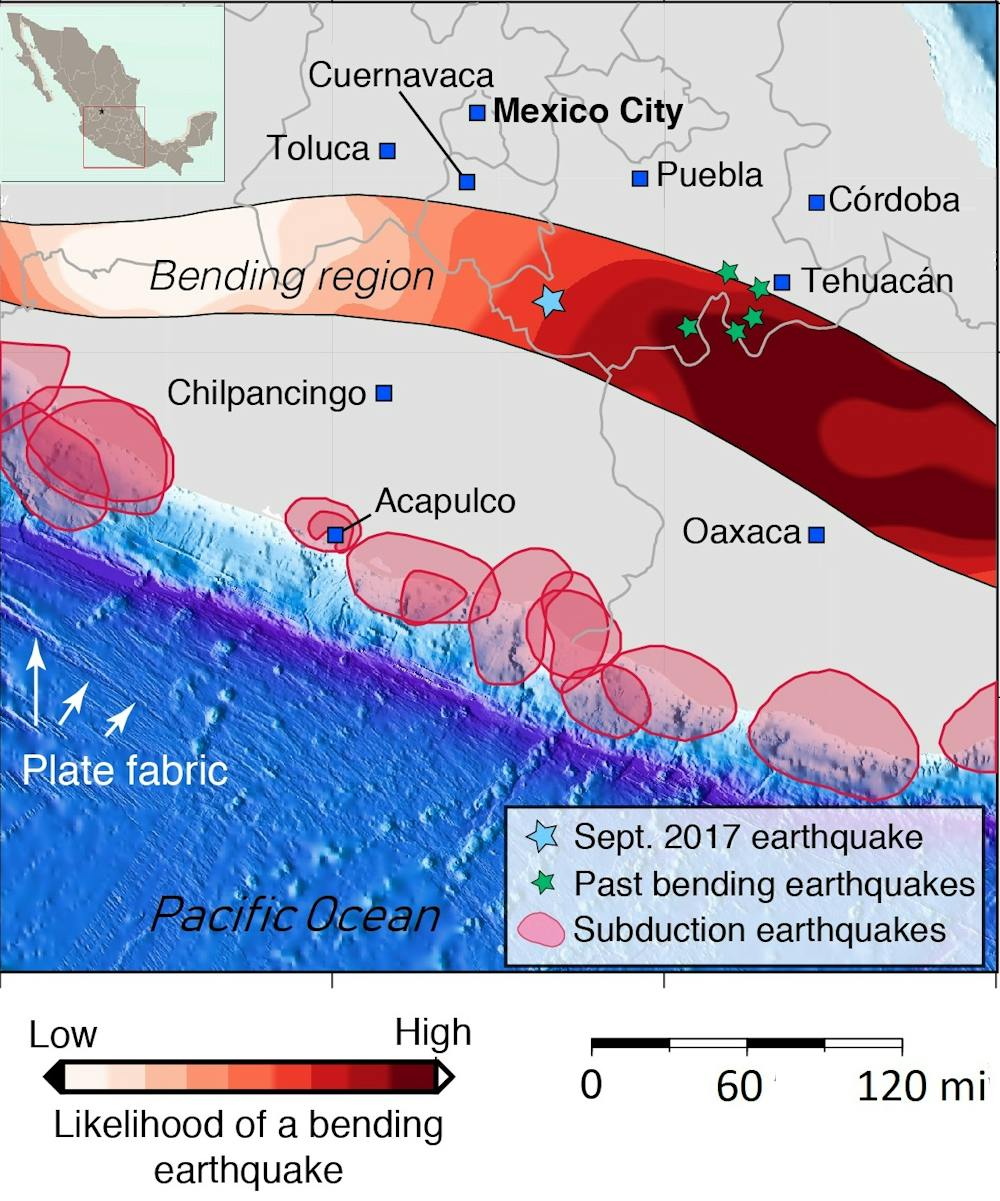
The zone of potential ‘bending’ earthquakes, where the subducted tectonic plate that runs beneath Mexico juts downward at a sharp angle, is a band spanning the country from center to south. Only five earthquakes have struck this region in the past century, including the deadly Sept. 18, 2017 quake that killed 300 in Mexico City. Major earthquakes typically occur along the Pacific coast.
Most major earthquakes worldwide happen along the unstable intersections in the Earth’s crust, where two tectonic plates – that is, the underground slabs that make up the planet’s rocky shell – collide, one plate sliding beneath the other.
These are called subduction zones, and continued plate movements in those areas are responsible for the world’s largest earthquakes – the kinds that occasionally rattle Alaska, Japan, Chile and Indonesia.
At most subduction zones, after one tectonic plate slides beneath a neighboring plate, it continues on a diagonal downward dive and sinks deep into the Earth’s mantle.
Not in Mexico. There, the initial contact between the two tectonic plates – which collide off the country’s southern Pacific coast – starts off normally enough, with the subducted plate sinking diagonally downwards.
But then, just as it begins to jut underneath the Mexican mainland, the plate – which is made of dense, heavy rocks – reverses course. It bends upward, sliding itself horizontally beneath the plate Mexico sits on top of. This setup continues for about 125 miles or so.
Then, underneath Puebla state – just south of Mexico City – at a depth of about 30 miles below ground, the subducted plate abruptly changes direction once more. It dives almost vertically downward, plunging itself deep into the Earth’s mantle.
What is a ‘bending’ quake?
When the plate bends downward, some of the rocks in the plate break. Think of a sturdy piece of wood. Flexed lightly, it bends. But when the flexing becomes too strong, it will splinter violently.
This is what causes “bending” earthquakes like Mexico City’s. After the bent tectonic plate snaps, seismic waves emanate outwards from the breaking point, causing the Earth to tremble. The closer you are to the epicenter, the stronger the shaking.
This kind of rare Mexican quake typically has a relatively lower magnitude than the more common Pacific coast variety. But that doesn’t mean the shaking above ground feels weak. Because “bending” quakes strike in Mexico’s densely populated central region, beneath the feet of many millions, the shaking can be very strong indeed.
And when they hit near Mexico City, as September 2017 demonstrated, the consequences can be devastating.
It is here – from Michoacán state, part way up the Pacific coast, all the way down to southernmost Oaxaca – that bending earthquakes could occur.
But the tectonic plate’s bend, we learned, is only half of the story behind central Mexico’s shaking. The plate’s texture matters, too.
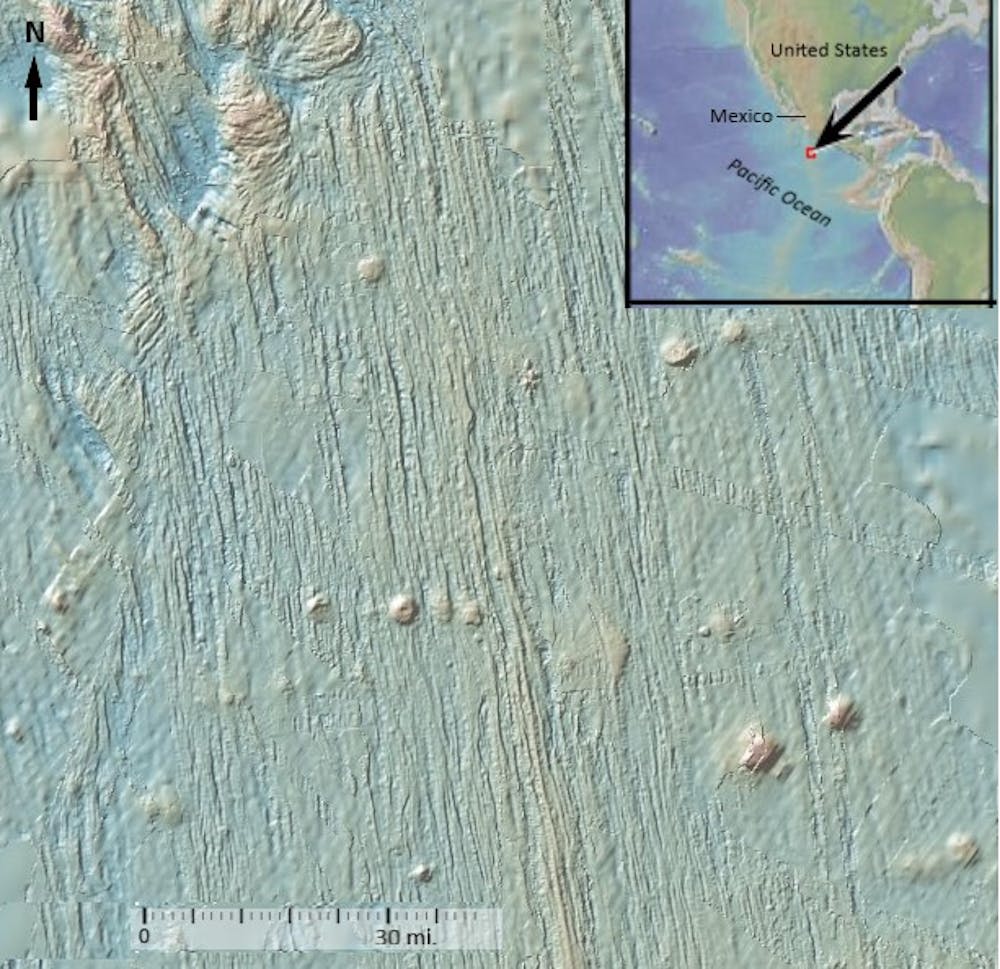
High-resolution images of the ocean bottom off Mexico’s Pacific shore reveal that the seafloor terrain is rugged in a very organized fashion. There, beneath thousands of feet of water, we see high, narrow ridges and deep valleys that run lengthwise in a northwest-to-southeast direction.
This “fabric” was created about 8 million years ago, when the rocks first formed – way before tectonic plates collided to give Mexico its subduction zone. Even so, the plate’s texture – marked by this linear fabric of underground mountains and canyons – turns out to be relevant in determining where these rare, bending earthquakes might occur.
High-resoulution images of the Pacific Ocean seafloor off Mexico’s coast reveals that the subducted plate there has a linear texture comprised of ridges, valleys and bumps. This ‘fabric’ continues when the plate slides beneath the Mexican mainland and then angles downward, plunging itself into deep into the Earth’s mantle. ‘Bending’ earthquakes are most likely to occur where the plate bends in the same northwest-to-southeast direction as its ridges and valleys run.
Our research found that because its ridges and valleys are oriented uniformly – think of the grain on a sturdy piece of wood – a tectonic plate is far less likely to snap if the force that bends it is at an angle perpendicular to the direction the fabric runs. Like a sheet of plywood, a tectonic plate is more resistant to pressure when bent against the grain.
In other words, large, damaging “bending” earthquakes are most likely to occur where the subducted plate’s own texture aligns with the direction of its downward bend.
This is good news for cities like Morelia, in Michoacán, where we believe the plate’s fabric runs almost perpendicular to the direction of the plate’s break – the wrong setup for a strong earthquake.
But it is bad news for neighboring Puebla and Oaxaca. There, plate texture and plate bend are almost perfectly aligned – off by less than 10 degrees. Under such circumstances, the bent plate can more easily snap and break from continued tectonic movement.
What’s in store for Mexico City?
The part of the plate bend near Mexico City, where the Sept. 19 quake occurred, falls somewhere in between. The alignment between texture and plate is not perfect – but they’re off angle by just 20 to 30 degrees.
That means the capital could see another large quake. And, based on our analysis, the epicenter could actually be closer to the city: This volatile tectonic band extends as far north as the city of Cuernavaca, 30 miles from Mexico City’s southern edge.
These findings are a step forward in understanding Mexico’s complex geology. But we still don’t know how often “bending” earthquakes might happen – whether once a century or every decade. Seismologists worldwide are still far from being able to predict where, when and how the next big one will strike.
What our new study can do, we hope, is help Mexicans nationwide understand what’s happening beneath their feet.
This article has been updated. It was originally published on March 12, 2018.
The United States said it was ready to resume talks with North Korea after Pyongyang pledged on Wednesday to dismantle its key missile facilities and suggested it would close its main Yongbyon nuclear complex if Washington took unspecified actions.
U.S. Secretary of State Mike Pompeo said he had invited North Korea’s foreign minister to meet in New York next week, with the aim of completing its denuclearization by January 2021, after a Pyongyang summit between the leaders of the two Koreas.
The United States appeared eager to seize on commitments by North Korean leader Kim Jong Un at his talks with South Korean President Moon Jae-in even as critics said the steps did little to put Pyongyang on a course for irreversible denuclearization.
North Korea will allow experts from “concerned countries” to watch the closure of its missile engine testing site and launch pad at Tongchang-ri, Moon said at a joint news conference with Kim after their meeting in the North Korean capital.
North Korea will also take additional steps such as closing its main Yongbyon nuclear complex if the United States undertook unspecified reciprocal measures, Moon added.
The sudden revival of diplomacy followed weeks of doubts in U.S. President Donald Trump’s administration’s about whether North Korea was willing to negotiate in good faith after a June summit between Trump and Kim yielded few tangible results.
The January 2021 completion date was the most specific deadline set in what is expected to be a long process of trying to get the North to end its nuclear program, which may threaten U.S. allies South Korea and Japan as well as the U.S. homeland.
In addition to inviting North Korean Foreign Minister Ri Yong Ho to meet when both are in New York next week for the annual U.N. General Assembly gathering of world leaders, Pompeo said Washington invited Pyongyang’s representatives to meet the U.S. special representative for North Korea, Stephen Biegun, in Vienna at the “earliest opportunity.”
China, North Korea’s most important economic backer and diplomatic ally, said it warmly welcomed the agreement reached in Pyongyang and strongly supported it.
“We absolutely cannot let this hard to come by opportunity for peace slip away once again,” the Chinese government’s top diplomat, State Councillor Wang Yi, said in a statement.
SKEPTICISM
Some U.S. officials were deeply skeptical. Speaking before Pompeo’s announcement, two senior U.S. officials involved in U.S.-North Korea policy voiced fears Kim was trying to drive a wedge between Washington and Seoul.
At the summit, the two Koreas agreed on plans to resume economic cooperation, including working to reconnect rail and road links. They agreed as well to restart a joint factory park in a border city of Kaesong and tours to the North’s Mount Kumgang resort, when conditions are met.
U.S. officials suggested Kim was trying to ease the economic pressure on him to curb his nuclear programs and to undercut the rationale for U.S. troops being based in South Korea by improving relations with Seoul.
The United States has some 28,500 U.S. troops in South Korea to deter North Korean attack. Pyongyang has long sought their withdrawal and Trump has questioned their rationale and cost.
“There is nothing the North has offered so far that would constitute irreversible movement toward denuclearization, however you define that, by January 2021 or any other time, or even a reduction of the military threat it poses to the South and the region,” said a U.S. intelligence official.
“Everything that’s out there now is conditional on U.S. actions that would reduce the pressure on the North to cooperate or (is) filled with loopholes and exit ramps,” added the official, who spoke on condition of anonymity.
U.S. officials said the ambiguity about what Washington was supposed to do for the North to close its nuclear complex at Yongbyon gave Kim room to argue that Washington had not done enough for North Korea to follow through on its pledges.
TRUMP: ‘HE’S CALM, I’M CALM’
Even if North Korea were to shut down Yongbyon, officials and experts believe it has other secret nuclear facilities.
South Korea’s national security adviser, Chung Eui-yong, said the reciprocal U.S. steps could include an end-of-war declaration. South Korea and the United States remain technically at war with North Korea because the 1950-53 Korean War ended in an armistice and not a peace treaty.
Though Wednesday’s inter-Korean agreement failed to stipulate the North’s commitment to declare nuclear and missile facilities for inspection and eventual decommissioning, Seoul has been in talks with both Pyongyang and Washington over the issue, a senior South Korean official said.
“What North Korea really wants and their priorities may be different from ours,” the official told reporters on Thursday on condition of anonymity.
“We’re talking about a package that would carry many elements, including the declaration of the facilities, Yongbyon and Tongchang-ri, which are of U.S. interest, and from the North side, the issues of normalizing relations, ending the war and easing sanctions.”
Despite the doubts of U.S. officials and outside analysts, North Korea’s pledge at the summit with the South Korean president drew an enthusiastic response from Trump.
Speaking before Pompeo’s comments, Trump welcomed Kim’s pledges, calling them part of “tremendous progress” with Pyongyang on a number of fronts, and hailing “very good news” from the summit between the Koreas.
“He’s calm, I’m calm - so we’ll see what happens,” Trump, who last year threatened to destroy North Korea, told reporters.
‘THEATRICAL PROMISES’
Kim pledged to work toward the “complete denuclearization of the Korean peninsula” during two meetings with Moon earlier this year and at his summit with Trump.
But discussions over how to implement the vague commitments have since faltered and North Korea has consistently refused to give up its nuclear arsenal unilaterally.
Washington has demanded concrete action, such as a full disclosure of North Korea’s nuclear and missile facilities, before agreeing to Pyongyang’s key goals, including an easing of international sanctions and an official end to the Korean War.
While North Korea has stopped nuclear and missile tests in the past year, it did not allow international inspections of its dismantling of its Punggye-ri nuclear test site in May, drawing criticism that its action was for show and could be reversed.
The day after the June 12 Trump-Kim summit, Pompeo said he hoped to achieve “major disarmament” by North Korea by the end of Trump’s first term in January 2021.
His latest statement that the process “should be completed by January 2021” may be a signal Washington will not wait forever.
“The statement clearly implies that inter-Korean summits and theatrical promises to dismantle the odd facility simply can’t substitute for a negotiating process on the nuclear issue,” said the Asia Society Policy Institute’s Daniel Russel.
“Invoking the end of Trump’s term in January 2021 is another way of saying to the North that American patience is not unlimited and that Kim Jong Un won’t be able to sidestep denuclearization indefinitely,” Russel added.
Reporting by Lesley Wroughton in Washington and Hyonhee Shin in Seoul; Additional reporting by Joyce Lee, Soyoung Kim and Joint Press Corps, Jeongmin Kim, Haejin Choi and Ju-min Park in Seoul, Ben Blanchard and Zhang Min in Beijing, and Roberta Rampton, David Brunnstrom and John Walcott in Washington; Writing by Yara Bayoumy and Arshad Mohammed; Editing by David Gregorio, Peter Cooney and Lincoln Feast.
Fifty years after creating the Che Guevara poster that still adorns student bedrooms around the world, Irish artist Jim Fitzpatrick is delighted at its ubiquity, but concerned at its exploitation for commercial gain.
Fitzpatrick created the image in 1968 from a photograph of the Argentine Marxist revolutionary taken in 1960 by Cuban photographer Alberto Korda, and made it available for free to anyone who wanted to use it.
It was quickly adopted by left-wing movements, appearing on T-shirts, posters and leaflets, but has also been used by companies to brand products - something that annoyed Fitzpatrick and pushed him to reclaim the copyright in 2010.
“It didn’t bother me at first, I couldn’t give a hoot who was doing T-shirts,” he told Reuters.
“But when a big commercial company, like a cigarette company, who have literally stolen my image, produce cigarette packs with my image twisted around the other way, left to right, as though that solves the copyright problem, then I have severe problems, because I detest that kind of commercial exploitation.”
Speaking in his home studio in Sutton, north of the Irish capital Dublin, Fitzpatrick recounted how the image was created.
“I did a couple of posters of it, but the one that matters, the red and black one that everyone is familiar with, the more iconic one, that was done after (Guevara’s) murder and execution while a prisoner of war, for an exhibition in London called Viva Che,” he said, referring to Guevara’s death at the hands of Bolivian forces in 1967.
“The Che is very simple. It’s a black and white drawing that I added red to. The star was painted by hand in red,” he said, displaying a large print of the image.
“Graphically, it’s very intense and straightforward, it’s immediate, and that’s what I like about it.”
Fitzpatrick said he offered the copyright of the image to the Guevara family, who have not yet returned the documents necessary for him to turn it over to them, and that he may bequeath it to a local charity instead.
The accuser killer of Iowa college student Mollie Tibbetts, whose disappearance produced national headlines, pleaded not guilty to first-degree murder at a court appearance on Wednesday.
Cristhian Bahena Rivera, a 24-year-old farm worker from Mexico accused of stabbing 20-year-old Tibbetts, appeared in a black-and-white striped jumpsuit at his arraignment in Poweshiek County Courthouse in Montezuma, Iowa.
“Mr. Rivera pleads not guilty,” his lawyer Chad Frese told the judge as Rivera listened through black headphones to a translator.
District Court Judge Joel Yates set his trial for April 16. Rivera was ordered held on $5 million bail at a previous court appearance.
Tibbetts, a University of Iowa student, vanished while jogging on July 18, and her body was found about a month later in a field near Brooklyn, Iowa.
Law enforcement officials told reporters that Rivera was in the country illegally. His defense lawyer has said in a court filing that Rivera had legal status.
The case further fueled a national debate over illegal immigration and crime, with U.S. President Donald Trump saying Tibbetts’ death was a result of weak immigration laws.
In an opinion piece for the Des Moines Register earlier this month, Tibbetts’ father, Rob Tibbetts, called on politicians not to “distort” her death to advance views “she believed were profoundly racist.”
Reporting by Barbara Goldberg in New York; Editing by Joseph Ax and Bill Berkrot
U.S. Attorney General Jeff Sessions announced new limits on the ability of immigration judges to terminate deportation cases on Wednesday, the latest in a series of decisions to facilitate the removal of immigrants in the country illegally.
Unlike the federal judiciary system, U.S. immigration courts fall under the Department of Justice and the attorney general can rewrite opinions issued by the Board of Immigration Appeals. Sessions, a Republican former U.S. senator appointed by President Donald Trump, has been unusually active in this practice compared to his predecessors.
In his most recent decision, Sessions said judges can only terminate or dismiss cases in “specific and circumscribed” circumstances. Judges “have no inherent authority to terminate removal proceedings even though a particular case may pose sympathetic circumstances,” he said.
The decision laid out specific circumstances under which immigration judges can terminate deportation proceedings, including in cases where the government cannot prove its case for removal. Judges can also terminate proceedings if the government asks for a dismissal or to allow an immigrant time for a final hearing on a pending petition for naturalization when the matter involves “exceptionally appealing or humanitarian factors.”
Having a deportation case terminated does not confer legal status on an immigrant, but it does give them time to pursue other avenues of remaining in the country legally. The Department of Homeland Security can place immigrants whose cases are dismissed back into deportation proceedings with a new charging document.
“The decision is the next step in a concerted effort by the A.G. to undermine judicial independence and to minimize the role of judges in immigration court,” said Kate Voigt, associate director of government relations at the American Immigration Lawyers’ Association.
Dana Leigh Marks, president emeritus of the National Association of Immigration Judges, said the decision “shows again the amount of pressure being applied to judges to move cases forward toward removal as quickly as possible.”
The Department of Justice declined to comment.
Reporting by Kristina Cooke in San Francisco and Reade Levinson in New York; Editing by Tom Brown
The most significant changes to Wall Street’s broad industry sectors since 1999 will take effect Monday, reclassifying many of the hot growth companies that have been nearly synonymous with the “tech” rally that has fueled the stock bull market.
While any immediate market impact will be hard to gauge, investors are preparing for volatility in stocks being moved from one industry to another when some investors readjust portfolios.
It may affect how mutual fund managers chose stocks and force passively-managed sector exchange traded funds (ETFs) to reallocate billions of dollars.
WHAT ARE THE MOST IMPORTANT CHANGES?
S&P Dow Jones Indices is reorganizing the Global Industry Classification Standard (GICS).
It means none of the so-called FANG stocks - Facebook Inc, Amazon.com Inc, Netflix Inc and Google parent Alphabet Inc - will remain in the S&P’s information technology sector.
Facebook and Alphabet will leave tech to join an expanded S&P telecom group, renamed communications services, along with Twitter Inc. They will accompany AT&T Inc, Verizon Communications Inc and CenturyLink Inc, which made up the old telecommunications services sector.
Apple Inc, part of the extended FAANG group, will stay in the S&P technology index. It will account for 20 percent of the index’s market capitalization, up from 16 percent, once Alphabet and Facebook leave.
Other names moving from technology to communications services include PayPal Holdings Inc and videogame makers Electronic Arts Inc, and Activision Blizzard Inc
Netflix will move to communications services from the consumer discretionary sector .SPLRCD, where it resided alongside Amazon.com, which will remain. Consumer discretionary heavyweights Walt Disney Co and Comcast Corp ( will also move to the new sector.
S&P will make the changes after the close on Friday. MSCI, another index provider, will make the changes in November.
For a table of affected stocks, see.
S&P will make the changes after the close on Friday. MSCI, another index provider, will make the changes in November.
WHY IS IT HAPPENING?
The changes are meant to reflect how the tech, media and consumer industries have evolved.
Maintained by S&P and MSCI since 1999 and widely used by portfolio managers, the taxonomy classifies companies across 11 sectors. The most recently created sector was real estate .SPLRCR, split off from financials .SPSY in 2016. The move allowed an easier route to invest in real estate investment trusts (REITs).
“The changes are a step towards acknowledging the convergence of telecommunications, media, and select internet companies and the overlapping services rendered by these companies, within the GICS Structure,” S&P wrote in a note.
UBS in a research paper said telecoms have moved away from voice telephony to focus on fixed and mobile broadband data that is increasingly bundled with video content.
“This business model looks a lot like what cable TV companies are offering,” the investment bank said.
Meanwhile, with only three constituents, the old telecom sector was only 2 percent of the S&P 500 “making it somewhat of an afterthought for many investors.”
WHY IS IT IMPORTANT?
Stocks being shifted account for about 8 percent of the S&P 500, and S&P sub-indexes will also reflect the changes on Monday. Select Dow Jones indexes will be affected, S&P said.
A higher weight in communication services and lower profile in technology will make sector composition more balanced, BMO Capital Markets Chief Investment Strategist Brian Belski wrote.
The renamed communications services sector will include three out of four FANGs, even though investors widely view them as the leaders of a tech rally that has powered the stock market in recent years.
While the technology sector’s importance in the S&P 500 will fall from 26 percent to 20 percent, the changes will also increase the weight of smaller tech companies. After Apple, Microsoft Corp , Visa Inc , Intel Corp and Cisco Systems Inc will round out the S&P tech index’s largest five components.
HOW ARE INVESTORS POSITIONING?
UBS said it did not expect the reclassification to significantly impact the trading of the three sectors. “It has been well telegraphed by S&P and MSCI and market participants have been preparing for these changes for several months.”
Leading fund provider Vanguard Group started transitioning its sector ETFs in the June quarter, while State Street Global Advisors (STT.N) has already launched a new fund tracking communication services.
Some active portfolio managers may ignore the new sector classifications. A number of telecommunications funds, for instance, compare their performance to utilities indexes or other benchmarks that will not be affected by the GICS changes.
A technology mutual fund could hold Facebook even though it is no longer in the information technology index that the fund is measured against. And some funds use their own customized sector groupings that differ from GICS.
“Managers are going to be reluctant followers (of the sector changes) because they’re still going to want to choose stocks that fit their criteria,” said Todd Rosenbluth, director of ETF and mutual fund research at CFRA.
Still, many such rule-based investment managers are constrained by contracts or company policy from deviating too much from specific sectors, according to Rosenbluth.
“For some funds, being significantly underweight or overweight a sector that’s as sizeable as communication services, or as sizeable as tech or consumer discretionary, is going to be problematic ... so I do think there are going to be stock movements as a result of this.”
Additional reporting by Noel Randewich in San Francisco and Trevor Hunnicutt in New York; Editing by Nick Zieminski
Canadian Prime Minister Justin Trudeau said on Wednesday he wanted to see flexibility from the United States if the two sides are to reach a deal on renewing NAFTA, which Washington insists must be finished by the end of the month.
Ottawa is pushing back against increasing pressure by the administration of U.S. President Donald Trump and its allies to make the concessions they say are needed for the trilateral North American Free Trade Agreement.
“We’re interested in what could be a good deal for Canada but we’re going to need to see a certain amount of movement in order to get there and that’s certainly what we’re hoping for,” Trudeau told reporters in Ottawa.
Canadian Foreign Minister Chrystia Freeland met U.S. Trade Representative Robert Lighthizer for their fourth set of talks in four weeks in Washington with the two sides still disagreeing on major issues.
Freeland told reporters the talks had been constructive and said she would meet Lighthizer again later on Wednesday.
“We are a country that is good at finding compromises and that’s a talent our negotiators certainly demonstrate. At the same time, our core objective ... is to defend the national interest,” she said.
Trump has already wrapped up a side deal with Mexico and is threatening to exclude Canada if necessary. Canadian officials say they do not believe the U.S. Congress would agree to turn NAFTA into a bilateral treaty.
The Republican chairman of the U.S. House of Representatives Ways and Means Committee, Kevin Brady, told CNBC on Wednesday that “Canada needs to really step up here this week” to meet the Oct. 1 deadline set by Washington.
“We’re not going to leave Mexico hanging,” he added.
But U.S. Chamber of Commerce President Thomas Donohue said it would be extremely complicated, if not impossible, for the administration to pull off a Mexico-only agreement.
“If Canada doesn’t come into the deal there is no deal,” Donohue told a media breakfast in Washington.
Donohue said he believed that if the administration wanted to end the current NAFTA, such a move would be subject to a vote in Congress, which would be difficult to get.
The Chamber, the most influential U.S. business lobby, wants NAFTA to be renegotiated as a tri-lateral agreement, citing how highly integrated the three member nations’ economies have become since the pact came into force in 1994.
Negotiators are arguing over cultural protections, dispute resolution, and a U.S. demand for more access to Canada’s protected dairy market. Sources say Ottawa has made clear it is prepared to make concessions, which would anger the influential dairy lobby.
“For American farmers the Canadian market is a drop in the bucket. For us it’s our livelihood,” Dairy Farmers of Canada vice president David Wiens told reporters in Ottawa. Concessions in past trade deals had already hurt Canadian farmers, he said.
Reporting by David Ljunggren; editing by Susan Thomas
A woman who has accused Brett Kavanaugh, President Donald Trump’s U.S. Supreme Court nominee, of sexually assaulting her decades ago has until Friday morning to provide prepared testimony to the Senate Judiciary Committee, the panel’s chairman said on Wednesday.
The committee has invited Ford and Kavanaugh to testify on Monday about the allegation. Republican Senator Chuck Grassley, in a letter to the lawyers for university professor Christine Blasey Ford, also said the committee would be willing to hold the hearing behind closed doors rather than in a public session, adding that he was disturbed to hear that Ford has been subjected to personal threats.
Kavanaugh has denied the assault allegation.
Reporting by Susan Heavey and Tim Ahmann; Editing by Will Dunham
A high-ranking Spanish official says President Donald Trump offered an odd suggestion for helping to halt the arrival of migrants to the European country.
Foreign minister Josep Borrell revealed that Trump urged Spain to adopt a solution similar to his own signature campaign proposal, reported El País.
"Build a wall in the Sahara," Trump suggested, according to the Spanish official.
The Spanish delegation expressed skepticism, but the U.S. president pressed on.
"The border with the Sahara can not be bigger than ours with Mexico," Trump argued.
Borrell made clear to the newspaper that he disagreed with Trump's suggestion but believed something must be done to slow migration from Africa.
"European societies are not structured to absorb more than a certain percentage of migrants, especially if they are Muslims," Borrell said.
Borrell did not specify when or where Trump made the suggestion.
Nike Inc has sold out 61 percent more merchandise since the controversial ad campaign featuring former NFL player Colin Kaepernick appeared earlier this month, according to data on the company’s online sales from Thomson Reuters Proprietary Research.
Kaepernick, who sparked a national controversy by kneeling during the national anthem, first tweeted the ad on the Labor Day weekend, which immediately sparked demands for a boycott of the company’s products.
President Donald Trump also tweeted, without providing evidence, that “Nike is getting absolutely killed with anger and boycotts”.
But the research by Thomson Reuters, conducted in collaboration with StyleSage Co, showed here the world's largest sportswear maker sold out far more items between Sept. 3 and Sept. 13 than in the 10-day period before the ad came out.
Nike discounted fewer products in the 10-day period after the ad and saw its Colin Kaepernick women’s jersey sell out on Sept. 17, the research also showed.
“These strong statistics reinforce the notion that Nike is standing firm – and not just in a social context,” said Jharonne Martis, director of consumer research at Thomson Reuters.
“They don’t need to participate in the discounting that tends to plague other retail brands.”
Thomson Reuters is the parent company of Reuters News.
Shares in Nike have rebounded from an initial drop when the first versions of the ad were released, hitting a record high a little over a week later.
The stock is now up nearly 7 percent since the drop, outperforming a 1.9 percent gain for the Dow over the same period, helped by at least four analysts raising price targets ahead of first-quarter results on Sept. 25.
Social media sentiment around the company, which dived in the immediate aftermath of the ad, also turned positive earlier this week, according to Thomson Reuters’ Eikon Social Media Monitor.
“(Nike’s) new “Just Do It” ad campaign with Colin Kaepernick was a stroke of genius ... this premeditated move was another subtle but significant sign of Nike’s strength and confidence in its position in the marketplace,” Canaccord Genuity analyst Camilo Lyon wrote in a client note last week.
Reporting by Uday Sampath in Bengaluru; Editing by Sriraj Kalluvila
The United States is seeking to negotiate a treaty with Iran that will cover both its ballistic missile and nuclear programs, the U.S. special envoy for Iran said on Wednesday ahead of U.N. meetings in New York next week.
“The new deal that we hope to be able to sign with Iran, and it will not be a personal agreement between two governments like the last one, we seek a treaty,” envoy Brian Hook told an audience at the Hudson Institute think tank.
But Hook said Iranian leaders have not been interested in talking despite statements by President Donald Trump and Secretary of State Mike Pompeo this year that the administration was willing to meet.
Trump announced in May that he was pulling the United States out of an Obama-era nuclear deal signed between Iran and six world powers.
The 2015 deal was an executive agreement that was not ratified by the U.S. Senate. A treaty would require approval by the Senate.
Opponents of the nuclear agreement have argued that Obama’s failure to seek ratification of the deal allowed Trump to unilaterally scrap the deal in May.
“They did not have the votes in the U.S. Senate so they found the votes in the U.N. Security Council. That is insufficient in our system of government if you want to have something enduring and sustainable,” Hook said, without elaborating on how the administration would negotiate.
Trump will chair a session on Iran during the U.N. General Assembly meetings in New York next week. In July, Trump said he was willing to meet Iran’s leaders “anytime they want” prompting speculation that a meeting could occur at the U.N. meetings next week.
“The ayatollah, the president and foreign minister have all indicated they are not interested in talking,” Hook said, referring to Iran’s Supreme Leader Ali Khamenei, President Hassan Rouhani and Foreign Minister Mohammad Javad Zarif.
“We respect that though that does not change our plans. We have a sanctions regime that is underway, stronger measures are yet to come,” he added.
Hook said the administration was expanding its diplomatic efforts to ensure that purchases of Iranian oil were “close to zero” by Nov. 4 when Washington reimposed oil sanctions against Tehran.
Reporting by Lesley Wroughton; Editing by Chizu Nomiyama and Alistair Bell