Would it surprise anyone to learn the party that can’t seem to get out of its own way is, once again, on track for another historically tone-deaf move?
The champagne hasn't even gone flat, and the Democrats are already figuring out how to squander their victory.
After a record number of voters delivered an epic rebuke to Donald Trump and the Republican Party, the Democratic leadership that helped get us into this mess in the first place, appears determined to interpret the historic results as just another election cycle. Rather than an overwhelming mandate for change.
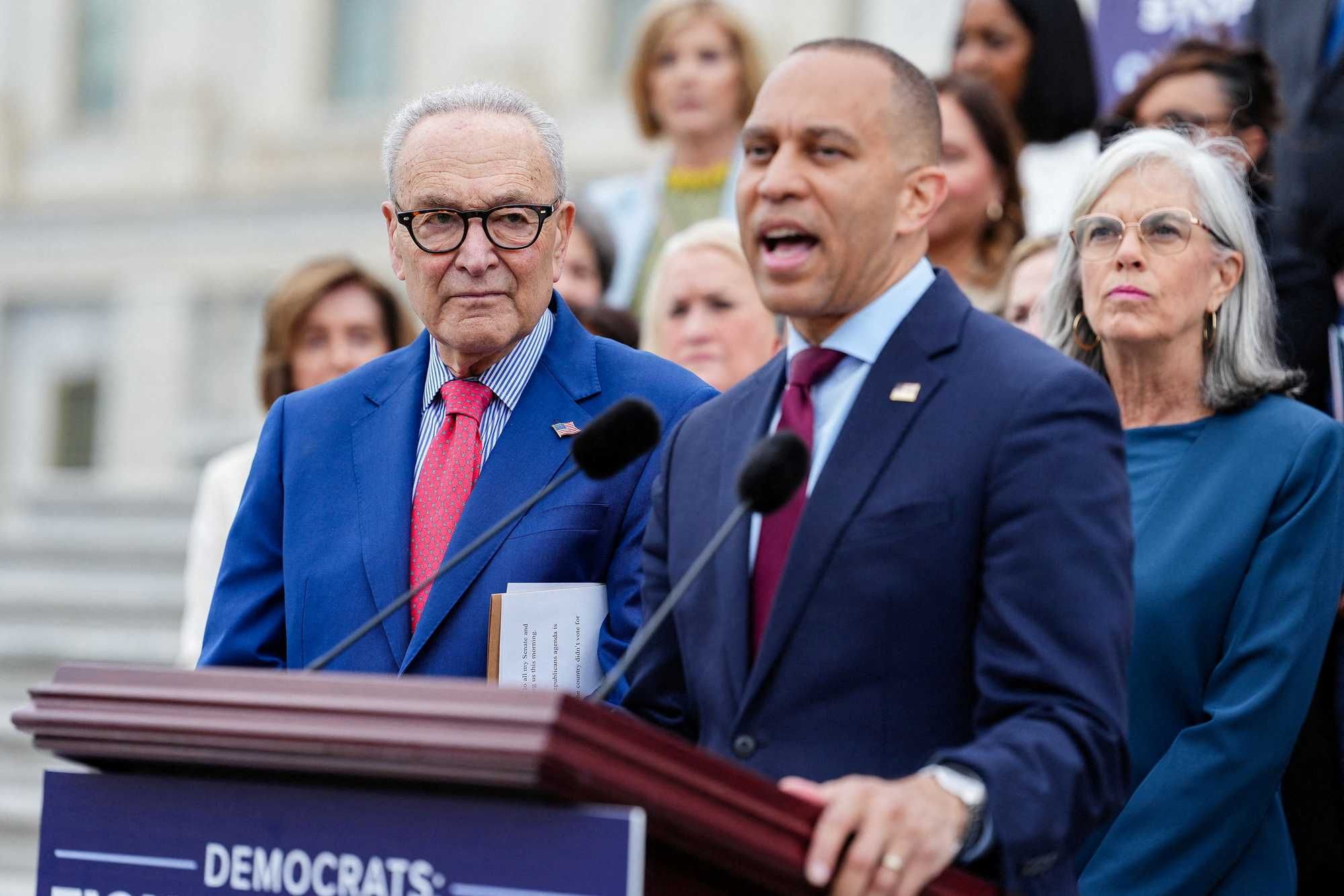
And what better way to celebrate a demand for said change than by handing the keys right back to the “old guard”? Chuck Schumer and Hakeem Jeffries?
Seriously. This appears to be the plan.
Americans have spent years watching their democratic institutions battered and betrayed, their constitutional safeguards tested, and their elected representatives struggle to mount anything resembling a coherent resistance. Millions of voters who turned to Democrats on Nov. 3 have already made it clear they didn’t sign up for another season of inadequate leadership that fails to meet the moment. Case in point, the change.org petition to remove Jeffries’ name from consideration that’s already garnered over half a million signatures and counting.
Voters want fighters. Fighters who recognize the gravity of this moment and fighters who don’t attribute ‘accountability’ to ‘revenge.’
Voters definitely don’t want another committee prepared to spend the next two years studying whether fighting might be appropriate. We already saw what happens when Justice is delayed. Right, Merrick Garland?
Yet here we are, the euphoria from this monumental day of reckoning still very much being felt across the globe, and the Democratic establishment seems prepared to treat its leadership positions like reserved parking spaces. Schumer stays. Jeffries moves up. Everybody gets a better office. The consultants congratulate themselves, and the people who actually delivered the victory are expected to applaud politely.
This is precisely how political parties lose the confidence of their own supporters. Which, should the Dems ignore the voices of their voters, is exactly what will happen.
Start with Chuck Schumer.
At a moment when the country desperately needs an opposition party capable of confronting Trump with urgency, clarity, and conviction, Schumer has too often seemed like a man waiting for the Senate to return to the collegial atmosphere of 1997.
His willingness to entertain the possibility that Trump might somehow become more cooperative, more reasonable, or more interested in bipartisan governance is not merely naive. It's an astonishing failure to recognize the political reality staring everyone in the face. And, both he and Jeffries accept major donations from PAC’s.
How many times must someone demonstrate exactly who they are before Washington's leadership class stops pretending a transformation is just around the corner? Or worse. Completely ignores the demand for transformation of any kind?
Trump isn't waiting for an invitation to a bipartisan luncheon. He understands power, confrontation, and the advantages of an opposition that spends half its time worrying about whether it sounds too confrontational.
Schumer's instinct to preserve institutional norms might have made sense in an era when both parties generally agreed those norms were worth preserving. But, after billions in bit coin, an insurrection, illegal wars, a Justice Dept. that does the president’s personal bidding, and trying to tamper with our elections on an hourly basis, those norms are out the window.
Then there's Hakeem Jeffries.
Jeffries is articulate, disciplined, and unquestionably skilled at navigating the Democratic caucus. But those qualities alone do not make someone the right person to lead a political movement through an extraordinary national crisis. The crisis of being ruled by the most criminally corrupt administration in history. And the new crisis of a possible Speaker who, in the immediate aftermath of the historic rebuke of the Mar-A-Lago Mafia, went on national television and said ““The American people don't want us to get even. They want us to get things done on their behalf, because life is way too expensive.” He could not be more wrong. Or clueless.
A Democratic victory should be an opportunity to rethink the party's leadership, priorities, and approach to power. Instead, the conversation seems focused on maintaining continuity.
Continuity with what, though, exactly?
The inability to communicate a compelling national message? The endless obsession with avoiding political risk? The reflexive deference to consultants who seem perpetually terrified that a forceful response might offend an imaginary undecided voter in suburban Pennsylvania?
Democrats need to understand something fundamental: The voters aren’t demanding a return to business as usual. We are demanding that somebody finally do something.
That means aggressive oversight. Meaningful investigations. A willingness to use congressional authority rather than merely explain why using it might be complicated. It means confronting abuses of power directly and publicly, not burying them beneath procedural language designed to avoid making anyone uncomfortable. Should they ignore this, they face losing every election going forward for generations. As the faith in them - and the entire Democratic party will be lost.
For years, Democrats have allowed Republicans to frame virtually any attempt to investigate wrongdoing as partisan retaliation. The result has been a political culture in which demanding consequences for misconduct somehow requires more justification than the misconduct itself.
That needs to end today.
And perhaps most importantly, Democrats need leaders who understand that the public's patience is not infinite. Millions of young voters just made their voices heard by electing candidates of all colors, shapes and sizes. If the Dems in the House and Senate think these outcomes translate to asking for more of the same, they will be in for a rude awakening come 2028.
The party cannot keep asking voters to rescue democracy every two years while offering the same leadership in return.
Nobody is suggesting that replacing Schumer and Jeffries would magically solve the country's problems. Leadership changes are not substitutes for policies, organization, or legislative competence.
But leadership sends a message.
Retaining the same people sends one, too.
It tells voters that the establishment believes the problem was never its approach, only the number of seats it controlled.
That's a dangerous conclusion to draw from an election fueled by frustration.
There is no shortage of talented Democrats capable of bringing fresh energy, sharper messaging, and a more confrontational approach to Washington. The party should be encouraging a genuine competition of ideas rather than treating challenges to incumbent leadership as acts of disloyalty.
Because loyalty to a political party should never require unquestioning loyalty to the politicians running it. Just look at what happened to the MAGA movement.
Democrats have been handed an incredible opportunity at an amazing moment in our history. Whether they turn that opportunity into lasting reform, or another exercise in institutional self-preservation, remains to be seen.
But if their first major decision is to reward the same leadership without demanding a fundamentally different strategy, they will have missed the most important lesson of the election:
The voters didn't send Democrats to Washington to restore the status quo. They sent them to change it.
And if Schumer, Jeffries, and the Democratic establishment cannot understand that distinction, they may discover that the cliff they're marching toward is considerably closer than they think.