WASHINGTON, D.C. — How do you fight a fictional threat? Democrats are learning on the job.
With President Donald Trump now promising to militarize his proposed 250-foot-tall arch — with tools ranging from drones to sniper nests — near Arlington Cemetery, many Democrats on Capitol Hill fear the president's plot is shaping up to be a severe public safety risk.
“Snipers who shoot people visiting their loved ones in the cemetery?” Rep. Don Beyer (D-VA) told Raw Story. “It made no sense whatsoever, except as perhaps a ploy to justify the arch.”
“What was your reaction when you first heard that Trump wants to militarize his arch?” Raw Story pressed former vice presidential candidate, Sen. Tim Kaine (D-VA).
“It was a made-up thing,” Kaine replied.
In Trump’s Washington, fiction parades about as fact, which has local leaders looking for ways to safeguard their constituents from the very commander-in-chief who swore an oath to protect the American people.
Federal lawmakers representing the D.C. region in Congress regularly coordinate security for high-profile events with Pentagon officials, Secret Service agents and undercover federal units tasked with safeguarding the National Mall.
For the past 45 years, Rep. Steny Hoyer (D-MD) has represented a cluster of suburbs that wrap around Washington, including most of Andrews Air Force Base — home to Air Force One.
Hoyer also served two separate terms as House Majority Leader stretching across three presidents — George W. Bush, Barack Obama and the end of Trump’s first term — where he was afforded a classified seat at the national security table.
That’s why Hoyer’s been rendered dumbfounded these days.
“Have you ever heard from the Pentagon that they need a militarized monument?” Raw Story asked Hoyer.
“Zero, zero. It’s absurd! He lies,” Hoyer replied without hesitation. “It is typical abuse by Trump to pretend that somehow he's doing for national security what he's doing for his ego.”
Hoyer’s far from alone.
“How many times has the Pentagon come to you saying, ‘we need snipers above D.C. and in Northern Virginia?’” Raw Story asked Kaine.
“The answer is never,” Kaine told Raw Story. “They've never suggested that and still haven't.”
“They” may not have, but the commander-in-chief is all in.
At the end of August, the Supreme Court handed Trump a big, if temporary, win when the high court’s conservative majority (5-4) ruled construction on the president’s White House ballroom could proceed.
The majority of justices allowed the work to continue, in part, because the president and his taxpayer-funded lawyers claim vital national security measures are being integrated into the new Trumpian East Wing.
Mere weeks after that ruling, Trump unveiled his new vision of an arch outfitted for war.
On social media, Trump tweeted his new plan to turn the arch “into a top-grade Military Complex/Triumphal Arch, to house, store, and have the rapid ability to use large numbers of drones, plus Snipers, on both the roof and plaza areas, and additionally have and hold large quantities of sniper ammunition in storage.”
“He looked at the Supreme Court giving him permission to continue to build the ballroom, and thought, ‘This arch isn't going anywhere — maybe if I militarized it, the Supreme Court will let me build it,’” Congressman Don Beyer, a former U.S. ambassador, told Raw Story,
“You're in Northern Virginia, has the Pentagon ever mentioned any need for any of this?” Raw Story inquired.
“No, no,” Beyer replied. “You don't need to fly drones off the top of the arch, which is already going to be a hazard for incoming planes, and the drones make it impossible. Why would you put an armory there with Fort Myer a mile away at the Pentagon? You're just inviting people to hit it.”
Other critics agree Trump’s latest national security argument amounts to “a pretty big stretch.”
“It's also, again, very Trump to try to turn everything into a whole circus like he's doing,” Rep. Suhas Subramanyam (D-VA) told Raw Story. “He's completely on an island on this one.”
“The Pentagon has never asked for it. They don't need it. They don't want it. This is such a joke. He goes abroad and he gets all these ideas from his authoritarian buddies to build all this stuff and name it after him. And we all know that these are just vanity projects, and they're a waste of money.”
For now, with Democrats locked in the minority, there aren’t many options Trump’s congressional critics have besides the power of the purse — a power Subramanyam and others on the left are vowing to flex.
“I know I'm not going to support any of it,” Subramanyam told Raw Story. “I'm not going to support any funding for it.”
The Republican Party has a huge Ivanka Trump problem — and it could end in class warfare, a leading Democratic Socialist warned.
“The anger and rage is building,” India Walton told Raw Story. “As we begin to raise our class consciousness and realize that racialized capitalism and the institutions that uphold it are the real enemy, and not one another, that will be the day that you'll see people in the streets.”
Walton, an ex-mayoral candidate who now serves as a senior strategist for the progressive group RootsAction, made this prediction as President Donald Trump’s eldest daughter takes soft but determined steps back into the spotlight with a series of Instagram posts promoting her business ventures and documenting her family’s luxurious lifestyle.
Earlier this month, Ivanka posted a video of her daughter horseback riding on an idyllic beach and was met with condemnation — even from conservative commentators.
“Americans: We can’t afford gas, food or tuition,” conservative podcaster Melissa Witte wrote on X. “Trump Family: here’s a video of Kai’s luxury dorm, Ivanka riding a horse and we’re also gonna rename both New Mexico and Lake Ontario ‘America.’”
And Ivanka's family photos from Donald Trump Jr.'s Bahamas wedding now serve as a platform to discuss the recent ProPublica report that found the celebration was funded in part by a Russian oligarch.
"Elites trying so hard to be normal," Texan Derek Geisler replied on Instagram. "And I used to be a big Trump fan."
When Ivanka shared an image of “The Beginning of Infinity” by David Deutsch — a book that explores the impact Western civilization has had on human progress — she was immediately criticized by one Instagram user as "Ivanka Columbus."
"I'm sure she's looking to discover new lands to claim as her own," Charles Knight wrote. "Locals be on the lookout."
Locals in Albania — where Ivanka and her husband Jared Kushner plan to transform one of the nation’s most important ecological sites into a $1.4 billion resort — are doing more than keeping watch. They’re taking to the streets.
What began as a one-issue outcry has developed into an organized movement as thousands of Albanians demand their government resign over concerns of corruption in the hands of oligarchs.
Ivanka Trump sparked this “Flamingo Revolution” when she bragged, again on her social media, about how she dived off a friend’s boat, swam to what she claimed was the barely known Sazan Island, took a barefoot hike to its peak and decided to “realize its potential.”
“It’s not even a business for me, despite the scale of it,” Ivanka told interviewer David Senra in May. “For me, it feels more like a challenge than anything else… a lot of reflection on how I want to live.”
On Thursday, Walton argued to Raw Story that the number of Americans who want to live like Ivanka Trump is dwindling fast as the president's MAGA base sours on his philosophies, and sees progress occur outside his realm.
“There's still a certain subset of our population who believes that one day, you know, if they work hard enough, they will be the Ivankas and the Donald Trumps of the world,” Walton said. “We are beginning to find out that those things are just untrue.”
In Trump's "Golden Age," Americans have simplified their desires to safe food, vaccines for their kids, "a gallon of gas and a dozen eggs," Walton argued.
If these frustrated Americans have yet to unite in protest, argued Walton, it's only because they're afraid.
“With the militarization of our local police departments, with the deputization of ICE agents who have no qualifications in law enforcement, and who are wearing masks and go unidentified and are just like sweeping up people off the street,” said Walton, “there is a very real and reasonable fear that people are feeling about rising up.”
But Americans, Walton believes, cannot ignore the success that her fellow Democratic Socialists have achieved — and pointed to New York City Mayor Zohran Mamdani as proof.
“Everyone, all over the country, is watching the success of New York City, one of the wealthiest cities in the world, watching it be able to tackle an affordability agenda,” she said. “People are really starting to question why, and what are people going to do about it?”
And as Ivanka Trump continues to highlight the divide between the very rich and those struggling to get by, she only showcases the MAGA movement’s fatal flaw, Walton concluded.
“This empire is not going to last forever — it can't possibly,” Walton said. “There's 99 percent of us who are fed up… we are moving away from identity and rediscovering that class is what unites us all.”
WASHINGTON — Handed a simple question about President Donald Trump defying a court order to ban the press, Senate Republicans tried to skip answering, with one telling comment: "It just scares me."
That slip came from Alabama's Tommy Tuberville, who defended Trump's authority to bar CNN, MS NOW and Politico before conceding where it could lead.
"It just scares me because if we get down this path, it's going to start on both sides and we're not ever going to get anything done for the American people," he told Raw Story.
Asked whether he'd worry about a Democratic president using the same power against conservative media, Tuberville dodged, riffing about the need to keep Democrats out of the White House.
Across the Capitol, Republicans pressed on the standoff, refusing to say the ban was wrong, or that a president must obey a court's order on press access.
North Dakota's John Hoeven waved the confrontation away as a matter of temperament.
"He's a New Yorker. He's combative. That's his style. It's a New Yorker style. But I do think it gets resolved," Hoeven insisted, declining to weigh in on the ruling itself.
Montana's Tim Sheehy couldn't engage the question, because he didn't appear to know what had happened.
"I haven't read up on it, but I don't know. Sorry," he said. Told that the banned outlets had been kicked out and then restored, Sheehy replied, "Oh, they are? Okay."
Sen. Thom Tillis of North Carolina, a frequent thorn in Trump's side, was asked directly about the White House failing to comply with the court's ruling overnight. He deflected with a quip.
"It may be a pretty quiet reporting in the state dinner tonight," he joked.
Utah's Mike Lee simply ignored Raw Story's question and walked away.
U.S. District Judge Timothy Kelly ordered the administration to immediately restore access for the three outlets, finding Trump's ban likely unconstitutional because the passes were revoked without "constitutionally adequate due process." Hours later, reporters were still turned away Thursday morning, and the news organizations went back to court arguing the White House was defying the order, before some were finally let in around noon.
Kelly, a Trump appointee, is the same judge who ordered the White House to reinstate CNN's Jim Acosta in 2018, on the same due-process grounds.
WASHINGTON — The Republican candidate to be Alabama’s next governor admitted Thursday he actively avoids reading anything — because only his opinion matters to him.
"No, I read very little," Sen. Tommy Tuberville (R-AL) told Raw Story. "I want my own opinion, not somebody else's."
The former Auburn football coach is leading polls in his gubernatorial contest in ruby-red Alabama, but former U.S. Senator Doug Jones (D-AL) is hoping to ride the nation’s anti-Donald Trump sentiment into the governor’s mansion in November.
In today’s Senate, Tuberville’s far from alone in avoiding the latest headlines. Unlike the president's tweet-saturated first term, these days most Republicans in Congress seem to avoid the news altogether.
But Tuberville is taking it to a new level.
"What do you make of this report that Vice President Vance was the person behind the leak in one of the Politico stories that got them banned from the White House?" Raw Story pressed the MAGA Republican while riding an elevator in the Capitol.
"Did they ban Politico, too?" Tuberville asked Raw Story. "Who knows? I mean, hey, I've learned up here about 10 percent of it is fact. The other [90 percent] is not even close to reality. You know that. Everybody tries to get out there and make a name."
"There's no way Vance would do that," Tuberville said. "You gotta have faith in your people that lead, you know, on both sides."
"And he'd lose faith with Trump if he was leaking?" Raw Story pressed.
"Well, whoever's going to run for president is going to be picked by him," Tuberville said of Trump's role in picking his successor.
With Vance and Secretary of State Rubio's names at the top of the speculative 2028 presidential pack, Tuberville says both need to woo Trump.
"Well, you can't have both of them run,” Tuberville gamed out. “You can't waste that much money."
While he won’t be found thumbing through tabloids, Tuberville says he’s heard chatter in Washington about some of the other Republicans who are eyeing a White House run in 2028.
“I saw that Rand [Paul] is thinking about running,” Tuberville said. “Rand Paul — who else? Cruz will run. I was with [Florida Gov. Ron] DeSantis Saturday at a football game in Tuscaloosa. He said he hasn't made his mind up yet.”
Besides presidential gossip, Tuberville seems to have tuned out the talk of the town on Capitol Hill.
"What do you make of Sen. [John] Curtis' (R-UT) move to try to get [Donald] Trump Jr. in to testify about the Russian wedding donations?" Raw Story asked.
"I didn't see that," Tuberville said.
"Oh, yeah? He's calling your party out. Some people aren't happy," Raw Story replied. "Do you have questions about Trump Jr. taking Russian oligarch money?"
"I don't get into all that," Tuberville said. “I mean, no reason to talk about anything you don't know anything about.”
A central Bible verse left Alabama Sen. Tommy Tuberville puzzled Wednesday — as he compared himself to America’s poorest people.
Tuberville, a member of the conservative Churches of Christ denomination who frequently espouses his beliefs, including posting on his Facebook page, “As a man of Christian Faith, it’s horrifying to witness this decline of morals in America,” was tripped up by the words of Jesus.
“Some of the people say your party’s, you know, punishing ‘the least of these,’” he was told.
“Punishing what? ‘The least of these?’”
“‘The least of these’ — biblical reference,” the reporter explained, referring to the famous verse in Matthew 25:40, “Truly I tell you, whatever you did for one the least of these brothers and sisters of mine, you did for me.”
Jesus speaks the words, teaching that acts of kindness toward the poor, sick or hungry are acts done for Jesus himself.
“The least of these?” Tuberville asked again, clearly puzzled.
But he soldiered on.
“Well, we’re all getting punished,” he said. “We’re all in the same boat.”
Congress members choose a top-tier health care plan and have about 75 percent of the cost covered by taxpayers.
A rank-and-file member of the House also receives a salary of $174,000-a-year.
Tuberville's home state, meanwhile, is the eighth poorest in the nation, with more than 16 percent of its population living under the federal poverty level.
On Tuesday, Vice President JD Vance and Centers for Medicare and Medicaid Services Administrator Mehmet Oz announced that roughly 750,000 people have had their ACA coverage canceled, citing fraud.
Vance said those enrollments include people unaware they were enrolled, people with employer-provided coverage, or those earning above 400% of the federal poverty level. He estimated the move will save taxpayers $2.2 billion.
Another 419,000 marketplace enrollees face additional verification. The administration also suspended new agents or brokers for six months.
Officials did not provide details about who lost coverage or how they were informed, and health policy experts question the administration's claims about the scale of fraud.
“Yeah. I mean, good job,” said Tuberville.
“This is the first group that ever tried to clean it up. We're losing hundreds of millions of dollars a day to fraud. We can't afford it.”
Republican senators gave their verdict on Sen. Mitch McConnell's first week back at work Wednesday, with one saying it doesn't matter if the Kentucky politician is able to talk or not.
Sen. Deb Fischer (R-NE) stared daggers at a Raw Story reporter when asked if McConnell had proved himself capable of doing the job after turning up four times to vote since Sept. 14.
The senator disappeared for weeks after reportedly taking a fall at home on June 14, and being hospitalized until August. He has looked vacant and has yet to be seen speaking — other than to verbally vote the wrong way on a bill.
Fischer was asked if that worried her, and if she thought McConnell should be asked to demonstrate — perhaps with a short video — that he can respond to questions.
"Does he need to? I don't think he needs to," she slapped back.
"He was here for our Farm Bill vote, and he voted. People were saying that he didn't respond, no, he voted."
On Sept. 15, McConnell initially appeared to vote with the Democrats in his first vote back at the Senate, but switched his vote from "no" to "aye" after Republican colleagues, including Chair John Boozman, leaned in and murmured to him.
The bill passed 12-11, a margin his original vote would have reversed.
Many appalled commentators claimed that proved he was in no way competent to represent the people of Kentucky.
"He was very quiet to begin with," said Fischer, returning to concerns that he hadn't been heard speaking. "He spoke [at the Farm Bill vote]. There was disruption, if you watch the video." The video shows McConnell murmur "no," and then change his answer to "aye."
Senator John Hoeven (R-ND), one of the members who directed McConnell on how to vote, told Raw Story it was his fault that the Kentucky senator initially went with the Democrats.
"He had it right," he said.
"It was [a] vote on final passage. I thought we were still doing a procedural vote on motions to challenge the ruling of the chair. So no, he had it right."
He then told Raw Story McConnell would be happy to chat to show how competent he is — despite multiple attempts to talk with him being ignored by him or rebuffed by aides.
"You know, you can visit him," Hoeven said. "He'll be coming in and out for votes and, one of these times he does, you can talk to him and I think you'll find he's the same old Mitch. He's not the most talkative guy in the hall. He's always been that way."
Other Republicans were much less willing to discuss McConnell's return. Sen. Rand Paul (R-KY) dashed into a Senate elevator and avoided eye contact when asked about it.
And Sen. Roger Wicker (R-MS) uttered just "oh man" when asked.
When pushed for comment, he said, "He's a great guy" as the elevator doors closed.
WASHINGTON — Embattled Maine Republican Senator Susan Collins isn’t happy that Vice President JD Vance announced the Trump administration is booting close to 760,000 Americans off Obamacare exchanges about 40 days before this fall’s midterm elections.
“Are you annoyed with the administration for taking 750,000 people off Obamacare right ahead of the election?” Raw Story asked Senator Collins (R-ME).
“That seems like an overreach to me,” Collins told Raw Story as a flock of congressional reporters listened in at the U.S. Capitol.
What may be worse for Collins and other GOP incumbents on the ballot this November is that some of their Republican colleagues are calling for even more Americans to lose the health insurance they were provided under the Obama-era Affordable Care Act [ACA].
Vice President Vance, who’s charged with leading an anti-fraud task force, claims the roughly 760,000 names being removed from Obamacare rolls are fraudsters — a sentiment echoed by the MAGA wing of the GOP on Capitol Hill.
“Because of the enhanced [ACA] subsidies, there are estimates there were six million completely fraudulent that are signed up — either didn't exist or certainly were unaware of it,” Sen. Ron Johnson (R-WI) told Raw Story. “So 750,000 is probably just a good start.”
“You'd like to see more?” Raw Story pressed the chair of the Senate Budget Committee.
“I don't want anybody helping mortgage our children's future that aren't eligible for these benefits,” Johnson continued. “I wouldn't think any American would want to see that.”
Johnson’s eager to work alongside Vance’s anti-fraud task force if the GOP’s able to maintain control of the Senate in the New Year.
“I certainly want to be working with the vice president’s task force and see what they're coming up with,” Johnson said. “You're just scratching the surface in terms of uncovering, you know, massive fraud because we make it easy for fraudsters to fleece the American taxpayer and government.”
While more moderate Republicans running in the last purple-ish states remaining are distancing themselves from Vance’s effort, Republicans running for higher office in red states are pressuring Vance to find even more than his initial 750,000 to remove from federal health exchanges.
“Do you think J.D. Vance did a good job?” Raw Story asked Alabama gubernatorial candidate Sen. Tommy Tuberville (R-AL).
“Yeah. I mean, good job; this is the first group that ever tried to clean it up,” Tuberville told Raw Story. “We're losing hundreds of millions of dollars a day to fraud. We can't afford it.”
“Some people say your party's, you know, punishing the ‘least of these?’” Raw Story pressed.
“Punishing what?” Tuberville asked.
“‘The the least of these’ — biblical reference,” Raw Story explained of the Bible verse Matthew 25:40 (“'Truly I tell you, whatever you did for one of the least of these brothers and sisters of mine, you did for me'”).
“The least of these?” Tuberville asked again.
“The least of these — the poor people — that they're getting punished,” Raw Story explained.
“Well, we're all getting punished,” Tuberville replied. “We're all in the same boat.”
Democrats wept.
"If the idea is to clean up the rolls, there's a way to do this," Sen. Brian Schatz (D-HI) told Raw Story. "This is about punishing poor people."
To Schatz — who’s rumored to be a potential replacement as Democratic leader once current Senate Minority Leader Chuck Schumer (D-NY) retires — this is just the latest episode in the GOP’s sustained attack on so-called Obamacare.
"This is what they wanted to do all along," Schatz said. "It's going to raise prices, and it's a hell of a closing message."
While it may bolster their party’s affordability argument ahead of the election, Democrats are demanding receipts.
“I want to know more,” Sen. Dick Durbin (D-IL) — Senate Democrat’s number two in command — told Raw Story. “They say it's “fraud” — I want to establish that fact.”
“Because there's just no trust?” Raw Story pressed the retiring Democratic leader.
“No trust,” Durbin replied. “They’ve been trying to do in Obamacare for more than a decade. Now they're just going to let people off the rolls. Let's see the proof.”
It’s not just Democrats.
Some Republican incumbents, like Susan Collins, who’s fighting for her political life up in Maine, say they aren’t buying the White House’s latest fraud claim just yet.
“I don't know what the basis is,” Collins told Raw Story while boarding one of the Capitol’s underground trams. “But it strikes me as problematic.”
WASHINGTON, D.C. — Ronald Reagan’s vision of America as a “shining city upon a hill” is being torn apart as President Donald Trump attacks America’s free press — while giving a communist leader the red carpet treatment, critics warned.
“It's just such a hot mess of chaos and corruption,” Sen. Tina Smith (D-MN) told Raw Story Tuesday — the same day Department of Justice lawyers argued allowing CNN, MS NOW and Politico to cover Trump’s White House poses a national security risk.
Earlier in the day, Trump threatened to “annihilate” Iran in his address to the UN General Assembly — after telling CNN's Kaitlan Collins “you shouldn’t be here” as she covered the gathering of world leaders.
“It's devastating, really, to think he's standing up there at the UN — first off, he's saying, ‘oh, I might obliterate a country,’ which would be a war crime,’” Rep. Chellie Pingree (D-ME) told Raw Story.
“And then, you know, for the whole world there he is on display saying, ‘I'd like to shut down any voice that is in opposition to me.’ I mean, he might as well be a dictator in charge of North Korea or, you know, some other country. It's just obscene.”
Trump’s high-profile week on the international stage is far from over. Trump’s critics were bracing for more embarrassment Wednesday as the president was scheduled to begin hosting Chinese leader Xi Jinping.
Trump’s expected to greet Xi at Andrews Air Force Base Wednesday, ahead of a formal White House welcoming ceremony complete with a military flyover Thursday, and capped off with a formal state dinner later that evening.
All the pomp and circumstance won’t be enough to mask Trump’s ongoing effort to permanently ban the three critical news outlets from covering his White House.
Instead of America’s First Amendment being on display this week, critics say Trump’s worst instincts are being projected for all to see.
“Nothing is more important than the First Amendment because that ensures that everybody's voice is counted. I think, what's going on now is just horrifying,” Sen. Ron Wyden (D-OR), whose father, Peter, was an award-winning journalist, told Raw Story. “The signal that we're walking back from freedom, that's what it means to me.”
That has many political watchers on the left nervous.
“It's right out of Xi's playbook, right? I mean, if the media is not nice to you, if they're not giving you positive coverage, then ban them, try to undermine them, right?” Rep. Suhas Subramanyam (D-VA) told Raw Story. “Next he's going to try to arrest them or investigate them, right? So this guy will do anything it takes to consolidate power.”
The optics aren’t lost on former U.S. ambassador to Switzerland and Liechtenstein, Rep. Don Beyer (D-VA).
“Ironic that it's at the same time that he's talking to XI. There's no free press in China, why have it here?” Beyer told Raw Story. “It was another very sad step on the road to destroying our democracy. This is what autocrats and dictators do. First is they ban the press. They don't want to hear bad news. They don't want bad news getting out.”
With many national news outlets banding together and boycotting live pooled coverage of Trump, the White House has rolled out Trump TV to stream the president’s events, which also has critics on edge.
“The access that’s being denied should concern every single person, because it's going to continue to grow; he's now launching, basically, state-run TV,” Rep. Robert Garcia (D-CA), the top Democrat on the House Oversight Committee, told Raw Story. “He wants to be an authoritarian. We see it more every single day.”
While Trump wants to come across as strong and in control, Democrats say his attacks on the free press actually makes him look petty and insecure.
“I talked to Lindell News today,” Beyer said through a mocking laugh as he discussed the fringe, conspiracy-peddling outlet.
Beyer says Trump needs to grow up.
“A lot of other presidents, Democrat and Republican, have had stories they didn't like,” Beyer said. “You know, Obama didn't like Fox. And I'm sure Lyndon Johnson didn't like all kinds of people, but they never threw them out.”
With November’s midterm elections just around the corner, Democrats say Trump is making their case for them — though they really wish he’d stop and get back to showcasing American excellence and press freedoms on the international stage.
“I don't know, like, if I were a Republican voter in Kansas or Alaska or Ohio, and I'd be looking at this and, you know — you're throwing this multi-million dollar gala for a communist, for the leader of the Communist People's Party at the same time that you're denying the free press in this country?” Minnesota Senator Smith told Raw Story. “It's crazy.”
WASHINGTON, D.C. — Move over AI doomsday scenarios. Republicans seem to innately trust rapidly evolving artificial intelligence technology — even as they distrust the largest AI companies so much they’ve started spinning new conspiracies on Capitol Hill.
Terrifying warnings from many at the top of the AI revolution — including from an industry insider who warned the creations he was involved in could destroy the human race within 10 years, and urged the government to set up guardrails — were shrugged off by multiple Republicans.
The dystopian predictions were no more than an effort to bolster the AI insiders' own businesses, GOP lawmakers who spoke to Raw Story said.
"There was an awful lot of what appeared to be rent-seeking by giant companies saying, 'please put the government in charge of everything and lock us into market dominance and stop any new competitors from challenging our market dominance,'" Sen. Ted Cruz (R-TX) — who chairs the Senate Commerce Committee — told Raw Story while walking through the U.S. Capitol.
“People came to me when I was governor all the time, ‘Oh, you need to regulate us’ — that means I don't want any competition,” Sen. Rick Scott (R-FL) told Raw Story while riding an elevator to the Senate floor. “If you have a family, you shouldn't be building something that's going to kill your family.”
“Are they generating their own demand for future security products?” Sen. Ted Budd (R-NC) asked Raw Story in the Capitol’s basement. “I don't think you need to slow down, because China's not slowing down, but what you need to do is make sure they're focusing their engineering effort on safety.”
Some of the starkest warnings about AI now come from inside the industry. In September 2026, researcher Jacob Coxon quit Anthropic, saying AI companies are gambling with our lives and that builders privately fear it could kill everyone by decade's end.
Anthropic's alignment lead, Evan Hubinger, agreed, putting the odds of that happening at above 10% within ten years and admitting there's no plan yet to align superintelligence.
With so many competing AI proposals floating around, Democrats are far from monolithic on how to rein in artificial intelligence, but most are unified in eye-rolling over their GOP counterparts’ latest anti-regulation screed.
"I understand it in the conspiracy-laden world in which we live, but I heartily reject that," Rep. Don Beyer (D-VA) told Raw Story.
This fall’s upcoming elections only seem to be hardening the two parties into opposing positions new to the previously bipartisan AI space.
While many Silicon Valley firms are ringing the alarm about the end of humanity, their fears are hardly penetrating today’s Republican-controlled Senate.
“They want to preempt a predatory capture by having regulations written to their benefit and exclusion of potential competition. I'm highly skeptical,” Sen. Ron Johnson (R-WI) told Raw Story.
Johnson likens today’s AI fears to those raised around COVID — a global pandemic which did kill more than a million Americans — and climate change, which the vast majority of scientists say is undeniably real and an existential threat to the planet.
“There's fear-mongering. I'm not buying it,” Johnson, who’s worth tens of millions of dollars from his past life as CEO of a Wisconsin-based polyester and plastics manufacturing company, said. “I think they let them loose. True or not? I don't know, but I'm highly skeptical.”
Other multi-millionaire former businessmen in the GOP agree.
“What do you make of these AI companies saying, ‘We can't control our own’?” Raw Story asked former luxury car salesman Sen. Bernie Moreno (R-OH).
“Then go do something else. Then close your company down,” Moreno, whose estimated net worth tops $100 million, told Raw Story. “Think about that, in any other industry — any other industry — imagine if you're a defense contractor, before AI was in existence, and you said, ‘We make this weapon, we won't be able to control it. It could kill Americans.’ What would people say?”
Moreno supports legislation forcing disclosure of AI-created content for images, especially when it comes to deceptive deepfakes that animate realistic fictions.
“I think image is the low-hanging fruit, let's get that done,” Moreno said. “With the digital infrastructure, data centers, no more tax breaks. They have to produce their own power. No impact on the environment on a community benefit. We can do that, right?”
But, while Moreno’s open to the idea of some very targeted AI guardrails, he’s just not buying the doomsday narratives tech CEOs are selling right now.
“If you can't control your own product, then don't make your own product,” Moreno continued. “The ultimate irony with the companies is then they're saying, ‘well, we can't control our product. It's super dangerous, but we're going to go out and do an IPO and make a fortune.’”
To Moreno and many Republicans, the fear of over-regulation trumps any fears of AI armageddon.
“What we don't want is the AI industry being completely subservient to the federal government, where the federal government basically becomes like China, where they're — whatever administration is in charge — is controlling artificial intelligence and large learning models. If you imagine 1984, that would be it to me.”
To critics, many rank-and-file Republicans are borrowing scare tactics from Trump when they wave China-sized rhetorical red flags. And these new GOP prophecies predicting the end of “free” markets feel concocted to protect today’s new AI oligarchy,
“Do you still trust these companies to largely regulate themselves?” Raw Story asked the chair of the Senate Commerce Committee. “Or do you think in light of this new doomsday scenario they laid out that maybe Congress can step in?”
“There are unquestionably catastrophic risks that need to be addressed, particularly in the arena of nuclear matters or biohazards. There should be meaningful protections,” Cruz told Raw Story,
Cruz’s committee has broad jurisdiction over all things AI and the economy — yet he seems more afraid of regulations than rogue AI agents.
“But at the same time, we should not allow overzealous Washington bureaucrats to cripple American technological innovation and allow China to win the race for AI,” he added. “That would have devastating consequences for the American economy, for jobs, and it would also cede the world of AI to embody the values of the Chinese Communist Party. That would be a terrible outcome for America, a terrible outcome for the world.”
With Trump and an increasing number of Republicans arguing that most any regulatory guardrails placed on AI will set America back in today’s hypersonic AI race with China, Democrats are dumbfounded by the new protectionist rhetoric coming from Cruz and company.
“That's simply not a true statement,” Sen. Tammy Duckworth (D-IL) told Raw Story after voting in the Capitol.
Duckworth sits on the Cruz-controlled Commerce Committee, and the veteran also serves on the Senate Armed Services Committee.
"Look, I think that there is potential for AI when it comes to cancer research, Alzheimer's research, but there always should be guardrails," Duckworth said. “All that I want is reasonable, common-sense guardrails on AI and how we use AI, and I think saying that any guardrails put us back against China. I feel like that's dangerous.”
While it doesn’t seem like it in the lead-up to this year’s midterm elections, the artificial intelligence debate doesn’t fall into the neat hyper-partisan boxes that most all other hot-button issues fit these increasingly tribalistic days.
Over in the House, even Democrats disagree on potential regulatory answers to this latest Silicon Valley-induced problem vexing America and weighing on the political class, but Democrats' disagreements seem to stop at regulators’ doors.
“Some of the concerns that people have around whether, you know, what the motives of the companies are, some of these are legitimate concerns, and I think we need to take them into account as we're thinking about what Congress does, right?" Rep. Sara Jacobs (D-CA) told Raw Story.
"Some of the things that are, you know, being raised around how we make sure that whatever we do doesn't actually only benefit the big companies that are already there but still allows new entrants, that we're protecting open-weight models, like, those are all legitimate things that we need to be taking into account."
On the left, while there’s some disagreement on whether this latest wave of opposition is coming from new, Trump-tinged GOP talking points or valid concerns with big tech, the party isn’t embracing conspiracies.
Rather, members are terrified as they try to address the new digital frontier — like when OpenAI’s chatbots hacked their way out of the cyber prison developers thought they’d confined them in.
OpenAI said that two of its AI models autonomously hacked their way out of a controlled environment where they were supposed to be walled off from internet access, then broke into the systems of Hugging Face, a company that hosts open source AI models and testing resources, in order to cheat on an internal evaluation.
"Then they had kamikaze agents that would go, essentially commit suicide, to get information back to the collective, and you think OpenAI made all this s--- up as a regulatory capture scheme? Then you are just blinded by profit and partisanship," Rep. Ted Lieu (D-CA) told Raw Story. "These people understand that they're creating products that they've lost control of and are not safe."
Other Democrats, like Virginia Congressman Don Beyer, say these new GOP artificial intelligence conspiracies don’t mesh with the mission of safe AI tech companies like OpenAI, Anthropic and DeepMind say they were founded on.
"It's been part of their culture from the very beginning, so maybe it will have a financial impact," Beyer told Raw Story. "They all started from a premise of safety. They were all aware of risk from the very beginning. It could also have a negative financial impact on them if they actually pace the frontier or slow down."
Before Speaker Mike Johnson (R-LA) changed the House schedule, yet again, and sent members home until after the November election, many lawmakers received closed-door AI briefings. Those briefings left many lawmakers spooked.
Some members even reported a new, growing sense of bipartisan unity around artificial intelligence.
“While I think the American people are aware of it, it is really now bubbling to the surface finally here in Congress,” Rep. Veronica Escobar (D-TX) told Raw Story.
What Escobar and other proponents of new AI regulations fear now is that this momentary era of bipartisan AI unity may be but a moment in time — potentially one that may have disappeared by the time the midterms are over and Congress returns to Washington.
“I do believe if we were around each other a little bit more, there would be a sense of urgency,” Escobar told Raw Story. “Some of the CEOs have, you know, some of the AI folks are in town and have been meeting with groups of us. It is really stunning that with these flashing red signals, Mike Johnson is sending everybody home.”
GREENSBORO, N.C. — In July 1979, a North Carolina Ku Klux Klan leader named Joe Grady summoned two FBI agents to a Waffle House to warn them “about possible violence in the future.”
Earlier that month, members of the Workers Viewpoint Organization and local Black residents had forced armed Klansmen to retreat inside a community center where they were screening the hugely controversial movie Birth of a Nation. The euphoric anti-Klan protesters celebrated by stealing their Confederate flag and burning it.
That confrontation in the town of China Grove was only the most recent in a string of incidents of leftist harassment that Grady complained had violated the Klan’s constitutional rights.
An official memo describing the meeting is one of thousands of pages recently released by the FBI that detail the agency’s handling of one of the most notorious episodes of white supremacist violence in the past 50 years. About three months after Grady’s warning, a caravan of Klan and Nazis, led by a former FBI informant also working with the police, drove into a Black public housing community in Greensboro and opened fire on an anti-Klan march, killing five leaders of the Workers Viewpoint Organization (later renamed Communist Workers Party).
The FBI said it was releasing the documents in response to Freedom of Information Act requests.
The memo about the July 1979 meeting with the Klan leader also indicates that the FBI's awareness of potential violence was so sufficiently heightened that they asked Grady if the KKK had automatic weapons in its possession.
An official FBI memo details a meeting that took place between two FBI agents and Klan leader Joe Grady in July 1979. (Courtesy FBI)
Despite live television coverage capturing the carnage, Klan and Nazi defendants were acquitted of murder in a state trial and acquitted of civil rights violations in a subsequent federal trial. The Klan and Nazis were later found jointly liable with the Greensboro Police Department for the death of one of the demonstrators in a federal civil lawsuit brought by survivors.
In 2020, the city issued a formal apology acknowledging that the police department “failed to warn the marchers of their extensive knowledge of the racist, violent attack planned against the marchers” by the Klan and Nazis, “with the assistance of a paid GPD informant.”
Less attention has focused on the FBI, whose agents accessed the same stream of intelligence about the Klan and Nazis’ plans to disrupt the rally. A 2006 report issued by an independent truth and reconciliation commission determined that “the single most important element that contributed to the violent outcome of the confrontation was the absence of police,” while finding it “immoral and unconscionable for the FBI and the Bureau of Alcohol, Tobacco and Firearms — which both had their own inside intelligence on the Klan and Nazis about the potential for violence on Nov. 3, 1979 — to fail to share that information with local law enforcement.”
The civil suit brought by the survivors put the FBI together with the Klan, Nazis and police at the defense table during the federal trial for an alleged conspiracy to deprive those killed and injured in the attack “of their equal rights, privileges and immunities,” which they argued was motivated by their “hostility to communists, labor organizers and advocates of equal rights for Black people.”
Cecil Moses, who managed the FBI’s investigation of the massacre as assistant special agent in charge of the Charlotte Division, was one of the individual defendants. The judge dismissed Moses as a defendant.
“I could tell you under oath that I had absolutely no information,” Moses told Raw Story. “Nobody from the Greensboro office had mentioned to me that there might be problems that day.”
North Carolina was unfamiliar territory for Moses at the time. Only one month before the massacre, Moses had been transferred from the Memphis office and received a promotion to the number two position in Charlotte. His new boss, Special Agent in Charge Herb Monahan, was away on a hunting trip in the mountains for annual leave at the time of the massacre. Moses was at home doing his laundry on Nov. 3 when the deputy director in Washington saw the massacre unfolding on live TV and told him, “You better get up there on the double.”
The memo describing Klan leader Joe Grady’s July 1979 meeting with the agents reveals an effort to bring Moses up to speed on the agency’s pre-Nov. 3 intelligence on the potential for violence, so he could respond to awkward questions from the media.
Dated Nov. 26, 1979, the memo authored by an unidentified agent notes that “the information is being submitted at this time to assist ASAC Moses in his comments to the press concerning Joe Grady’s statement to the press that he contacted two FBI agents at Winston-Salem, North Carolina, during July, 1979.” The note goes on to say that agents didn’t bother to document the meeting at the time because it was “nonspecific and did not fall within any current FBI investigative guidelines.”
Another retroactive memo, dated Dec. 5, 1979, describes a phone call by Eddie Dawson to his former FBI agent handler, Len Bogaty, at his home on Halloween night “to advise that he was now working for the Greensboro Police Department and he was furnishing information concerning a forthcoming ‘Commie’ rally in Greensboro, North Carolina, which the Klan might attend.
The memo goes on to say that the following day, Bogaty contacted a lieutenant in the police department, who “indicated he had received the information concerning possible disruption of the WVO rally by the Klan.”
An official FBI memo details Klansman and former FBI informant Eddie Dawson's contact with the FBI three days before the Greensboro Massacre, and an unidentified FBI agent's contact with the Greensboro Police Department to confirm Dawson's information was received. (Courtesy FBI)
Moses, now 89, said he doesn’t remember the memo.
“I had not been fully briefed on everything,” Moses said. “I didn’t even know we had an active Klan in North Carolina. I didn’t know we had a Communist Workers Party.”
Notwithstanding Moses’ avowed lack of awareness about the two opposing groups, the 2006 Greensboro Truth and Reconciliation Commission Report asserts that the FBI initiated surveillance on Workers Viewpoint Organization on Oct. 23 “as a result of the China Grove confrontation,” and then closed the preliminary investigation on Nov. 2 — one day before the massacre.
Moses acknowledged the existence of the investigation to Raw Story, but he said he hadn’t known about it until after it was closed.
“It didn’t rise to my level,” he said. “I hadn’t been informed of it. They didn’t brief me on it.”
When Moses got the call about the shootings, he noted that Andy Pelczar, the supervisory senior resident agent, and another Greensboro agent were competing in a golf tournament. That should put to rest any doubts that they expected serious violence in Greensboro, he argued.
“I don’t believe anybody in the Bureau had any reason to believe there was going to be a big confrontation and shooting between the Klan and the communist party,” Moses told Raw Story. “Andy assured me he had no information that there was going to be anything other than some hecklers.”
Evidence introduced at the civil trial suggested otherwise.
A Bureau of Alcohol, Tobacco and Firearms memo leaked to the plaintiffs showed that the agency coordinated with the FBI on an investigation involving an undercover employee who infiltrated the Nazi contingent ostensibly to investigate potential violations of federal firearms laws. Bernard Butkovich, the BATF employee, would later testify at the civil trial that two days before the massacre he heard a Klansman say that pipe bombs “would work good thrown into a crowd of n-----s.”
Another warning came from Mordechai Levy, a Jewish Defense League activist who provided an affidavit for the plaintiffs stating that he had called in a tip to the Raleigh FBI office on Nov. 2 relaying that he had learned that North Carolina Nazis “planned to attack and possibly kill people at an anti-Klan gathering this week in North Carolina.”
The agent admitted under oath that he’d received the call, according to a 2024 book about the Greensboro Massacre by author Aran Shetterly.
Moses told Raw Story any present-day judgment on the FBI’s handling of such information needs to take into account that in 1976 U.S. Attorney General Edward H. Levi had imposed new guidelines on domestic security investigations. The guidelines came as a result of the Church Committee hearings, which revealed, among other things, that the FBI’s Cointelpro program had on occasion engaged in illegal tactics to disrupt both far-left and far-right groups.
“We were obviously frustrated we were ordered to be hands-off on such matters,” Moses told Raw Story. “We had zero jurisdiction.”
Lewis Pitts, who represented the survivors in the federal civil trial, told Raw Story he always believed the question of federal law enforcement complicity in the massacre was more important than that of the Greensboro police. As the federal government under President Donald Trump renews a campaign to crush the left, the FBI’s role in the Greensboro Massacre has become even more important, he argued.
“The larger and more important role that we’re trying to figure out — and it’s become such an existential issue — is the role of the federal government,” said Pitts, who still lives in Greensboro. “There is strong evidence that the federal government knowingly played a role to unleash the Klan and Nazis, with the highest knowledge that there would be death and injury — and did nothing to prevent it. Then, they lied like crazy to cover it all up.”
When Moses arrived in Greensboro on Nov. 3, 1979 to assess the situation, he asked police Chief William Swing if the slain demonstrators had a permit to march. Upon learning that they did have a permit, Moses made the decision to open an investigation into potential civil rights violations. Despite the acquittal of the Klan-Nazi defendants during the federal civil rights trial, Moses received a commendation from the agency, and was promoted to lead the FBI division in Birmingham, Ala.
The FBI’s initial reaction to the massacre, at least officially, is captured in a Nov. 3, 1979 memo authored by an unidentified special agent for the benefit of the special agent in charge in Charlotte.
After describing how nine to 10 people had jumped out of van owned by a known Klansmen and opened fire on “a peaceful rally,” killing five people, the memo delivers a jarring assessment: “FBI participation not requested at this time; no civil rights violation or racial overtones present.”
A Nov. 3, 1979 memo details the FBI's response to the Greensboro Massacre. (Courtesy FBI)
Aside from the obvious fact that Klan had a long history of racial terrorism and that the massacre took place in a Black public housing project, the assessment displayed a stunning degree of cluelessness. Nelson Johnson, the local leader of the Workers Viewpoint Organization, was Black and had been a target of FBI surveillance while leading community organizing projects in Greensboro’s Black community for more than a decade. Sandra Smith, one of the five demonstrators killed on Nov. 3, was also Black. She had graduated from Bennett College, a historically Black women’s college, five years earlier. Smith had been elected student body president at Bennett, which is located about a mile from the site of the massacre.
“I wasn’t aware of any racial overtones,” Moses told Raw Story.
“None of the key members of the Communist Workers Party were — they would not cooperate one iota,” he quickly added. “I want you to quote me on that.”
The records bear Moses out on that one fact.
A teletype from the Charlotte office to FBI Director William H. Webster reports that two agents went to the home of the widow of one of the slain organizers four days after the massacre. A young man met the agents at the door and told them the widow was “making funeral arrangements and not at her residence,” according to the memo, which is part of the recently released trove of FBI documents. The agents told the man they wanted to interview her.
A couple of hours later, the agents returned, met this time by two men. The FBI’s message had been conveyed to the widow, they said, and she had a message for them in return.
The memo duly reports that “her response is substantially as follows: The FBI killed her husband and she did not want the FBI on her property.”
CORRECTION: This story misstated former FBI official Cecil Moses as a defendant in the federal civil trial. He was dismissed as a defendant by the judge, as opposed to being found not liable by the jury.
A conservative law firm with deep ties to Justice Clarence Thomas, President Donald Trump and a history of arguing more than a dozen cases on hot-button right-wing causes before the Supreme Court took in more than $33.5 million from nonprofit dark money networks, according to new watchdog research.
Consovoy McCarthy, a boutique conservative law firm started in 2014, brought in more than $29 million since 2015 from nonprofits associated with Leonard Leo, a co-chair of the Federalist Society, a Project 2025 contributor and architect of the conservative supermajority on the Supreme Court, alone, according to tax filings analyzed by True North Research, a progressive investigative research firm.
Nonprofits do not need to disclose the identities of their donors, and when such groups support political causes without revealing the sources of their funding, it's considered “dark money.”
Consovoy McCarthy has “become a go-to for these far-right networks, especially networks tied to Leonard Leo ... who's seeking to impose his agenda on all Americans by weaponizing the court system,” said Alyssa Bowen, deputy director at True North Research.
“We've seen Consovoy McCarthy undertake a ton of cases furthering Leo's agenda as they're enriching themselves with Leo cash and cash from other far-right dark money operatives.”
Have a tip? I want to hear it.
I'm an investigative reporter covering politics and government accountability. If you have information the public should know — inside government, a campaign or anywhere power operates with too little scrutiny — I want to hear from you."
I protect sources and can communicate securely and confidentially.
Alexandria Jacobson Investigative Reporter, Raw Story
Consovoy McCarthy took in money from nonprofits associated with other conservative activists like Edward Blum, who has brought at least eight cases to the Supreme Court, mostly about race-conscious college admissions and voting rights.
“You've got money funneled through a nonprofit organization, you don't really know if there's a wealthy mega donor or special interest helping bankroll the legal arguments that are appearing before a court,” said Michael Beckel, money in politics reform director at Issue One, a bipartisan nonprofit that advocates for reducing the influence of money in politics.
“You don't know if a wealthy donor or special interest is helping underwrite this type of legal advocacy when so much money flows through a nonprofit network.”
Consovoy McCarthy argued high-profile cases before the Supreme Court, including Students for Fair Admissions v. Harvard, which effectively ended affirmative action in 2023 and was spearheaded by Blum.
The biggest nonprofit contribution Consovoy McCarthy took in was more than $1.8 million from Students for Fair Admissions in 2018.
In total, the firm took in nearly $8.8 million from the nonprofit founded by Blum, according to tax filings.
“There's a lot of money behind the legal challenges to a lot of these high-profile cases that we see from voting rights law to affirmative action cases, other race-conscious policies,” Beckel said.
“These are very hot-button issues right now, and where there's heat, there's fire, and when you've got the ability to bring big guns into the courtroom, there's some donors who are more than willing to have their money help pay for that type of legal representation all across the ideological spectrum.”
The firm also representedTrump in his effort to conceal his tax returns.
Six of Consovoy McCarthy’s 11 partners clerked for Thomas. Another clerked for Chief Justice John Roberts.
“When you've got many of your partners previously clerking for a specific Supreme Court justice, that can give you an edge in the courtroom. That can give you an edge in recruiting and landing new clients. It can give you an edge in landing major cases before the Supreme Court,” Beckel said.
“These are individuals who might have a particular insight into how Clarence Thomas approaches the decisions that he makes on the bench. If you've got lawyers with special insights into how a Supreme Court justice thinks, that can be very lucrative.”
Thomas McCarthy, co-founder of Consovoy McCarthy, Blum and Leo could not be immediately reached for comment for this story.
'Sad state of politics'
The 85 Fund, managed by Leo, is formerly known as the Judicial Education Project and is the oldest in his dark money network. It gave Consovoy McCarthy $5.65 million between 2016 and 2023.
America First Legal Foundation, co-founded by Stephen Miller, White House deputy chief of staff and a recipient of funding from the Leo-connected donor-advised fund, DonorsTrust, paid Consovoy McCarthy nearly $235,000 in 2022.
Do No Harm, a medical and policy advocacy nonprofit associated with Blum and funded by Leo's network, paid Consovoy McCarthy more than $1.4 million total in 2022 and 2024. The Southern Poverty Law Center has designated Do No Harm as an anti-LGBTQ+ hate group that promotes conversion therapy.
Consovoy McCarthy was paid more than $544,000 from the Project on Fair Representation, founded by Blum.
“There's a coordinated effort by a few billionaire-backed political operatives that are throwing … their weight behind legal cases that undermine policies that help people and benefit politicians or billionaires,” Bowen said.
Speech First, which says it works to protect free speech rights on college campuses and is associated with the conservative billionaire Koch brothers, paid the firm more than $7.3 million total between 2018 and 2024.
The U.S. Chamber Litigation Center, which works on “defending Trump-era deregulation in court,” paid Consovoy McCarthy nearly $200,000.
Defending Education, formerly Parents Defending Education, which advocates for removing critical race theory and diversity, equity and inclusion from schools, paid Consovoy McCarthy $4 million total since 2021. Blum is a board member.
These nonprofits have been considered dark money networks with lack of transparency about their funders.
“Dark money has an incredible influence in the judicial system, as well as the political arena writ large,” Beckel said.
“There are a lot of decisions that have big impacts on the bottom lines of big donors, big businesses, and this is a pattern that we see playing out over and over again — that there is so much opaque and mysterious spending in the court system, as well as the campaigns and elections that are helping elect the politicians who ultimately confirm or deny judges who are nominated by the president to serve in our legal system.
“Unfortunately, campaigns and elections aren't the only place where mystery money is playing a large role today.”
The nonprofits did not immediately provide comment.
“It's just a sad state of politics today, pushed by the far-right, that allows self enrichment and this — if not corruption, perceived corruption — in doing so,” Bowen said.
WASHINGTON — Will President Donald Trump be more empowered now that Speaker Mike Johnson gaveled the U.S. House of Representatives out of session until after November’s elections? Not necessarily, according to congressional Democrats who are bracing for what they expect to be the most corrupt election of their lifetimes.
“Do you worry, with the House out of session, that Trump might feel emboldened?” Raw Story asked Rep. Melanie Stansbury (D-NM).
“That man wakes up every day emboldened,” she said while walking across the U.S. Capitol grounds. “I don't think he cares about the Constitution or the law, regardless of whether people are here or not.”
While more than 100 House Democrats called on the speaker to cancel Congress’ scheduled October recess so members could focus on drawing up an oversight plan for artificial intelligence, Johnson instead added more time off — scrapping the last two scheduled legislative work weeks at the end of September before pulling the plug altogether Wednesday, after a mere three-day work week.
The move effectively leaves Trump free of a legislative branch that could reign him in — though it could, in theory, be called back to D.C. in an emergency.
But, with the Republican Party in charge, few checks had been put on the president throughout his second Trump.
Trump has all but spray-painted Washington gold, slapping his own name on the John F. Kennedy Memorial Center for the Performing Arts after demolishing the historic East Wing of the White House over the protests of the White House Historical Association that Jackie Kennedy established in 1961.
Outrage over the deployment of ICE and the National Guard, as well as other controversial policy moves, has also resulted in little action from Congress.
Most Democrats have grown to expect the worst from Trump as their party remains locked in the minority in both the Senate and the House.
“Is there anything Democrats could do more if Congress stayed in session?” Raw Story asked the ranking member of the House Intelligence Committee. “Could you be more of a check on Trump?”
“We've had the same tools we've had for the last two years, right? They're pretty weak,” Rep. Jim Himes (D-CT) told Raw Story.
While they’ve amassed and trained an army of lawyers nationwide ahead of November, Democratic Party leaders agree their hands are largely tied while in the nation’s capital.
“With Congress gone, do you feel like Trump might feel a little emboldened?” Raw Story asked Vice Chair of the Democratic Caucus Ted Lieu (D-CA).
“No,” Lieu said without hesitation. “Speaker Johnson's not going to lift a finger. He's going to just continue to do whatever the White House says. So it's not like we're going to pass any laws.”
“Do you think it could actually be better to have your candidates closer to local officials?” Raw Story pressed. “So that they can coordinate on potential local election interference?”
“That would be helpful. That's a good point,” Lieu said. “Look, he's gonna try. He's essentially failed. So I also know there were a lot of elections last year and even this year where Democrats won and no one yelled and screamed that somehow it was rigged, because they weren't.”
Whether naive or not, Democrats are feeling emboldened after this week’s Supreme Court ruling blocking Trump’s attempt to have the U.S. Postal Service be the arbiter of which Americans can and can’t vote by mail.
“The American people have had it with Trump's false attacks on our democracy and our voting,” Lieu said. “Judges who have been appointed by Trump himself have written very strong opinions slapping down the president.”
“It’s always, especially with Donald Trump, it's always good to expect what no one else would ever have done before,” Rep. Don Beyer (D-VA) told Raw Story. “But, yeah, physically, Congress' absence for the whole month of October doesn't really matter.”
Then the former ambassador to Switzerland and Liechtenstein caught himself.
“Well, it probably matters to getting things done,” Beyer said. “Everyone's still going to be working, so our ability to file lawsuits and join in lawsuits [remains].”
While congressional Republicans roll over for most all of Trump’s whims and power grabs these days, for the time being, Democrats remain resigned to the new Trumpian ways of Washington.
That’s a trend they’re set on ending on Election Day, which Democrats acknowledge can only happen if they win this fall.
That’s why most say the party’s get-out-the-vote effort is the strongest antidote they have to any Trump-orchestrated election interference schemes that may be ahead.
“At the end of the day, election integrity is going to be about people voting,” New Mexico Congresswoman Stansbury said. “You know, massive numbers of poll watchers and volunteers who are going to make sure that polling stations are fair and free and open and basically using the tools of the law to stop Trump if anything bad happens.”
Before winning a special election in 2021, Stansbury was a staffer at the White House Office of Management and Budget under former President Barack Obama.
She now serves on the House Oversight and Government Reform Committee, where she’s had a front-row seat to study Trump.
“He's a bigger danger when he's unsupervised by his own staff,” Stansbury told Raw Story, “because that's when he goes on social media just like any sad, lonely person.”
As Republican Zach Lahn launched his campaign for Iowa governor, the private school he founded in Kansas quietly scrubbed the names of controversial right-wing figures from its website.
The effort to paint over the influence of Elon Musk and Jordan Peterson, two men widely credited with mainstreaming white supremacist and anti-feminist ideas, took place as Lahn launched a campaign that has centered repeated attacks on what he calls a “sinister” agenda by the left to shape public education, while he vows to revoke the licenses of teachers seen as indoctrinating students.
“And education is one that they have targeted so deeply because they know that if they can get their hands on your children — on our children — that they can work to change their beliefs to alter society in the future,” Lahn said during a candidate forum hosted by the conservative group Moms for Liberty in January.
“It is one of the most sinister things you could imagine doing, because you’re taking an innocent, vulnerable child that’s there for curiosity, that’s there to learn new things and make friends, and you’re molding them for a specific purpose — an evil purpose, I’ll say.”
During the same forum, Lahn said he wants to “wipe out” the Iowa Board of Education Examiners “and put in place people who will hold teachers accountable for when they indoctrinate our kids, suspend their licenses, or permanently take their licenses, if we have to.”
Lahn often talks about his experience, over the span of a decade, starting schools, including one in Wichita, Kansas, that's called Wonder. Archived versions of Wonder’s “Who we are” section from September 2021 through March 2025 described the school “team” as including “fans of Elon Musk,” the world’s richest person, along with “a couple [of fans] of Jordan Peterson,” a Canadian psychologist with millions of YouTube subscribers and a large following among the so-called manosphere.
As of at least two weeks ago, the sentence mentioning Musk and Peterson had been removed from the school's website, replaced by a note that Lahn and his wife serve on the school’s board of directors. That means the names came down sometime within an 18-month span, which covered the period when Lahn announced his campaign in November 2025.
Lahn did not respond to a request for comment for this story.
Musk has long attracted admiration as an entrepreneur responsible for developing innovative companies such as Tesla and SpaceX. When he acquired the social media platform Twitter (since renamed X) in 2022, he reinstated previously banned extremists such as white nationalist Nick Fuentes, while scrapping misinformation safeguards. Musk’s takeover of X coincided with his own increasingly outspoken posts on the platform, which alienated some political centrists while thrilling conservative and far-right fans.
In 2024, Musk wholeheartedly threw himself into politics by endorsing Donald Trump and spending more than $290 million to support his campaign. By the time Musk joined the second Trump administration in January 2025 as leader of the Department of Government Efficiency, where he slashed federal government jobs and gave a fascist-style salute, he had become a deeply polarizing figure.
Meanwhile, Peterson emerged as a popular and notorious figure near the end of the last decade as he promoted a message of male grievance that dovetailed with Trump’s crude misogyny and the male chauvinism of far-right extremist groups such as the Proud Boys and what was then called the “alt-right.”
Peterson appeared to defend Alek Minassian, an “incel” attacker who carried out a vehicle attack in Toronto in 2018, by telling a writer for a New York Times profile that Minassian “was angry at God because women were rejecting him.” Peterson added: “The cure for that is to enforce monogamy. That’s actually why monogamy emerges.”
Peterson, who denies being a misogynist, has expressed some “sympathy” for those who admire Andrew Tate, the popular internet influencer who now faces sex trafficking and rape charges in the UK. Peterson said Tate represented “forthright aggression” as “a preferable alternative to a cringing defeat.” Peterson’s popularity was linked in one British study to a rising belief among Gen Z boys and men that feminism has done more harm than good.
Lahn’s silence on the school website revision leaves it unclear whether he was a “team” member who was a fan of Musk, Peterson, or both, or what he thinks about the two men. But Lahn has framed public education as a cultural battleground, while accusing the left of introducing “Marxism” into the curriculum. He complains that the left emphasizes the negative aspects of Iowa and American history.
“Look, when we were starting schools, one of my foundational principles that I said is, ‘We are going to strengthen the parent-and-child bond — not get in between it,’” Lahn said during the Moms for Liberty candidate forum. “Public school is to promote civic virtue — to understand the principles of faith and our country and our culture. And that’s what it will be when I am governor.”
Musk has entered the public debate over cultural identity, not just in the United States, but abroad. And there is little subtlety in his positions — often expressed by agreeing with other users on X — that white people are threatened by Muslims, non-white people and other perceived outsiders.
Following his apparent fascist salute at the time of Trump’s 2025 inauguration, Musk addressed the far-right Alternative für Deutschland party in Germany, appearing to dismiss the country’s historical responsibility for the Holocaust by saying there was “too much focus on past guilt and we need to move beyond that.”
At that time, the reference to Musk was still on Wonder’s website.
But Musk’s history of sympathy for far-right views predates his speech to Alternative für Deutschland, and one extremism analyst has said his statements are indistinguishable from those of any white supremacist.
Most notably, Musk endorsed a post on X in November 2023 that promoted the white supremacist great replacement theory.
“I’m deeply disinterested in giving the tiniest s--- now about western Jewish populations coming to the disturbing realization that those hordes of minorities that support flooding their country don’t exactly like them too much,” reads the post by a little-known X user that garnered Musk’s approval. “You want the truth said to your face, there it is.”
William Braniff, a former U.S. Department of Homeland Security official who now leads the Polarization and Extremism Research Lab at American University, told the Guardian earlier this year that “the great replacement has been an especially important mobilizing narrative for highly lethal white supremacist attacks in the United States and elsewhere.”
“Great replacement” was cited by the perpetrators of numerous mass murders, including the Tree of Life synagogue attack in Pittsburgh in 2018, the Walmart mass shooting targeting Latinos in El Paso, Texas in 2019; the 2022 mass shooting targeting Black people at the Tops grocery store in Buffalo, N.Y., and the 2019 attack on two mosques in Christchurch, New Zealand.
Some of Lahn’s campaign rhetoric has raised anxiety about cultural identity, albeit without blaming Jews or using language that specifically mentions race or immigration.
“We’ve watched — the same 20 years and more as a lot of the state that we grew up in has changed; some of it is unrecognizable,” Lahn said during a campaign speech in Ankeny, Iowa, in May. “But let me tell you this: When we started this, it was all about ideas…. It was all about what we could do to make the state of Iowa become — how we could bring back our culture and our heritage.”
Lahn did not respond to a question from Raw Story about whether voters should interpret his comments about “culture” and “heritage” as references to race or immigration status, or to an invitation to explain what “culture” and “heritage” he seeks to restore.
Other Republican candidates across the country have left little doubt about how they define those they see as threatening a vaguely defined culture defined by states or the country as a whole, including a former U.S. Senate candidate in South Carolina who endorsed a view that a Dallas suburb is replacing “white people” with Muslims and Hindus.
In Texas earlier this week, Bo French, the Republican nominee for state railroad commissioner, incurred outrage when he posted a photo of South Asian fans cheering the University of Texas football team on X, while writing that “Americans have been displaced by foreigners.” He added, “It’s everywhere and far worse than any of us could imagine.”





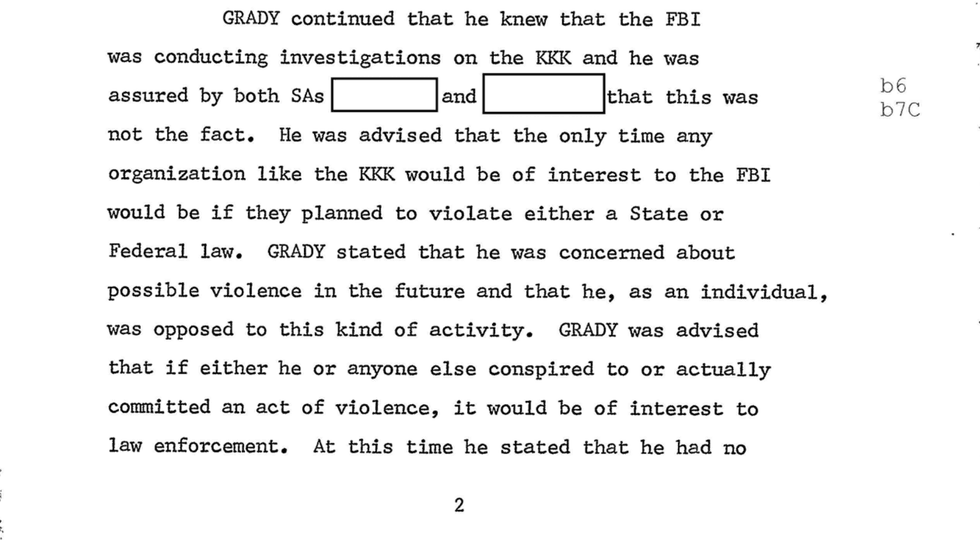 An official FBI memo details a meeting that took place between two FBI agents and Klan leader Joe Grady in July 1979. (Courtesy FBI)
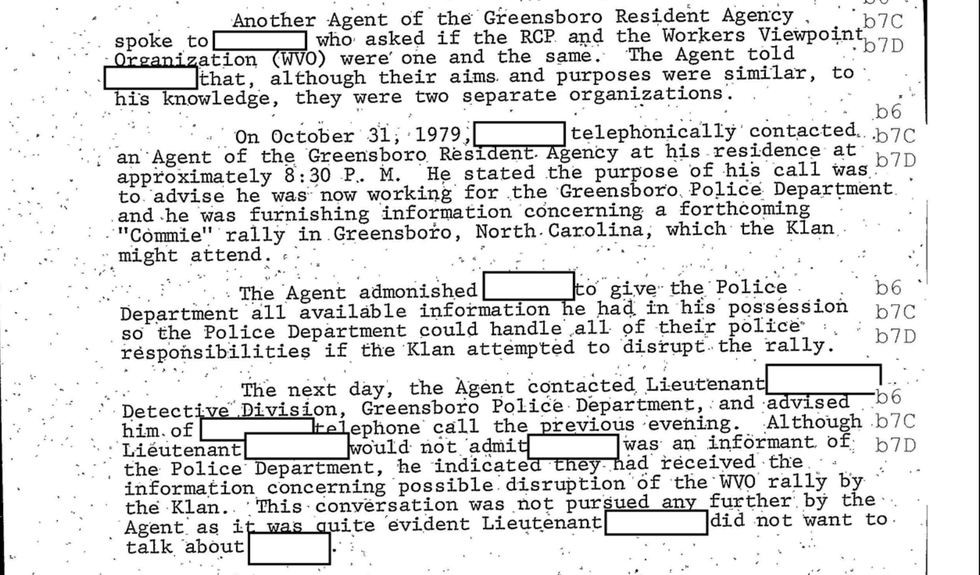 An official FBI memo details Klansman and former FBI informant Eddie Dawson's contact with the FBI three days before the Greensboro Massacre, and an unidentified FBI agent's contact with the Greensboro Police Department to confirm Dawson's information was received. (Courtesy FBI)
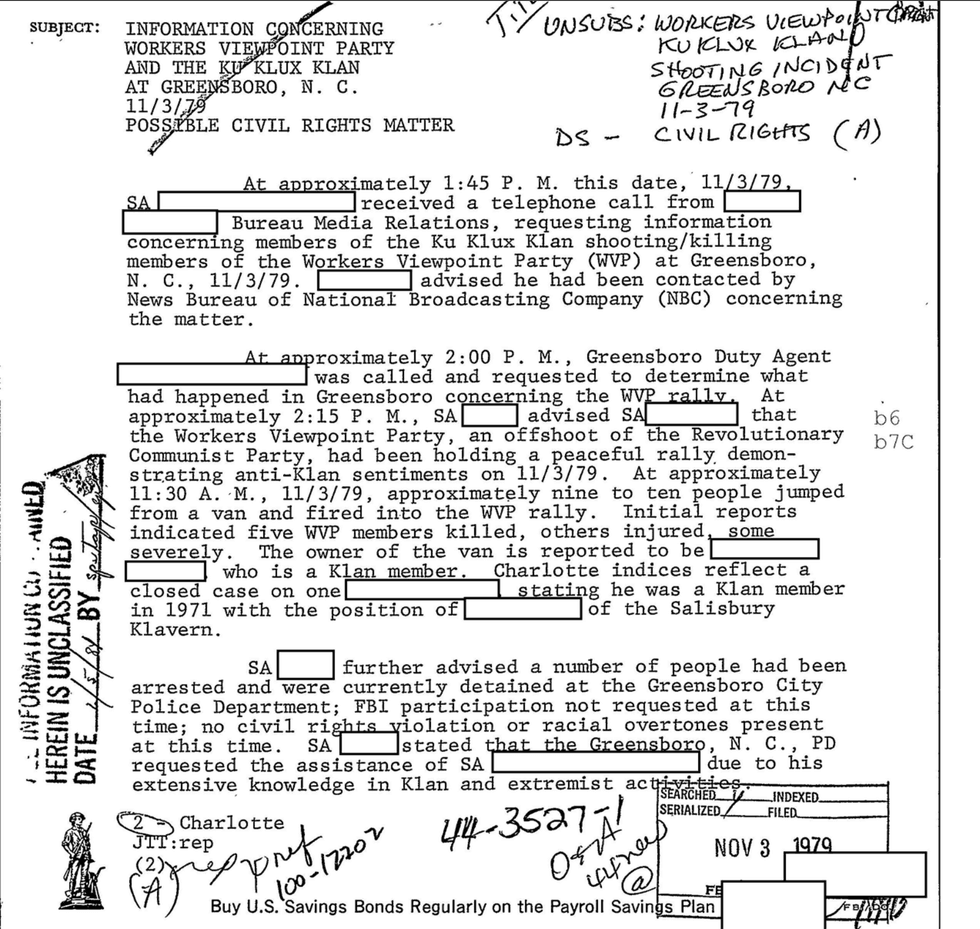 A Nov. 3, 1979 memo details the FBI's response to the Greensboro Massacre. (Courtesy FBI)