North Carolina was supposed to be the Republicans’ backstop. What happened?
Among seven swing states in the 2020 presidential election, North Carolina was the one that remained in President Donald Trump’s column, while Democrat Joe Biden narrowly carried Georgia, Pennsylvania, Arizona, Michigan, Wisconsin and Nevada.
The chairman of the North Carolina GOP that year was Michael Whatley, and he earned Trump’s eternal gratitude.
“What a lot of people don’t know is we got screwed in 2020 — we did great,” Trump said at a campaign rally in Greenville, N.C. last week, while airing his false claim that the election was stolen from him. “But you know who didn’t allow it to happen was Michael Whatley.”
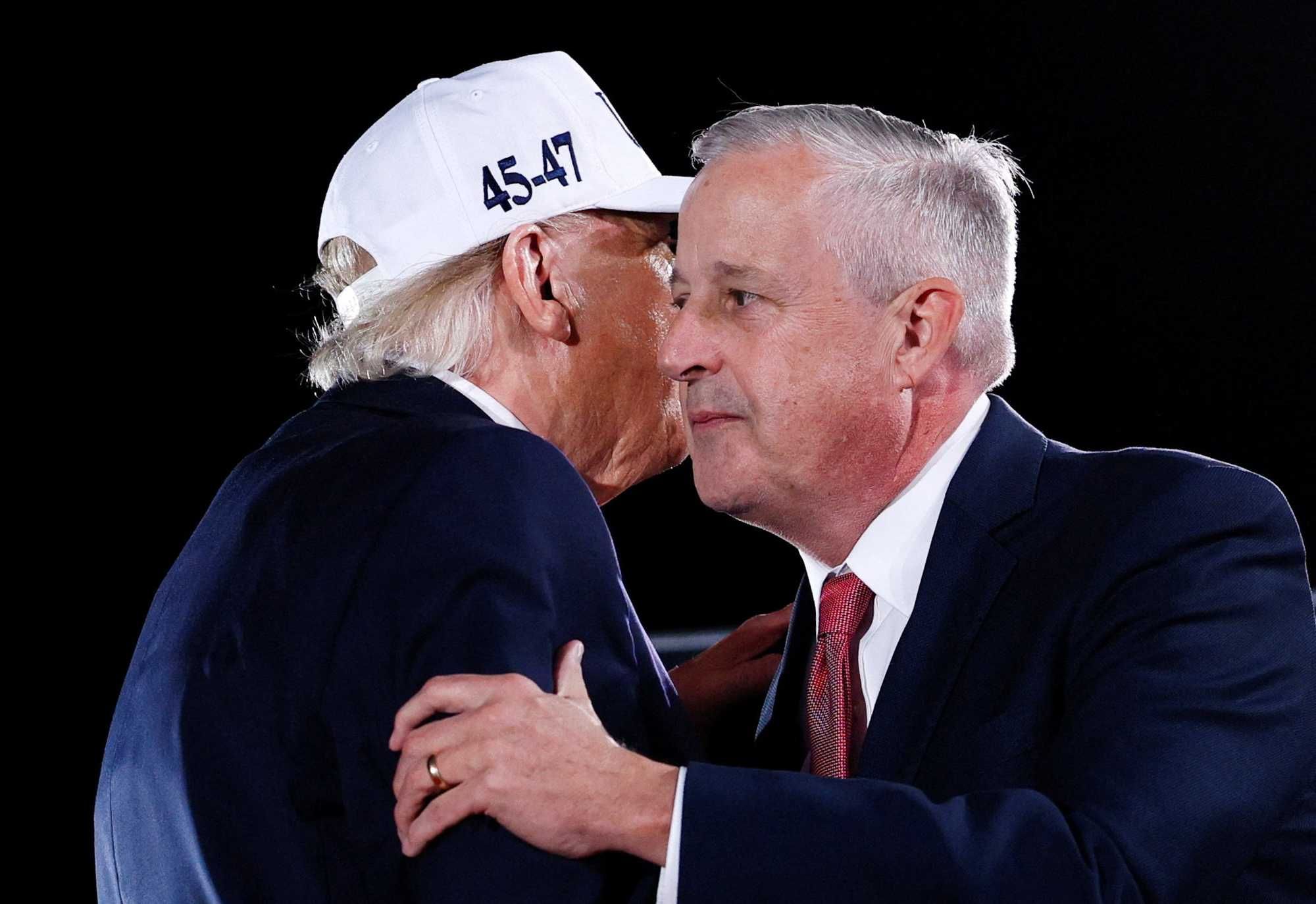
After 2020, Trump vowed that if he ran for president again, he would get Whatley to lead the Republican National Committee — which he did. And after Trump won the 2024 election, he recruited Whatley to run for Senate from North Carolina.
Now, recent polling shows Whatley trailing his Democratic opponent by double digits weeks after Republicans pulled money out of the North Carolina race to shore up candidates in states like Kansas that no one expected to be contested.
The 11th Congressional District in the western part of the state that was ravaged by Hurricane Helene two years ago, and was once considered a GOP stronghold, is now rated as leaning Democrat by the Cook Political Report.
Even the 1st Congressional District, which the Republican-controlled legislature redrew at Trump’s direction to make it more friendly to the GOP, is still considered a toss-up.
No state perhaps better exemplifies the collapse of Republicans’ midterm prospects for holding onto control of Congress than North Carolina.
Whatley’s entrance in the Senate race came, in part, as a result of Sen. Thom Tillis, the Republican incumbent, breaking with his party over the 2025 “Big Beautiful Bill.” Tillis refused to support the legislation over his objection that it would cost the state $40 billion in Medicaid funding over 10 years, including $10 billion in lost hospital receipts imperiling rural healthcare.
The day before Tillis announced his retirement, Trump had posted on Truth Social that he would be meeting with potential primary challengers. Whatley instantly became the Republican primary frontrunner the following month, with Trump’s post offering his “Complete and Total Endorsement.”
The post cemented both Whatley’s campaign platform and his link to Trump.
“He is STRONG on the Border, stopping Crime, supporting our Military/Veterans, cutting Taxes, and saving our always under siege Second Amendment,” Trump wrote. “I need him in Washington, and I need him representing YOU!”
Whatley, who started the race with little name recognition, has stuck with a traditional Republican law-and-order message since the beginning of the campaign by hammering his Democratic opponent for supposedly being soft on crime.
That opponent is Roy Cooper, a popular former two-term governor, who previously served four terms as the state’s attorney general. Cooper enjoys unparalleled name recognition, having appeared on statewide ballots six times in the past 26 years. And in both of his gubernatorial races, in 2016 and 2020, he won in presidential election years in which Trump carried the state, demonstrating crossover appeal.
During repeated campaign stops in North Carolina, Trump has attempted to challenge Cooper’s reputation as a “moderate,” deriding him during an Oct. 20 rally in Greenville as “a radical, left-wing lunatic,” while Whatley charged that his opponent “has stood with the woke mob and the radical Democrats instead of North Carolina families.”
Not only are the national political winds unfavorable to Republicans this year, but Whatley has the misfortune of facing an opponent who is “an excellent candidate,” Christopher Cooper (no relation to the candidate), a political science professor at West Carolina University, told Raw Story.
“He’s a trusted commodity,” Christopher Cooper said of the Democratic candidate. “He’s a hard person to attack. He has won statewide races every year he’s run for office since 2000. It’s hard to remake someone who North Carolinians feel they know so well. He’s won statewide races for attorney general so many times it’s hard to portray him as a radical.”
Whatley’s other challenge is that he hasn’t introduced himself to voters in a way that makes him a credible messenger for the attacks.
“People tend to trust Republicans more on crime,” Christopher Cooper said. “In that sense, he’s going along with the grain. The problem is he never defined himself as a candidate before he started doing that. Voters never got to know who he is.”
Whatley and Trump’s attacks on Cooper center on a trifecta of decisions related to the COVID-19 pandemic and protests against the police murder of George Floyd in the latter part of his first term as governor and early in his second term.
Following a night of unrest in which rioters broke windows at a police precinct and set fire to stores in Raleigh in May 2020, Cooper briefly marched with protesters outside the Governor’s Mansion. He issued an executive order establishing a Task Force for Racial Equity in Criminal Justice that called for addressing policies “that disproportionately affect communities of color and developing solutions to ensure racial equity in North Carolina’s criminal justice system.”
But the biggest target of attacks by Whatley and Trump is Cooper’s agreement to settle a lawsuit after previously resisting calls to release North Carolina prisoners with underlying health conditions to protect them from COVID-19. Under the terms of the agreement, the state released 3,500 inmates.
Whatley and Trump have repeatedly claimed that 25 of the inmates released through the settlement went on to commit murders, including DeCarlos Brown Jr., a mentally ill man who stabbed Iryna Zarutska, a Ukrainian refugee, to death on the Charlotte light-rail in 2025.
The claim about 25 murders appears to be based on a New York Post story reporting that at least 18 inmates released from prison were later charged with killing someone. But an analysis by WRAL News based on court and prison records found that “the majority of them either were already out of prison before the settlement was signed, or would’ve been out of prison anyway when they were accused of killing someone, even if they hadn’t been included in the early-release settlement.”
And contrary to Whatley’s repeated claims, Brown wasn’t in prison at the time of the settlement and the early release agreement had no bearing on Zarutska’s murder.
“Now, the most famous guy on this list, DeCarlos Brown Jr., got rearrested and re-released 13 times before he got on a light-rail car in Charlotte, North Carolina and brutally murdered a beautiful Ukrainian refugee named Iryna Zarutska in cold blood,” Whatley said in Greenville on Oct. 20. “That monster never should have been on the streets of North Carolina. That monster never should have been on that light-rail car. And Iryna Zarutska should be alive today. And her blood is on Roy Cooper’s hands.”
During a rally to support Whatley in Gastonia in September, Trump described North Carolina cities as “blood-soaked killing fields,” and vowed to defeat Cooper, whom he called a “murderer and criminal protector.” Trump resumed the attack during his Oct. 20 rally in Greenville, describing Cooper as “a man who has let out murderers.”
“Independent factcheckers have called these attacks false — Michael Whatley is desperate and it’s shameful that he and his Washington, DC friends are using heinous crimes to try and deceive North Carolinians,” a Cooper campaign spokesperson told Raw Story.
During a campaign stop in Greenville which NPR senior political correspondent Tamara Keith ranked as “one of the smallest Trump rallies” she has ever covered, the president fondly reminisced about recruiting Whatley to run for Senate based on his work to help him win the 2024 presidential election.
“I’m the one who got him into this,” Trump remarked. “I hope — I hope it works — I hope it works out.”
Later, as the energy noticeably flagged during his nearly two-hour speech, Trump seemed to concede the race.
“It’s crazy,” Trump said, after showing the crowd an anti-Cooper attack ad. “You’re going to send him to Washington to represent you.”
Democratic Senate candidate Roy Cooper greets supporters at a campaign event in Raleigh, North Carolina on Oct. 22, 2026. (Courtesy Cooper for North Carolina campaign)A recent poll by Elon University gave Cooper a 13 percent lead over Whatley, as Democratic and unaffiliated voter turnout surged in the first 10 days of early voting while Republican turnout remains flat.
The Elon University Poll found that 57 percent of North Carolinians disapprove of Trump’s job performance, while significant majorities said they believe many aspects of their lives, including cost of living and overall economy, are worse than they were two years ago. The issues at the forefront of voters’ concerns appear to favor Cooper, who has been holding events with ordinary North Carolinians, including a pastor, small business owner and single mother, to highlight his campaign theme of “make stuff affordable again.”
With more than 1.5 million votes already banked in North Carolina, Christopher Cooper, the political scientist, said it’s probably too late for Whatley to pivot from his law-and-order attacks on his opponent to a populist economic message that might resonate more with independent voters and moderate Democrats.
“Obviously, Trump is underwater,” Cooper said. “There’s no way Whatley could have gotten through the primary without his endorsement. There’s no way to get away from it: People associate Michael Whatley with President Trump. He didn’t really have a choice in the matter.”
Lacking the option of ditching Trump, Whatley’s best shot might be leaning into his embrace. The polling numbers bear that strategy out, said Jason Husser, director of the Elon University Poll, due to a gap between the margin of Cooper’s lead when registered voters are compared to a smaller subset who say they are likely to vote. That implies an opportunity for Republicans to turn out more of their base voters.
“Among Republicans, almost none indicate that a Trump endorsement makes them less likely to support an endorsed candidate, and slightly more than half said it makes them more likely to support that candidate,” Husser said. “This gives credence that visits by President Trump and Vice President [JD] Vance to the state have the potential to motivate Republicans to turn out, even if those visits do not do much to persuade voters outside the GOP.”
If Cooper wins, it will be the first time North Carolinians send a Democrat to the U.S. Senate since 2008. A North Carolina win would notch the first of four Republican seats Democrats need to flip to forge a majority, with tougher battles in toss-up states such as Maine, Ohio and Iowa. At the same time, Democrats will need to hold all of their Senate seats, with Michigan being the most vulnerable.
In Greenville, Whatley rallied the MAGA faithful by emphasizing his biography as someone who has lived the American Dream, having grown up in a small town in the mountains of western North Carolina that grew from one Hardees to one Outback Steakhouse, met his wife on a blind date after law school, and raised “three absolutely amazing children.”
It could all go away, he warned them. The American Dream is “under assault,” and Michael Whatley is holding the line.
“It’s under assault by a woke mob,” he said. “It’s under assault by a radical mob, by an extreme mob, by a Democratic mob, by a socialist mob. And it’s gonna be a fight. And we know that we have to win here in North Carolina. We have to hold the line and make sure that we have a Republican Senate.”