SmartNews
'Y'all are just incompetent': Feds tackled wrong woman in hunt for activist
November 23, 2026 10:59AM ET
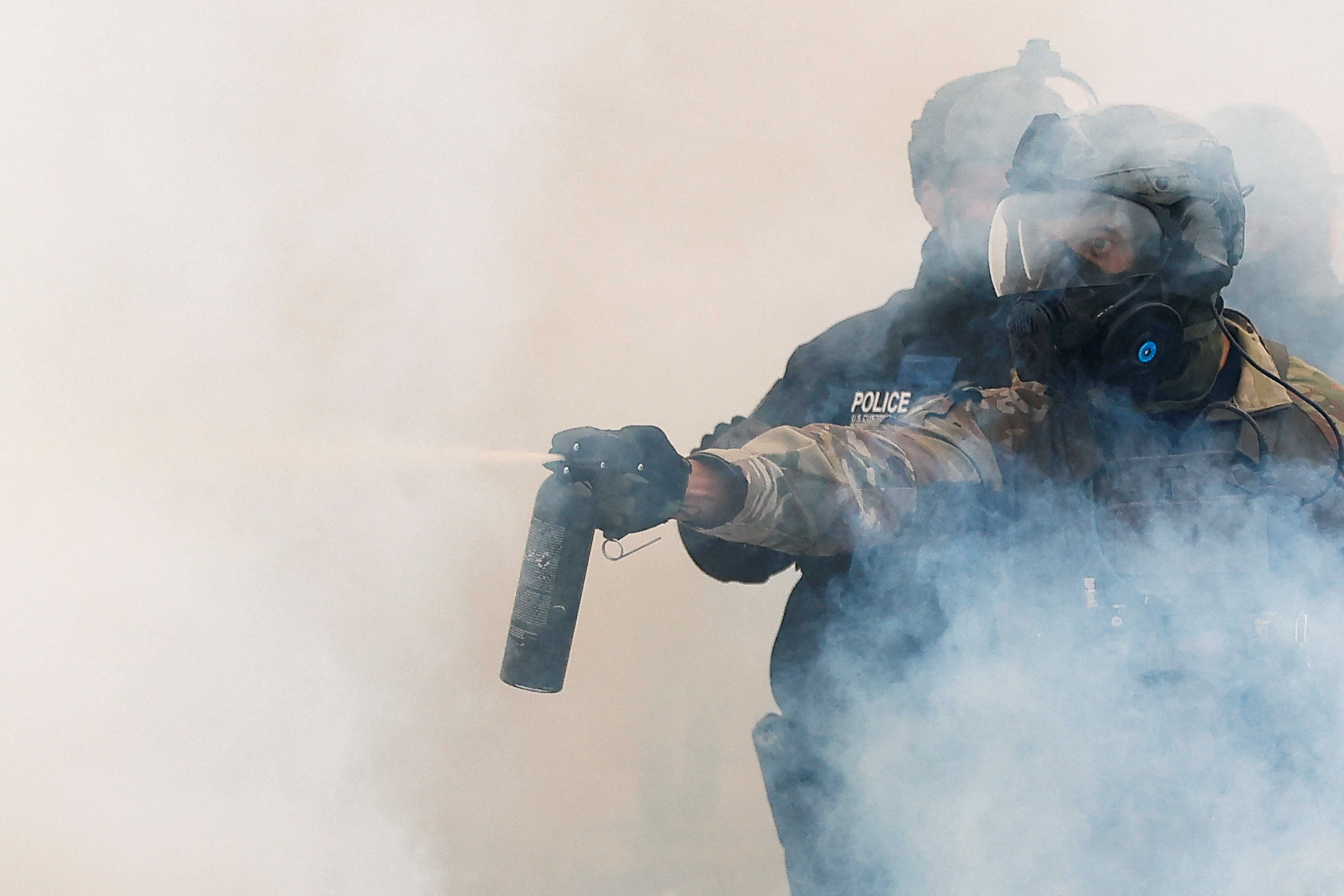
A Federal agent sprays pepper spray through tear gas at an ICE facility in Portland. REUTERS/John Rudoff
Before federal agents filmed themselves arresting Nekima Levy Armstrong for leading a protest in a church last winter — and the White House doctored the footage to make her appear to be crying — agents tackled and detained the wrong Black woman.
Satara Strong-Allen, who is about 6 inches shorter and 15 years younger than Levy Armstrong, suffered a concussion at the hands of federal immigration agents and was detained for hours even after she explained she was not the widely known civil rights activist.
The error underscores the fervor with which the Trump administration sought a public and forceful response to the activists involved in the anti-ICE demonstration — and the journalists who observed it — that disrupted Sunday service at a St. Paul church in January.
“They were targeting me, so they wanted to attack and assault me,” Levy Armstrong said in an interview.
Strong-Allen’s account of mistaken identity was hardly an aberration during the Trump administration’s Operation Metro Surge, which brought thousands of federal immigration agents to Minnesota.
Federal agents arrested ChongLy Scott Thao, a 56-year-old Hmong man and U.S. citizen, saying he matched the description of two wanted Asian men, one of whom had been in prison since 2024. Agents took him from his home in St. Paul in 10-degree weather while he was wearing only shorts and Crocs.
ICE agent Christian Castroshot a Venezuelan man in the leg in north Minneapolis in January after initiating a car pursuit of a driver he mistook for another Latino man. The man the agent shot, Julio Sosa-Celis, was neither the man driving nor the target for arrest.
And U.S. citizen Rogelio Jimenez said when federal agents arrested him in Brooklyn Park in January, they told him they were looking for someone else with the same name.
The Jan. 18 protest at Cities Church — where one of the pastors, David Easterwood, also works as a local ICE official — drew swift condemnation from the Trump administration as an assault on religious liberty.
Hours after the demonstration, the White House Press Office posted on social media that the Justice Department had opened an investigation, writing, “President Trump will not tolerate the intimidation and harassment of Christians in their sacred places of worship.”
Strong-Allen, who also helped organize the protest, would later be indicted as one of the 39 defendants in the Cities Church case, but she wasn’t wanted by federal authorities at the time she was tackled and detained by agents pursuing Levy Armstrong.
She was arrested around 2 a.m. on Jan. 22 in a downtown Minneapolis hotel, where she was staying with her wife, Chauntyll Allen, and Levy Armstrong out of concern for their safety.
Allen, a St. Paul School Board member, and Levy Armstrong were receiving threats and wanted to be able to turn themselves in to avoid a raid on their homes.
Strong-Allen had just stepped out of Levy Armstrong’s room to go to her own when the door across the hall opened and a federal agent came out, Levy Armstrong said. The agent chased after Strong-Allen.
“There was no ‘Freeze.’ There was no ‘You’re under arrest.’ There was none of that. It was literally just tackle,” Strong-Allen said in an interview.
She hit her head on a wall, and then agents were on her back, pushing her head into the floor while she asked to see a warrant, she said.
They put handcuffs on her and led her to their vehicle, slamming her foot in the door. On the way to the Whipple Federal Building, which served as the headquarters of Operation Metro Surge, she said an agent showed her an arrest warrant on his phone for Nekima Levy Armstrong.
“I was like, ‘Y’all are just incompetent,’” Strong-Allen recalled thinking. “I told them that was not my name.”
Nevertheless, they took her to Whipple, where they held her for hours and took her photograph and fingerprints. The authorities released her in the early morning hours. She had agents drop her off at a gas station because she didn’t trust them to take her home.
U.S. Immigration and Customs Enforcement declined to comment.
For days, Strong-Allen said she felt foggy and saw spots. It took weeks to recover full movement in her hands, which were injured by the handcuffs. She still has small but visible scars from the handcuffing and where the agents slammed the car door on her foot. Medical records reviewed by the Reformer show Strong-Allen was diagnosed with a concussion, nerve injury in both hands, bruising in her foot and emotional distress.
The aggressive arrest led her to believe that the agents wanted to hurt Levy Armstrong, whom the White House had cast as a dangerous political enemy.
The botched arrest could have been avoided had federal authorities allowed Levy Armstrong to turn herself in as she was trying to do. Her attorney, Jordan Kushner, said U.S. Attorney Daniel Rosen called him and indicated Levy Armstrong would be able to turn herself in but then called back and said she would have to be arrested.
“Obviously, he was getting instructions from D.C.,” Kushner said in an interview.
The U.S. Attorney’s Office declined to comment.
Federal agents returned to the hotel later that day to arrest Levy Armstrong. Video footage taken by her husband and one of the federal agents shows Levy Armstrong asking the agents to treat her with respect, telling them she has a brain tumor.
She also asked why the agent was filming her on a phone. He said because he wanted there to be a record of the arrest. Levy Armstrong asked him to stop — she was thinking about ICE officer Jonathan Ross filming himself before shooting and killing Renee Good just two weeks earlier.
“I don’t want to be a trophy for MAGA,” Levy Armstrong told the agents.
“It’s not going to be on Twitter,” the agent filming replied.
Soon after, then-Homeland Security Secretary Kristi Noem posted a still image from the footage on X, which the White House then doctored for a post that makes Levy Armstrong appear to be crying. A Trump administration official defended altering the image, saying “the memes will continue.”
The federal agents’ mistake is particularly striking given the level of surveillance they conducted. Agents trailed Levy Armstrong the day before her arrest, watching her run errands and move bags into her hotel room. Levy Armstrong suspects the Aloft hotel told federal agents which room she was staying in so they could be across the hall. The hotel declined to comment.
Federal prosecutors pointed to Levy Armstrong and Allen’s hotel stay as evidence they were flight risks and shouldn’t be released from jail pending trial. U.S. District Judge Laura Provinzino ruled against the government, calling the prosecutors’ assertions “simply speculative.”
Levy Armstrong and the other defendants — including the journalists Don Lemon and Georgia Fort — are charged with two felonies: conspiracy against the right of religious freedom at a place of worship and injuring, intimidating and interfering with the exercise of the right of religious freedom at a place of worship.
They are seeking to have the charges dismissed, arguing in part that they are being subjected to a vindictive prosecution by the Trump administration. The defendants also argue the government has failed to allege their conduct violated the 1994 federal law aimed at protecting access to abortion clinics and places of worship and that the law is unconstitutional.
“We did not commit a crime. We were at the church to inform parishioners about the immorality of their pastoral leadership,” Strong-Allen said.
A judge is weighing their arguments.
Minnesota Reformer is part of States Newsroom, a nonprofit news network supported by grants and a coalition of donors as a 501c(3) public charity. Minnesota Reformer maintains editorial independence. Contact Editor J. Patrick Coolican for questions: info@minnesotareformer.com.