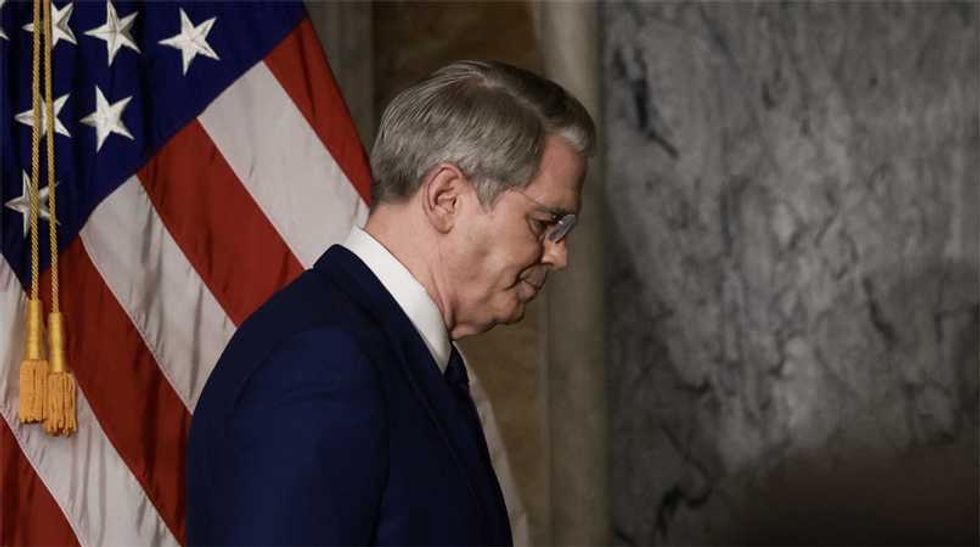
U.S. Treasury Secretary Scott Bessent walks following a press conference to outline further sanctions against Iran, at the Treasury Department in Washington, D.C., U.S., August 24, 2026. REUTERS/Evelyn Hockstein

Before Treasury Secretary Scott Bessent could flee reporters after announcing plans for an economic war on Iran, one reporter called him out over his “D-Day” analogy.
Prior to his press availability, Bessent had previewed his plan by claiming, “Today, at President Trump's direction, the United States Treasury has begun Operation Economic Outcast, an unprecedented campaign against the Islamic Republic of Iran and its enablers. In the Second World War, D-Day marked the historic beginning of a campaign with our allies to target and drive the enemy from its positions, including those in third countries. Today, in that same spirit, we are launching an economic onslaught against Iran's financial connections around the globe."
On Monday during his speech, he dramatically claimed he was putting Iran’s leaders on notice but did not say when Operation Economic Outcast would exactly go into effect.
That led one unidentified reporter to ask, “You described this as an ‘Economic D-Day,' but D-Day wasn't a threat of an invasion, and the U.S. didn't give a timeline to Germany. So why not impose the sanctions today?”
“Well, we are giving everyone the opportunity to remedy bad behavior. Why would I want to blow up the global financial system?” he protested. “We believe that it is important to level set and give people a cure, period. But they should know that we will move very quickly and that we are serious.”
He later added, “So we believe that a warning shot and a level set of expectations is appropriate. And if people do not want to meet our expectations, then we expect and they should expect that they should will leave the dollar system.”
- YouTube youtu.be
Report typos and corrections to corrections@rawstory.com.
For customer support contact support@rawstory.com.