The Federal Communications Commission on Thursday approved a proposal to expand a telephone subsidy for low-income Americans to include Internet access, after a deal to cap the cost of the plan collapsed.
The commission voted 3-2 to approve a proposal by FCC Chairman Tom Wheeler, unveiled earlier this month, to expand the $9.25 monthly mobile phone subsidy to include broadband Internet access. The agency's three Democrats voted yea and its two Republicans nay.
Republicans have pushed for a budget cap for the $1.5 billion annual program, called Lifeline, which has helped lower-income Americans get access to telecommunications technologies since 1985. There is currently no cap.
FCC Commissioner Ajit Pai, a Republican, said Democratic Commissioner Mignon Clyburn had signed onto a deal with Republicans earlier in the day after intensive negotiations, only to change her decision.
Pai's aide, Matthew Berry, said Wheeler had "bullied" fellow Democrat Clyburn into withdrawing from a "moderate, bipartisan deal" that would also have set a minimum standard on broadband speeds.
Clyburn told reporters that Wheeler had not pressured her to withdraw from the deal, but she said she had decided "upon reflection" that the deal wasn't the best result. " I took a risk," Clyburn said.
Wheeler has said he wants to give those receiving the subsidy a choice of using it for phone services, high-speed Internet, or both. But households would only receive a single $9.25 per month subsidy that would apply to both services.
The program currently helps about 12 million U.S. households afford landline and mobile phones, according to agency estimates.
Wheeler proposed setting a budget for the program of $2.25 billion a year, indexed for inflation. The extra funds would give more than 5 million additional households access to the program, but FCC officials say the money will not be used all at once.
The FCC estimates that some 95 percent of U.S. households with incomes of at least $150,000 have access to high-speed Internet, while less than half of households with incomes lower than $25,000 have Internet access at home.
The proposal requires phone providers to offer unlimited talk time for all plans for subsidy users after December 2016, and by the end of 2019 providers would have to offer both phone and broadband services to qualify under the program.
FCC Republican Commissioner Michael O'Rielly said this month that Wheeler's proposal would "massively expand the size and scope" and "balloon a program plagued by waste, fraud and abuse."
Democratic presidential candidate and Vermont Senator Bernie Sanders has urged the FCC to act on the program.
(Reporting by David Shepardson; Editing by Alan Crosby and Steve Orlofsky)
The National Renewable Energy Laboratory this week said that rooftop solar panels have the potential to generate nearly 40 percent of electricity in the U.S. But what about the cost of going solar?
Many people ask when the cost of producing power from solar photovoltaic (PV) panels will be equal to or less than buying from the grid – a point called “grid parity” that could accelerate solar adoption.
But in asking the question, they often compare apples to oranges and forget that the answer varies from place to place and from one type of installation to another.
For example, electricity from utility-scale solar systems (typically large arrays where panels slowly change tilt and orientation to face the sun all day) usually costs less than electricity produced from solar panels fixed on someone’s home. Also, residential electric rates, on average about 12 cents per kilowatt-hour in in the U.S., are much higher than wholesale electric rates – the price utilities pay to power generators – which are usually less than 4 cents per kilowatt-hour.
At the same time, different states have more or less sun – solar power in Florida is typically more economic than in Alaska, for instance. All of these factors make the question more complicated than people might anticipate.
How, then, can we compare the cost of rooftop solar to the cost of buying power from the local electricity grid and thereby find when which states will hit the point of grid parity?
Putting a number on solar cost
The levelized, or average, cost of electricity from a solar PV array is derived from all the money spent to buy, install, finance and maintain the system divided by the total amount of electricity that system is expected to produce over its lifetime. We call this value the Levelized Cost of Electricity (LCOE) and it’s expressed in terms of dollars per kilowatt-hour ($/kWh). The same metric can be used to determine the cost for a coal or natural gas plant. Planners like it because it reduces the cost of a power plant over a span of many decades into a single number.
Despite the strengths of LCOE as a metric – it is easy to understand and widely used – it has some shortcomings, too. Namely, it leaves out geographic variability, changes with seasons and usually ignores the cost of environmental impacts such as the cost of carbon emissions. This metric is a bit too simple when comparing variable wind and solar generators to power plants that you can turn on and off at will, such as those fueled by uranium, coal and natural gas.
Today the average cost of energy from solar PV in U.S. is reported to be 12.2 cents per kWh, which is about the same as the average retail rate.
Those who keep close tabs on electricity prices might think that it is about on par with what they are paying for their own electricity at home. This number can be misleading, however, because it represents the average price of utility-scale solar across the U.S., not necessarily the cost borne to produce electricity from solar panels on our homes.
So how do we know how close residential solar is to grid parity where you live? Ultimately, that depends on two things: how much you pay for the electricity you buy from the local grid, and how much can you get paid for the electricity you can produce from PV. Let’s take a look at both of them.
How much sun do you get?
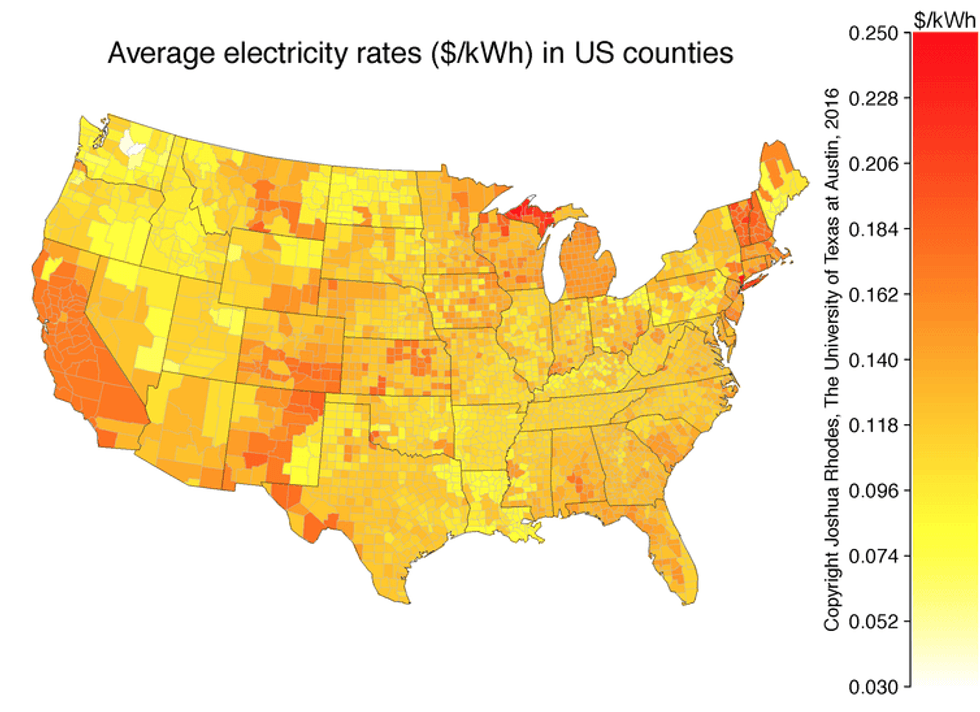
The Energy Information Agency (EIA) has created a map of average electricity rates by zip code, averaged to the county level and remade by the author in the map below. The deep red (or darker) colors indicate higher average residential electricity rates.
Map of average electricity rates across the U.S. (EIA)
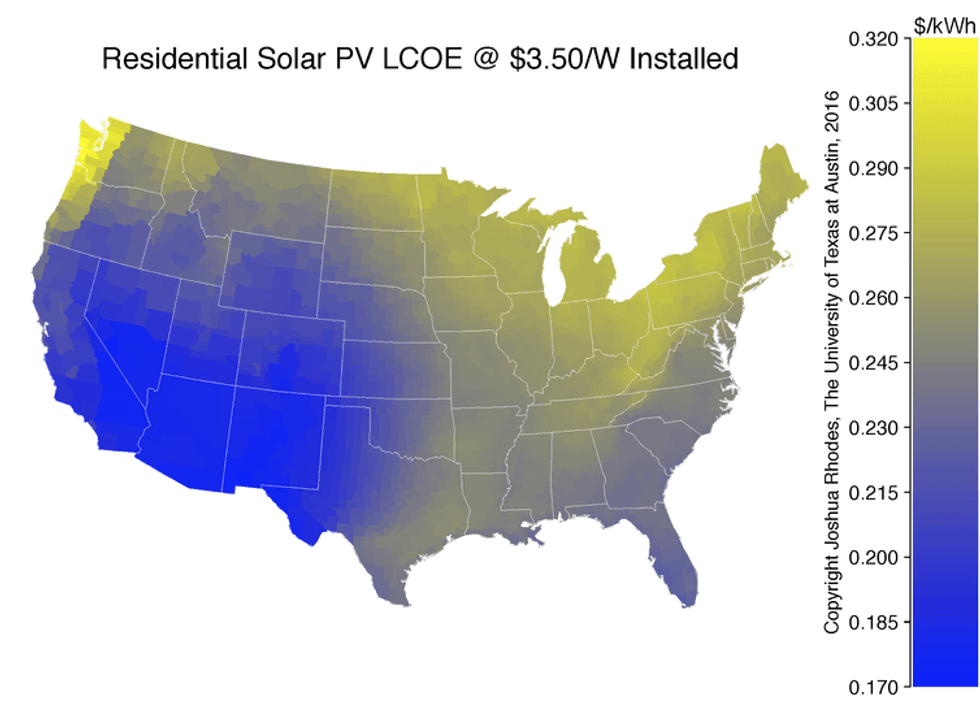
Electric rates vary a great deal across the country, and these differences could be caused by a number of economic, historical or regulatory reasons. Likewise, the costs of solar and the availability of the solar resource (i.e., how often and how strong the sun shines) also are not homogeneous throughout the U.S. The figure below shows the LCOE of residential solar across all counties nationwide.
LCOE of residential solar across the U.S.
The data on the residential solar costs were pulled together from an ongoing large-scale campus-wide research project at the Energy Institute at The University of Texas at Austin. The main assumptions behind the data are a total cost of US$3.50/Watt for the solar PV installation for a fixed array pointing south with a tilt of 25 degrees. Solar production data are based on a 2013 National Renewable Energy Laboratory study.
The U.S. Department of Energy SunShot Initiative has a stated goal of lowering residential solar PV system installations to $1.50/Watt. Cheap PV panels from China have driven down the hardware costs to the point where the price of a total PV system is now dominated by “soft costs” – namely, customer acquisition, installation, supply chain, permit, etc. Still, total installed system costs continue to fall.
While those cost cuts are impressive, the major driver in the cost of energy produced is the amount of solar radiation that strikes the solar panels. Obviously, some locations are sunnier than others so a solar array in Arizona will produce more energy than one in Washington state, making the system more economic for the homeowner.
And, the prevailing cost of electricity varies nationwide. Some of the areas with the lowest cost of grid power (e.g., Washington) have some of the highest solar costs because of low levels of sunshine. It will be difficult to make solar reach parity in those locations.
On the other hand, there are other locations where the price of grid electricity is high and the solar LCOE is relatively low, including New Mexico, California and Hawaii; these places are prime locations for solar to be at parity sooner.
Moving target
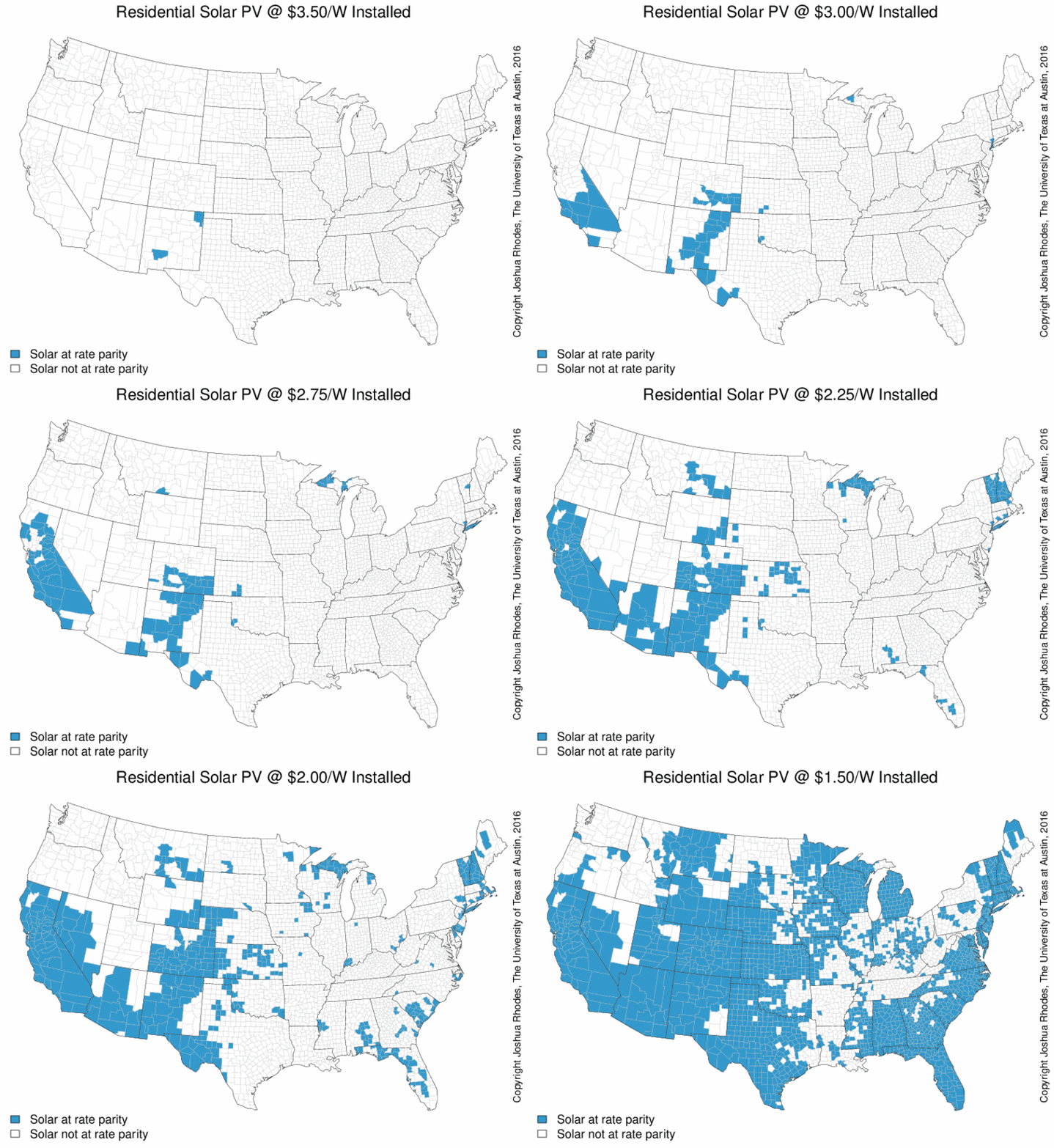
To illustrate this point, we take the same information that underlies the solar cost map and reduce the total installed cost of installed solar in $0.50/Watt increments – from $3.50/Watt to $1.50/Watt (the SunShot goal). We can then subtract the electricity rate from the solar LCOE in every county. Where this difference is zero or negative (electricity rates > LCOE), we can estimate when that county will be at grid parity for residential solar PV.
Below is a GIF that shows the estimate of the point of parity as the price of installed solar falls. Note that the total installed costs include the federal investment tax credit and any local rebates and tax incentives.
GIF showing the locations where residential solar LCOE reaches parity with local average electric rates at various solar installed costs.
These calculations and estimates come with several caveats. First, the above calculation assumes that PV owners are paid for their generation at standard electric rates in their area. This arrangement is typically known as net metering.
But there is a wide range of ways that utilities interact with customers who have installed solar PV. Some utilities may pay homeowners wholesale market rates for the excess electricity they feed into the grid from their panels, which tend to be considerably lower than retail rates. If utilities pay homeowners based on the wholesale rate, rather than the retail rate, solar is less economic.
But that’s not all. One could add in the cost benefits of reducing CO2 emissions and other pollutants. On the other hand, there are costs associated with “firming up” the solar power when it’s nighttime or cloudy.
Keeping these factors in mind, the answer to the question, “Does it make economic sense for me to install solar?” is: it depends. As the map demonstrates, the crucial thing to watch, apart from any changes in electricity costs, is how quickly the overall costs of solar go down.
Robotic systems and unmanned vehicles are playing an ever-growing role in the US military -- but don't expect to see Terminator-style droids striding across the battlefield just yet.
A top Pentagon official on Wednesday gave a tantalizing peek into several projects that not long ago were the stuff of science fiction, including missile-dodging satellites, self-flying F-16 fighters and robot naval fleets.
Though the Pentagon is not planning to build devices that can kill without human input, Deputy Secretary of Defense Robert Work hinted that could change if enemies with fewer qualms create such machines.
"We might be going up against a competitor that is more willing to delegate authority to machines than we are, and as that competition unfolds we will have to make decisions on how we best can compete," he said.
Work, who helps lead Pentagon efforts to ensure the US military keeps its technological edge, described several initiatives, including one dubbed "Loyal Wingman" that would see the Air Force convert an F-16 warplane into a semi-autonomous and unmanned fighter that flies alongside a manned F-35 jet.
"It is going to happen," Work said of this and other unmanned systems.
"I would expect to see unmanned wingmen in the air first, I would expect to see unmanned systems undersea all over the place, I would expect to see unmanned systems on the surface of the sea," Work told an audience at a discussion in the capital hosted by The Washington Post.
The US military has over the past 15 years invested heavily in unmanned drone technology, used to surveil vast parts of the Middle East and Africa and sometimes conduct deadly strikes -- though remote human operators decide when to fire.
- Driverless convoys -
Commercial tech firms like Google are rushing to develop driverless vehicles, but Work said it would take longer for the military to create autonomous trucks given the challenges of navigating off-road.
"When the roads become more dangerous we will go off road, and that type of navigation is extremely difficult," Work said.
The US military wants to build driverless convoys to protect against roadside bombs, a low-tech weapon that has killed hundreds of troops in Iraq and Afghanistan.
Science and technology leaders including British physicist Stephen Hawking fret that the development of weapons with a degree of autonomous decision-making could be feasible within years, not decades.
Earlier this year, they called for a ban on offensive autonomous weapons that are beyond meaningful human control, warning the world risked sliding into an artificial intelligence arms race and raising alarm over the risks of such weapons falling into the hands of extremists.
- Micro drones -
Work's comments come after Defense Secretary Ash Carter last month lifted the lid on a couple of secret Pentagon projects. Next year's proposed budget includes $71.4 billion in research and development funds.
Carter said the secretive Strategic Capabilities Office had created tiny, swarming drones that are built largely from components created by 3D printers.
The drones could fly through heavy winds and be launched from the back of a fighter jet moving at Mach 0.9.
Pentagon researchers also are developing small bombs that use cameras and sensors to improve their targeting capabilities.
Other projects include robot boats and a hyper-velocity gun -- known as the electromagnetic rail-gun -- that can blast a projectile out at an astonishing 4,500 miles (7,250 kilometers) per hour.
The Pentagon is also looking toward the heavens as it tries to figure out future threats -- Work said the military worries about satellites being targeted and is developing devices that can dart away from incoming anti-satellite missiles.
The Pentagon is also developing artificial intelligence capabilities, such as "deep-learning" machines that can sift mind-boggling amounts of data.
Already, the military is tasking these machines to scrutinize the Islamic State group and better understand its organizational structure.
"Learning machines are going to allow us to get after ISIS as a network and deal them a lasting defeat," Work said.
The FBI may be allowed to withhold information about how it broke into an iPhone belonging to a gunman in the December San Bernardino shootings, despite a U.S. government policy of disclosing technology security flaws discovered by federal agencies.
Under the U.S. vulnerabilities equities process, the government is supposed to err in favor of disclosing security issues so companies can devise fixes to protect data. The policy has exceptions for law enforcement, and there are no hard rules about when and how it must be applied.
Apple Inc has said it would like the government to share how it cracked the iPhone security protections. But the Federal Bureau of Investigation, which has been frustrated by its inability to access data on encrypted phones belonging to criminal suspects, might prefer to keep secret the technique it used to gain access to gunman Syed Farook's phone.
The referee is likely to be a White House group formed during the Obama administration to review computer security flaws discovered by federal agencies and decide whether they should be disclosed.
Experts said government policy on such reviews was not clear-cut, so it was hard to predict whether a review would be required. "There are no hard and fast rules," said White House cybersecurity coordinator Michael Daniel, in a 2014 blog post about the process.
If a review is conducted, many security researchers expect that the White House group will not require the FBI to disclose the vulnerability it exploited.
Some experts said the FBI might be able to avoid a review entirely if, for instance, it got past the phone's encryption using a contractor's proprietary technology.
Explaining the policy in 2014, the Office of the Director of National Security said the government should disclose vulnerabilities “unless there is a clear national security or law enforcement need."
The interagency review process also considers whether others are likely to find the vulnerability. It tends to focus on flaws in major networks and software, rather than individual devices.
During a press call, a senior Justice Department official declined to disclose whether the method used on Farook's phone would work on other phones or would be shared with state and local law enforcement.
Apple declined to comment beyond saying it would like the government to provide information about the technique used.
PROTECTING "CRUCIAL INTELLIGENCE"
The government reorganized the review process roughly two years ago and has not disclosed which agencies regularly participate other than the Department of Homeland Security and at least one intelligence agency. A National Security Council spokesman did not respond to a request for comment about agency participation.
In his April 2014 blog post, White House cybersecurity coordinator Daniel, who chairs the review group, said secrecy was sometimes justified.
“Disclosing a vulnerability can mean that we forego an opportunity to collect crucial intelligence that could thwart a terrorist attack stop the theft of our nation’s intellectual property,” Daniel wrote.
On Tuesday, a senior administration official said the vulnerability review process generally applies to flaws detected by any federal agency.
Paul Rosenzweig, a former deputy assistant secretary at the Department of Homeland Security, said he would be “shocked” if the Apple vulnerability is not considered by the group.
“I can’t imagine that on one of this significance that the FBI, even if it tried to, would succeed in avoiding the review process,” said Rosenzweig, founder of Red Branch Consulting, a homeland security consulting firm.
He predicted the FBI would not be forced to disclose the vulnerability because it appears to require physical possession of a targeted phone and therefore poses minimal threat to Internet security more broadly.
Many security researchers have suggested that the phone's content was probably retrieved after mirroring the device's storage chip to allow data duplication onto other chips, effectively bypassing limitations on the number of passcode guesses.
Kevin Bankston, director of the think tank Open Technology Institute, said there is no public documentation of how the review process has worked in recent years. He said Congress should consider legislation to codify and clarify the rules.
Stewart Baker, former general counsel of the NSA and now a lawyer with Steptoe & Johnson, said the review process could be complicated if the cracking method is considered proprietary by the third party that assisted the FBI.
Several security researchers have pointed to the Israel-based mobile forensics firm Cellebrite as the likely third party that helped the FBI. That company has repeatedly declined comment.
If the FBI is not required to disclose information about the vulnerability, Apple might still have a way to pursue details about the iPhone hack.
The Justice Department has asked a New York court to force Apple to unlock an iPhone related to a drug investigation. If the government continues to pursue that case, the technology company could potentially use legal discovery to force the FBI to reveal what technique it used, a source familiar with the situation told Reuters.
At least one expert thinks a government review could require disclosure. Peter Swire, a professor of law at the Georgia Institute of Technology who served on the presidential intelligence review group that recommended the administration disclose most flaws, said there is “a strong case” for informing Apple about the vulnerability under the announced guidelines.
“The process emphasizes the importance of defense for widely used, commercial software,” he said.
(Reporting by Dustin Volz in Washington; Additional reporting by Dan Levine and Joseph Menn in San Francisco; Editing by Sue Horton, Peter Henderson and David Gregorio)
When Anonymous declared “total war” on Donald Trump in early March, the hacktivist group set a countdown clock, calling on “everyone to target Trump websites” on April 1. But that may not have been its real objective.
Regardless of what, if anything, is planned for April 1, the actual attack may have already happened. That’s because the hack appears to be not of any website or technology but rather of Trump himself.
By exploiting Trump’s quick-trigger tendencies to attack and destroy his rivals – including by threatening police action – Anonymous is seeking to tear down not his personal privacy, but something much more sacred to him: his brand.
My research into Anonymous, its goals and its tactics, suggests that provoking just such an aggressive response, including the involvement of multiple law enforcement agencies, may have been the actual goal of the Anonymous effort.
As a spokesman in an ever-grinning mask would soon reveal, those “private” details of the billionaire-turned-presidential-candidate were already public – they had been available online since 2013. “Trump want[s] to turn America into a fascist dictatorship where anyone can be arrested for just posting old information online,” the hacktivists contended.
Understanding hacktivism
This bait-and-switch tactic of issuing a technological threat and then playing a non-technical trick on Trump may seem like a departure from traditional hacktivist methods. After all, Anonymous is best known for digital actions, including actually stealing private information, defacing websites and, most destructively, distributed denial of service (DDoS) attacks, in which a deluge of well-coordinated web traffic forces a website to shut down.
Some see a contradiction in this group that champions free speech while effectively silencing that of their enemies. However, a close look at Anonymous reveals that its overall aim is not technological in nature, but rather societal: to pull the curtain back on their adversaries and force the public to look. Most hacktivist “#operations” are backed by a clear mission statement, protesting issues as diverse as whale-hunting and unlawful incarcerations around the globe.
Their tactics reflect this drive for social change. Journalist Andres Jauregui likened one Anonymous method, DDoS, to a civil disobedience strategy employed by student activists in the 1960s: “Clog the hallway of a government office with enough people, and it effectively ceases to function; direct enough traffic to a website, and the same thing happens.” But that is not how the media portray the group.
My 2015 news analysis found that most journalists frame Anonymous as “malicious pranksters” whose missions are broadly tantamount to tying the enemy’s shoelaces together and running away. The next most frequent characterization used more ominous terms, painting Anonymous as a global threat much like the movie character in the Guy Fawkes mask who gleefully plotted the demise of world order.
By eliciting such a forceful and police-centric response, Anonymous is highlighting its basis in protest. The group is making the political suggestion that rather than being viewed as thepolitical outsider of this election season, Trump represents a brand of totalitarianism that will aim establishment power at whatever target he directs. Like his personal information, Anonymous seems to say, Trump’s true nature is already visible to the public.
Attacking Trump’s brand
My research also found that 78 percent of Anonymous’ targets belonged to one of the following categories: government agencies, corporations and media empires – a tripartite of corrupted establishments, according to hacktivists. To Trump supporters, the rogue Republican candidate would seem an odd choice to add to that list.
Indeed, poll after poll has shown that Trump supporters choose him because he is the antiestablishment candidate who answers to no corporate sponsor, media outlet or political party agenda.
But Anonymous’ declaration of “war” on Donald Trump may not really be the establishment-threatening assault suggested by “V for Vendetta.“ Rather, it appears to be an attack in the spirit of conning a con man, as in “The Sting.”
Anonymous declares “total war” on Trump.
Based on the group’s previous actions, we can then speculate that Anonymous’ goal is to show that Trump is the quintessential autocrat in the making. When he promises a “deportation force” to round up illegal immigrants, or threatens to expose sensitive information on his political enemies or their wives, and even when he calls on everyone to “boycott Starbucks” for allegedly removing Christmas from their cups, he is directly raising the specter of Anonymous’ Orwellian nightmare.
Whether or not Anonymous succeeds in dismantling – or even tries to attack – Donald Trump’s websites on April Fools’ Day is probably irrelevant. By cleverly goading Trump into calling for a law enforcement response against people who have only distributed already-public information, Anonymous has already begun to undermine his antiestablishment brand. That’s a pretty good trick.
If the U.S. Department of Justice asks a New York court to force Apple Inc to unlock an iPhone, the technology company could push the government to reveal how it accessed the phone which belonged to a shooter in San Bernardino, a source familiar with the situation said.
The Justice Department will disclose over the next two weeks whether it will continue with its bid to compel Apple to help access an iPhone in a Brooklyn drug case, according to a court filing on Tuesday.
The Justice Department this week withdrew a similar request in California, saying it had succeeded in unlocking an iPhone used by one of the shooters involved in a rampage in San Bernardino in December without Apple's help.
The legal dispute between the U.S. government and Apple has been a high-profile test of whether law enforcement should have access to encrypted phone data.
Apple, supported by most of the technology industry, says anything that helps authorities bypass security features will undermine security for all users. Government officials say that all kinds of criminal investigations will be crippled without access to phone data.
Prosecutors have not said whether the San Bernardino technique would work for other seized iPhones, including the one at issue in Brooklyn. Should the Brooklyn case continue, Apple could pursue legal discovery that would potentially force the FBI to reveal what technique it used on the San Bernardino phone, the source said.
A Justice Department representative did not have immediate comment.
In a statement, Apple said "we don't know" the FBI's technical solution, which vendor developed it or "what it allegedly achieves."
A federal magistrate in Brooklyn last month ruled that he did not have authority to order Apple to disable the security of an iPhone seized during a drug investigation. The Justice Department then appealed to a district court judge.
After filing that appeal, U.S. prosecutors notified the magistrate in the San Bernardino case that a third party had demonstrated a new technique which could access the iPhone in question.
The Justice Department disclosed the new technique to the judge one day after the demonstration, and then confirmed its success on Monday, according to court filings, though it did not reveal how its solution works.
The U.S. government did not disclose any details in a letter to the Brooklyn judge on Tuesday. Instead, prosecutors only agreed with a request by Apple to delay briefing deadlines in the case, and said it would update the court by April 11 as to whether it would "modify" its own request for Apple's assistance.
Law enforcement officials across the country have said they regularly encounter Apple devices they cannot access.
Hillar Moore III, the district attorney in East Baton Rouge, said he has asked the FBI whether its new technique would access an iPhone to help solve a murder case he is overseeing. Moore has not yet received an answer.
"Eventually we would like to know: Is this technology available to us, or is the third party going to sell it, and how much would it cost?" he said.
Americans will soon be able to buy a smartphone-shaped gun that can hold two bullets and easily slip into a pocket.
The Minnesota-based company Ideal Conceal says it will sell the new weapon from mid-2016.
"Ingeniously designed to resemble a smartphone, yet with one click of the safety it opens and is ready to fire," the company says on its website.
"Smartphones are everywhere, so your new pistol will easily blend in with today’s environment," it adds. "In its locked position it will be virtually undetectable because it hides in plain sight."
The gun is a double-barrelled .380 caliber folding pistol that will sell for $395, the company says.
Americans are deeply divided over gun rights between those who say carrying firearms is necessary for self-defense and others who support better gun control to fight an epidemic of shooting deaths in the country.
Firearms kill a total of 30,000 people each year.
However, Republican lawmakers, many of whom are backed by the powerful National Rifle Association, have blocked President Barack Obama's attempt to pass gun control legislation.
"No one wants to be in a dreadful situation that may require you to defend yourself with the use of deadly force," Ideal Conceal's website says. "Yet as the old adage goes: 'It’s better to have a gun and not need one, than to need a gun and not have one.'"
Law enforcers may have a different view.
"In general, the concept of any kind of weapon that's disguised, so that it's not apparent that it's a weapon, would be cause for concern," Bill Johnson, director of the National Association of Police Organizations, told CNN.
Eight states allow carrying concealed guns without a permit to do so.
The U.S. Justice Department is expected to withdraw its legal action in California seeking to force Apple to unlock an encrypted iPhone used by one of the San Bernardino shooters, a law enforcement official familiar with the situation said.
Apple declined to immediately comment on Monday.
Apple has been fighting a court order obtained by the Federal Bureau of Investigation last month, which required the company to write new software to disable passcode protection and allow access to the phone used by one of the San Bernardino, California shooters, Rizwan Farook.
U.S. officials said last week that they were hopeful they would be able to unlock the iPhone without help from Apple.
(Reporting by Dan Levine in San Francisco; Writing by Eric Beech; Editing by Tom Brown)
Seven Iranian hackers conducted a coordinated cyber attack on dozens of U.S. banks, causing millions of dollars in lost business, and tried to shut down a New York dam, the U.S. government said on Thursday in an indictment that for the first time accused individuals tied to another country of trying to disrupt critical infrastructure.
It said the seven accused were believed to have been working on behalf of Iran's government and the Islamic Revolutionary Guard. Those named live in Iran and the Iranian government is not expected to extradite them. There was no immediate comment from Tehran.
At least 46 major financial institutions and financial sector companies were targeted, including JPMorgan Chase , Wells Fargo and American Express , the indictment said. AT&T also was targeted.
The hackers are accused of hitting the banks with distributed-denial-of-service attacks on a near-weekly basis, a relatively unsophisticated way of knocking computer networks offline by overwhelming them with a flood of spammed traffic.
“These attacks were relentless, they were systematic, and they were widespread,” U.S. Attorney General Loretta Lynch told a Washington news conference.
The indictment from a federal grand jury in New York City said the attacks occurred from 2011 to 2013. Washington has previously accused military officers from China and the North Korean government of cyber attacks against U.S. businesses.
The attack on the Bowman Avenue Dam in Rye Brook, New York, was especially alarming, Lynch said, because it represented a known intrusion on critical infrastructure. A stroke of good fortune prevented the hackers from obtaining operational control of the flood gates because the dam had been manually disconnected for routine maintenance, she said.
The Bowman hack was a "game-changing event" for the U.S. government that prompted investigators to uncover other systems vulnerable to similar attacks, said Andre McGregor, a former FBI agent and a lead case investigator on the dam intrusion.
"The investigation's discovery of many more exposed computer systems with vulnerable management consoles is a constant reminder that basic cyber hygiene remains at the forefront of the battle against cyber attacks," said McGregor, now director of security at Tanium, a Silicon Valley cyber security firm.
"We must step up our counter-hacking game ASAP to deal with threats from places like Iran and would be terrorists," said New York Senator Chuck Schumer in a statement.
Cyber security experts and U.S. intelligence officials have grown more alarmed in recent months by the possibility of destructive hacks of critical infrastructure such as dams, power plants and factories. Some have said a December cyber attack on the Ukraine's energy grid that caused a temporary blackout of 225,000 should serve as a wake-up call.
LONG MEMORIES
The defendants were identified as Ahmad Fathi, Hamid Firoozi, Amin Shokohi, Sadegh Ahmadzadegan, Omid Ghaffarinia, Sina Keissar and Nader Seidi, all citizens and residents of Iran. They are accused of conspiracy to commit computer hacking while employed by two Iran-based computer companies, ITSecTeam and Mersad Company.
Firoozi also is charged with obtaining and abetting unauthorized access to a protected computer.
The indictments are the latest attempt by the Obama administration to more publicly confront cyber attacks carried out by other countries against the United States.
The campaign began two years ago when the Justice Department accused five members of China's People’s Liberation Army with hacking several Pennsylvania-based companies in an alleged effort to steal trade secrets. It continued with President Obama's vow to "respond proportionally" against North Korea for the destructive hack against Sony Pictures.
“An important part of our cyber security practice is to identify the actors and to attribute them publicly when we can," Lynch said Thursday. "We do this so that they know they cannot hide.”
U.S. officials largely completed the investigation more than a year ago, according to two sources familiar with the matter, but held off releasing the indictment so as to not jeopardize the landmark 2015 nuclear deal with Iran or a January prisoner swap.
Even though Iran is not expected to extradite the suspects, FBI Director James Comey vowed to pursue justice.
"The world is small and our memory is long," he said at the news conference with Lynch.
Dmitri Alperovitch, chief technology officer with cyber security firm CrowdStrike, said, “This sends an important message to Iran and other governments that these people cannot operate anonymously.”
The U.S. and Israel launched a cyber attack against Iran in 2010, now famously known as the Stuxnet worm, in order to disable Iran's nuclear centrifuges. Some security researchers and officials have long suspected the attacks against U.S. banks and the dam were done in part as retaliation.
Separately, the U.S. Treasury Department blacklisted two Iranian companies on Thursday for supporting Iran's ballistic missile program and also sanctioned two British businessmen it said were helping an airline used by Iran's Revolutionary Guards.
An estimated seven million drones will fly in US skies by 2020, nearly tripling the number expected to be in circulation by the end of the year, the Federal Aviation Administration said.
"Unmanned aircraft systems will be the most dynamic growth sector within aviation," the agency said in a report, which forecast that some 2.5 drones million will be in use by the end of 2016.
How the civilian drone market evolves, however, will depend on future security and regulatory measures put in place by the US government, the FAA said, emphasizing that "unprecedented milestones" were already set in 2015.
In December of last year, the FAA released rules requiring registration of small unmanned aircraft weighing more than 250 grams (0.55 pounds) and less than 25 kilograms (55 pounds), including payloads such as on-board cameras.
"This registration rule will aid in investigations and allow the FAA to gather data," the agency said in its report.
The number of hobby drones is expected to climb from 1.9 million in 2016 to 4.3 million in 2020, while commercial drones are predicted to soar from 600,000 to 2.7 million.
However, the FAA added that predictions for commercial drones "are more difficult to develop given the dynamic, quickly-evolving nature of the market."
The FAA will publish final regulations regarding drone use within the next few months, it said.
The agency worked with Teal Group, a drone industry expert, to better understand the market for unmanned aircraft systems.
An estimated 90 percent of the drone fleet in 2020 will cost an average of $2,500. The most expensive models may reach $40,000.
The ripple effects of Donald Trump’s presidential candidacy have led to a civil war in the Republican party. But they have also had the unexpected consequence of leading to a subterranean civil war within Anonymous, the mysterious hacking collective.
Most of the political operations targeted by Anonymous – including the Church of Scientology, Isis and the KKK – have instigated some level of internal dispute among people claiming to be part of Anonymous. But when the group announced their next target would be the Trump campaign, it set off the most heated debate yet within the movement – which has no leader, and no specific set of aims.
Many disavowed the anti-Trump operation as being counter to Anonymous’s tradition of not taking sides in political contests. (A previous operation against Trump was similarly derailed, albeit on a smaller scale, when another hacker calling himself Black Mafia wrested control of the Twitteraccount .)
Others have even alleged the movement is being hijacked by either campaign operatives or activists trying to co-opt Anonymous for their own political ends. On March 15, a video was released.
“We are feeling deeply concerned about an operation that was launched in our name – the so-called Operation Trump,” says the video, which, in classic Anonymous style, is narrated by a disembodied computerised voice.
“We – Anonymous – are warning you about the lies and deceits pushed under our banner,” the voice continues.
But a user named Beemsee posted a message to a site called Ghostbin to defend the operation.
“There has been large amounts of opposition to this operation as many think that OpTrump aims to censor Donald Trump’s free speech,” said Beemsee, who is linked to the Twitter account OpTrumpHQ . “This is not the case. We do NOT stand for a specific political ideology,” Beemsee continued.
The Twitter account YourAnonCentral is one of the longest-standing nodes for Anonymous communications. Its administrator, who has been involved in the movement since its inception around 2006 on the anarchic image-board 4chan, said that the Trump and Sanders campaigns had been seen “actively attempting to subvert and misuse Anonymous for their own gains.”
“They are both using Anonymous as a prop in their ‘war’ and it is a lie,” the administrator said over Twitter direct message. “Anonymous comes from every part of the political spectrum, the only things we could be all (mostly) aligned on are against the censorship of candidates by the media or against human rights violations or similar,” adding that mimicking the style of Anonymous would be “really easy” for anyone motivated to do so.
Some personal information on Trump has been released as part of the operation, but many in the movement have derided it as including only information that was already in the public domain.
OpTrumpTruth was one of the early Twitter accounts associated with the purported action against Trump. The operator of the account said that she had joined Anonymous nine months ago, and had been part of previous operations against SeaWorld and campaigns in support of Chelsea Manning.
She described herself as politically independent but said, also over Twitter direct message, that “we believe Mr. Trump is a blatant hateful racist with enough money to buy his way to power that’s something that we in good conscience can’t allow”.
Asked about the schism in the movement, she said that many of the major Anonymous accounts - including YourAnonCentral - were opposed to the anti-Trump operation because “they say Anonymous is against the whole system not just one man.”
She also said that there were many Trump supporters within Anonymous and “those people will not want to see anything that brings him down.”
On the message-board for OpTrump - which is open and, of course, anonymous - users have been engaging in fiery debate as to the veracity, and the advisability, of taking sides in the presidential election. “So what decision should we make, not choosing doesn’t help anything,” said a user who had taken the nickname EverythingBerns. “Well, you’ve got to pick someone,” one user replied. “DON’T CHOSE [sic]” said another.
Another account using the visual lingua franca of Anonymous, called OpWhiteRose, also agitates against Trump. After several messages, the operator of that account admitted that they had no involvement or affiliation with Anonymous. Instead, the operator said they were “a small group of like-minded people who want to stop Trump’s politics from destroying the US.”
Asked why they were using the Anonymous logo on their account, and the signifiers of a true Anonymous operation, OpWhiteRose replied with a question. “Have you ever thought to ask Anonymous why they use an image of a Guy Fawkes mask?”
“It’s a powerful symbol,” OpWhiteRose said, “and it goes hand in hand with its history that ‘the people’ would use it, freely, in acts of righteous rebellion when the times call for it.”
Israel's Cellebrite, a provider of mobile forensic software, is helping the U.S. Federal Bureau of Investigation's attempt to unlock an iPhone used by one of the San Bernardino, California shooters, the Yedioth Ahronoth newspaper reported on Wednesday.
If Cellebrite succeeds, then the FBI will no longer need the help of Apple Inc, the Israeli daily said, citing unnamed industry sources.
Cellebrite officials declined to comment on the matter.
Apple is engaged in a legal battle with the U.S. Justice Department over a judge's order that it write new software to disable passcode protection on the iPhone used by the shooter.
The two sides were set to face off in court on Tuesday, but on Monday a federal judge agreed to the government's request to postpone the hearing after U.S. prosecutors said a "third party" had presented a possible method for opening an encrypted iPhone.
The development could bring an abrupt end to the high-stakes legal showdown which has become a lightning rod for a broader debate on data privacy in the United States.
Cellebrite, a subsidiary of Japan's Sun Corp, has its revenue split between two businesses: a forensics system used by law enforcement, military and intelligence that retrieves data hidden inside mobile devices and technology for mobile retailers.
(Reporting by Tova Cohen; Editing by Elaine Hardcastle)
Workers at an Amazon.com warehouse in Germany are starting a new round of strikes in an attempt to pressure the U.S. online retailer to increase pay.
The walkout by workers at the warehouse in Koblenz, western Germany, began on Monday night and is due to run until the end of the night shift on Wednesday, March 23, union Verdi said in a statement.
Verdi has organised frequent strikes at Amazon warehouses across Germany since May 2013 as it seeks to force the retailer to raise pay for warehouse workers in accordance with collective bargaining agreements in Germany's mail order and retail sector.
The most recent strikes in Germany, Amazon's second-biggest market behind the United States, were held in the run-up to Christmas.
(Reporting by Victoria Bryan; Editing by David Goodman)